HelloGrowthCRM software
Built for real small-business sales teams
HelloGrowthCRM helps reps qualify faster, follow up on time, and close more deals—with practical automation in one place.
- AI lead scoring and pipeline visibility
- Built-in dialer, WhatsApp, and email automation
- Sales forecasting and RevOps-ready reporting
Sales scripting is creating a prepared guide for sales conversations to ensure consistent, clear communication with leads and customers. This article covers why sales scripting matters, how to create an effective script step-by-step, common mistakes to avoid, and how HelloGrowthCRM supports your sales efforts.
Why this comes up / what goes wrong
Small business owners often struggle with inconsistent sales conversations. Without a sales script, salespeople or founders may forget important points, respond poorly to objections, or miss follow-up opportunities. This inconsistency can lead to lost leads and lower conversion rates. Many small teams rely on text messages, emails, and spreadsheets, which makes maintaining a repeatable, high-quality sales process difficult. Sales scripting helps standardize communication, making it easier to train new team members and ensure every lead receives a consistent experience.
Step-by-step
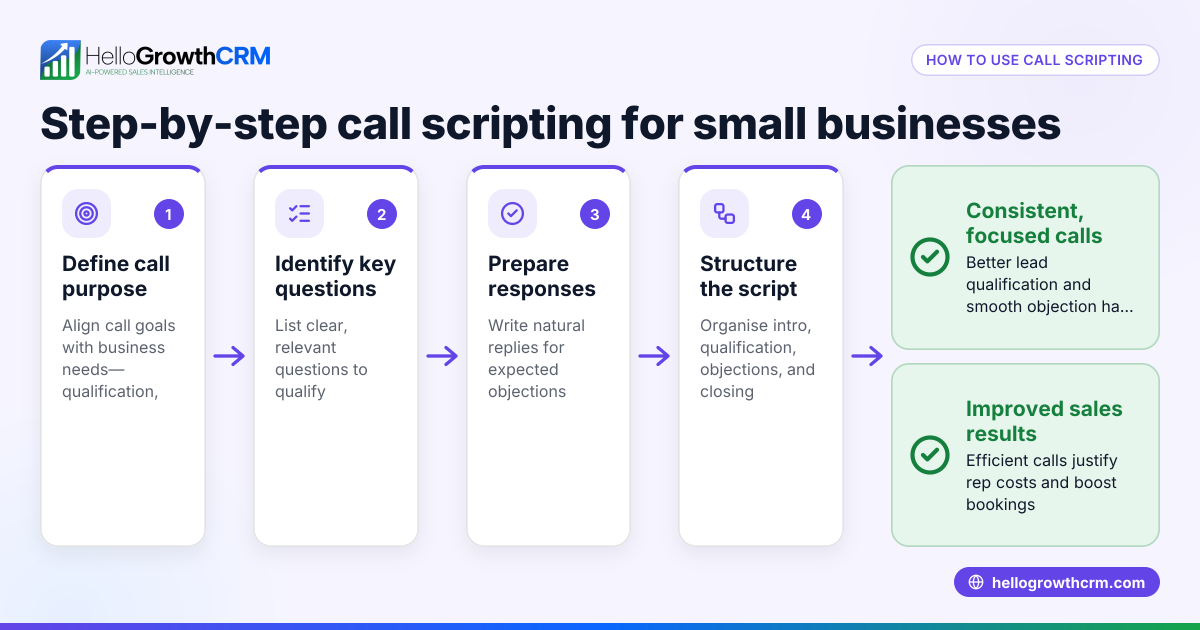
- Identify your sales goal
- Define what you want to achieve in your sales conversations, such as booking a demo, qualifying a lead, or closing a sale.
- Check that this goal fits into your overall sales process.
- Understand your audience
- Research common customer questions, objections, and needs.
- Check that your script addresses these points clearly.
- Outline key conversation stages
- Divide the script into stages: introduction, needs discovery, product pitch, objection handling, closing, and follow-up.
- Check that each stage flows logically and naturally.
- Write clear, concise language
- Use simple, direct sentences.
- Check that your tone matches your brand and audience.
- Include prompts and questions
- Add open-ended questions to engage the prospect.
- Check that prompts encourage dialogue rather than a one-way monologue.
- Prepare responses to common objections
- List typical objections and your best answers.
- Check that responses are empathetic and solution-focused.
- Add clear next steps
- Specify what the salesperson should do after the call, such as sending a quote or scheduling a follow-up.
- Check that follow-up tasks are actionable and time-bound.
- Test and refine your script
- Role-play with your team and gather feedback.
- Check that the script feels natural and effective.
- Train your team
- Share the script with your salespeople and practice regularly.
- Check that everyone understands and is comfortable using it.
- Review and update regularly
- Monitor results and adjust the script based on what works.
- Check that the script evolves with your product and market.
For ready-to-use sales templates, see sales templates.
Example (fictional figures)
A B2B software reseller in Denver, Colorado, wants to improve follow-up after demos using a sales script. Their average deal value is $12,000, and they currently close 5 deals per month from 50 demos.
Calculation before scripting:
50 demos × 10% close rate = 5 deals 5 deals × $12,000 = $60,000 monthly revenue
After implementing the script and training, they aim to increase the close rate but no specific percentage is assumed here to avoid unverified claims.
This example shows how a structured sales script can help improve sales conversations and follow-up consistency, which can lead to better conversion rates and revenue over time.
Common mistakes
- Overly rigid scripts: Making scripts sound robotic turns off prospects. Prevent this by allowing flexibility and encouraging natural conversation.
- Ignoring objections: Not preparing for common objections leads to lost deals. Prevent this by listing objections and crafting empathetic responses.
- Skipping follow-up steps: Forgetting to specify next actions causes leads to slip away. Prevent this by including clear, time-bound follow-up tasks.
- Not updating scripts: Using outdated scripts misses market changes. Prevent this by scheduling regular reviews and updates.
- Lack of training: Giving scripts without practice leads to poor use. Prevent this by role-playing and coaching your team.
- Using jargon or complex language: Confusing prospects reduces trust. Prevent this by using simple, clear language.
Learn more about effective sales communication in WhatsApp and SMS CRM.
Doing this in HelloGrowthCRM
HelloGrowthCRM helps you manage your sales pipeline with Deals (pipeline), where a quotation sent last week appears at the 'quote sent' stage with a follow-up date, ensuring no lead is forgotten. For businesses with field sales, Territories, field operations and commissions features let reps log visits from their phones while managers track daily activity. If you lack a dedicated sales manager, Managed RevOps provides weekly support for follow-up queues, pipeline hygiene, and KPI reporting, helping you keep sales scripting and execution on track. Learn more about these features in HelloGrowthCRM for the United States.
Frequently asked questions
What is the main purpose of a sales script? A sales script guides sales conversations to ensure consistent messaging, handle objections effectively, and lead to clear next steps. It helps salespeople stay organized and improves conversion rates.
Can sales scripts be customized for different customers? Yes. While a script provides a framework, it should be flexible to adapt to different customer needs and responses. Customizing helps keep conversations natural and relevant.
How often should I update my sales script? Regular updates are important. Review your script at least quarterly or whenever your product, market, or customer feedback suggests changes are needed.
Is it necessary to train my team on the sales script? Training is essential. Practice ensures your team understands the script’s purpose, can use it naturally, and feels confident handling objections and follow-ups.
Can HelloGrowthCRM help with sales scripting? HelloGrowthCRM supports your sales process by tracking deals and follow-ups, helping your team stay on script and not miss any opportunities. It also supports field sales and offers managed RevOps for additional sales support.
For more sales tools, visit sales templates.
Key takeaways
- Sales scripting standardizes and improves sales conversations for better results.
- Create scripts with clear goals, stages, objections, and next steps.
- Avoid common mistakes like rigidity, ignoring objections, and lack of training.
- Regularly test, train, and update your script to keep it effective.
- HelloGrowthCRM helps track deals and follow-ups to support your scripted sales process.
Start improving your sales conversations today. Start on the Free Forever plan (200 leads, no credit card).
Ready to put this into practice?
Set up your pipeline, WhatsApp follow-ups, and AI lead scoring in minutes — free, no credit card.
Try HelloGrowthCRM freeGet CRM tips in your inbox
Join thousands of sales professionals who get weekly insights on CRM strategy, AI automation, and pipeline optimization.

The HelloGrowthCRM team publishes guides on CRM strategy, AI sales tools, and revenue operations for small business sales teams.