HelloGrowthCRM software
Built for real small-business sales teams
HelloGrowthCRM helps reps qualify faster, follow up on time, and close more deals—with practical automation in one place.
- AI lead scoring and pipeline visibility
- Built-in dialer, WhatsApp, and email automation
- Sales forecasting and RevOps-ready reporting
Sales task management means organising and tracking all sales-related tasks—calls, meetings, follow-ups—so nothing is forgotten and leads move smoothly through your sales pipeline. This article explains why sales task management matters for small UK businesses, gives step-by-step guidance, a practical example, common mistakes to avoid, and how HelloGrowthCRM helps.
Why this comes up / what goes wrong
Small business owners and sales teams often struggle to keep track of all the follow-ups and tasks needed to close sales. Leads come in from web forms, calls, WhatsApp messages, or emails, but without a clear system, important next steps get missed. Sales conversations happen on multiple channels like WhatsApp, email, or phone, and using spreadsheets or notebooks leads to lost or forgotten tasks. This slows down response times, causing potential customers to lose interest or go to competitors. Without clear ownership of each lead and scheduled follow-ups, deals stall and revenue suffers.
Step-by-step
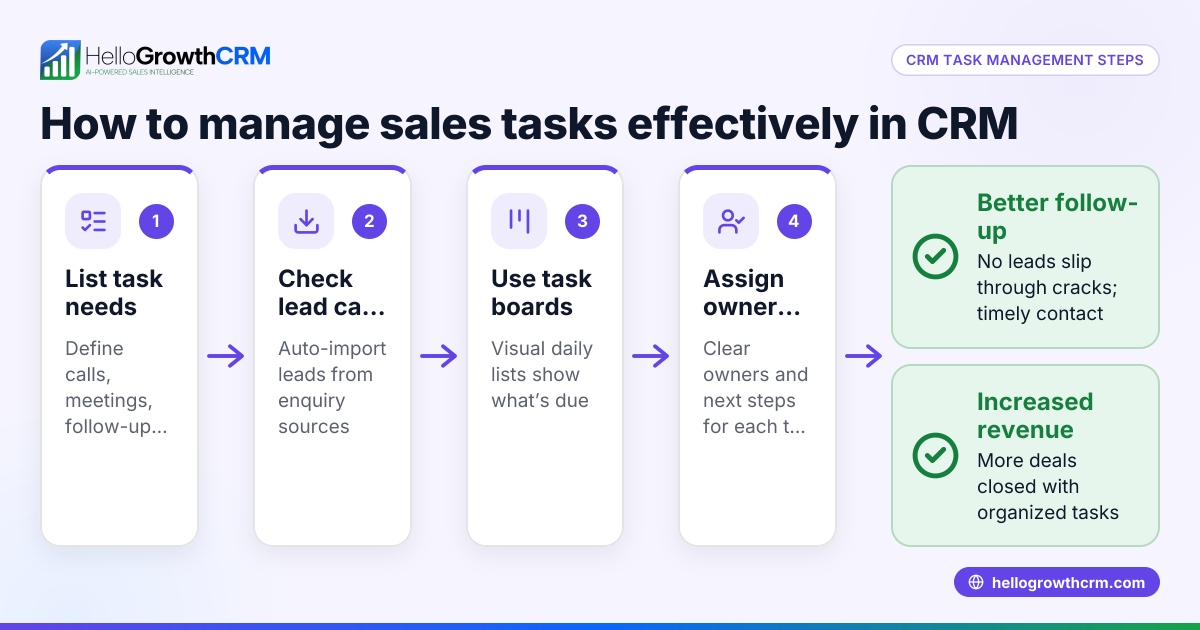
- Capture every lead immediately. When a new enquiry arrives—whether from a web form, WhatsApp message, or phone call—record it in one place. Check that each lead has an assigned owner responsible for follow-up.
- Create a task for each follow-up action. After initial contact, note the next step needed, such as sending a quote, calling back, or arranging a meeting. Assign a due date to the task to ensure timely action.
- Use a task board or list to organise daily activities. Check your task board every morning to see what calls, emails, or meetings are due. This prevents relying on memory or scattered notes.
- Track deals through your sales pipeline. For each quotation or proposal sent, move the deal to the relevant pipeline stage and set a follow-up date. Regularly review pipeline stages to prioritise high-value opportunities.
- Log all communications and notes. Keep a record of calls, meetings, and messages tied to each lead or deal. This history helps your team stay informed and maintain personalised contact.
- Review and update tasks daily. Mark completed tasks done and reschedule any that need another follow-up. Ensure no task is left overdue.
- Analyse your sales task progress regularly. Check which tasks lead to closed deals and adjust your approach to improve efficiency.
By following these steps, you create a clear, actionable sales task management routine that keeps your team organised and responsive.
Example (fictional figures)
Sarah runs a solar-panel installation business in Glasgow. On 15/03/2024, she receives a web enquiry from a potential customer.
- Lead captured on 15/03/2024 with Sarah assigned as owner.
- Sarah creates a task: "Call customer to discuss requirements" with due date 16/03/2024.
- She calls on 16/03/2024 and sends a quotation of £12,500 on the same day.
- Sarah moves the deal to "quote sent" stage and sets a follow-up task for 22/03/2024.
- On 22/03/2024, she calls again; the customer agrees to proceed.
- Sarah marks the deal as "won" and logs all communications.
This process ensured no step was missed, and Sarah closed the sale efficiently.
Common mistakes
- Not assigning ownership of leads. Prevent this by always allocating each lead to a specific team member.
- Using multiple unconnected tools. Avoid scattered notes by centralising tasks and leads in one system or board, such as a sales task board.
- Failing to set due dates. Without deadlines, follow-ups get delayed. Always assign a due date to every task.
- Ignoring pipeline stages. Without tracking deals through stages, it’s easy to forget quotations or lose momentum. Regularly update your deals pipeline.
- Relying on memory or spreadsheets. This leads to missed calls or emails. Use a tool that lists daily calls and tasks clearly.
- Not reviewing task progress. Prevent backlog by daily review and rescheduling overdue tasks.
Doing this in HelloGrowthCRM
HelloGrowthCRM helps you manage sales tasks by capturing every enquiry from forms, calls, or WhatsApp as a lead with an owner and a next step, instead of losing them in notebooks. Each follow-up becomes a task with a due date, so your day's calls are a clear list, not a memory test. Quotations sent appear as deals in the pipeline with follow-up dates, ensuring no opportunity is forgotten. Use sales task boards to organise your activities, and manage leads and deals efficiently with HelloGrowthCRM's integrated pipeline and task tools. Learn more about how HelloGrowthCRM supports UK businesses with WhatsApp and SMS CRM features.
Frequently asked questions
What is the best way to organise sales tasks? The best way is to capture all leads in one place, assign owners, create tasks with due dates for each follow-up, and use a task board or list to organise daily activities. Tracking deals through a sales pipeline helps prioritise efforts.
How can I avoid missing sales follow-ups? Set clear due dates on every task and review your task list daily. Using a CRM with task boards and pipeline views can help you see what’s due and keep follow-ups on track.
Why use a sales pipeline for task management? A sales pipeline shows where each deal stands and what next steps are needed. This visibility prevents losing deals due to forgotten quotes or delayed follow-ups.
Can WhatsApp be integrated into sales task management? Yes, integrating WhatsApp with your CRM lets you capture enquiries directly and log conversations as part of your sales tasks, keeping everything organised in one place.
How do task boards improve sales team productivity? Task boards visualise all follow-ups and internal tasks, making it easier for sales teams to prioritise work, share responsibilities, and avoid duplicated efforts.
Key takeaways
- Capture every lead immediately and assign an owner.
- Create tasks with due dates for every sales follow-up.
- Use task boards to organise daily sales activities.
- Track deals through a sales pipeline with follow-up dates.
- Log all communications to keep sales history complete.
- Review and update tasks daily to avoid missed opportunities.
Start organising your sales tasks today to improve follow-up speed and close more deals. Try HelloGrowthCRM and start on the Free Forever plan (200 leads, no credit card).
Ready to put this into practice?
Set up your pipeline, WhatsApp follow-ups, and AI lead scoring in minutes — free, no credit card.
Try HelloGrowthCRM freeGet CRM tips in your inbox
Join thousands of sales professionals who get weekly insights on CRM strategy, AI automation, and pipeline optimization.

The HelloGrowthCRM team publishes guides on CRM strategy, AI sales tools, and revenue operations for small business sales teams.