HelloGrowthCRM software
Built for real small-business sales teams
HelloGrowthCRM helps reps qualify faster, follow up on time, and close more deals—with practical automation in one place.
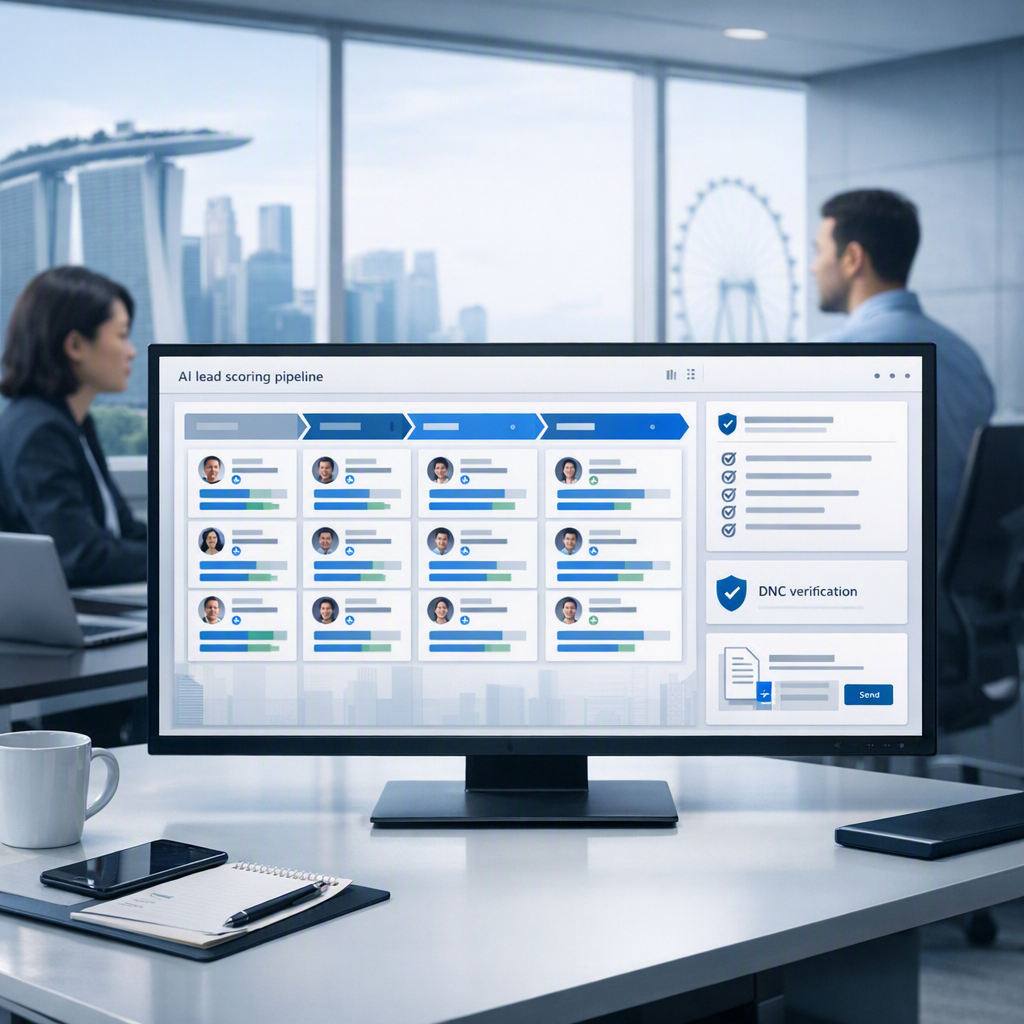
- AI lead scoring and pipeline visibility
- Built-in dialer, WhatsApp, and email automation
- Sales forecasting and RevOps-ready reporting
A Singapore CRM workflow for B2B sales teams is a structured lead-to-revenue process that routes enquiries by territory and fit, checks consent and DNC exposure before outreach, tracks pipeline in SGD, and hands won deals cleanly into finance systems for PDPA-safe, PEPPOL-ready invoicing.
Key Takeaways
- A strong Singapore CRM workflow should connect lead capture, routing, follow-up, forecasting, and finance handoff in one system.
- PDPA-safe execution means limiting access to personal data, keeping purpose clear, and recording consent and outreach history.
- DNC-aware outreach matters most when teams call or text mobile numbers from inbound forms, events, or purchased lists.
- Territory design should reflect real operating zones like Singapore CBD, Jurong East, and Tampines, not just broad “West” or “East” labels.
- HelloGrowthCRM can support faster response times with AI CRM, Meeting Scheduler, CRM Dialer, and Revenue Attribution.
- Finance handoff should include customer data, commercial terms, tax fields, and PEPPOL-ready billing details so invoicing starts without rework.
Why Singapore B2B sales teams need a dedicated CRM workflow
A Singapore B2B sales team needs a dedicated CRM workflow because local selling combines fast follow-up expectations with strict data handling rules, multi-channel outreach, and finance handoffs that often break between sales and billing. A generic workflow usually creates lead leakage, compliance risk, and weak forecasting.
Most teams do not fail because they lack activity. They fail because their activity is disconnected.
A typical Singapore setup looks like this:
- Marketing captures leads from website forms, events, LinkedIn, WhatsApp, and partner referrals
- SDRs or account executives manually assign records
- Managers track deals in spreadsheets
- Finance rekeys won deal data into billing tools
- Nobody can explain why response times vary between Singapore CBD, Jurong East, and Tampines
That creates three problems.
Lead routing becomes inconsistent
If lead assignment depends on a sales manager checking email, hot enquiries wait too long. In B2B sales, first response time affects meeting conversion. It also shapes buyer trust.
In one rollout we did with a 12-person sales team, the biggest issue was not lead volume. It was that inbound demo requests sat unassigned for two to four hours during lunch coverage and after events. Once we switched to rule-based routing with backup ownership, meeting rates improved within two weeks.
Compliance checks happen too late
Many teams only think about consent or DNC exposure when a rep is ready to call. That is late. By then, the lead may already be in a sequence.
The Personal Data Protection Commission states that organisations in Singapore must comply with obligations under the PDPA when collecting, using, and disclosing personal data. That means your workflow should not treat compliance as a side task.
Finance handoff is often manual
If sales stores pricing, tax status, billing entity, and PO details in free text, finance has to interpret the deal after close. That delays invoicing and raises error rates. For B2B teams working with larger buyers, PEPPOL-ready fields should be captured before the deal is marked closed-won.
What should a Singapore CRM workflow include?
A Singapore CRM workflow should include lead capture, territory-based routing, PDPA-safe permissions, DNC-aware outreach rules, follow-up automation, stage-based pipeline management, SGD forecasting, and a structured handoff to finance with invoicing fields. The best workflows reduce manual work while preserving auditability and clear ownership.
Think of the workflow as six linked layers.
1. Lead capture and source tagging
Every lead should enter with:
- Source
- Campaign
- Company name
- Contact role
- Country
- Phone and email
- Consent status where relevant
- Product interest
- Lead owner or routing queue
If you run multi-source acquisition, connect forms and channels through All Integrations. For teams using Gmail and calendar-based selling, Gmail and Calendly integrations reduce admin and keep activity synced.
2. Routing logic
Routing should be based on:
- Geography: CBD, Jurong East, Tampines, or national
- Segment: SME, mid-market, enterprise
- Fit: industry, headcount, use case
- Existing ownership: named account or current opportunity
- Capacity: active lead load per rep
HelloGrowthCRM supports this through AI Lead Scoring, Territory Management, and Sales Task Boards, so reps see what to work next instead of waiting for manual assignment.
3. Compliance controls
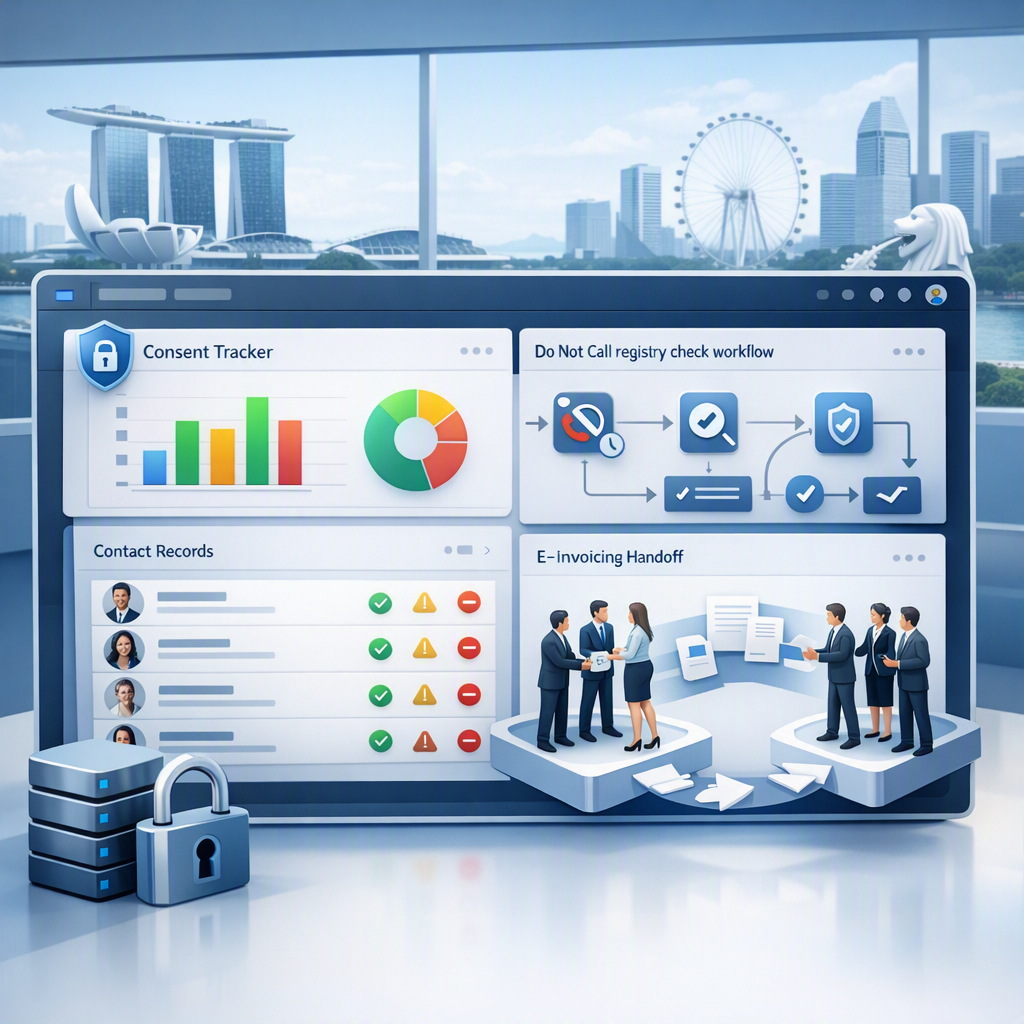
Use role-based access. Limit who can export records. Store timestamps for consent changes. Flag mobile numbers for DNC review before SMS or call sequences.
For WhatsApp outreach, connect approved flows through WhatsApp or use WhatsApp & SMS CRM so message history and opt-out context stay attached to the record.
4. Pipeline structure
A practical B2B pipeline should track:
- New
- Qualified
- Discovery booked
- Solution fit confirmed
- Proposal sent
- Commercial review
- Verbal commit
- Closed won or lost
When I have audited pipelines like this, the biggest forecasting issue is stage inflation. Reps move deals forward on hope instead of evidence. Require stage exit criteria such as MEDDPICC checkpoints, next meeting date, budget range, or technical sign-off.
5. Reporting in SGD
Your sales dashboard should show:
- Pipeline value in SGD
- Weighted pipeline
- Stage velocity in days
- Win rate by segment
- Lead response SLA
- Conversion by source
- Forecast by close month
With Sales Forecasting and AI Pipeline Management, managers can see coverage gaps early instead of finding them at month end.
6. Finance handoff
Won deals should trigger a structured handoff with:
- Legal entity name
- Billing address
- UEN where needed
- PO number
- Tax and discount fields
- Contract value
- Billing frequency
- Finance owner
- PEPPOL recipient details if applicable
For revenue visibility after handoff, Revenue Attribution helps connect booked pipeline to realised outcomes.
How PDPA and DNC rules affect CRM workflow design
PDPA and DNC rules affect CRM workflow design by shaping how your team collects personal data, stores consent, controls access, and decides when calling or messaging is allowed. In practice, the CRM should enforce compliance checks before outreach, not leave them to rep memory.
This is where many teams get exposed. They treat CRM as a database, not a control system.
PDPA-safe workflow principles
Your workflow should support these practical controls:
- Collect only data needed for the sales purpose
- Record why the data was collected
- Restrict access by role
- Log edits to contact and consent fields
- Keep retention and deletion processes clear
- Prevent broad exports by default
The PDPC advisory guidelines are the reference point your ops team should align to when defining internal handling rules.
DNC checks before call or message
Singapore’s Do Not Call regime matters when using voice calls, SMS, or similar outreach. This is especially important for mobile-first lead capture from events and landing pages.
The Do Not Call Registry lets organisations check whether Singapore numbers are registered before sending certain marketing messages or making telemarketing calls.
That does not mean every B2B interaction is blocked. It means your process must identify the outreach basis clearly and keep records. Your legal team should validate your exact use case.
A simple compliance checkpoint model
Build three CRM checkpoints:
| Workflow point | Required check | CRM action |
|---|---|---|
| Lead created | Source, purpose, owner | Tag source and lock default permissions |
| Outreach queued | Consent or outreach basis, DNC review for call/SMS | Pause sequence if fields are incomplete |
| Deal won | Billing and retention rules | Transfer only required data to finance |
This works well for teams under 50 reps. Above that, expect to add formal approval flows, audit logs, and system-level policy controls.
How to build a Singapore CRM workflow for B2B sales teams: Step-by-Step
Building a Singapore CRM workflow for B2B sales teams means mapping your lead-to-cash journey, defining routing and compliance rules, automating follow-up, and standardising finance handoff fields. Start simple, enforce ownership early, and only add automation after your stages, data fields, and approval rules are clear.
- Map your current journey
List every step from lead capture to invoice. Include handoffs between marketing, SDR, AE, sales manager, and finance. - Define your territories
Create routing rules for Singapore CBD, Jurong East, Tampines, or named-account ownership. Avoid overlapping territory logic. - Set qualification criteria
Use a clear framework such as ICP fit, pain, budget range, decision role, and timeline. Add mandatory fields before a lead becomes an opportunity. - Build compliance fields
Add source, consent notes, DNC review status, communication preference, and privacy owner. Keep these visible on the contact record. - Automate assignment and alerts
Trigger owner assignment, Slack alerts, and task creation the moment a qualified lead enters. Slack helps sales managers spot unworked leads quickly. - Create follow-up sequences
Use Email Automation, Smart Inbox, and Meeting Scheduler to keep follow-up fast and consistent. - Lock stage exit criteria
Require evidence before a deal moves stages. For example, “proposal sent” should require amount, products, and decision process notes. - Add forecasting dashboards
Track pipeline in SGD by segment, owner, and month. Use Pipeline Health Score or CRM ROI Calculator to pressure-test your setup. - Standardise finance handoff
Trigger a closed-won checklist with billing data, contract details, and invoice readiness fields. If your finance team uses connected tools, review Stripe, QuickBooks, and All Integrations. - Review every 30 days
Audit routing accuracy, lead response time, stale deals, and conversion by source. Improve one bottleneck at a time.
A practical blueprint for CBD, Jurong East, and Tampines teams
A practical blueprint for Singapore CBD, Jurong East, and Tampines teams assigns leads by territory and segment, sets response SLAs by source, and standardises reporting and finance handoff across locations. The goal is local accountability without creating separate systems or conflicting definitions.
Here is a model many B2B teams can use.
Singapore CBD team
Best for:
- Enterprise accounts
- Financial services
- HQ-led procurement
- Multi-stakeholder deals
Workflow focus:
- Named account ownership
- Longer MEDDPICC cycles
- Approval-heavy proposals
- Strong Proposal Builder and forecast discipline
Jurong East team
Best for:
- Industrial and logistics accounts
- Field-heavy sales motion
- Site visits and operational stakeholders
Workflow focus:
- Territory-based routing
- Fast post-visit notes
- Mobile call logging with CRM Dialer
- Clear next-step tasks
Tampines team
Best for:
- SME and mid-market coverage
- High inbound and outbound volume
- Faster demo-to-close cycles
Workflow focus:
- Speed-to-lead
- Sequence automation
- Capacity-based routing
- Rep productivity tracking
The IMDA continues to promote digital capability and adoption across Singapore businesses, which is why many growing teams now prioritise integrated sales systems over spreadsheets and siloed tools.
Why HelloGrowthCRM fits this workflow better than disconnected tools
HelloGrowthCRM fits this workflow better than disconnected tools because it combines lead routing, outreach, pipeline control, forecasting, and handoff visibility in one operating layer. That reduces manual admin, improves compliance discipline, and gives managers one source of truth for action and reporting.
To be clear, HelloGrowthCRM is our product, so this is not a neutral software comparison. But that also means we can be specific about where it fits and where it does not.
Where HelloGrowthCRM is strong
It is a strong fit for Singapore B2B teams that need:
- One place for inbound and outbound activity
- Cleaner ownership and routing logic
- Better AI Deal Insights
- Faster rep execution with AI Sales Copilot
- Forecast visibility for managers
- Cleaner handoff into finance and ops
A 10 to 50-person commercial team is usually the sweet spot. Smaller teams benefit from speed. Mid-sized teams benefit from control.
Where you may need more
If you run:
- Highly customised enterprise legal workflows
- Multi-country data residency requirements
- Deep CPQ complexity
- Large call centre operations
Then you may need extra integration design or Managed RevOps support.
Quick comparison
| Requirement | Spreadsheet + point tools | Generic CRM | HelloGrowthCRM |
|---|---|---|---|
| Rule-based lead routing | Manual | Partial | Strong |
| DNC-aware workflow controls | Weak | Varies | Strong with configurable process |
| SGD pipeline reporting | Manual | Usually possible | Native workflow-friendly setup |
| Finance handoff discipline | Weak | Depends on customisation | Strong |
| AI guidance for reps | None | Limited | Strong via Agentic AI Hub |
| Time to first workable setup | Fast but fragile | Medium | Fast for B2B teams |
If you want to evaluate fit on your own numbers, start with the RevOps Maturity Assessment and then book a Demo.
Singapore B2B teams do not need a more complex CRM. They need a cleaner operating system for routing, outreach, forecasting, and finance handoff. If your team in the CBD, Jurong East, or Tampines wants faster follow-up, better pipeline visibility, and PDPA-safer execution, try HelloGrowthCRM with a Free Trial or review Pricing to see what fits your stage.
About the author
Ethan Lim is Sales Operations Lead at HelloGrowthCRM with 9 years of experience in B2B SaaS revenue operations, CRM design, and pipeline management. He has led CRM workflow rollouts for sales teams across Singapore, including a 12-person commercial team that rebuilt lead routing, stage governance, and finance handoffs after moving off spreadsheets. His work focuses on practical RevOps systems that improve response time, forecast accuracy, and compliance discipline. This article draws on those field implementations and ongoing work with Singapore-based sales teams.
Frequently Asked Questions
Q: What is a Singapore CRM workflow for B2B sales teams?
A: A Singapore CRM workflow for B2B sales teams is a structured process that manages leads from capture to close while enforcing local routing, compliance checks, and finance handoffs. It helps teams follow up faster, track pipeline in SGD, and reduce manual mistakes.
Q: Does PDPA stop B2B sales teams from storing lead data in a CRM?
A: PDPA does not stop B2B sales teams from storing lead data in a CRM, but it does require proper handling of personal data. Your team should limit access, record purpose, control exports, and align internal processes to PDPA obligations.
Q: Do Singapore sales teams need to check the DNC Registry before calling leads?
A: Singapore sales teams may need to check the DNC Registry before calling or messaging leads for marketing purposes, especially on mobile numbers. Your exact obligations depend on the outreach context, so legal review and clear CRM rules are important.
Q: How should leads be routed across Singapore CBD, Jurong East, and Tampines?
A: Leads across Singapore CBD, Jurong East, and Tampines should be routed using clear territory, segment, and ownership rules. The best setup also includes backup routing, capacity balancing, and named-account protection so hot leads never sit unworked.
Q: What fields should be included in a PEPPOL-ready finance handoff?
A: A PEPPOL-ready finance handoff should include billing entity details, address, commercial terms, tax data, PO information, and buyer identifiers where needed. The key is to collect these fields before closed-won, not after finance chases the sales rep.
Q: Can HelloGrowthCRM support DNC-aware and PDPA-safer workflows?
A: HelloGrowthCRM can support DNC-aware and PDPA-safer workflows by centralising lead records, permissions, outreach history, and workflow controls. Teams still need internal policy and legal guidance, but the system makes compliant execution easier.
Q: What reports should a Singapore B2B sales manager track weekly?
Frequently Asked Questions
Ready to put this into practice?
Set up your pipeline, WhatsApp follow-ups, and AI lead scoring in minutes — free, no credit card.
Try HelloGrowthCRM freeGet CRM tips in your inbox
Join thousands of sales professionals who get weekly insights on CRM strategy, AI automation, and pipeline optimization.

The HelloGrowthCRM team publishes guides on CRM strategy, AI sales tools, and revenue operations for small business sales teams.