HelloGrowthCRM software
Built for real small-business sales teams
HelloGrowthCRM helps reps qualify faster, follow up on time, and close more deals—with practical automation in one place.
- AI lead scoring and pipeline visibility
- Built-in dialer, WhatsApp, and email automation
- Sales forecasting and RevOps-ready reporting
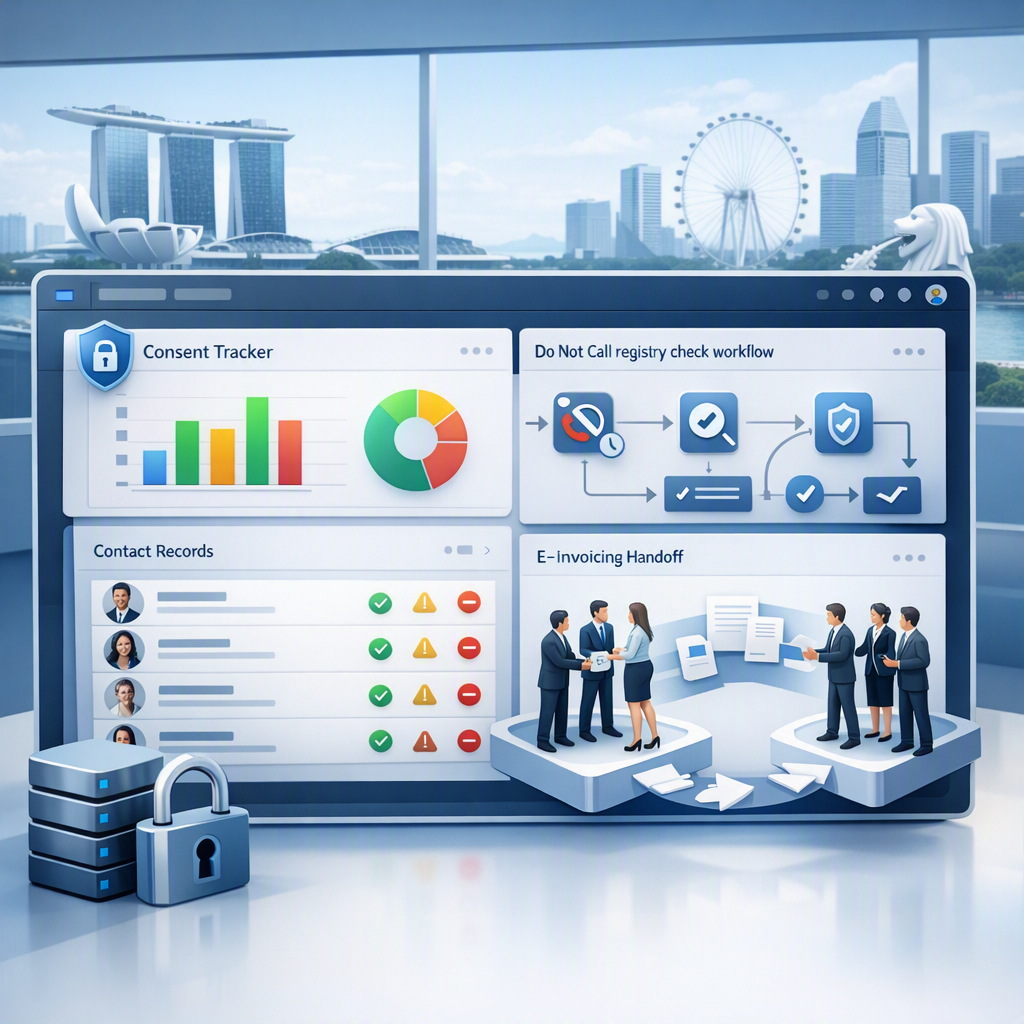
A Singapore CRM workflow setup for PDPA-safe lead routing, DNC checks, and PEPPOL-ready B2B sales ops is a structured way to capture leads, record consent, screen outreach against Singapore rules, route accounts to the right reps, and hand won deals to finance for compliant invoicing and revenue reporting.
Key Takeaways
- Singapore B2B teams need CRM workflows that connect lead capture, consent logs, routing rules, and invoicing handoff in one system.
- PDPA-safe setup means you should record purpose, consent status, source, retention logic, and access controls from the first touchpoint.
- DNC checks matter when sales teams call or message prospects, especially if outreach uses mobile numbers, WhatsApp, or SMS.
- PEPPOL-ready sales ops starts in the CRM, not in finance, because billing fields, entity data, and handoff triggers should be set before a deal closes.
- HelloGrowthCRM helps unify lead routing, AI CRM, WhatsApp & SMS CRM, and Revenue Attribution for Singapore teams.
- This setup works especially well for B2B teams under 50 reps. Larger teams may need tighter role design, deeper audit controls, and more formal RevOps governance.
Why does a Singapore CRM workflow setup need to cover PDPA, DNC, and PEPPOL together?
A Singapore CRM workflow setup needs to cover PDPA, DNC, and PEPPOL together because lead capture, outbound contact, opportunity management, and invoicing are one operating flow, not separate tasks. If these controls sit in different tools, teams create compliance gaps, duplicate work, and slower sales-to-cash handoffs.
Most teams in the Singapore CBD, Jurong East, or Tampines do not fail because they lack a CRM. They fail because the workflow inside the CRM is incomplete.
A common bad pattern looks like this:
- Marketing captures leads in forms
- Sales exports CSV files for calling
- Reps track consent in notes
- Finance rekeys invoice data after close
- Managers cannot prove who contacted whom and why
That setup creates risk under the Personal Data Protection Act and poor operating discipline. The PDPC expects organisations to be accountable for how personal data is collected, used, and disclosed. In practical sales terms, that means your CRM should hold a usable audit trail.
For Singapore B2B teams, a stronger design links:
- Lead source and collection purpose
- Consent and lawful contact basis
- DNC screening status
- Territory or account routing
- Opportunity stage controls
- Finance handoff for PEPPOL-ready billing data
In HelloGrowthCRM, this is easiest when your Features stack is built around one object model for lead, contact, company, deal, and invoice handoff. That removes the need for reps to remember compliance steps manually.
What PDPA-safe lead routing should look like inside a CRM
PDPA-safe lead routing inside a CRM means every lead record stores collection source, contact purpose, consent status, owner, and next action before any outreach happens. Routing should happen only after required fields are validated, so the system prevents avoidable compliance mistakes and creates a usable audit trail.
The key idea is simple. A lead should not be assigned like a loose spreadsheet row. It should be assigned like a regulated business record.
Minimum fields to capture at lead creation
For most Singapore B2B teams, I recommend these fields as the minimum:
- Full name
- Business email
- Business phone or mobile number
- Company name
- Lead source
- Country
- Consent status
- Consent source
- Purpose of collection
- DNC check required: Yes/No
- Route owner or queue
- Timestamp created
If you use HelloGrowthCRM forms plus the Meeting Scheduler, add hidden source parameters so sales can see whether the lead came from LinkedIn ads, an IMDA event, referral, webinar, or partner form.
Routing rules that reduce risk
A safe routing logic usually follows this order:
- Validate required identity and source fields
- Check whether the contact method triggers DNC controls
- Apply territory or segment rules
- Assign owner
- Create compliant task sequence
- Lock or warn on restricted outreach channels
In one rollout we did with a 12-person sales team selling into industrial accounts around Jurong East, the biggest improvement did not come from automation alone. It came from forcing a consent-source field and blocking task creation when mobile contact data had no screening status. That cut rep confusion immediately.
If your team uses AI Lead Scoring, do not let score override compliance. Priority should affect queue order, not whether a lead can be contacted.
Role-based access matters too
PDPA-safe design also means not every user should see every field.
Use role controls for:
- Sensitive notes
- Personal mobile numbers
- Consent edits
- Data export permissions
- Bulk messaging rights
When I have audited pipelines like this, overexposure usually comes from exports, not dashboards. Keep exports limited to RevOps, sales managers, and approved admins.
How should DNC checks work in a Singapore B2B sales workflow?
DNC checks in a Singapore B2B sales workflow should happen before calls, SMS, or WhatsApp outreach to relevant numbers, with the CRM storing status, timestamp, and channel restrictions. The goal is to stop unauthorised outreach automatically rather than rely on reps to remember legal rules.
Singapore’s Do Not Call regime is administered by the PDPC. The official DNC information and obligations are explained by the PDPC Do Not Call Registry page.
A practical CRM workflow for DNC screening
In HelloGrowthCRM, I would set this up with fields and automation:
- Contact number type: business line / direct line / mobile
- DNC check status: pending / passed / restricted / exempt-reviewed
- DNC checked date
- DNC checked by
- Allowed channels: email / call / SMS / WhatsApp
- Outreach hold reason
Then set workflow rules:
- New lead with mobile number -> create compliance review task
- No valid DNC status -> block CRM Dialer sequence
- Restricted number -> disable WhatsApp & SMS CRM automation
- Approved contact path -> trigger Email Automation or call task
DNC checks should not live in rep memory
This is where many teams slip. A rep says, “I thought it was a business contact.” That is not a system.
A system means the CRM decides what can happen next.
For example:
- A Tampines software reseller receives an inbound demo request from a corporate email and desk number. Email follow-up may be allowed by your process, but mobile outreach still needs the correct review path.
- A Singapore CBD consultancy imports old event leads. The CRM should mark all mobile records as “pending review” before any sequence starts.
The PDPC provides the main compliance guidance on personal data protection and DNC obligations through its official resources at pdpc.gov.sg.
How does PEPPOL-ready B2B sales ops start in the CRM?
PEPPOL-ready B2B sales ops starts in the CRM because invoice accuracy depends on customer entity data, tax details, billing contacts, and approval checkpoints captured before close. If those fields are missing in the pipeline, finance teams end up chasing sales after the deal is already won.
Too many teams treat PEPPOL as a finance-only project. In practice, sales ops sets the quality of the handoff.
What sales should capture before closed-won
If you sell to larger buyers, public sector-adjacent entities, or structured procurement teams, capture these fields early:
- Legal entity name
- UEN
- Bill-to contact
- Purchase order requirement
- PEPPOL e-invoicing required: Yes/No
- Payment terms
- Currency
- Contract start date
- Implementation owner
Singapore’s Infocomm Media Development Authority supports nationwide e-invoicing through InvoiceNow, based on the PEPPOL framework, and explains adoption on the IMDA InvoiceNow page.
Why this improves forecast accuracy
Forecasts break when closed-won does not mean invoice-ready.
In HelloGrowthCRM, you can align Sales Forecasting with operational milestones such as:
- Commercial close
- Procurement complete
- Billing details verified
- Invoice submitted
- Revenue recognised
That matters in Singapore where finance teams may need clean data for PEPPOL flows and downstream accounting integrations like QuickBooks or Stripe.
A simple operating comparison
| Workflow area | Manual setup | HelloGrowthCRM setup |
|---|---|---|
| Lead capture | Form fills go to email inboxes | Centralised capture with field validation |
| Consent tracking | Notes and spreadsheets | Structured consent fields and timestamps |
| DNC checks | Rep memory or offline review | Workflow gates and channel restrictions |
| Lead routing | Manager reassigns manually | Rules by territory, segment, or queue |
| Pipeline handoff | Sales emails finance after close | Stage-triggered handoff and billing fields |
| PEPPOL readiness | Finance rekeys customer data | Deal fields passed into invoicing workflow |
| Forecasting | Based only on stage | Based on stage plus operational readiness |
Which HelloGrowthCRM workflows matter most for Singapore B2B teams?
The HelloGrowthCRM workflows that matter most for Singapore B2B teams are lead intake validation, consent and DNC controls, territory routing, opportunity stage automation, and finance handoff triggers. These workflows reduce manual work while keeping sales execution aligned with local compliance and billing requirements.
If you are evaluating Demo options, focus less on flashy dashboards and more on workflow controls.
Workflow 1: Lead intake and qualification
Use:
- Required compliance fields
- Source tagging
- Auto-assignment by geography or segment
- AI Lead Scoring after validation
- Qualification checklists like MEDDPICC or BANT
Workflow 2: Outreach control
Use:
- Channel permissions
- DNC status logic
- Smart Inbox for auditable communication history
- CRM Dialer only when records are approved
- Gmail or WhatsApp integrations with logging
Workflow 3: Pipeline discipline
Use:
- Required exit criteria for each stage
- Stage-velocity in days
- Next-step enforcement
- AI Pipeline Management
- AI Deal Insights for risk flags
Workflow 4: Sales-to-finance handoff
Use:
- Closed-won checklist
- Billing data validation
- Contract and proposal link
- PEPPOL-required flag
- Handoff trigger to finance or billing
In my experience, teams with 8 to 25 sellers get the fastest gains from this sequence. Above that, I usually add Managed RevOps support because ownership lines become harder across sales, marketing, and finance.
How to set up a Singapore CRM workflow for PDPA, DNC, and PEPPOL: Step-by-Step
Setting up a Singapore CRM workflow for PDPA, DNC, and PEPPOL means mapping your real sales process first, then turning each compliance and handoff requirement into fields, rules, permissions, and stage gates. Start small, test with one team, and expand only after audit trails look clean.
- Map your sales-to-cash process
Write out every step from lead capture to invoice submission. Include marketing, SDR, AE, manager, finance, and ops actions. - Define required lead and contact fields
Add source, purpose, consent, number type, and DNC status fields. Make them mandatory before assignment. - Create routing logic
Route by industry, territory, account size, or queue. For Singapore teams, you can split by CBD, West, East, or named account rules. - Set compliance gates
Block call, SMS, or WhatsApp tasks when screening status is incomplete. Allow approved channels only. - Build stage exit criteria
Require next step, close date, amount in SGD, and qualification proof. For later stages, require billing and procurement details. - Add PEPPOL-ready billing fields
Capture legal entity, UEN, bill-to contact, payment terms, and invoice method before closed-won. - Connect communication and finance tools
Link Slack, Gmail, and billing systems where needed. Keep communication history inside the CRM. - Test with a pilot team
Run one pod for two to four weeks. Review blocked actions, routing errors, and missing fields. - Measure operational outcomes
Track lead response time, stage-velocity, conversion rate, blocked outreach count, and invoice-ready close rate. - Scale with governance
Document who can edit consent fields, export records, change workflows, and approve exceptions.
A practical starting point is to use HelloGrowthCRM with the Free Trial, then benchmark your current process using the RevOps Maturity Assessment and model expected gains with the CRM ROI Calculator.
What metrics should Singapore sales leaders track after setup?
Singapore sales leaders should track response time, routing accuracy, compliance exceptions, stage conversion, stage-velocity, forecast variance, and invoice-ready close rate after setup. These metrics show whether the CRM workflow is improving both revenue execution and operational control.
Track these in weekly reviews:
- Median lead response time
- Percentage of leads with complete consent fields
- DNC pending records older than 24 hours
- Stage-velocity in days
- Win rate by source
- Forecast variance by month
- Closed-won deals missing billing fields
- Average days from close to invoice submission
IMDA notes that InvoiceNow is Singapore’s nationwide e-invoicing network based on the PEPPOL standard, which is relevant when designing clean billing handoffs from CRM to finance (IMDA).
If your current process still depends on spreadsheets, start with the highest-friction metric first. In most audits I run, that is either slow lead assignment or poor closed-won handoff.
For Singaporean teams that want one system for pipeline execution, compliant outreach controls, and finance-ready deal data, HelloGrowthCRM is built for exactly this kind of workflow. Explore the Pricing, book a Demo, or start a Free Trial to configure a PDPA-aware, DNC-safe, PEPPOL-ready setup for your team in Singapore.
About the author
Marcus Tan is a Revenue Operations Lead at HelloGrowthCRM with 11 years of experience in B2B SaaS sales ops, CRM design, and pipeline governance. He has led CRM and workflow rollouts for Singapore sales teams across software, services, and industrial sectors. One project that informed this article was a redesign for a 12-person commercial team that needed cleaner consent tracking, territory routing, and finance handoff for SGD-denominated deals. HelloGrowthCRM is the author’s product, so this guide is both practical and product-informed.
Frequently Asked Questions
Q: What is a PDPA-safe CRM workflow in Singapore?
A: A PDPA-safe CRM workflow in Singapore is a lead and customer management process that records collection purpose, consent status, access permissions, and usage history so teams can handle personal data responsibly. It should also limit exports, log edits, and support clear retention practices.
Q: Do B2B sales teams in Singapore need DNC checks?
A: Yes, B2B sales teams in Singapore should review DNC obligations when using calls, SMS, or messaging to contact numbers, especially mobile numbers. The safest approach is to build DNC screening into CRM workflow rules before outreach begins.
Q: How does PEPPOL affect CRM setup?
A: PEPPOL affects CRM setup because sales teams need to capture invoice-ready customer and billing data before a deal closes. If legal entity, UEN, or billing contact fields are missing, finance will need to rework the deal handoff.
Q: Which fields should I make mandatory for Singapore lead routing?
A: The fields you should make mandatory for Singapore lead routing are source, company, contact method, consent status, purpose of collection, and DNC screening status where relevant. These fields help both assignment quality and compliance control.
Q: Can HelloGrowthCRM block reps from calling unreviewed records?
A: Yes, HelloGrowthCRM can block reps from calling unreviewed records by using workflow rules tied to DNC status, channel permissions, and contact number type. This is one of the most effective ways to reduce preventable outreach mistakes.
Q: Is this setup suitable for small Singapore teams?
Frequently Asked Questions
Ready to put this into practice?
Set up your pipeline, WhatsApp follow-ups, and AI lead scoring in minutes — free, no credit card.
Try HelloGrowthCRM freeGet CRM tips in your inbox
Join thousands of sales professionals who get weekly insights on CRM strategy, AI automation, and pipeline optimization.

The HelloGrowthCRM team publishes guides on CRM strategy, AI sales tools, and revenue operations for small business sales teams.