HelloGrowthCRM software
Built for real small-business sales teams
HelloGrowthCRM helps reps qualify faster, follow up on time, and close more deals—with practical automation in one place.
- AI lead scoring and pipeline visibility
- Built-in dialer, WhatsApp, and email automation
- Sales forecasting and RevOps-ready reporting
AI lead scoring uses machine learning algorithms to rank your leads based on their likelihood to convert. This automatically prioritizes the most promising prospects, helping B2B sales teams in the United States focus on deals that matter most, save time, and increase revenue.
Key takeaways - AI lead scoring improves pipeline prioritization by ranking leads using customer data and engagement signals. - It automates the manual, subjective lead qualification process, saving sales teams time and reducing biases. - AI-powered lead scoring integrates with your CRM and sales automation tools for seamless workflows. - It continually learns and adjusts lead scores to reflect changing buyer behavior and market conditions. - Businesses based in the United States benefit from AI lead scoring through increased sales efficiency and better forecasting. - Using AI tools aligned with your compliance requirements (like CAN-SPAM and TCPA) ensures legally compliant outreach.
What is AI lead scoring and why does it matter for B2B sales?
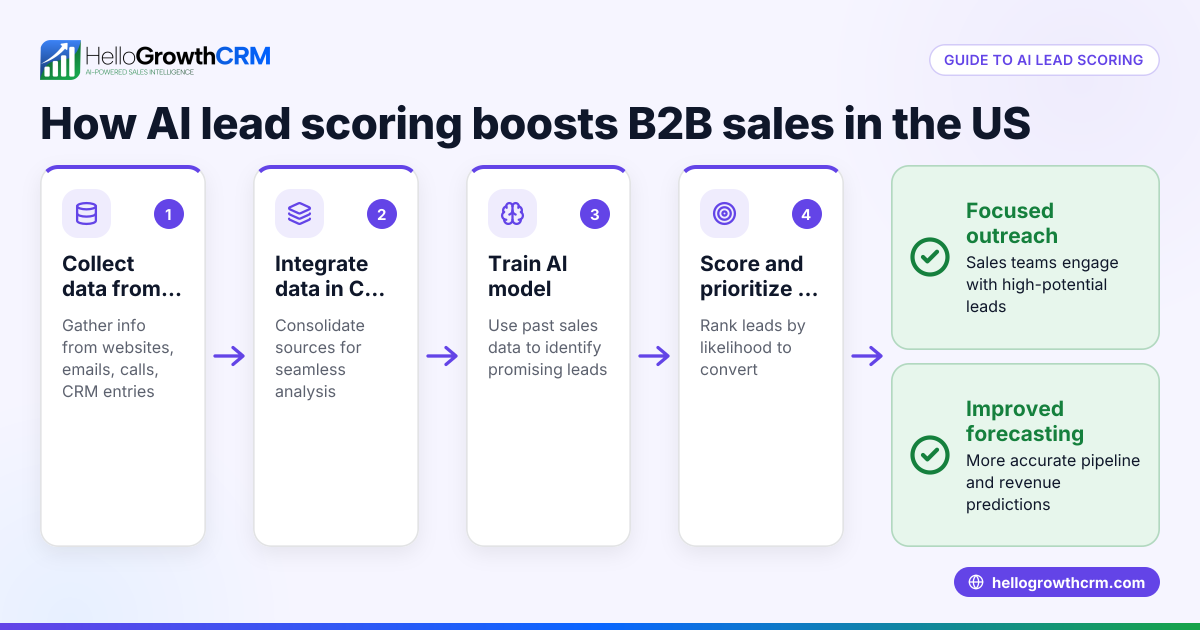
AI lead scoring is an AI-powered method that analyzes data from various sources to predict which leads are most likely to buy. Unlike traditional lead scoring, which uses fixed rules or manual grading, AI lead scoring uses machine learning models trained on historical customer data. This makes the scoring more accurate and dynamic.
In B2B sales in the US, where deal cycles can be long and complex, knowing which prospects deserve immediate attention is critical. Poor prioritization wastes time and risks losing deals. AI lead scoring automates and optimizes this process, allowing sales reps and managers to focus on leads with higher conversion probabilities. This reduces churn in the sales pipeline and improves revenue predictability.
How does AI-powered lead scoring work in practice?
Automated with AI, lead scoring systems combine quantitative and qualitative data—from CRM entries, email engagement, website visits, to firmographic details like company size and industry. The AI tool analyzes this data to identify patterns linked to successful deals.
Typically, AI lead scoring models are trained on your historical sales data and continuously updated with fresh inputs. This lets them assign a score to each lead, often on a 0-100 scale, reflecting the likelihood of a conversion. A higher score means the lead is more sales-ready.
Businesses often integrate these AI scores directly within their CRM system to streamline pipeline management. Sales reps see lead priorities automatically and can adjust their outreach accordingly.
Why is AI lead scoring especially valuable for growing B2B sales teams in the United States?
Growing B2B companies frequently deal with limited sales resources and ever-increasing lead volumes. AI lead scoring acts as a multiplier by automating lead qualification, improving team productivity.
US companies also face strict regulatory environments affecting outreach, such as CAN-SPAM for email marketing and TCPA for phone calls. AI lead scoring helps focus messaging on the best leads, minimizing mass outreach and reducing compliance risks.
Moreover, pipeline transparency becomes critical with larger teams spread across cities like Chicago, Houston, or Detroit. An AI-powered lead scoring system provides objective, data-driven insights into pipeline health, enabling better forecasting and strategic planning.
How does AI lead scoring integrate with sales automation and CRM?
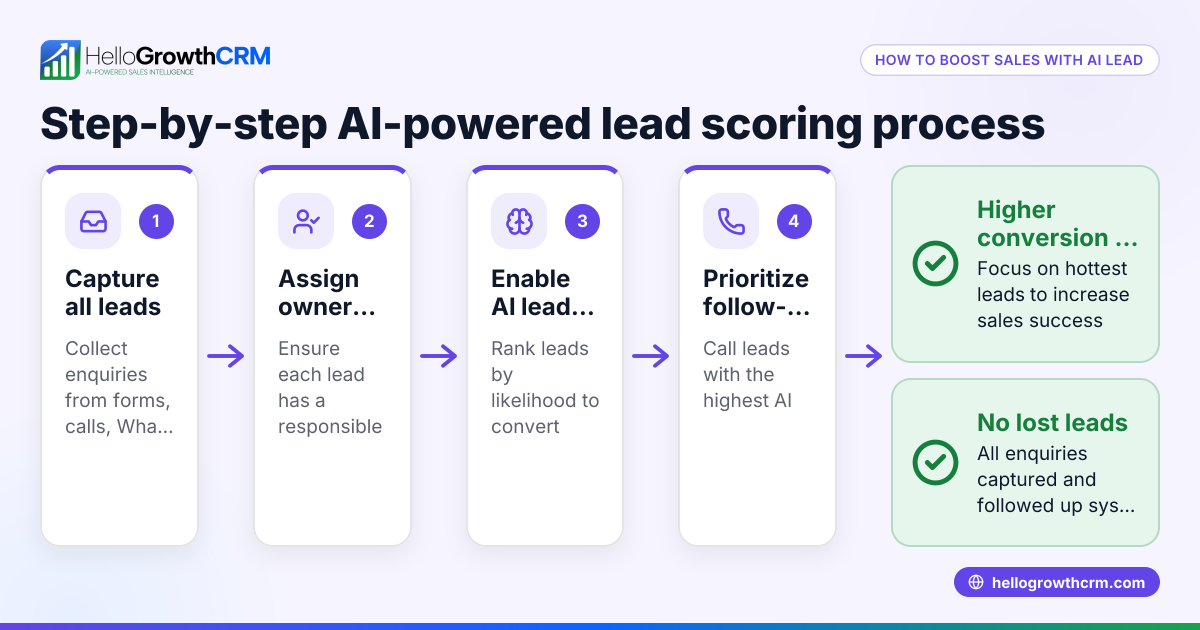
AI lead scoring is not a standalone tool—it works best when paired with your existing features, such as email automation, pipeline management, and unified communication channels like calling and WhatsApp.
For example, when a lead’s AI score crosses a threshold, automated workflows can trigger personalized email sequences or assign the lead to a specific rep. This ensures timely, relevant follow-up without manual effort. Integration also means sales managers get real-time reporting and forecasting based on AI-prioritized opportunities.
Choosing an AI CRM that offers seamless integrations with your marketing platforms, finance stacks like QuickBooks or Stripe, and ERP systems will maximize the benefits. Managed RevOps support can help optimize these workflows further.
What does it cost to use AI lead scoring for my sales team?
AI lead scoring is typically included in the subscription pricing of an AI CRM platform or sales automation suite. Costs vary based on features and team size.
Many US B2B companies consider this an investment rather than a cost, as AI tools speed up deals and improve win rates. Prices are often subscription-based, with scaling options as your team grows.
To understand specific pricing details and which plan fits your business needs, check out pricing or contact providers for a personalized consultation.
How can I start using AI lead scoring today?
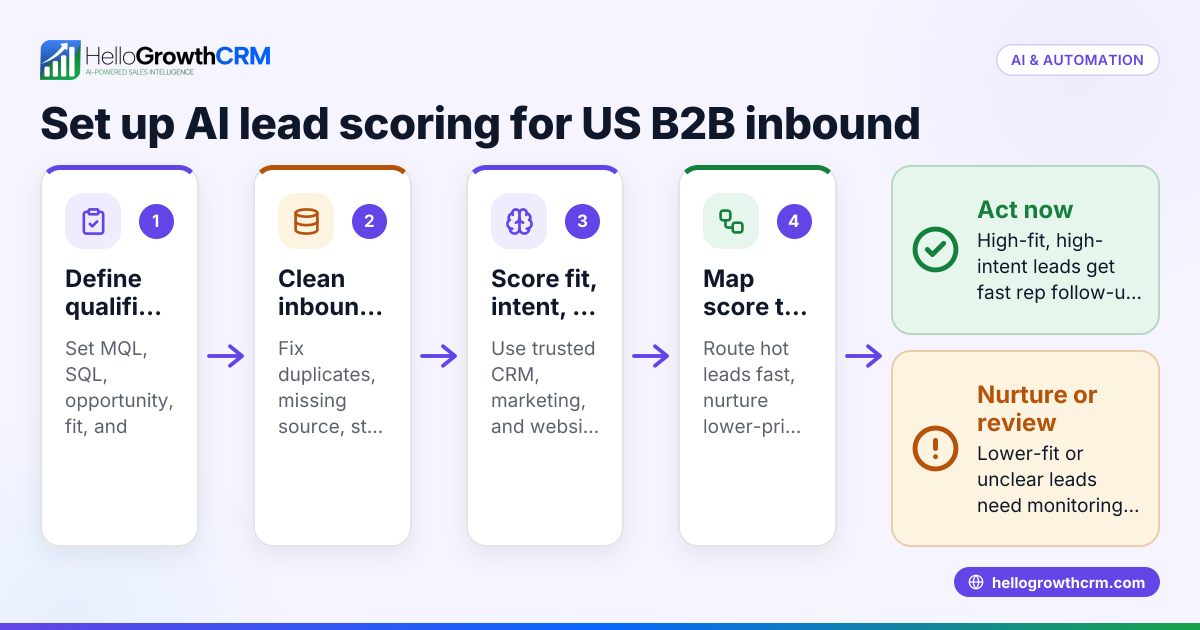
Starting with AI lead scoring involves a few steps:
- Assess your current sales process: Identify bottlenecks in lead qualification and pipeline management.
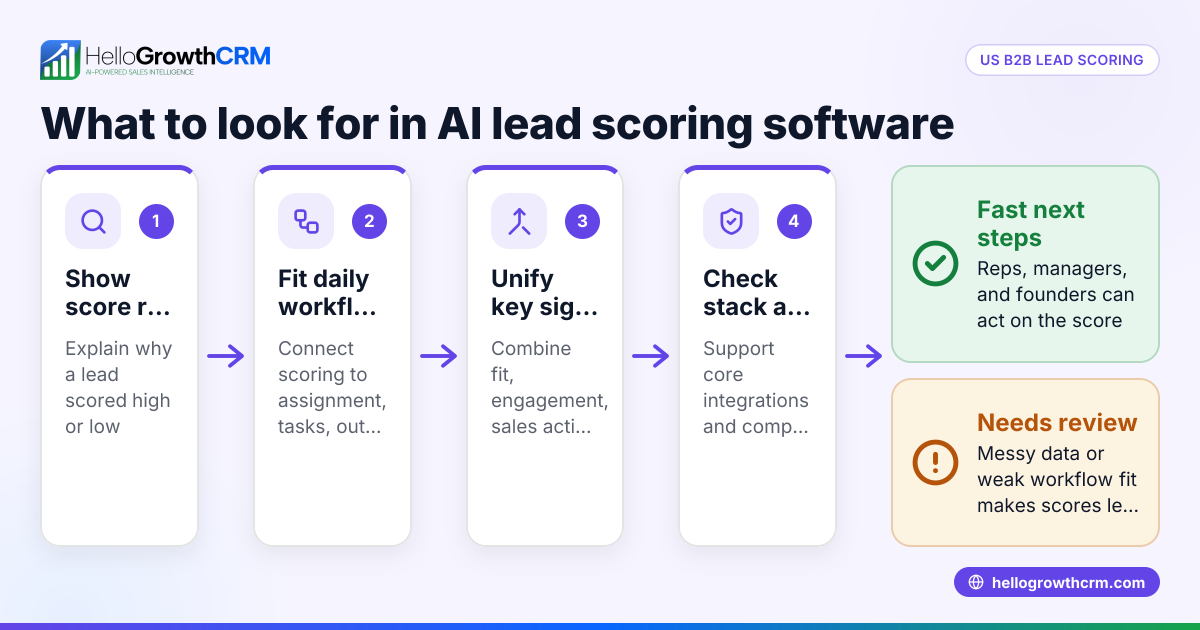
- Choose an AI CRM or software: Look for platforms that offer AI lead scoring integrated with communication and pipeline tools.
- Import your sales data: Historical sales and CRM data train the AI model.
- Set scoring criteria and thresholds: Align AI scores with your sales funnel stages.
- Train your team: Ensure reps understand and trust AI scores in prioritizing leads.
- Monitor and optimize: Review AI performance and update rules as market conditions evolve.
A platform like HelloGrowthCRM specializes in growing US-based B2B sales teams with [automated with AI] lead scoring plus managed RevOps support for faster ROI.
How does AI lead scoring improve sales forecasting accuracy?
AI-powered lead scoring contributes to precise sales forecasting by providing predictive insights into conversions. By ranking leads according to likelihood and expected deal size, sales leaders can generate forecasts based on weighted pipelines rather than subjective gut feeling.
AI models dynamically update scores with new data, reflecting real buyer behavior and external market trends. This results in forecasts that better reflect reality and helps leaders allocate resources and set targets with confidence.
What are the common challenges when implementing AI lead scoring?
While AI lead scoring offers many benefits, companies may face hurdles:
- Data quality: AI’s accuracy depends on clean, complete sales and marketing data.
- User adoption: Sales reps might distrust automated scores if results aren’t transparent.
- Integration complexity: Connecting AI scoring with existing CRMs and workflows requires technical resources.
- Compliance: Ensuring outreach triggered by AI respects US laws like CAN-SPAM and TCPA.
- Ongoing tuning: AI models need regular retraining to adapt to changing buyer profiles.
Addressing these with managed RevOps services or vendor support ensures smooth adoption.
How do AI tools handle compliance with US sales and marketing regulations?
An AI tool designed for US B2B sales prioritizes compliance features such as opt-out management, timestamp logging, and outreach limits. This supports adherence to CAN-SPAM, TCPA, and data privacy rules during automated email and phone campaigns.
By focusing efforts on qualified leads through AI lead scoring, companies also reduce broad unsolicited messaging. Selecting AI software with built-in compliance capabilities safeguards your brand and prevents costly fines.
To see how AI lead scoring can increase your B2B sales pipeline efficiency, start a free trial of HelloGrowthCRM today or book a demo to learn more.
Frequently asked questions
What data does AI lead scoring use?
AI lead scoring uses data from your CRM such as contact info, job titles, company details, past interactions, email clicks, website visits, and engagement patterns to predict buying intent.
Can AI lead scoring replace sales reps’ judgment?
No, AI lead scoring is a complementary tool. It helps reps prioritize leads faster and more objectively but does not replace human relationship-building and negotiation skills.
How often should AI lead scoring models be updated?
Models should be retrained regularly—monthly or quarterly—depending on sales cycle length and changing market conditions to maintain accuracy.
Does AI lead scoring work for all B2B industries?
AI lead scoring is effective across most B2B sectors but works best with historical sales data and clear buyer profiles. Industries with longer cycles or complex deals benefit significantly.
Is AI lead scoring secure for handling sensitive customer data?
Reputable AI CRM platforms comply with SOC 2 standards and US data privacy laws, ensuring secure data handling in their AI processes.
How do I measure ROI from AI lead scoring?
Measure ROI by tracking sales cycle reduction, higher conversion rates, improved forecast accuracy, and increased revenue after AI lead scoring implementation.
Read next
This article covers one part of a bigger topic. For the complete picture, read our guide to ai lead scoring.
Frequently Asked Questions
Ready to put this into practice?
Set up your pipeline, WhatsApp follow-ups, and AI lead scoring in minutes — free, no credit card.
Try HelloGrowthCRM freeGet CRM tips in your inbox
Join thousands of sales professionals who get weekly insights on CRM strategy, AI automation, and pipeline optimization.

The HelloGrowthCRM team publishes guides on CRM strategy, AI sales tools, and revenue operations for small business sales teams.