HelloGrowthCRM software
Built for real small-business sales teams
HelloGrowthCRM helps reps qualify faster, follow up on time, and close more deals—with practical automation in one place.
- AI lead scoring and pipeline visibility
- Built-in dialer, WhatsApp, and email automation
- Sales forecasting and RevOps-ready reporting
Tracking customer health scores helps small and mid-sized businesses identify which customers need attention before issues escalate. It combines data from sales, support tickets, referrals, and communication history to produce a score indicating customer satisfaction and risk of churn. Businesses running sales on WhatsApp and spreadsheets often miss timely signals, causing lost renewal or upsell opportunities.
Why this comes up / what goes wrong
Small-business owners often struggle to keep track of customer satisfaction across multiple channels. When sales teams use WhatsApp and Excel, customer interactions are scattered and manual. Without automated tracking, it is hard to spot unhappy customers or those who need follow-up. This leads to lost revenue and poor customer retention. Automatic customer health scoring tools can centralise data and highlight customers who require immediate action.
Step-by-step
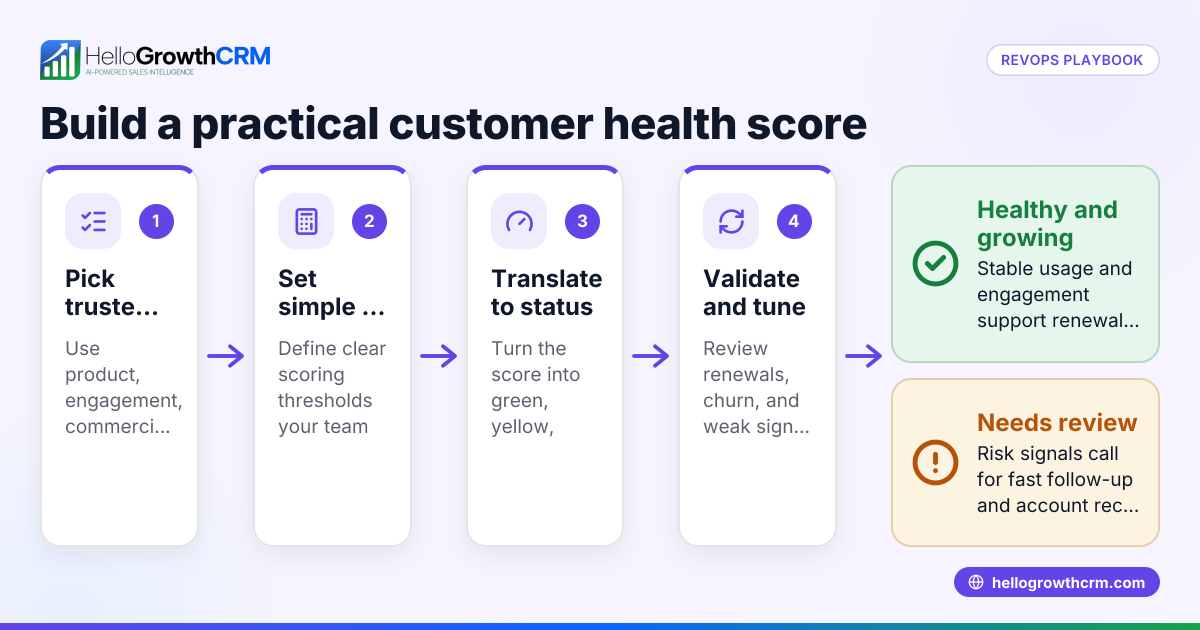
- Choose a tool with automatic data integration: Look for software that pulls data from sales, support tickets, referrals, and communication channels like WhatsApp or email.
- Define customer health metrics: Decide which factors affect your customer health score, such as response times, open support tickets, purchase frequency, or referral activity.
- Set up scoring rules: Configure how each metric impacts the overall health score. For example, an open unresolved ticket might reduce the score, while a recent purchase might increase it.
- Connect customer records across channels: Ensure the tool links all interactions, including after-sales service requests, to the same customer record for a full view.
- Monitor scores regularly: Use dashboards or alerts to identify customers with declining scores and assign tasks for follow-up.
- Review and adjust scoring criteria: Periodically refine the scoring based on feedback and changing business priorities.
- Train your team: Ensure sales and support teams understand how to use the health scores to prioritise their outreach.
Check that the tool offers a customer portal or ticketing system to track service requests on the same record as sales deals, which improves score accuracy. Also, free sales tools and templates can help you design your follow-up cadence and pipeline management.
Example (fictional figures)
A small Indian software company tracks customer health scores monthly. They assign points based on:
- Purchase frequency: 30 points for a purchase in last month
- Open support tickets: -20 points per ticket
- Referral activity: 10 points per referral
Customer A made a purchase in March 2024, has 1 open ticket, and 2 referrals.
Calculation:
Purchase frequency = 30 points Open tickets = -20 points × 1 = -20 points Referrals = 10 points × 2 = 20 points
Total health score = 30 - 20 + 20 = 30 points
Customer B made no purchase last month, has 2 open tickets, and no referrals.
Calculation:
Purchase frequency = 0 points Open tickets = -20 points × 2 = -40 points Referrals = 0 points
Total health score = 0 - 40 + 0 = -40 points
Customer B’s negative score signals urgent follow-up.
Common mistakes
- Ignoring after-sales service data: Not linking support tickets to customer records can cause inaccurate health scores. Use tools that integrate tickets with sales data.
- Overcomplicating scoring criteria: Too many metrics make scores hard to interpret. Focus on a few key indicators relevant to your business.
- Not updating scoring rules: Business needs change, so review and adjust scoring weights regularly.
- Failing to act on scores: A health score is only useful if your team follows up promptly on low scores.
- Using disconnected tools: Managing health scores across separate apps or spreadsheets causes delays and errors. Choose a unified CRM solution.
- Neglecting team training: Without clear guidance, teams may ignore or misuse health scores.
Doing this in HelloGrowthCRM
HelloGrowthCRM supports customer health tracking by keeping service requests, referrals, and tickets on the same customer record as deals. This ensures a complete view of customer interactions after the sale. The platform also offers free sales tools, templates, and calculators, including follow-up cadences and pipeline templates, which can be downloaded without an account to help you design your customer engagement strategy. Learn more about HelloGrowthCRM’s customer health score features at customer health score and explore free sales tools and calculators.
Frequently asked questions
What is a customer health score? A customer health score is a numeric value that reflects the overall satisfaction and engagement level of a customer. It combines data from purchases, support tickets, referrals, and communication to signal how likely a customer is to stay, renew, or churn.
Which metrics should I include in my health score? Common metrics include recent purchase frequency, number of open or resolved support tickets, referrals made, response times, and payment history. Choose metrics that impact your business outcomes and are easy to track.
Can I track customer health scores using WhatsApp? While WhatsApp itself doesn’t calculate health scores, CRM tools like HelloGrowthCRM integrate WhatsApp communication with sales and support data to provide automatic customer health tracking.
How often should I update customer health scores? Monthly updates are typical, but you can choose weekly or real-time updates depending on your business needs and tool capabilities.
What should my team do with low health scores? Assign immediate follow-up tasks to sales or support teams to address issues, resolve tickets, or offer incentives to improve customer satisfaction.
Are there free templates to help me start tracking customer health? Yes, HelloGrowthCRM provides free sales and pipeline templates, including follow-up cadences, that you can download without signing up. See free sales tools and calculators.
Key takeaways
- Automatic customer health scores combine sales, support, and referral data to highlight customer satisfaction and risk.
- Choose tools that integrate all customer interactions on one record, including after-sales service tickets.
- Keep scoring criteria simple, relevant, and regularly updated.
- Act promptly on low scores with clear team responsibilities.
- Avoid disconnected tools; use unified CRM solutions for accuracy and efficiency.
- Use free templates and calculators to design your follow-up and pipeline management.
Start tracking your customer health scores effectively to reduce churn and increase upsells. Start on the Free Forever plan (200 leads, no credit card) with HelloGrowthCRM to try these features yourself.
Ready to put this into practice?
Set up your pipeline, WhatsApp follow-ups, and AI lead scoring in minutes — free, no credit card.
Try HelloGrowthCRM freeGet CRM tips in your inbox
Join thousands of sales professionals who get weekly insights on CRM strategy, AI automation, and pipeline optimization.

The HelloGrowthCRM team publishes guides on CRM strategy, AI sales tools, and revenue operations for small business sales teams.