What quarterly funnel review does
The Quarterly Funnel Review is a structured working session, delivered on the RevOps Partner plan, where your specialist analyses a full quarter of CRM data end to end: where leads entered, where they leaked, which stages stalled deals, how conversion moved by source and rep, and whether the funnel's stage design still matches how you actually sell. It produces findings and an agreed set of changes — not a slideshow that gets filed.
Weekly reporting catches operational drift; it does not catch structural problems. A stage everyone skips, a lead source that converts at a fraction of its volume share, a qualification bar set wrong for the market — these only show up when someone steps back and reads a quarter's worth of data as one story. Skip that, and teams optimise execution inside a funnel shape that is quietly working against them.
How it works in HelloGrowthCRM
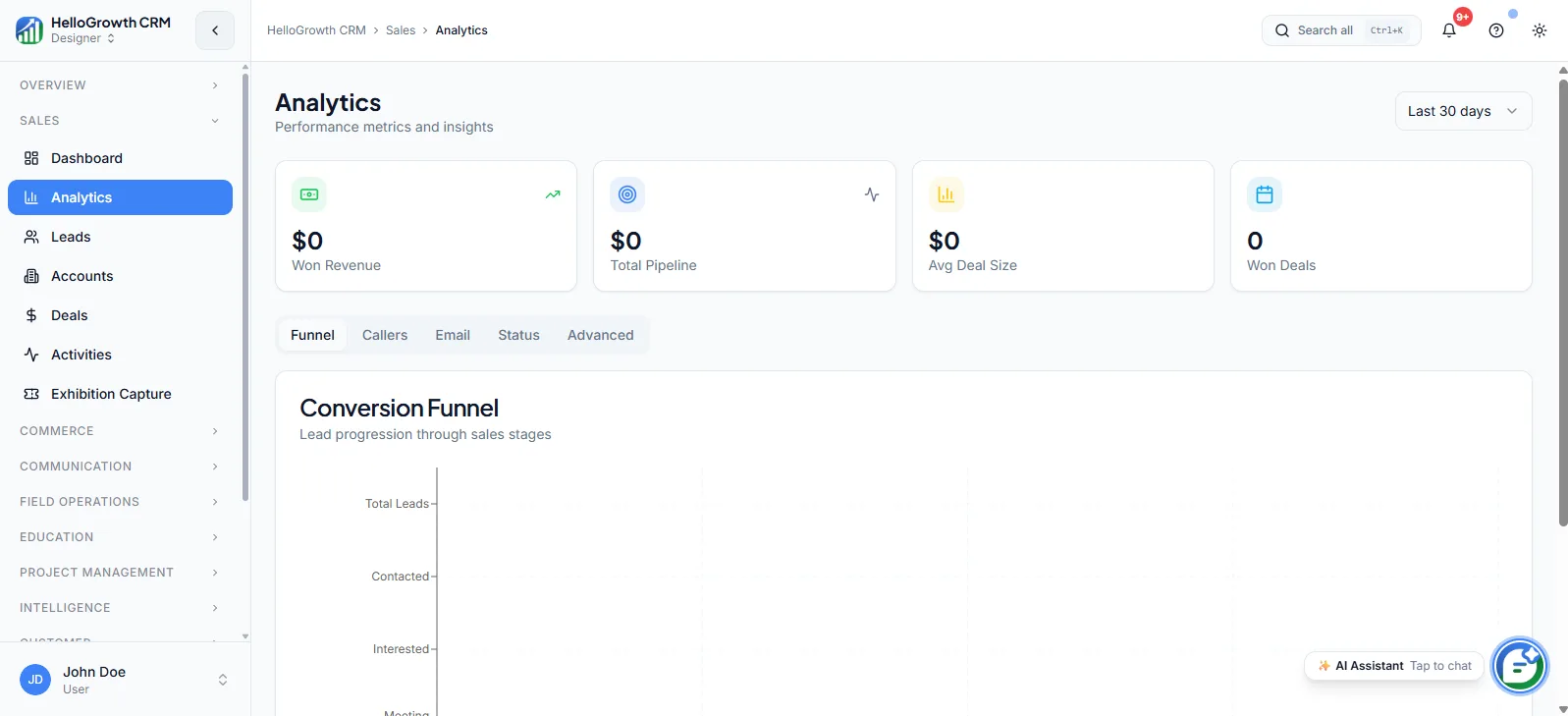
Ahead of the session, your specialist pulls quarter-long analytics from HelloGrowthCRM — stage-to-stage conversion, velocity, leakage points, source performance, and win/loss patterns — and prepares a short findings document. The review itself is a working meeting with leadership: findings are walked through, causes debated, and changes agreed with owners and dates attached.
Outputs typically become work for the rest of the managed stack: stage redefinitions and cleanup rules, automation builds for the specialist, scoring adjustments, and updated targets that the weekly KPI report tracks through the next quarter.
See it in action
How this capability is packaged by plan
| Plan | Availability |
|---|---|
| Free Forever | |
| Software Only | |
| Growth Engine | |
| RevOps Partner |
Setting it up — step by step
- 1
Set the quarterly calendar
Book review dates for the year in onboarding, timed after quarter close so full data is available.
- 2
Agree the funnel definition
Confirm the stages, entry points, and conversion definitions the review will measure against, so findings are not disputed later.
- 3
Confirm attendees and owners
Decide who joins — typically founder, sales lead, and specialist — and who owns actions coming out of each review.
- 4
Establish the baseline
The first review sets benchmark conversion and velocity numbers that future quarters get compared against.
- 5
Define the follow-through loop
Agree how actions are tracked between quarters, usually via the weekly report and monthly strategy calls.
Who uses quarterly funnel review
Founder/owner
Gets a quarterly, evidence-based answer to where do we actually lose deals — replacing instinct-driven pivots with changes grounded in a full quarter of their own funnel data.
Sales manager
Uses stage-conversion and velocity findings to redesign qualification bars and coaching focus, then holds the team to the new definitions through the following quarter's weekly reviews.
RevOps lead
Turns review findings into the next quarter's systems backlog — stage changes, routing adjustments, scoring tweaks — and uses the baseline comparison to prove whether last quarter's changes worked.
Quarterly Funnel Review in practice — industry examples
Startups
A SaaS startup sees pipeline growing but revenue flat. The review shows demos converting well while a proposal-to-signature stage silently eats six weeks per deal. Leadership restructures the closing motion with shorter contracts and an automated chaser sequence, and tracks the fix against the quarter's baseline.
Exporters
An exporter works inquiries from trade fairs, portals, and distributors. The quarterly review reveals fair leads convert at multiples of portal leads despite lower volume, shifting next year's budget toward exhibitions and prompting a stricter qualification bar for portal inquiries before sampling costs are incurred.
Travel agents
A tour operator's funnel review shows itinerary requests spiking pre-season but conversion collapsing at the quote stage during the same weeks. The finding — quote turnaround stretching under load — leads to templated itinerary packages and an extra quoting resource for the seasonal peak.
Common mistakes to avoid
Running the review on unclean pipeline data, so an hour gets spent debating whether numbers are real instead of what they mean.
Treating it as a reporting ceremony with no decisions, so the same leakage findings reappear verbatim next quarter.
Changing five funnel variables at once after one review, making it impossible to attribute the next quarter's movement to anything.
Excluding the sales manager from the session, then wondering why redefined stages never get enforced on the floor.
What teams usually care about here
Useful for scaling teams that want continuous process improvement rather than reactive cleanup only
Helps leadership revisit stage definitions, targets, and friction points using actual CRM data
Pairs well with KPI reporting, scoring refinement, and automation planning
How this fits the buying decision
Buyers usually do not evaluate quarterly funnel review in isolation. They want to know whether it improves execution, reporting, handoffs, and accountability inside the broader CRM workflow. That is why this capability matters most when it is connected to records, ownership, activity history, and manager review rather than living in a separate point tool.
The real decision is often less about whether a box is checked and more about how much depth the team needs. Lower tiers may be enough when the workflow is simple or the volume is small. Higher tiers become more valuable when teams need governance, faster response expectations, specialist execution, or a repeatable operating cadence around the process.
If this capability is important to your rollout, compare it in the context of the whole plan. That includes related workflows, support level, reporting expectations, and whether your team will manage the motion itself or rely on managed RevOps help to keep it consistent.
Frequently asked questions
Which plans include the Quarterly Funnel Review?
RevOps Partner only. Growth Engine includes weekly KPI reporting and ongoing hygiene, but the deep quarterly analysis of conversion, leakage, and stage design is part of the full-service RevOps Partner engagement. Software Only customers can run their own analysis using the analytics module.
How is the review set up with our team?
During onboarding you book the quarterly dates, confirm the funnel definition the review measures against, and agree who attends and owns actions. The first session establishes your baseline; subsequent quarters compare against it so improvement is measurable, not anecdotal.
How is this different from the Weekly KPI Report?
The weekly report tracks operational execution — leads, activities, movement — against the current funnel. The quarterly review questions the funnel itself: whether stages, qualification bars, and source mix are structured correctly. One monitors the machine; the other redesigns it.
What do we get out of each session?
A short findings document, an agreed action list with owners and dates, and updated benchmarks. Typical outcomes include stage redefinitions, source budget shifts, scoring adjustments, and automation requests routed to your specialist — all tracked through the weekly cadence afterwards.
Does the review look at channel performance like WhatsApp and calls?
Yes. Because dialer calls, WhatsApp messages, and email touches are logged on CRM records, the review can compare how contact strategy affects conversion by stage — for example whether deals receiving a call within a day progress faster than form-only follow-up.
Related Pricing Capabilities
Workflows
Automated workflow builder for triggering actions — task creation, field updates, notifications, stage moves — based on CRM events.
Territories
Territory definition and ownership tools that assign accounts, leads, and deals to reps based on geography, industry, or custom rules.
Commissions
Commission tracking inside the CRM that links deal outcomes to rep incentive calculations without exporting to spreadsheets.
Field Operations
Tools for managing field sales teams — check-ins, visit logs, route planning, and on-site activity capture from mobile.
Named Revenue Specialist
A dedicated operator who manages follow-up, pipeline discipline, and day-to-day revenue workflow reliability inside your CRM.
Managed RevOps
Done-for-you revenue operations support that turns HelloGrowthCRM from software into an execution system run with specialist help.