HelloGrowthCRM software
Built for real small-business sales teams
HelloGrowthCRM helps reps qualify faster, follow up on time, and close more deals—with practical automation in one place.
- AI lead scoring and pipeline visibility
- Built-in dialer, WhatsApp, and email automation
- Sales forecasting and RevOps-ready reporting
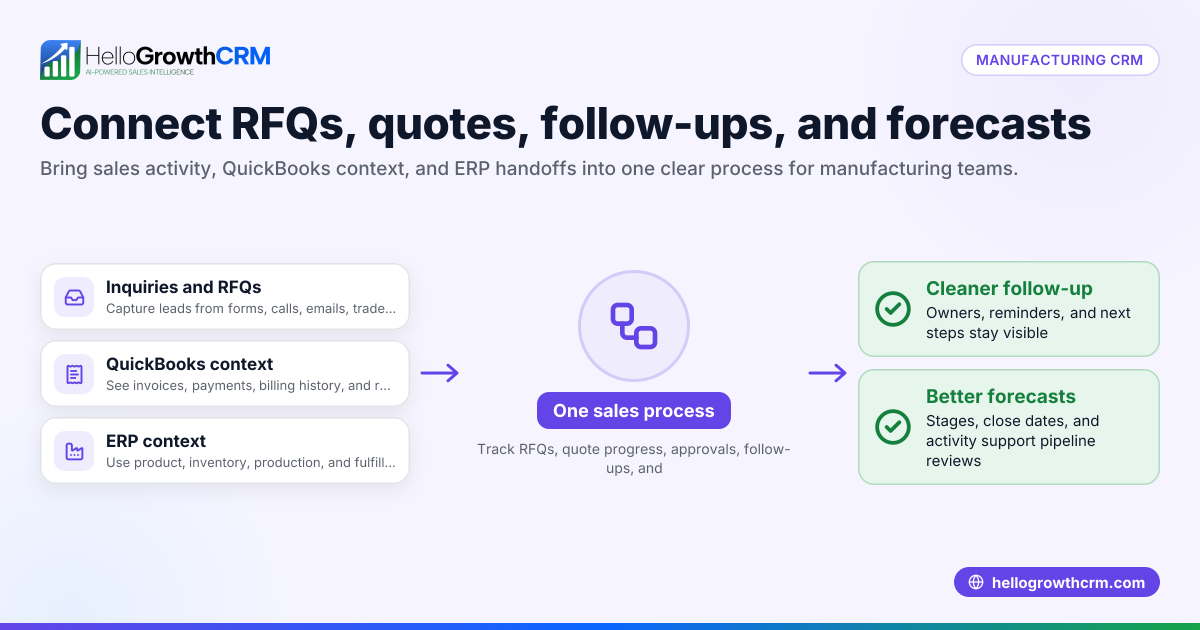
Manufacturers in Maharashtra need a CRM that can handle RFQs, distributor follow-ups, WhatsApp enquiries, plant-wise pipelines and realistic sales forecasts without adding admin work for the sales team. The best CRM for manufacturers in Maharashtra is one that fits daily factory sales operations in Mumbai, Pune, Nashik, Aurangabad and Nagpur, and ties together enquiries, quotations, follow-ups and reporting in one place.
Key takeaways
- The best CRM for manufacturers in Maharashtra should track RFQs, repeat enquiries, distributor orders and plant-wise sales in one system.
- WhatsApp, calling and email must sit inside the CRM, because many buyers and channel partners prefer quick message-based follow-ups.
- Manufacturers should choose a CRM that supports lead capture from IndiaMART, JustDial, website forms and field sales teams.
- Sales forecasting works better when stages match real manufacturing cycles such as enquiry, technical review, quote, sample, negotiation and PO.
- For Maharashtra-based manufacturers, CRM setup should reflect GST-linked commercial processes, approval flows and territory-based distributor management.
- An AI CRM can help teams prioritise hot enquiries and reduce missed follow-ups without forcing long manual data entry.
Why manufacturers in Maharashtra need a different kind of CRM
A generic CRM often fails in manufacturing. The problem is not just lead tracking. It is the mix of RFQs, technical discussions, price revisions, distributor follow-ups, dispatch coordination and long sales cycles.
A manufacturer in Maharashtra deals with many moving parts. A sales rep in Pune may handle OEM enquiries. A distributor manager in Nagpur may chase repeat orders. A business owner in Mumbai may want one clear view of monthly numbers. A plant head in Aurangabad may need visibility into committed demand.
That is why the best CRM for manufacturers in Maharashtra must match how manufacturing sales really happen.
Typical manufacturing sales workflows in Maharashtra
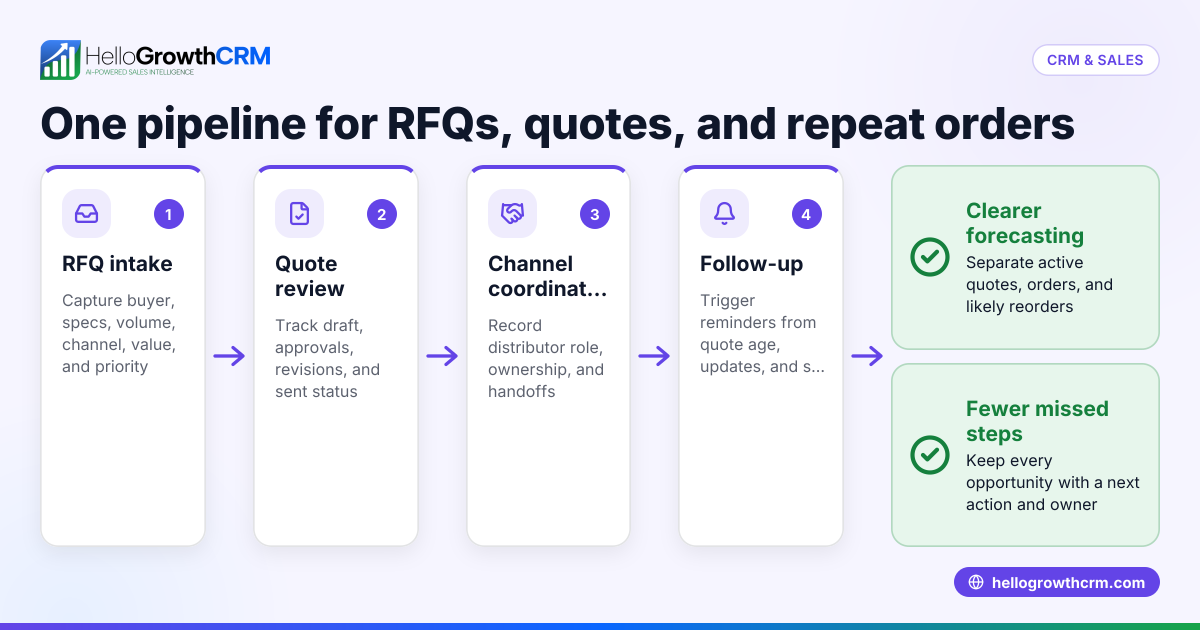
Most manufacturers do not work on a simple “lead to close” path. They work across:
- RFQ receipt
- Technical feasibility checks
- Pricing and quotation
- Sample approval
- Distributor or dealer follow-up
- Purchase order confirmation
- Dispatch coordination
- Repeat business and upsell
This is very different from a simple retail or service pipeline. If your CRM does not support these stages, your team will stop using it.
Common pain points in Maharashtra manufacturing businesses
Many small and mid-sized manufacturers still manage enquiries on spreadsheets, WhatsApp chats and personal notebooks. This creates predictable issues:
- RFQs are missed when one salesperson is on leave
- Distributor follow-ups depend on memory
- Old quotations are hard to find
- Website and IndiaMART enquiries are not assigned fast
- Forecasts are based on gut feel
- Owners cannot see plant-wise or territory-wise pipeline
In Maharashtra, where manufacturers often sell across Mumbai, Pune, Nashik, Kolhapur, Sangli, Nagpur and tier-2 markets, this gets worse as the business scales.
What makes the best CRM for manufacturers in Maharashtra?
The right CRM should solve operational problems first. Fancy dashboards alone are not enough. Your sales and channel team must actually use it every day.
RFQ management must be built into the process
Manufacturing sales starts with an enquiry or RFQ. The CRM should make it easy to capture:
- Company name
- Contact person
- Product category
- Quantity
- Required specification
- Target price
- Delivery location
- Expected order timeline
This information should not be buried in email threads. It should sit in one record. That lets the team move faster from enquiry to quotation.
Distributor and dealer follow-ups must be easy
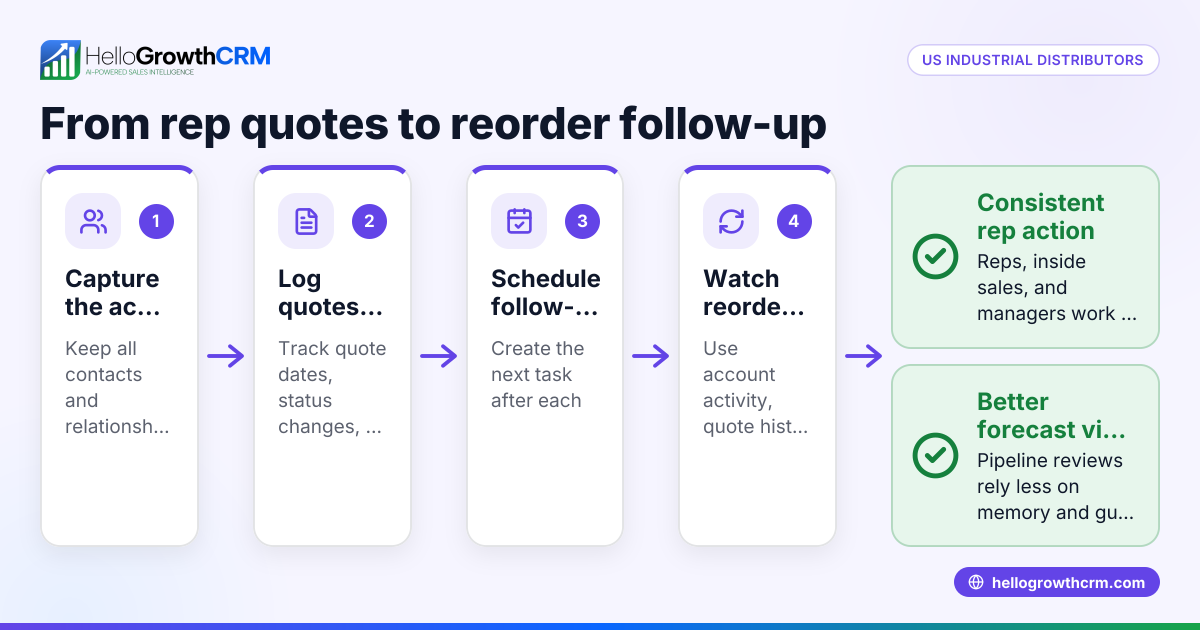
In Maharashtra, many manufacturers rely on distributor networks. These relationships need steady follow-up. The CRM should help your team track:
- Last order date
- Pending enquiries
- Payment-related sales holds
- Monthly targets
- Next follow-up date
- WhatsApp or call history
A good system should remind the team when a distributor has gone quiet. It should also help identify which channel partner is likely to place the next order.
WhatsApp matters as much as email
For many manufacturers, WhatsApp is the main business channel. Buyers ask for quotations, revised prices, product photos and dispatch updates there. Dealers also prefer quick WhatsApp follow-ups.
If your CRM ignores WhatsApp, your real sales communication stays outside the system. That creates blind spots. A better approach is to keep WhatsApp, calling and email connected to the same customer timeline. HelloGrowthCRM supports communication workflows, including email automation, which is useful when enquiries need quick acknowledgement and regular follow-ups.
Which CRM features matter most for a manufacturer in Maharashtra?
The most important CRM features for manufacturers in Maharashtra are RFQ tracking, quotation follow-ups, distributor management, WhatsApp communication, field sales visibility and dependable forecasting. If the CRM does these well with low manual work, your sales team will use it consistently.
1. Lead capture from real manufacturing sources
Manufacturers often get leads from:
- IndiaMART
- JustDial
- Website forms
- Sales reps
- Trade exhibitions
- Existing distributors
- Referral networks
Your CRM should capture these leads automatically where possible. It should also assign them quickly by territory, product line or sales owner. You can review HelloGrowthCRM integrations if lead source connectivity is a priority.
2. Custom pipeline stages for manufacturing sales
Your pipeline should reflect your commercial reality. For example:
- New enquiry
- RFQ received
- Technical review
- Quote sent
- Sample in progress
- Negotiation
- PO received
- Dispatch planned
- Repeat order opportunity
This structure helps forecast better. It also reduces confusion between the sales team, commercial team and plant operations.
3. Follow-up automation
Many orders are lost because no one follows up at the right time. A CRM should trigger reminders after:
- RFQ receipt
- Quote sent
- Sample dispatch
- No response for 3 days
- Distributor inactivity
- Repeat order due date
This is where ai best crm conversations become useful. Manufacturers do not need AI for hype. They need AI to prompt the next action and stop revenue leakage.
4. Sales forecasting that matches actual demand
Forecasting matters in manufacturing because it affects production planning, procurement and working capital. The CRM should make forecasts visible by:
- Month
- Product line
- Territory
- Salesperson
- Distributor
- Stage probability
A sales leader can then compare likely orders against plant capacity and raw material needs. HelloGrowthCRM includes sales forecasting for teams that want better visibility without spreadsheet-heavy reviews.
How should a manufacturer in Maharashtra set up CRM stages?
Use stages that match your actual sales cycle: enquiry, RFQ, technical review, quote sent, sample, negotiation, PO and repeat order. Keep the stage names simple, and define one clear exit rule for each stage so sales forecasts stay reliable.
Build the pipeline around your factory process
A CRM fails when stages are too generic. “Qualified” and “proposal” may sound fine, but they are often too vague for manufacturing teams.
Instead, define stages that your sales and production teams both understand. For example:
- RFQ received means full requirement details are available
- Technical review means internal feasibility is under discussion
- Quote sent means commercial offer is formally shared
- Sample stage means a trial item is being tested
- PO received means the order is commercially confirmed
These stage definitions reduce reporting disputes.
Use separate pipelines where needed
Not every manufacturer should use one pipeline. It may make sense to separate:
- OEM sales
- Distributor sales
- Export enquiries, if applicable within your India operations
- Spare parts or repeat business
- Project-based industrial orders
For a Maharashtra manufacturer with multiple units or product divisions, separate pipelines can improve reporting without making the CRM messy.
How can a CRM help with distributor follow-ups in Maharashtra?
A CRM helps by showing the last order, current enquiries, pending tasks and next follow-up for every distributor in one place. This stops inactive accounts from slipping through and gives sales managers a clear way to review territory health every week.
Track distributor activity by territory
Manufacturers selling across Maharashtra often divide teams by region. A good CRM should let you see:
- Mumbai and Thane distributors
- Pune and Pimpri-Chinchwad dealers
- Nashik and Ahmednagar channel partners
- Nagpur and Vidarbha accounts
- Kolhapur and Sangli industrial buyers
This makes regional reviews easier. It also helps identify low-coverage areas.
Standardise review meetings
A simple weekly distributor review can use CRM data to answer:
- Which distributors have not ordered in 30 days?
- Which ones have open RFQs?
- Which quotations need follow-up?
- Which accounts are close to repeat orders?
- Which territories are below monthly target?
When this data is visible, review meetings become faster and more useful.
What should manufacturers in Maharashtra look for in AI features?
Look for practical AI features that score leads, suggest follow-ups, summarise conversations and improve forecast quality. Avoid tools that add complexity but do not help your sales team close RFQs, manage distributors or respond faster on WhatsApp.
Good AI in manufacturing sales is operational
The right AI feature helps with daily work. For example:
- Prioritising high-intent enquiries
- Flagging leads with no follow-up
- Suggesting which distributor needs attention
- Summarising long message threads
- Highlighting likely closing deals this month
This is more useful than generic automation.
AI lead scoring can reduce wasted effort
If your team gets many enquiries from IndiaMART, trade shows or website forms, not all leads deserve the same effort. An AI lead scoring system can help the team focus on better-fit enquiries first.
For example, a lead asking for industrial volume, a clear specification and a near-term timeline should rank above a vague enquiry with no product detail. That saves time for both sales and application teams.
CRM setup tips for manufacturers in Maharashtra, Central India
Maharashtra manufacturers need CRM setup that reflects local sales habits, compliance-sensitive processes and multi-city operations. The system should support WhatsApp-first communication, territory ownership, GST-aware commercial handoffs and clear accountability across Mumbai, Pune, Nagpur and nearby industrial belts.
Map sales to actual roles
Do not assign everything to one “sales team” bucket. Set up users by role:
- Inside sales
- Field sales
- Distributor managers
- Key account managers
- Commercial support
- Sales heads
This improves ownership. It also makes review reports more meaningful.
Capture the right fields from day one
Start with practical fields only. For a manufacturer, these may include:
- Product category
- Annual requirement
- RFQ date
- Application type
- Industry segment
- Territory
- Distributor name
- Sample status
- Quote amount
- Expected close month
Avoid collecting too much data early. Adoption drops when reps must fill long forms.
Keep compliance and customer data in mind
Manufacturers handling customer contact data should store and use it responsibly. If you collect personal data such as contact names, mobile numbers and email addresses, your internal process should align with the Digital Personal Data Protection Act, 2023 where applicable. Keep access role-based, and avoid scattered customer records across personal devices.
Connect sales and finance handoffs
Many manufacturing delays happen after the sale is “won.” Commercial handoffs matter. For example:
- Credit approval may affect order confirmation
- GST-related documentation may be needed
- Dispatch timelines may depend on payment terms
- Tally entries may need clean customer data
A CRM should not replace accounting. But it should make the sales-to-accounts handoff cleaner. If you want to assess the broader workflow, review the platform’s features.
A practical checklist to choose the best CRM for manufacturers in Maharashtra
Use this checklist before you buy:
- Can it capture leads from IndiaMART, JustDial and website forms?
- Can it handle RFQ-specific stages?
- Does it support distributor and dealer follow-ups?
- Can the team use WhatsApp, calls and email from one system?
- Can managers view territory-wise and product-wise pipeline?
- Does forecasting reflect real stage progress?
- Is setup simple enough for fast adoption?
- Can it support multiple branches or plants in Maharashtra?
- Does it reduce manual reporting?
- Will your team actually use it daily?
Red flags to avoid
Be careful if a CRM:
- Feels too generic for manufacturing
- Needs heavy custom work for basic RFQ tracking
- Makes mobile usage difficult
- Does not support follow-up reminders well
- Shows weak reporting for sales managers
- Depends on manual spreadsheet imports every week
When is HelloGrowthCRM a good fit for manufacturers?
HelloGrowthCRM is a good fit when a manufacturer wants one system for lead capture, follow-ups, pipeline management, communication and forecasting, without building a large internal RevOps function. It is especially useful for growing B2B teams that need structure but want simple day-to-day usage.
For manufacturers in Maharashtra, the value is not just software. It is also having a practical process that matches how your team works. If your team needs support beyond setup, managed RevOps can help create cleaner sales workflows and reporting discipline.
If you are comparing options, check the pricing page for current plans and fit.
Frequently asked questions
What is the best CRM for manufacturers in Maharashtra?
The best CRM for manufacturers in Maharashtra is one that handles RFQs, distributor management, WhatsApp follow-ups and sales forecasting in a simple workflow. It should fit real factory sales processes, not just generic lead tracking.
Can a CRM help small manufacturers in Pune or Nashik?
Yes. Even a small manufacturing business benefits from centralised enquiry tracking, automated follow-ups and better visibility into pending quotations. This reduces dependency on one salesperson’s memory.
Why is WhatsApp integration important for manufacturers?
Many buyers and distributors prefer sharing quick updates, price discussions and order-related queries on WhatsApp. If this communication stays outside the CRM, the business loses visibility and follow-up discipline.
Do manufacturers need AI in a CRM?
They need useful AI, not extra complexity. AI is valuable when it helps score enquiries, flag missed follow-ups, summarise conversations and improve forecast accuracy.
How long does CRM setup usually take for a manufacturer?
It depends on the complexity of your sales process, number of users and data quality. A focused setup with clear stages, fields and user roles is usually faster and leads to better adoption than a heavily customised rollout.
Start with a practical system your sales team will actually use. You can start a free trial or book a demo to see how HelloGrowthCRM can support your manufacturing sales process in Maharashtra.
Frequently Asked Questions
Ready to put this into practice?
Set up your pipeline, WhatsApp follow-ups, and AI lead scoring in minutes — free, no credit card.
Try HelloGrowthCRM freeGet CRM tips in your inbox
Join thousands of sales professionals who get weekly insights on CRM strategy, AI automation, and pipeline optimization.

The HelloGrowthCRM team publishes guides on CRM strategy, AI sales tools, and revenue operations for small business sales teams.