HelloGrowthCRM software
Built for real small-business sales teams
HelloGrowthCRM helps reps qualify faster, follow up on time, and close more deals—with practical automation in one place.
- AI lead scoring and pipeline visibility
- Built-in dialer, WhatsApp, and email automation
- Sales forecasting and RevOps-ready reporting
In the United States, automated real estate lead follow up works best when it is built around consent records, source-specific messaging, time-zone aware routing, and a CRM history that can stand up to a dispute, a broker review, or a handoff.
Many U.S. teams automate too early and too generically. A Zillow inquiry, a Google Business Profile call, a Facebook lead form, and a referral from a past client are not the same lead. They arrive with different context, different expectations, and sometimes different legal constraints on how you can respond. If you want automation to help rather than create risk, design it around the realities of the United States: state-by-state privacy rules, the federal Telephone Consumer Protection Act for calls and texts, CAN-SPAM for email, state licensing oversight, and a market that runs across multiple time zones and language preferences.
TCPA records matter more than a fast text blast
For U.S. real estate businesses, the first design question is not which sequence to write. It is whether you can prove what the lead agreed to receive. Calls and texts are shaped by the Telephone Consumer Protection Act, enforced by the Federal Communications Commission, with Federal Trade Commission involvement in broader marketing practices. Because the TCPA carries a private right of action, your consent record is not just a marketing detail; it is evidence.
That means your automation should store the lead source, the form language or ad context that produced the inquiry, the timestamp, and the exact channel used for the first outreach. If a lead came from a portal that disclosed agent contact, that is different from a cold list upload. If a prospect filled a website form requesting a showing, that is different from a scraped phone number added to a campaign. Your follow-up logic should preserve those distinctions inside the contact record.
Email has its own U.S. rule set. The CAN-SPAM Act is enforced by the FTC and requires, among other things, a working opt-out in commercial email. In practice, your automated email follow up should keep unsubscribe handling clean and immediate, and your team should not keep manually re-adding opted-out leads to new campaigns.
If you operate in California, the California Consumer Privacy Act and the California Privacy Rights Act add another layer around notice, access, deletion, and data-sharing practices, overseen by the California Privacy Protection Agency and the state attorney general. Other states now have their own privacy statutes as well. The United States does not have one federal privacy baseline for all marketing data, so the state where the consumer lives can change your obligations.
Lead source should change the first message
In U.S. real estate, the source often tells you what the lead is trying to do right now. A Google Business Profile lead may want a direct callback because they searched for a local agent. A Facebook or Instagram lead form may be earlier-stage and more responsive to a short qualification message. A Yelp inquiry may be comparing several brokers. A referral usually expects immediate human recognition, not a generic drip.
Automation should therefore branch by source before it branches by property type. If the source is a referral, the first automated message can acknowledge that a team member will reach out personally and ask for the preferred contact window. If the source is a portal inquiry tied to a listing, the first message should reference the property and offer clear next actions: confirm availability, discuss similar homes, or book a call. If the source is a website valuation request, the first message should ask for missing property facts rather than pushing a buyer script onto a seller lead.
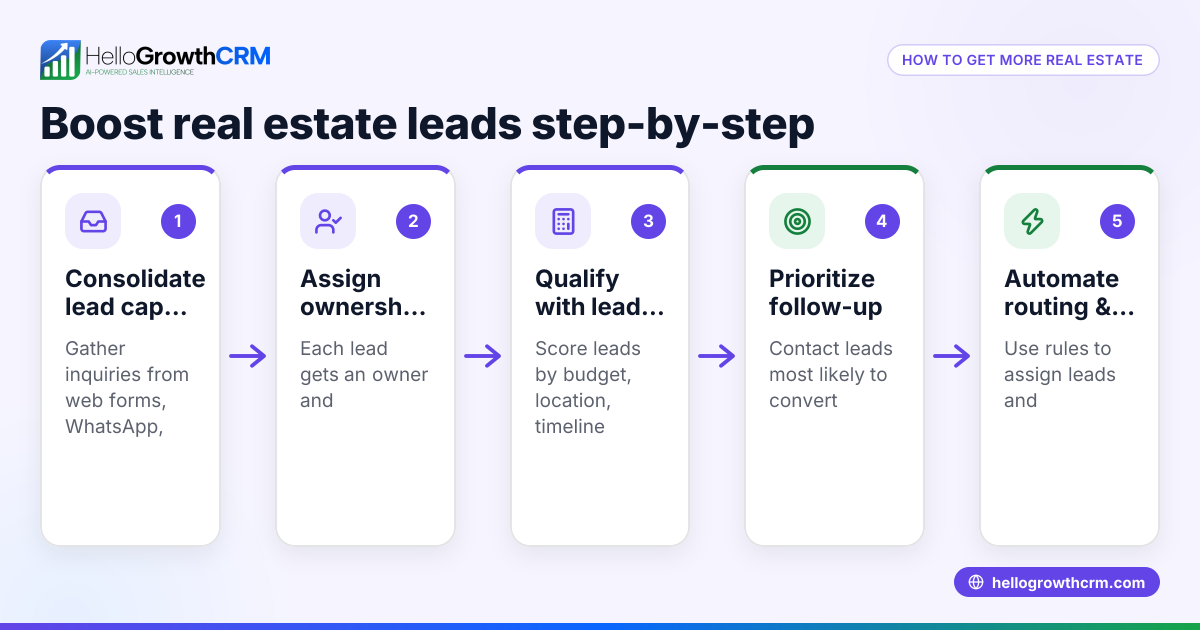
This is where organized lead capture and qualification matter. A system built around lead capture and qualification helps keep new inquiries from piling up in a single inbox with no context. The point is not novelty. It is that the record should show where the lead came from, what they asked for, and what message logic they entered.
For many metro markets in the United States, language choice belongs here too. English-only follow up can miss willing buyers and sellers who would respond faster to Spanish. Spanish-language copy is not a niche edge case in markets across Florida, Texas, California, Arizona, Nevada, Illinois, and beyond. A simple language preference field collected at inquiry stage can improve response quality without collecting sensitive identity data you do not need.
Time zones, daylight saving, and local calling hours need rules
National lead distribution creates a common U.S. failure: a team in one state sends messages at the wrong local time in another. This is not just annoying. It can create TCPA exposure if your calling and texting windows are not controlled. The United States spans multiple time zones, and Arizona and Hawaii do not observe daylight saving in the same way as most states. A booking made in autumn for a consultation in spring can shift if your automation uses the wrong zone logic.
Your workflow should treat the lead's local time as the governing time for outreach, reminders, and booking confirmations. That requires storing location cleanly, whether from area code, property ZIP code, listing market, or the lead's stated city and state. It also means your sequences should stop trying after business hours in the prospect's zone and resume the next business window.
Federal holidays are widely observed, but state holidays and local business rhythms vary. An agent covering Massachusetts and Texas should not assume one calendar fits both. If your team promises a quick response, tie that promise to staffed hours by market rather than to the office headquarters clock.
Scheduling tools can reduce this friction if they present available times in the lead's zone and write the meeting back to the contact history. That shortens the path from inquiry to conversation without forcing staff to manually translate times across markets. A booking flow such as meeting scheduling and booking is useful here only if it respects ownership, geography, and availability rather than dropping every lead into a shared calendar.
What your inquiry form should collect in a U.S. brokerage
A strong U.S. form captures enough to route and respond well, but not so much that you create unnecessary privacy or fair-housing risk. At first contact, most teams need property interest, market, budget band or price range, buy-versus-sell intent, preferred contact channel, language preference, and timing. They usually do not need government ID, Social Security information, health information, or open-ended notes inviting the prospect to share protected characteristics.
Real estate teams also need to remember that state licensing and advertising oversight are separate from privacy law. State licensing boards and state real estate commissions can scrutinize how licensed activity is supervised and represented. Automation should therefore make clear when a lead is being contacted by a licensed agent, an assistant, or an ISA, and it should keep that history attached to the record.
One useful U.S.-specific check is whether your form and your follow-up templates accidentally invite information you should not be using in housing decisions. Fair housing obligations sit outside the marketing stack, but your marketing stack can still create the evidence trail. Keep your questions tied to the transaction and the property search, not the person's protected status.
- Does the form capture the lead source and consent context?
- Does it collect a market or ZIP code so the lead can be routed locally?
- Does it ask for preferred channel and language?
- Does it avoid unnecessary identity or sensitive personal data?
- Does it create a record that shows who responded and when?
Routing by market and licence beats round-robin assignment
Round-robin assignment looks fair on paper, but U.S. real estate often needs a different logic. Leads should go to the right market, the right specialty, and where applicable the right licensed coverage. A condo seller in Miami, a first-time buyer in Phoenix, and an investor lead in Chicago require different follow-up and often different people. If a team spans multiple states, licensing status and local knowledge become operational facts, not just HR details.
Routing rules should use the information you already have: source, ZIP code, city, county, property type, language, and transaction type. Ownership can then pass into a pipeline that shows whether the lead is new, contacted, qualified, appointment set, touring, offer stage, or closed. A visible pipeline is valuable here because the record is not just a contact card; it shows who owns the opportunity, what happened, and what the next action is.
Tasks matter as much as messages. In U.S. teams, many missed deals are not caused by the first autoresponder failing; they are caused by nobody owning the second call, the lender introduction, the showing confirmation, or the stale-lead reactivation. Tying calls, notes, meetings, and internal handoffs to the same record with task boards and activity history helps a broker or team lead see whether automation is creating progress or just noise.
Email, SMS, and phone should each have a different job
U.S. lead follow up improves when each channel is used for what it does best. Email is useful for richer property context, disclosures, market updates, and summaries that the lead can forward to a spouse or lender. SMS is useful for quick confirmations and short choices. Phone is still the fastest path when a buyer wants a same-day tour or a seller wants to discuss timing and price strategy.
That means a sequence should not simply repeat the same sentence across three channels. A better design is: email with relevant property or market context, SMS asking a simple next-step question, and a call task if there is no reply. If the lead does respond, the sequence should stop and the ownership should switch clearly to a person.
For some teams, this can be run inside one system with sequences and shared inbox handling, a dialer for logged calls, and SMS or WhatsApp messaging. What matters is not the stack by itself. It is that every contact attempt, reply, note, and stage move stays tied to the same lead record so a handoff does not erase context.
Keep an audit trail that survives a commission dispute or broker review
U.S. real estate creates more recordkeeping pressure than many teams expect. If two agents argue over who cultivated a prospect, if a team member leaves, if a consumer claims they asked not to be contacted, or if a broker reviews supervision, your automation history becomes the file. You want a record that shows source, owner, contact attempts, replies, appointment booking, and stage progression without depending on one agent's memory.
This matters for money as well. There is no federal VAT or GST in the United States. Instead, taxes relevant to a brokerage's operations may include federal income tax, state income tax where applicable, employment taxes, and vendor reporting such as Form 1099 where required by the Internal Revenue Service. If you pay contractors for ISA work, photography, staging coordination, or ad services, your EIN setup and contractor records are separate from your lead workflow but they affect how the business runs. Current reporting rules and instructions are published by the IRS, and state tax registration is handled through state revenue agencies.
Payment records also need care. U.S. businesses commonly receive or send money through ACH, Zelle, credit card, check, and wire transfer. Some of those rails do not show up in a card processor dashboard. If your lead follow up includes consult fees, marketing retainers, broker price opinion charges where lawful, or invoice-backed services tied to a transaction-adjacent business line, manual reconciliation still matters because an ACH or check can otherwise vanish from the customer history.
The arithmetic in this paragraph is illustrative; the figures are made up to show the shape of the decision. Suppose an illustrative team spends $1,800 on portal leads and $900 on Google Local Services in a month, wins an illustrative listing that later generates a made-up gross commission amount of $12,000, and pays an illustrative ISA contractor $1,200 for follow-up support. That does not tell you profit, because it leaves out brokerage splits, ad creative, payroll taxes where applicable, software, MLS costs, and whether the contractor reporting triggers an IRS information return. The useful lesson is narrower: if your CRM cannot show source, touch history, and ownership, you cannot judge whether the follow-up system earned the spend.
Automation should shorten handoff time, not remove human judgment
The strongest U.S. automation does the admin work around the conversation rather than pretending to replace the conversation. It should capture the lead, score urgency, route the record, create the right tasks, send the first compliant message, and stop when a human reply needs judgment. Real estate still turns on nuance: financing strength, school-boundary concerns, timing around a lease end, relocation uncertainty, or a seller's comfort with prep work. Those are not problems to bury under more drip emails.
If your current process is scattered across inboxes and phones, using one system for lead capture, pipeline movement, tasks, messaging, and scheduling can tighten response without losing accountability. HelloGrowthCRM offers organized lead capture, pipeline tracking, task and note history, calling, messaging, scheduling, and workflow automation across the same record set, which is the practical base you need before you start adding more campaigns.
In the United States, automated real estate lead follow up is worth doing when it respects consent, reflects local time and market ownership, and leaves a record clear enough that the next person can continue the deal without guessing.
Ready to put this into practice?
Set up your pipeline, WhatsApp follow-ups, and AI lead scoring in minutes — free, no credit card.
Try HelloGrowthCRM freeGet CRM tips in your inbox
Join thousands of sales professionals who get weekly insights on CRM strategy, AI automation, and pipeline optimization.

The HelloGrowthCRM team publishes guides on CRM strategy, AI sales tools, and revenue operations for small business sales teams.