HelloGrowthCRM software
Built for real small-business sales teams
HelloGrowthCRM helps reps qualify faster, follow up on time, and close more deals—with practical automation in one place.
- AI lead scoring and pipeline visibility
- Built-in dialer, WhatsApp, and email automation
- Sales forecasting and RevOps-ready reporting
In Singapore, the right CRM is the one your team can use without creating PDPA problems, losing track of PayNow receipts, or forcing staff to patch around local lead sources and booking habits.
A generic buyer’s checklist is not enough here. A tuition centre in Tampines, an air-conditioning service firm in Jurong, a dental practice in Novena and a B2B logistics broker near Changi all need contact history, follow-up and pipeline visibility, but the buying test is different in Singapore because the operational details are different. Your shortlist should reflect local consent rules, GST timing, how customers actually pay, and where enquiries really come from.
If you are comparing systems, judge them against your own daily work rather than demo theatrics. In Singapore, that usually means checking how the CRM handles WhatsApp-first enquiries, records non-card payments, supports bilingual communication where needed, and keeps a clear audit trail for staff handoffs.
PDPA and Do Not Call shape how your CRM should store consent
Any Singapore CRM buying decision should start with the Personal Data Protection Act and the Personal Data Protection Commission’s guidance, not with automation features. If your team sends marketing messages to Singapore numbers, the PDPA’s Do Not Call provisions matter. The legal duty to check the relevant Do Not Call Registry sits with the sender, not the software vendor, so a CRM cannot “make you compliant” by itself. What it can do is help you store the evidence your team needs: when a person enquired, what they consented to, which channel they used, and whether a message was transactional or promotional.
This is where many buyers ask the wrong question. They ask whether the system sends SMS or WhatsApp. The more useful question is whether staff can see the full contact history before they send anything. If a prospect asked for an appointment reminder, that sits differently from a broad promotional blast. If a customer gave clear and unambiguous consent, that changes the position again. A CRM should make those distinctions visible at record level so staff do not guess.
Also watch your forms. PDPC guidance is restrictive on the collection of NRIC numbers. If your enquiry form, booking page or lead capture process asks for NRIC by default when you do not truly need it, you are adding risk with little operational benefit. A buyer’s guide for Singapore should say this plainly: a CRM that makes it easy to collect more personal data than necessary is not helping you.
For businesses in regulated sectors, the review goes further. Medical, dental and aesthetic practices should also check Ministry of Health rules and any applicable professional advertising or communication restrictions before turning on broad campaigns. A feature is not the same thing as permission to use it in every context.
PayNow, FAST and GIRO change what a clean customer record looks like
In Singapore, many businesses are paid through PayNow, FAST, GIRO, NETS, bank transfer and card, often in the same week. That matters because a CRM that only feels tidy when every payment comes through a card gateway will leave your records incomplete. PayNow and direct bank transfers often sit outside the dashboard of a card processor, so someone on your team must match the receipt to the right customer, quote, invoice or booking.
When you test a CRM, use a real scenario. A customer accepts a quote for air-con servicing, sends S$180 by PayNow, then the balance later by card. Can staff record both amounts against the same record without opening three systems and a spreadsheet? Can they see what is still outstanding? Can the person answering the phone tell, from one screen, whether payment has already been received?
This is not just an admin issue. It affects customer experience. In Singapore, customers often expect quick confirmation after payment because transfer rails are familiar and widely used. If your staff cannot reconcile “payment received” promptly, you get duplicate reminders, awkward chasers and avoidable disputes.
The tax angle also matters. For GST, IRAS publishes the current rules, and the GST Act is the legal starting point. For many taxable supplies, the obligation can arise at the earlier of invoice or payment, so a deposit can matter on the day it arrives. Do not rely on a CRM demo rep for the current treatment, registration position or filing requirements; check the current IRAS guidance and your adviser. But do insist that the system can timestamp deposits and connect them to the underlying sale, because that operational evidence is useful even when accounting sits elsewhere.
Google Business Profile, Carousell and WhatsApp are not side channels
Singapore businesses often get leads from Google Business Profile, Carousell, WhatsApp, Instagram, Facebook, LinkedIn, referrals and, for some suppliers, GeBIZ. Those are not edge cases. They are the top of your funnel. A CRM buyer should therefore judge lead capture by how fast enquiries become assigned records with the right source, owner and next action.
Consider the difference between two service businesses. An aesthetic clinic in Orchard may see a mix of Google Business Profile calls, Instagram enquiries and WhatsApp messages asking for price ranges or appointment slots. A B2B logistics broker near Changi may care more about LinkedIn, website forms and tender-related outreach. Both need a pipeline, but their capture problem is different. If the CRM loses source data, or if staff manually retype every WhatsApp lead, your reporting will be fiction within a month.
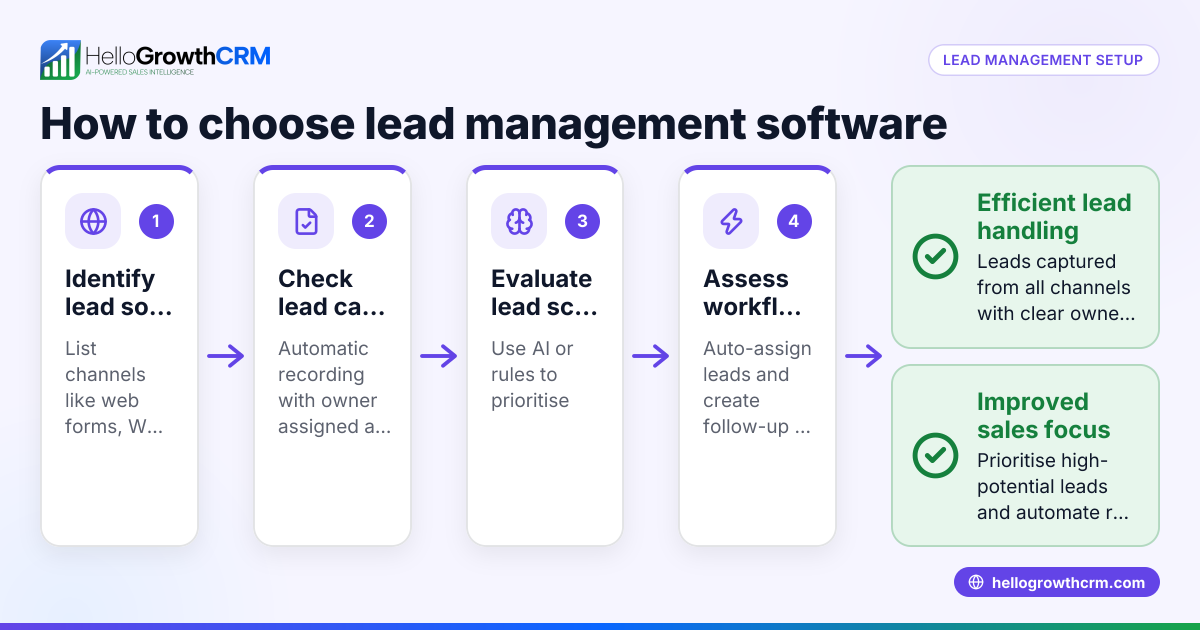
This is where features should be judged very practically. You need lead capture, qualification and pipeline entry that turn a scattered stream of inbound enquiries into one controlled queue. You also need messaging history attached to the contact record so the next staff member is not starting blind. If you are reviewing options, look at lead capture and qualification tools and ask whether they fit the channels your Singapore customers already use rather than the channels a foreign template assumes.
Public-sector sellers should add one more test. If GeBIZ matters to your business, the CRM should support disciplined opportunity tracking and task assignment around submission work, approvals and document follow-up even if the source itself sits outside the system.
Booking patterns in Singapore are lumpy, and your calendar needs to reflect that
Scheduling software is easy to underrate until it starts costing you jobs. Singapore has one time zone, which simplifies domestic booking, but demand is uneven. Lunch-hour slots and post-work appointments often move faster than mid-morning. CBD customers and heartland customers do not always want the same visit windows. Public holidays span different communities, and some move from year to year because they follow lunar or Islamic calendars.
A CRM buyer should therefore test booking logic against actual demand patterns. If you run a dental practice in Novena, can you hold back certain slots for higher-value procedures and leave shorter follow-ups elsewhere? If you run field service from Jurong, can you stop the system from offering impossible travel windows across the island? If your customer base includes regional ASEAN contacts, can staff avoid confusion when a Singapore-based meeting involves another offset?
The issue is not whether a calendar exists. The issue is whether booking choices improve conversion instead of creating no-shows and reschedules. A useful test is to map one week of real appointments into the trial account and see whether the tool helps or forces workarounds. For businesses that want a shorter path from enquiry to confirmed conversation, scheduling and booking tools are worth testing with your actual service windows, staff availability and holiday exclusions.
English is the working language, but customer-facing copy may need more than one version
Many Singapore teams operate internally in English while speaking to customers in Mandarin or Malay depending on segment. That affects CRM buying in two ways. First, your templates and follow-up messages need to be editable enough for channel-specific, audience-specific wording. Second, the record should show what was sent and in which language so the next person does not reply in a mismatched tone.
This matters more than it sounds. A tuition centre may run English administration but find that some parents respond faster to Mandarin reminders. A heartland service business may get better response rates to short, plain WhatsApp messages than to formal email. A B2B team may keep everything in English but still need local phrasing that does not read like imported sales copy.
When you test a CRM, look beyond campaign screens. Check whether staff can use shared inboxes, message templates and task histories without losing context. If your team relies on email plus mobile messaging, review shared inbox and outreach workflows together with WhatsApp and SMS messaging. The question is not volume. It is whether one customer conversation stays coherent across channels.
Corppass, ACRA and sector rules belong in your buying checklist
Singapore businesses live alongside formal processes: ACRA records, Corppass access to government services, SingPass for individuals, and sector-specific regulators. Your CRM does not replace those systems, but it should fit around them cleanly. That means your buying review should include permissions, auditability and the ability to document approvals or handoffs when a deal, booking or customer request depends on outside validation.
For regulated sectors, this is especially important. An aesthetic clinic or dental practice may need stricter control over who sends what to patients and how promotions are framed. A telecoms or media-related seller may need to pay attention to IMDA rules in its own area. A financial firm may have MAS obligations that affect communications and record-keeping. The CRM does not answer the law for you, but weak access control and poor activity history can make internal governance harder.
Use one shortlist review with legal and operations in the room. Ask only the points that change your decision:
- Can we see who contacted the customer, through which channel, and what was said?
- Can we restrict fields or workflows that our team should not use casually?
- Can we keep unnecessary identifiers, especially NRIC, out of standard forms?
- Can managers review open deals, pending approvals and overdue follow-ups without asking staff for spreadsheet updates?
- Will the system still make sense when one staff member leaves and another takes over the record?
If the answer to those questions is shaky, the product is a poor fit no matter how polished the demo looks.
The cheapest CRM becomes expensive when your team tracks the same job twice
Price matters, but in Singapore the hidden cost usually appears as duplicate work. One team keeps leads in a messaging app, another keeps appointments in a calendar, finance checks bank transfers separately, and sales maintains a private spreadsheet “just in case.” The monthly subscription may look modest while the operating drag is large.
The arithmetic below is illustrative; the figures are made up to show the shape of the decision. Imagine a Jurong air-conditioning firm with three office staff and four technicians. The business is considering a cheaper CRM at S$49 a month versus a stronger option at S$189 a month. On paper, the gap is S$140. But the office team currently spends about fifteen minutes per job confirming payments from PayNow or bank transfer, moving booking details into a second system, and chasing technicians for visit notes. If the firm handles one hundred and twenty jobs in a month, that is thirty hours of admin. Even if you value that time conservatively at S$18 an hour, the monthly operating cost of the workaround is S$540. In that light, the lower subscription is not the lower cost.
That calculation leaves out implementation time, training, tax treatment, failed follow-up, and the value of faster response to new leads. It also leaves out the fact that GST treatment, invoicing obligations and any registration issues must be checked against current IRAS guidance and your own professional advice. Still, it shows the right buying logic: compare subscription cost against the labour created by the gaps.
A short note on HelloGrowthCRM for Singapore teams
If you are assessing HelloGrowthCRM, focus on the parts that map to the Singapore issues above rather than treating it as an all-purpose promise. The platform offers lead capture and qualification, pipeline tracking, task and activity history, WhatsApp and SMS workflows, scheduling, quotes and invoices tied to deals, and payment reconciliation tied to invoices received. For a buyer dealing with mixed lead sources and mixed payment rails, that combination is relevant because it can reduce the number of handoffs between tools. You can review the core CRM and pipeline functions at the CRM product page, and teams that want to trial basic usage can start with the free CRM plan.
The right CRM for Singapore is the one that fits your consent process, your payment reality and your staff handoffs on an ordinary Tuesday, not the one with the loudest demo.
Ready to put this into practice?
Set up your pipeline, WhatsApp follow-ups, and AI lead scoring in minutes — free, no credit card.
Try HelloGrowthCRM freeGet CRM tips in your inbox
Join thousands of sales professionals who get weekly insights on CRM strategy, AI automation, and pipeline optimization.

The HelloGrowthCRM team publishes guides on CRM strategy, AI sales tools, and revenue operations for small business sales teams.