HelloGrowthCRM software
Built for real small-business sales teams
HelloGrowthCRM helps reps qualify faster, follow up on time, and close more deals—with practical automation in one place.
- AI lead scoring and pipeline visibility
- Built-in dialer, WhatsApp, and email automation
- Sales forecasting and RevOps-ready reporting
A CRM for packaging suppliers helps your sales team capture every RFQ, track plant buyer follow-ups, log distributor calls, and forecast revenue with less guesswork. In the United States, the best setup is one that fits long B2B sales cycles, repeat orders, multiple contacts per account, and the handoff between quoting, operations, and finance.
Key takeaways
- Packaging suppliers need a CRM that handles RFQs, sample requests, quote revisions, and repeat business in one place.
- US B2B sales teams often manage plant buyers, procurement contacts, distributors, and internal estimators on the same deal.
- A good CRM improves follow-up speed, quote visibility, and pipeline accuracy across territories and product lines.
- Automation matters when reps juggle email, phone calls, reminders, and handoffs to estimating or customer service.
- Forecasting works better when stages reflect real packaging sales steps, not generic software sales stages.
- An AI CRM can help teams prioritize the right opportunities and reduce manual data entry.
Why CRM for packaging suppliers matters
If you sell cartons, flexible packaging, labels, corrugated products, protective packaging, or custom printed materials, your sales process is rarely simple. A new opportunity may start with an RFQ from a plant in Chicago, a call from a distributor in Houston, or an inbound website form asking for pricing and lead times.
From there, the work branches quickly. A rep may need to confirm specifications, request volumes, coordinate with estimating, send samples, chase artwork details, and follow up with a plant buyer who has gone quiet for two weeks. At the same time, the same account may have open repeat orders, another division requesting a quote, and a distributor asking about inventory or freight timing.
That is why generic contact management is not enough. A strong CRM for packaging suppliers should help your team answer practical questions fast:
- Which RFQs are waiting on specs?
- Which buyer needs a follow-up this week?
- Which distributor calls turned into active quotes?
- Which deals are likely to close this month?
- Which accounts are growing, shrinking, or going dormant?
Without a clear system, reps keep information in inboxes, spreadsheets, notebooks, and memory. Managers then struggle to trust the pipeline. Forecast meetings become debates instead of decisions. Follow-ups slip. Quote turnaround slows down. Revenue becomes harder to predict.
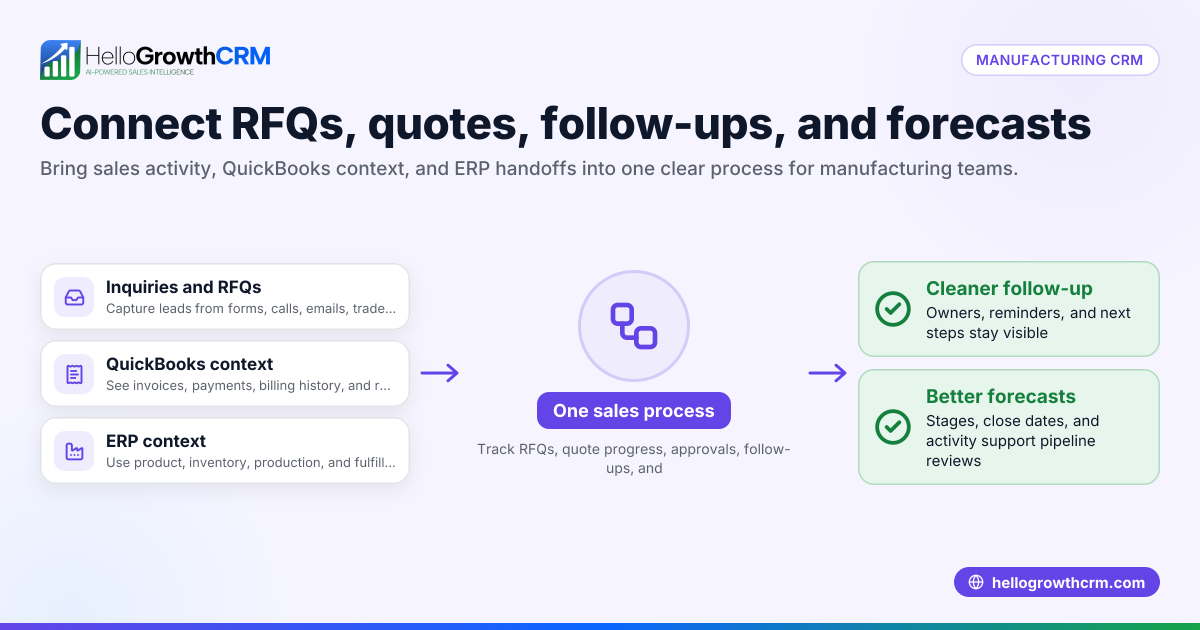
For US packaging suppliers, this problem gets worse when sales teams cover several states, manage both direct and channel sales, and coordinate with finance tools like QuickBooks or payment systems like Stripe for deposits or billing workflows. A CRM creates one operating view across the customer lifecycle.
What should a CRM for packaging suppliers track?
It should track RFQs, contacts, calls, quote status, sample activity, next steps, and expected revenue in one record. The best setup also shows account history across plants, divisions, and distributors so reps do not miss context.
At a minimum, packaging suppliers should structure their CRM around the real workflow of a quote-driven sales team. That means more than names and email addresses.
RFQs and quote details
RFQs sit at the center of many packaging sales motions. Your CRM should capture:
- Product type
- Material requirements
- Dimensions and specifications
- Annual or monthly estimated volume
- Target price
- Submission deadline
- Plant location
- Incumbent supplier if known
- Whether samples are required
- Whether artwork or compliance details are pending
This gives reps and managers a shared view of what is needed to move the opportunity forward.
Multiple contacts on one account
A packaging deal often includes several people. You may need to work with:
- A plant buyer
- A procurement manager
- An operations contact
- A quality contact
- A marketing contact for printed packaging
- A distributor sales rep
- An internal estimator or account manager
Your CRM should connect all of them to one account and one opportunity. That helps avoid the common problem where one rep logs a distributor call, while another misses a buyer email from the same account.
Activities and follow-ups
Calls, emails, tasks, meetings, and sample shipments need to live in the same timeline. This is where many teams fail. If activity logging is hard, reps skip it.
A practical CRM for packaging suppliers should make it easy to:
- Log distributor calls
- Track buyer follow-ups
- Set reminders
- Record objections
- Save quote revisions
- Note competitive pressure
- Flag urgent deadlines
That activity history becomes valuable when accounts go quiet, staff changes happen, or another rep has to step in.
How do packaging suppliers track RFQs without losing deals?
Use a CRM pipeline built around RFQ stages, not generic lead stages. Every quote should have an owner, next step, deadline, and estimated value so your team can see what is active, what is stuck, and what needs follow-up now.
Once that short answer is true, execution gets easier. The problem is not usually a lack of work. It is a lack of visibility.
Build stages around your actual sales cycle
Many packaging suppliers try to force their process into standard stages like lead, qualified, proposal, closed won. That can be too broad. A better pipeline often looks more like this:
- New inquiry
- RFQ received
- Specs pending
- Estimating in progress
- Quote sent
- Sample requested
- Buyer review
- Negotiation
- Awarded
- Lost or no decision
These stages make the pipeline more useful because they reflect real blockers. If twenty deals sit in "quote sent," you still do not know what to do next. But if eight are waiting on specs and six are in buyer review, your team can act.
Add required fields for cleaner data
To make RFQ tracking reliable, require a few fields before a deal can move forward:
- Product category
- Volume estimate
- Quote due date
- Next follow-up date
- Decision maker
- Plant or facility location
- Revenue estimate in USD ($)
This keeps reporting clean without making reps fill out long forms.
Use automation to reduce manual chasing
Sales teams should not waste time building reminder lists by hand. A CRM with workflow automation can trigger tasks when:
- An RFQ has no follow-up scheduled
- A quote has been sent but no reply arrives after a set number of days
- A sample request is logged
- A distributor has not been contacted recently
- A close date has passed
This is one reason many teams look for email automation inside the CRM rather than using disconnected tools.
How can a CRM improve plant buyer and distributor follow-ups?
A CRM improves follow-ups by giving reps one place to see the last contact, the next action, and the full account history. That makes outreach faster, more relevant, and less dependent on memory or scattered inboxes.
In packaging sales, the follow-up itself is often where deals are won or lost. Buyers are busy. Distributors manage many lines. Internal approvals take time. If your team waits too long, the opportunity cools off.
Make next steps mandatory
After every call or email, the rep should leave one clear next step. For example:
- Call buyer on 10/14/2026 after testing
- Send updated quote with freight estimate
- Confirm annual volume with distributor
- Follow up on sample review next Tuesday
- Ask plant team about line compatibility
The CRM should surface these tasks on a daily work list. That keeps follow-up discipline high.
Segment outreach by account type
Plant buyers and distributors often need different communication patterns.
For direct plant accounts, reps may need to focus on technical details, timelines, and production fit. For distributors, reps may need more frequent touchpoints about availability, pricing updates, territory activity, and open opportunities.
A good CRM lets you filter by:
- Direct vs distributor account
- Territory
- Product line
- Last contact date
- Stage
- Rep owner
This is useful for managers reviewing call coverage across a region.
Keep call notes short and useful
Long notes often become unreadable. Train reps to log three things after each interaction:
- What changed
- What matters
- What happens next
That gives the next person enough context to act quickly.
A practical pipeline for US packaging suppliers
A packaging supplier pipeline should match the operational reality of quoting and repeat business. If you sell into manufacturing, food, industrial, or retail supply chains, your CRM must account for both new quotes and ongoing account expansion.
Separate new business from repeat business
This is a key setup choice. New business opportunities often involve a full RFQ and evaluation process. Repeat business may be more about volume changes, pricing discussions, service issues, or additional SKUs.
Create separate pipelines or deal types for:
- New account opportunities
- New product line opportunities within existing accounts
- Repeat business expansion
- Distributor-driven opportunities
This prevents forecasts from blending very different revenue motions.
Track account hierarchy
Many US B2B suppliers sell to accounts with multiple plants, warehouses, or divisions. If one manufacturer has locations in Detroit and Houston, those sites may buy differently, use different contacts, and run separate timelines.
Your CRM should let you see:
- Parent company
- Individual plant or branch
- Active contacts by location
- Open opportunities by site
- Revenue history by site
This is especially important when your sales team works with operations or ERP systems in manufacturing environments.
Use tags carefully
Tags can help, but too many create clutter. Use a small set of meaningful tags, such as:
- Food packaging
- Industrial packaging
- Labeling
- Corrugated
- Flexible packaging
- Distributor
- Multi-plant account
- High priority renewal
Simple structure beats endless customization.
Where does ai crm actually help packaging sales teams?
An ai crm helps packaging sales teams spot hot RFQs, identify stalled deals, and reduce manual admin. It can highlight likely winners, suggest follow-ups, and keep pipeline data cleaner so managers can trust the forecast.
That short answer matters because packaging sales teams usually do not need flashy AI. They need useful help inside daily workflows.
Better prioritization
Not every RFQ deserves the same attention. Some have real volume, a real buyer, and a realistic timeline. Others are shopping exercises with weak fit.
Tools like AI lead scoring can help rank opportunities based on activity, completeness, account fit, and past deal patterns. That helps reps focus on deals with the strongest chance of closing.
Less data entry
A practical AI CRM should reduce repetitive work by helping summarize activity, log communication, and flag missing fields. Reps spend more time selling when they do not have to update everything manually after each interaction.
Stronger manager visibility
AI can also help identify risk patterns in the pipeline, such as:
- Large deals with no recent activity
- Quotes sitting too long without response
- Forecasts built on weak close dates
- Accounts with sudden drop-offs in engagement
Used well, this improves coaching and forecast reviews without creating extra reporting work.
Forecasting for packaging suppliers in the United States
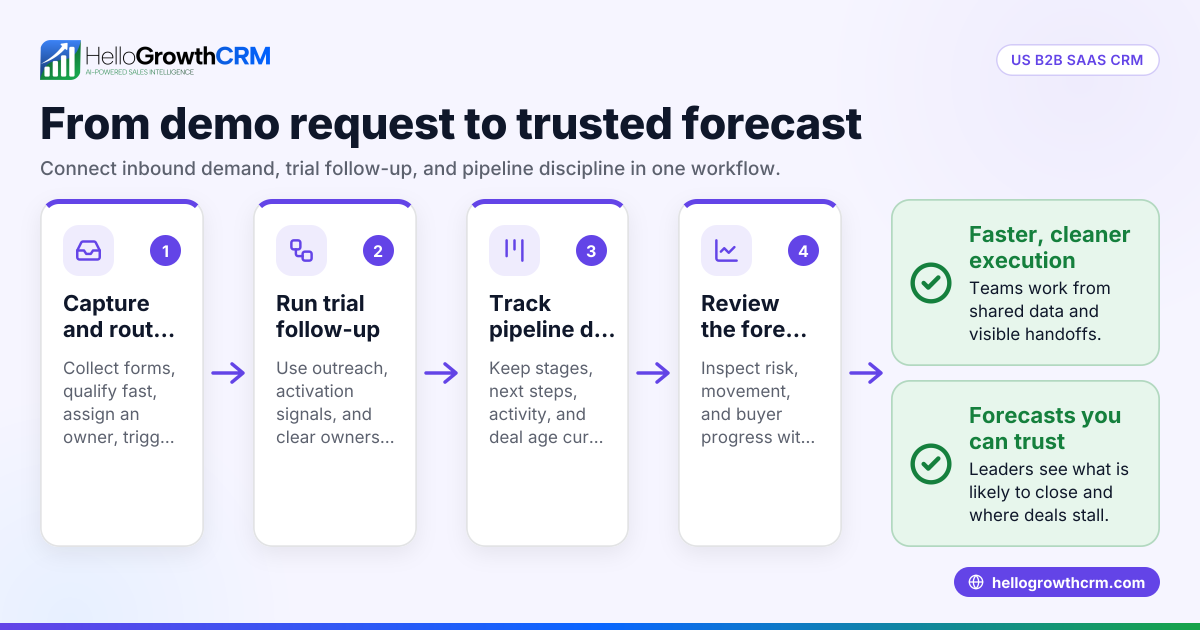
Forecasting matters because packaging businesses often deal with uneven order timing, custom quotes, plant-level buying decisions, and channel complexity. A CRM should make revenue forecasting less emotional and more evidence-based.
Base forecasts on stages and behavior
A simple weighted forecast works better when stages reflect reality. For example, "RFQ received" should not carry the same confidence as "buyer requested final pricing after sample approval."
Forecast quality improves when the CRM considers:
- Current stage
- Days in stage
- Recent activity
- Contact engagement
- Quote value
- Close date realism
- Historical outcomes by deal type
This is where sales forecasting tools can help sales leaders see likely outcomes by month, rep, territory, or product line.
Forecast by segment, not only total pipeline
A single top-line number hides risk. Packaging suppliers should forecast by segments such as:
- Direct sales
- Distributor-driven deals
- New business
- Existing account expansion
- Product line
- Territory
That helps leaders make better decisions about hiring, inventory planning, and production capacity.
Review forecasts weekly
A monthly forecast review is often too slow for active teams. Weekly pipeline reviews help managers catch stale deals, challenge unrealistic close dates, and support reps on blocked opportunities.
Keep the meeting focused on three questions:
- What changed since last week?
- What is at risk?
- What needs action now?
What features matter most in a CRM for packaging suppliers?
The best features are the ones your team will actually use every day. Fancy dashboards do not matter if reps avoid the system.
Core features to prioritize
Look for these basics first:
- Lead and RFQ capture
- Account and contact management
- Call, email, and task tracking
- Custom pipeline stages
- Quote and opportunity tracking
- Follow-up reminders
- Reporting and forecasting
- Mobile-friendly access
- Role-based visibility
You can review broad features if you are comparing systems.
Integration needs
Most packaging suppliers do not need dozens of integrations on day one. But they do need a few important connections to reduce duplicate work. Common priorities include:
- QuickBooks
- Stripe
- Email and calendar
- Calling tools
- Website forms
- ERP or operational systems where relevant
A clean set of integrations matters more than a long list no one uses.
Adoption matters more than customization
The best CRM is not the one with the most options. It is the one your sales team updates consistently. Keep the setup simple. Train reps on a few required habits. Review activity weekly. Improve the process after adoption starts.
If your team needs help defining stages, fields, reporting, and process ownership, managed RevOps can be useful.
How to choose the right CRM for packaging suppliers
Choosing a CRM is less about software alone and more about fit. Your process should shape the system, not the other way around.
1. Map your actual sales process
Before evaluating tools, document:
- How RFQs enter the business
- Who qualifies them
- How estimating gets involved
- When samples are sent
- How follow-ups happen
- What defines a real close date
- How repeat business is tracked
This will clarify what you really need.
2. Identify the must-have reports
For most packaging suppliers, useful reports include:
- Open RFQs by stage
- Quotes by rep
- Follow-ups due this week
- Distributor activity by territory
- Forecast by month
- Lost deals by reason
- Revenue by account and product type
If a CRM cannot make these easy, keep looking.
3. Test with real scenarios
Ask whether the system can handle these situations:
- One parent account with multiple plants
- One quote with several buyer contacts
- A distributor connected to multiple opportunities
- Quote revisions over time
- Repeat orders separate from net-new business
Real workflow testing is more useful than generic demos.
4. Plan rollout and accountability
Even a good CRM fails without ownership. Assign responsibility for:
- Data standards
- Pipeline definitions
- Reporting
- User training
- Weekly review cadence
This is where smaller B2B teams often benefit from a clear implementation partner or a simple platform designed for adoption. You can review options and setup fit on the pricing page if you are comparing approaches.
Ready to put this into practice?
Set up your pipeline, WhatsApp follow-ups, and AI lead scoring in minutes — free, no credit card.
Try HelloGrowthCRM freeGet CRM tips in your inbox
Join thousands of sales professionals who get weekly insights on CRM strategy, AI automation, and pipeline optimization.

The HelloGrowthCRM team publishes guides on CRM strategy, AI sales tools, and revenue operations for small business sales teams.