HelloGrowthCRM software
Built for real small-business sales teams
HelloGrowthCRM helps reps qualify faster, follow up on time, and close more deals—with practical automation in one place.
- AI lead scoring and pipeline visibility
- Built-in dialer, WhatsApp, and email automation
- Sales forecasting and RevOps-ready reporting
A CRM for UAE free zone B2B sales teams should do three things well. It should capture leads from your website, WhatsApp, and calls in one place, help your team follow up fast, and support PDPL-safe working practices. If your sales team works across Dubai, Abu Dhabi, or Sharjah, the right setup reduces missed leads and makes reporting far easier.
Key takeaways
- UAE free zone sales teams need one workflow for website, WhatsApp, and calling leads.
- Fast lead routing matters, especially when prospects expect quick replies on WhatsApp.
- PDPL-safe follow-ups start with clear data handling, access controls, and clean consent records.
- Bilingual sales teams need a CRM that supports both Arabic and English communication.
- An ai crm can help prioritise leads, automate routine tasks, and improve pipeline visibility.
- Managed setup and process design often matter more than software features alone.
Why UAE free zone B2B sales teams need a different CRM setup
A free zone B2B sales team often handles leads from several channels at once. A prospect may fill in a website form in the morning, send a WhatsApp message after lunch, and ask for a callback later that day. If those touchpoints stay in separate tools, your team loses context.
That problem grows when your team works across different offices or legal entities. A company based in a Dubai free zone may sell to clients in Abu Dhabi and Sharjah while using separate teams for inbound sales, account management, and operations. Without a shared CRM process, follow-ups become inconsistent.
The stakes are also higher in the UAE because communication habits are fast. Many buyers expect short response times and often prefer WhatsApp for early conversations. They may also switch between Arabic and English. Your CRM should support that reality rather than force your team into slow manual admin.
Free zone businesses also need to stay careful about data handling. Depending on your business setup, you may need to consider the UAE Federal PDPL and, where relevant, rules in free-zone frameworks such as DIFC or ADGM. A CRM cannot solve legal compliance on its own, but it should make safer working practices easier.
What should a CRM for UAE free zone B2B sales teams actually do?
It should centralise lead capture, track every conversation, assign ownership fast, and give managers a clear view of pipeline health. It should also support clean records, role-based access, and documented follow-up activity.
In practice, that means your CRM should help your team:
- Capture website leads automatically.
- Log WhatsApp conversations against the right contact.
- Record calls, notes, outcomes, and next steps.
- Route leads to the right salesperson based on territory, product, or company type.
- Trigger follow-up reminders and sequences.
- Keep one timeline for every account and contact.
- Report on source quality, response times, and conversion rates.
If your team is still copying data from forms into spreadsheets, the process will break under pressure. A proper AI CRM should reduce manual entry and make sales activity easier to manage every day.
Website leads: capture the details once
Website leads often enter with useful buying signals. A form can include company name, role, service interest, team size, and preferred contact method. But if your team receives those details by email and then manually re-enters them, speed drops.
A better approach is to send website enquiries straight into the CRM. The lead should be assigned automatically, matched against existing records where possible, and logged with source details. That gives your team immediate context before the first response.
This matters for B2B teams in free zones because lead ownership can get messy. If your business has different sales reps for mainland clients, free zone clients, or enterprise deals, routing rules need to be clear from day one.
WhatsApp leads: the channel many teams treat informally
In many UAE B2B teams, WhatsApp starts as an easy communication tool but turns into a reporting problem. Sales reps answer from personal devices, messages stay outside the CRM, and managers cannot see what happened.
That creates three issues. First, your team can miss handovers when a salesperson is on leave. Second, managers lose visibility into response quality and deal progress. Third, your data handling becomes harder to manage consistently.
A CRM should bring WhatsApp activity into the same lead record as forms, emails, and calls. This helps teams keep full conversation history and respond in a more organised way. It also supports better sales continuity when multiple people work on the same account.
Calling leads: every call should create a useful record
Phone calls still matter in B2B sales, especially for qualification, demos, and deal progression. But too many teams only log calls when a manager asks for updates. That means key details get lost.
Your CRM should make call logging simple. Reps should be able to save outcomes, add short notes, set a next action, and update the pipeline in seconds. When this process is easy, adoption improves.
For sales leaders, this also improves forecasting. You can see which deals are active, which have stalled, and which reps are following up consistently.
How do you keep follow-ups PDPL-safe?
Use your CRM to collect only needed data, control who can access it, and keep a clear record of consent, source, and follow-up activity. Set simple rules for storage, visibility, and retention. Train your team to use one approved process for WhatsApp, website forms, and calls.
A PDPL-safe approach begins with process, not just software. Your team should know what data they collect, why they collect it, and who can see it. That matters whether a lead comes from a website form, a WhatsApp enquiry, or a call.
Here are the basics your CRM process should support:
- Clear source tracking
Every record should show how the lead entered your system. This helps your team understand context and supports cleaner internal review. - Controlled access
Not every user needs access to every record. Sales reps may need their own deals, while managers need broader views. Role-based access helps reduce unnecessary exposure. - Consent and communication history
If a prospect agrees to be contacted, your team should log that clearly. The same applies to opt-outs or channel preferences. - One customer record
Duplicate records cause confusion. They also increase the chance that different team members contact the same person in conflicting ways. - Approved communication workflows
If reps use informal workarounds, your process becomes hard to manage. A proper CRM setup should guide them into one standard workflow. - Data review and cleanup
Outdated records create risk and clutter. Your team should review old leads regularly and decide what should stay active.
For free zone companies, governance matters even more when teams are distributed across entities, products, or regions. A CRM should help your internal discipline, not weaken it.
Which lead source should your team prioritise first?
Prioritise the source with the best mix of lead quality, response speed, and conversion rate. For many UAE B2B teams, that means measuring website forms, WhatsApp enquiries, and inbound calls together, then routing the highest-intent leads first.
Most teams guess. They assume website forms are more serious, or that WhatsApp leads close faster. Sometimes they are right. Often they are not. The only useful answer comes from consistent CRM tracking.
Start by defining what success means for each source. A good framework includes:
- Number of leads created
- First response time
- Qualification rate
- Demo booking rate
- Opportunity creation rate
- Closed-won rate
- Average sales cycle length
Once those metrics sit in one CRM, patterns become easier to spot. You may find that website leads have more complete information but slower response times. You may find that WhatsApp leads need faster handling but convert well when replied to within minutes. You may find that calls produce fewer leads but higher-value opportunities.
This is where AI lead scoring can help. Instead of treating every lead equally, your team can prioritise based on behaviour, source, company profile, and engagement. That improves focus without adding manual admin.
A simple lead routing model for free zone sales teams
A practical routing model keeps work moving and avoids internal confusion. You do not need something complicated at first.
Try this structure:
- Website forms go to the assigned inbound owner or territory queue.
- WhatsApp enquiries go to the first available trained responder during working hours.
- Inbound calls create a lead record immediately with a clear outcome.
- High-fit accounts get priority assignment to senior sales reps.
- Unqualified leads go into a nurture workflow rather than staying idle.
If your company serves different sectors in the UAE, you can also route by industry. For example, one team may handle construction suppliers in Sharjah while another handles professional services firms in Dubai.
Building one workflow for website, WhatsApp, and calling leads
Most CRM problems are workflow problems. The software may be fine, but your team does not have one agreed process from first touch to closed deal. That creates gaps.
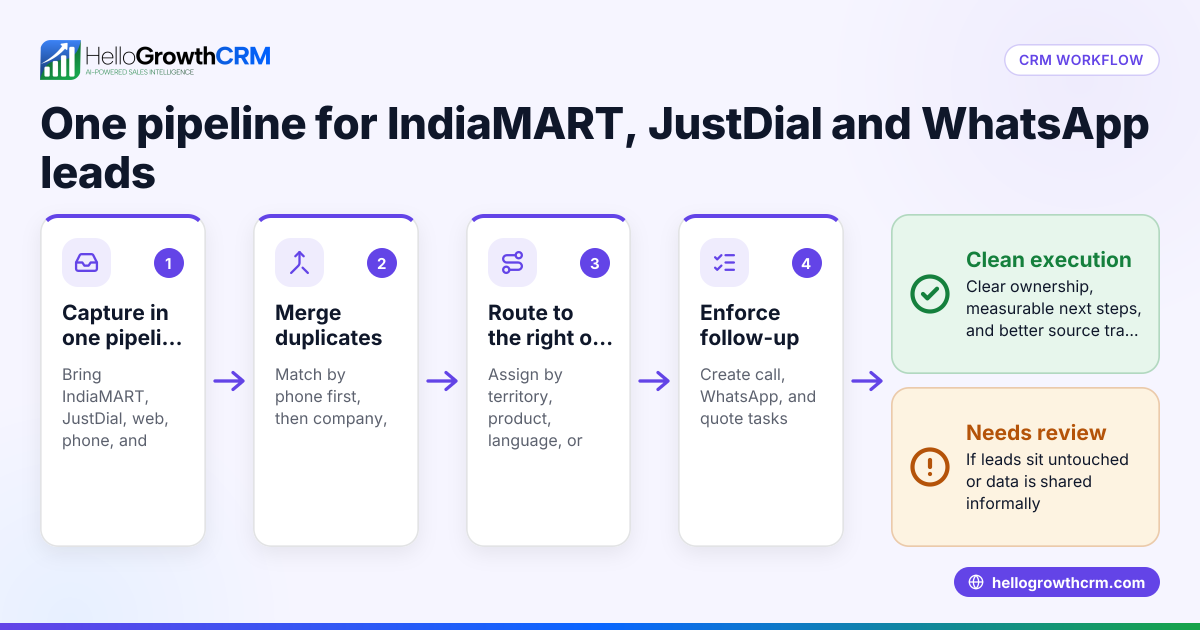
A strong workflow for UAE free zone B2B sales teams usually looks like this:
1. Capture every lead in one place
Website forms, WhatsApp enquiries, and call outcomes should all create or update CRM records. Sales reps should not need separate spreadsheets or personal notes.
This step sounds basic, but it changes everything. Once all channels feed the same system, managers can finally trust the pipeline.
2. Deduplicate and enrich records
If the same prospect contacts you twice, your CRM should link those interactions where possible. It should also let your team add useful context such as company size, service interest, free zone, and language preference.
This is especially useful for bilingual teams. A record that shows preferred language helps reps follow up more naturally.
3. Assign the right owner quickly
Leads need clear ownership. If your routing takes hours, response times suffer. Set rules based on product line, location, account type, or team availability.
For many growing businesses, this is where managed support helps. Process design, rules, and reporting setup often need as much care as the platform itself. That is why some teams use managed RevOps to build cleaner handoffs and better reporting.
4. Trigger the first follow-up automatically
The first reply matters. A CRM should help your team send a fast, relevant response without relying on memory. You might use templated acknowledgements, task reminders, or structured outreach.
The key is speed with context. A prospect who filled in a form asking about implementation should not get a generic message.
5. Keep the pipeline updated through every touchpoint
Every meeting, call, WhatsApp exchange, and proposal should move the record forward. If pipeline stages are not updated, forecasting becomes guesswork.
This is also where automation helps. With email automation, sales teams can reduce repetitive follow-ups while keeping records current.
What features matter most for a free zone B2B sales team?
Prioritise lead capture, channel visibility, fast assignment, clear activity history, and simple reporting. If your team cannot see every interaction in one timeline, it will struggle to follow up well and forecast accurately.
Once the basics are covered, look for features that improve day-to-day use:
Unified contact and account history
Your team needs one place to review forms, calls, notes, WhatsApp conversations, tasks, and deal stage changes. This saves time before meetings and reduces poor handovers.
Smart reminders and task management
Sales reps miss follow-ups when next steps live in their heads or inboxes. A CRM should create visible tasks tied to deals and contacts.
Practical reporting
Managers should be able to answer simple questions quickly:
- How many inbound leads arrived this week?
- Which source produces qualified opportunities?
- Which reps respond fastest?
- Where are deals stalling?
- What is expected to close this month?
For this, clean pipeline setup matters. A CRM with sales forecasting tools can help leaders see likely outcomes earlier.
Integrations that reduce rework
Your CRM should connect with the tools your team already relies on. The point is not to add complexity. It is to remove duplicate entry and broken handovers. Useful integrations support cleaner operations across marketing, sales, and customer-facing teams.
Adoption-first design
The best CRM is the one your team uses daily. If reps avoid it, no feature list will save the project. Choose a setup that makes logging activity and moving deals easy.
You can review broader platform features later, but day-one usability should come first.
Common mistakes UAE free zone sales teams make
Even strong sales teams can outgrow their process. Here are the common errors:
Treating WhatsApp as separate from the CRM
This is one of the biggest visibility gaps. If important conversations stay outside your system, pipeline quality drops.
Routing leads too slowly
A lead that waits too long often goes cold. Fast assignment rules matter more than long process documents.
Letting duplicates pile up
Duplicate contacts create poor customer experience. They also distort reporting and lead scoring.
Using too many pipeline stages
Keep stages simple and meaningful. If reps do not understand the difference between stages, updates become inconsistent.
Ignoring bilingual communication needs
A sales process that works only in English can slow down conversations. Capture language preferences early and make them visible.
Focusing on software before process
A CRM project fails when there is no agreement on ownership, qualification, stage definitions, and follow-up rules.
A practical rollout plan for your team
If your team wants to improve fast, use this rollout plan:
- Map your current lead sources
List every place leads come from. Include website forms, WhatsApp, calls, referrals, and direct outreach. - Define one lead record structure
Decide which fields matter most. Keep it practical. Include source, owner, company, contact details, service interest, and next step. - Set routing rules
Decide who handles each lead type and how quickly. - Create follow-up standards
Define what happens in the first hour, first day, and first week. - Train the team on one workflow
Keep training short and role-based. Show reps exactly how to update records and log activity. - Review reports weekly
Track response times, source quality, and stage movement. Fix process issues early. - Refine after real usage
Your first workflow will not be perfect. Adjust fields, automations, and stages based on real behaviour.
If you are comparing systems, start with the operational fit, then review pricing. A cheaper CRM that your team ignores will cost more in lost opportunities.
Start a free trial to see how HelloGrowthCRM can help your UAE free zone sales team manage website, WhatsApp, and calling leads in one place, or book a demo if you want a walkthrough of the right setup for your sales process.
Ready to put this into practice?
Set up your pipeline, WhatsApp follow-ups, and AI lead scoring in minutes — free, no credit card.
Try HelloGrowthCRM freeGet CRM tips in your inbox
Join thousands of sales professionals who get weekly insights on CRM strategy, AI automation, and pipeline optimization.

The HelloGrowthCRM team publishes guides on CRM strategy, AI sales tools, and revenue operations for small business sales teams.