HelloGrowthCRM software
Built for real small-business sales teams
HelloGrowthCRM helps reps qualify faster, follow up on time, and close more deals—with practical automation in one place.
- AI lead scoring and pipeline visibility
- Built-in dialer, WhatsApp, and email automation
- Sales forecasting and RevOps-ready reporting
A CRM for capital equipment sales helps U.S. manufacturers, distributors, and field sales teams track long, complex deals from first demo request to signed purchase order. The right system keeps distributor follow-ups, plant visits, technical reviews, quotes, and forecasts in one place so reps do not lose momentum on six-figure and seven-figure opportunities.
Key takeaways
- Capital equipment sales cycles are long, multi-step, and easy to lose control of without a structured CRM.
- The best CRM setup tracks direct buyers, distributors, plant visits, quotes, and post-demo follow-ups in one workflow.
- U.S. sales teams need clean forecasting, territory visibility, and solid communication records across email, phone, and field activity.
- A good ai crm can help prioritize serious buyers, reduce admin work, and improve rep follow-through.
- CRM success depends on simple pipeline stages, required next steps, and strong reporting that sales leaders actually trust.
Why capital equipment sales teams need a different kind of CRM
Selling capital equipment is not like selling a simple monthly subscription. Deals are larger. Buying groups are bigger. Sales cycles are longer. The process usually includes technical validation, budget checks, site visits, distributor coordination, and internal approvals.
A rep might start with a form fill from a plant manager in Houston. Then the opportunity expands to include a maintenance lead, an operations director, a procurement contact, and a local distributor. After that, the team schedules a demo, visits the plant, sends a revised quote, answers implementation questions, and waits on capital budget timing. That is too much to manage in spreadsheets.
A CRM for capital equipment sales should do four things well:
- Capture every inquiry fast.
- Keep every next step visible.
- Show the true status of each deal.
- Give leaders a realistic forecast.
Without that structure, teams miss easy wins. Demo requests sit in inboxes. Distributor follow-ups happen late. Plant visit notes stay in a rep’s phone. Forecast calls become guesswork. The result is slower sales and less confidence in the pipeline.
What should a CRM for capital equipment sales track?
It should track the full buying journey, not just the quote.
That means your CRM should store the account, contacts, product interest, estimated deal value, location, distributor involvement, plant visit activity, quote history, expected close timing, and the next action. It should also track whether the buyer is replacing an old machine, expanding capacity, or opening a new line. Those details shape urgency and close probability.
For U.S. B2B teams, the most useful records usually include:
- Demo requests from the website
- Calls and emails with plant or procurement contacts
- Distributor or dealer involvement
- Plant visit dates and field notes
- Equipment configuration details
- Quote and revision history
- Expected installation timing
- Financing or payment discussion notes
- Competitive replacement information
- Forecast category and close confidence
This matters because capital equipment deals rarely move in a straight line. A buyer may look active because they asked for pricing. In reality, the deal may be blocked until the next budget cycle or plant shutdown window. Your CRM should capture that context clearly.
Demo requests are only the start
Many teams overvalue inbound demo requests and undervalue follow-up discipline. A buyer who requests a demo is interested, but not necessarily qualified. They may be researching next year’s purchase. They may not control budget. They may need a distributor involved before the deal can move.
Your CRM should capture the request immediately and route it to the right owner. Then it should require the next step, such as a qualification call, distributor handoff, or site assessment. If a demo happens without a defined follow-up plan, the opportunity often stalls.
Distributor follow-ups need structure
Many capital equipment companies sell through a mix of direct reps and distributors. That creates confusion fast when no one knows who owns the next action.
A good CRM should show:
- Whether the deal is direct or distributor-led
- Which distributor is involved
- What the distributor promised to do
- When the last update happened
- Whether the manufacturer rep needs to step in
This prevents a common problem in capital equipment sales: the opportunity looks alive because someone touched it two weeks ago, but there is no confirmed next step. CRM rules should make that visible.
How do you track plant visits in a CRM?
Use the CRM to log the visit date, attendees, site findings, equipment needs, risks, and the exact next step before the rep leaves the facility.
Plant visits are often the turning point in a capital equipment deal. They reveal fit, urgency, layout issues, utilities, safety constraints, and buyer seriousness. But if those notes stay buried in a notebook or phone, the sales team loses valuable context.
Create a standard plant visit record in your CRM. Keep it simple enough that reps will actually complete it. A useful template often includes:
- Facility location
- Line or process reviewed
- Current equipment in use
- Main pain point observed
- Decision-makers present
- Timeline discussed
- Technical risks or constraints
- Follow-up owner
- Next scheduled action
For example, a rep visiting a food processing plant outside Chicago may learn that the prospect needs new packaging equipment, but only after a planned line reconfiguration in Q1. That timing matters. So does the note that engineering wants one more throughput test before approving the purchase. Those details belong in the opportunity record, not in private notes.
Standardize field notes
Field sales teams often resist CRM updates because they feel slow. The solution is not more fields. The solution is better fields.
Use dropdowns where possible. Make only a few fields required. Focus on information that changes deal quality or forecast accuracy. For plant visits, require:
- Visit outcome
- Buyer urgency
- Estimated project timing
- Next step
- Next step date
That gives sales leaders enough to coach and forecast without forcing reps into long admin sessions after every visit.
What pipeline stages work best for capital equipment deals?
Use stages that match real buying steps, like qualified inquiry, discovery, demo or assessment, quote, technical review, commercial review, and close.
Most CRM pipelines fail because they are too generic. “Contacted,” “proposal sent,” and “negotiation” are not enough for capital equipment sales. They hide what is actually happening.
A stronger pipeline reflects the real path to purchase. A practical example looks like this:
- New inquiry
- Qualified opportunity
- Discovery completed
- Demo or plant assessment completed
- Solution scoped
- Quote sent
- Technical review
- Commercial review
- Verbal agreement
- Closed won or closed lost
Each stage should have a clear entry rule. That matters more than the stage name. “Quote sent” should not mean a rough price was mentioned on a call. It should mean a formal quote was delivered and the next review date is known.
Tie every stage to one clear exit condition
A clean pipeline gives everyone the same definition of progress. That improves forecast quality and makes deal reviews faster.
For example:
- Discovery completed: pain, use case, timeline, and buying contacts confirmed
- Demo or plant assessment completed: buyer attended and next evaluation step agreed
- Quote sent: formal pricing delivered and follow-up date scheduled
- Technical review: engineering or operations review underway
- Commercial review: budget, terms, or procurement discussion active
When stages are defined this way, leaders can spot weak deals earlier. Reps can also see what they must do next to move an opportunity forward.
Use AI to score and prioritize serious buyers
Not every inbound lead deserves the same rep time. That is especially true when you sell high-value equipment with limited field coverage. AI can help rank opportunities by likely fit and urgency.
An AI lead scoring setup can combine signals such as industry, product interest, form details, response speed, meeting activity, and account engagement. It does not replace rep judgment. It helps reps focus first on the opportunities most likely to turn into real pipeline.
This is where an AI CRM becomes useful for capital equipment teams. It can surface leads that match your best buyer profile, remind reps about stalled follow-ups, and reduce manual admin after calls and visits. For a small U.S. sales team, that can mean better coverage without hiring extra coordinators.
AI should support process, not hide it
AI works best when your sales process is already clear. If your pipeline stages are vague, your data is inconsistent, and your reps do not log next steps, AI will not fix the problem. It may simply make the mess harder to trust.
Start with clean process rules first:
- Every opportunity has an owner
- Every active deal has a next step
- Every next step has a date
- Every forecasted deal has a defined close reason
Then add AI to improve prioritization, reminders, and reporting.
How should you forecast capital equipment revenue?
Forecast by deal stage, buyer commitment, project timing, and known blockers, not by rep optimism alone.
Capital equipment forecasts break when teams confuse activity with probability. A plant visit is good. A demo is good. A quote is good. None of those automatically means the deal will close this quarter.
A better forecasting model uses several factors together:
1. Stage-based probability
Start with stage probability, but do not stop there. A deal in technical review should carry more weight than one still in discovery. Still, stage alone can mislead if buyers are waiting on budget approval or construction timing.
2. Buyer-confirmed timing
Reps should record the buyer’s stated purchase window, installation target, and budget cycle. If a Detroit manufacturer plans to decide in November but install in February, your forecast should reflect the decision timing, not just rep hope.
3. Verified next step
A forecasted deal should have a specific next meeting, review, or approval event on the calendar. If there is no next event, the close date is weak.
4. Deal blockers
Track common blockers in structured fields. Examples include budget not approved, engineering review pending, distributor quote delay, plant expansion timing, and procurement review. These blockers help managers pressure-test close dates.
5. Rep confidence plus manager judgment
Rep input matters. So does manager review. Forecasts improve when leaders look at actual deal evidence, not just a weighted number.
A strong sales forecasting system helps teams see commit, upside, and risk clearly. That matters when one delayed equipment order can shift a whole month or quarter.
Build workflows for demo requests and distributor handoffs
Many capital equipment teams lose speed between first inquiry and first real conversation. That gap is expensive. Buyers often contact multiple vendors. Slow follow-up reduces your odds before discovery even starts.
A simple workflow can fix this.
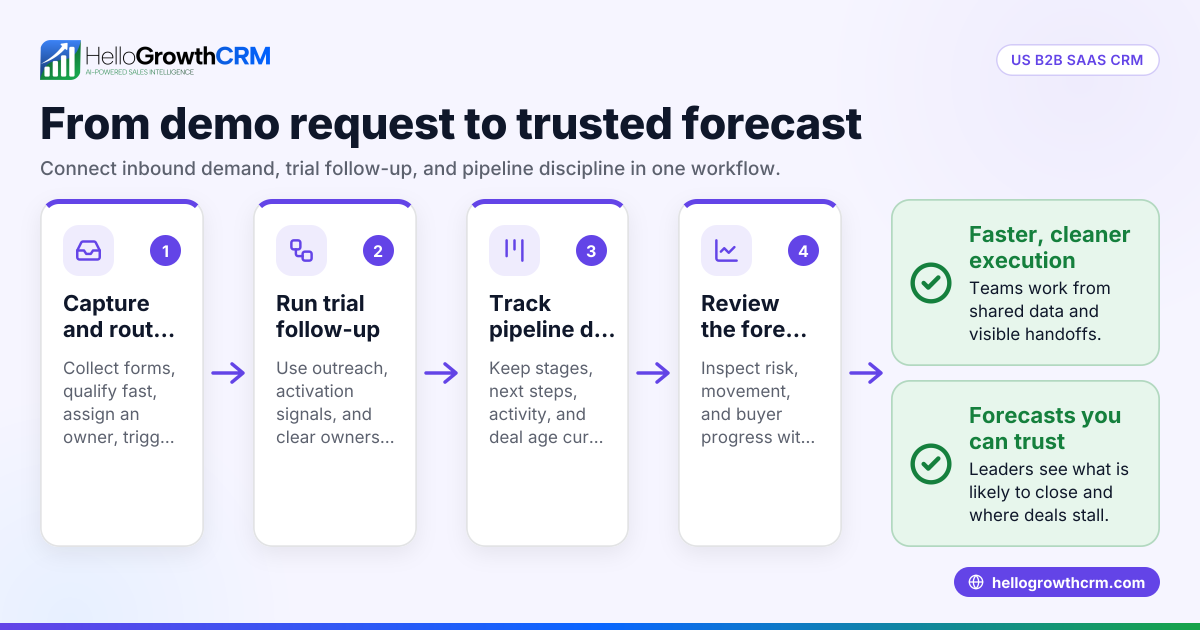
Demo request workflow
- Capture the website form into the CRM instantly.
- Assign the lead based on territory, product line, or account type.
- Send an immediate confirmation email.
- Create a task for qualification within one business day.
- If the lead fits a distributor model, trigger handoff steps.
- If there is no response, schedule follow-up across email and phone.
With email automation, teams can send fast confirmations and reminders without making the process feel robotic. The key is still human follow-up. Automation should support speed, not replace conversation.
Distributor handoff workflow
If distributors are part of your go-to-market model, define the handoff rules clearly:
- When the distributor becomes the owner
- When the manufacturer rep stays involved
- What updates are required
- When a stale distributor-led deal gets escalated
This is where CRM discipline directly improves revenue. If no one owns the handoff, no one owns the delay.
Reporting that sales leaders actually need
Capital equipment leaders do not need more dashboards. They need a few reports that help them make better decisions.
Start with these:
Inquiry-to-opportunity conversion
How many demo requests or inbound leads become real opportunities? Break this down by product line, territory, and source.
Time-to-first-follow-up
How fast does a rep or distributor respond after an inquiry? This is one of the easiest process improvements to make.
Plant visits completed
How many site visits happened this month? How many turned into scoped opportunities or quotes?
Quote-to-close rate
How often do formal quotes become won deals? If the number is low, you may have a qualification problem, pricing issue, or weak follow-up process.
Forecast coverage and slippage
Do you have enough pipeline to hit target? How often do forecasted deals slip into the next month or quarter?
These reports matter because they connect activity to outcomes. They also help identify where RevOps should focus. If your team is drowning in manual cleanup, managed RevOps support can help standardize process and reporting without forcing sales leaders to build everything themselves.
Choose a CRM your reps will actually use
The best CRM for capital equipment sales is not the one with the longest feature list. It is the one your reps, managers, and operations team can use consistently.
Look for these qualities:
- Fast lead capture
- Easy mobile updates after calls and plant visits
- Clear pipeline stages
- Strong task and follow-up management
- Email and phone activity tracking
- Useful forecasting
- Flexible fields for equipment and project details
- Solid integrations with tools your team already uses
If finance and operations rely on QuickBooks, Stripe, or an ERP, your CRM should fit the process instead of creating more duplicate data entry. If buyers expect SOC 2 maturity from vendors, your internal systems should support organized, auditable customer records. If your team uses outbound email and calling, your process should also respect rules like CAN-SPAM and TCPA where they apply.
You can review HelloGrowthCRM features to see how this kind of workflow can be handled in one system. The main point is simpler: your CRM should match how capital equipment deals are really sold in the United States.
A practical rollout plan for U.S. capital equipment teams
Do not try to rebuild your whole sales process in one week. Start with the basics that create visibility and accountability.
Phase 1: Fix lead capture and pipeline basics
Set up:
- One pipeline for capital equipment opportunities
- Clear stage definitions
- Lead routing rules
- Required next step and next step date
- Basic reporting for follow-up speed and stage movement
Phase 2: Add field sales structure
Next, standardize:
- Plant visit notes
- Demo outcomes
- Distributor handoff rules
- Quote tracking
- Forecast categories
Phase 3: Improve prioritization and forecasting
Then add:
- Lead scoring
- Automation for reminders and follow-ups
- Better forecast review rules
- Manager dashboards
- Lost deal reasons
This phased approach works because it helps the team form habits before adding complexity.
If you want to compare setup options, review HelloGrowthCRM pricing and decide what level of support your team needs.
Ready to put this into practice?
Set up your pipeline, WhatsApp follow-ups, and AI lead scoring in minutes — free, no credit card.
Try HelloGrowthCRM freeGet CRM tips in your inbox
Join thousands of sales professionals who get weekly insights on CRM strategy, AI automation, and pipeline optimization.

The HelloGrowthCRM team publishes guides on CRM strategy, AI sales tools, and revenue operations for small business sales teams.