HelloGrowthCRM software
Built for real small-business sales teams
HelloGrowthCRM helps reps qualify faster, follow up on time, and close more deals—with practical automation in one place.
- AI lead scoring and pipeline visibility
- Built-in dialer, WhatsApp, and email automation
- Sales forecasting and RevOps-ready reporting
A CRM for construction suppliers helps you capture general contractor inquiries, manage quote follow-ups, log contractor calls, and forecast future revenue from open jobs. For US B2B suppliers, the best setup is simple: one system for leads, quotes, contacts, tasks, and reporting so outside sales reps, estimators, and managers all work from the same pipeline.
Key takeaways
- A good CRM for construction suppliers should track GCs, subcontractors, builders, jobs, quotes, and follow-up dates in one place.
- The most useful workflows are lead capture, quote reminders, call logging, pipeline stages, and forecast reporting by rep, branch, or product line.
- Construction sales cycles are long and messy, so your CRM must handle repeat bids, stalled jobs, and relationship-driven follow-up.
- Mobile access matters because reps often work from job sites, trucks, warehouses, and branch offices.
- Forecasts get better when every quote is tied to a real project, expected close date, and dollar value in USD ($).
- An AI CRM can reduce admin work and help teams keep up with busy bid pipelines.
Why construction suppliers in the United States need a different kind of CRM
Construction suppliers sell in a way that looks simple from the outside but gets complicated fast. One rep may talk to a GC in Chicago, a project manager in Houston, and a purchasing contact at a subcontractor on the same day. Each conversation can relate to a different job, quote, delivery timeline, and margin target.
That is why spreadsheets break down.
A generic CRM can also fall short. Construction suppliers do not just manage leads. They manage relationships tied to active jobs, branch territories, quote deadlines, and repeat buyers. They need to know who requested pricing, who approved the submittal, who took the contractor call, and whether the opportunity is still real.
For most suppliers, the sales process includes:
- A GC, builder, or subcontractor sends an inquiry.
- The supplier qualifies the request.
- A rep or estimator creates a quote.
- The team follows up by email or phone.
- The customer asks for revisions, alternates, or delivery details.
- The job moves forward, stalls, or disappears.
- Management tries to forecast what will close this month or quarter.
Without a clean system, people rely on memory. That causes missed follow-ups, duplicate quotes, and weak forecasting. It also creates risk when a top rep leaves and account history disappears with them.
A CRM gives your team one source of truth. It shows every account, contact, quote, task, and call record in one place. It also gives leaders a better view of pipeline health across territories and product categories.
What should a CRM for construction suppliers track?
It should track the account, the people involved, the project, the quote, and the next action. If your CRM cannot connect those five pieces clearly, your team will work around it.
Here are the core records a construction supplier should manage.
Accounts
These are the companies you sell to or influence. That may include:
- General contractors
- Subcontractors
- Builders
- Developers
- Facility owners
- Architects or engineers when they influence the buy
Each account should include branch location, territory owner, industry segment, and customer status. If you serve different metro areas, that matters for routing and reporting.
Contacts
Most construction deals involve several people. You may need to track:
- Estimators
- Project managers
- Purchasing contacts
- Superintendents
- Owners
- Accounts payable contacts
A useful CRM lets you tie each person to the right account and job. It also keeps a history of emails, phone calls, and notes.
Projects or jobs
This is where many CRMs fail construction teams. Suppliers need a project record for each active or quoted job. That record should include:
- Project name
- Job address
- Bid due date
- Estimated start date
- Stage
- Expected order value
- Competitors
- Linked quotes
- Key stakeholders
This makes the pipeline meaningful. Instead of seeing random deals, managers see actual jobs.
Quotes and follow-ups
A quote is not the end of the process. It is the start of a follow-up sequence. Your CRM should track quote amount, sent date, version, and next follow-up date.
That is how you avoid the common problem where quotes go out and no one follows up for two weeks.
Activities
A rep may call from the road, send pricing by email, or stop by a job trailer. All of that should be logged quickly. Good activity tracking makes account handoffs easier and gives managers a real picture of coverage.
How do you track GC inquiries without losing good jobs?
Capture every inquiry into one pipeline, assign an owner fast, and require a next step on each record. If a GC request sits in someone’s inbox, it is not being managed.
The first problem for many suppliers is not closing. It is intake.
GC inquiries come from everywhere. Some arrive through the website. Some come by email. Some come from a branch phone line. Some come from long-time relationships where the rep gets a text and forgets to log it later. That creates blind spots from the first touch.
A better process is to route all inbound inquiries into one system. The lead should create a record with the company name, contact, project, requested materials or scope, and due date. Then it should be assigned to the right salesperson, estimator, or branch.
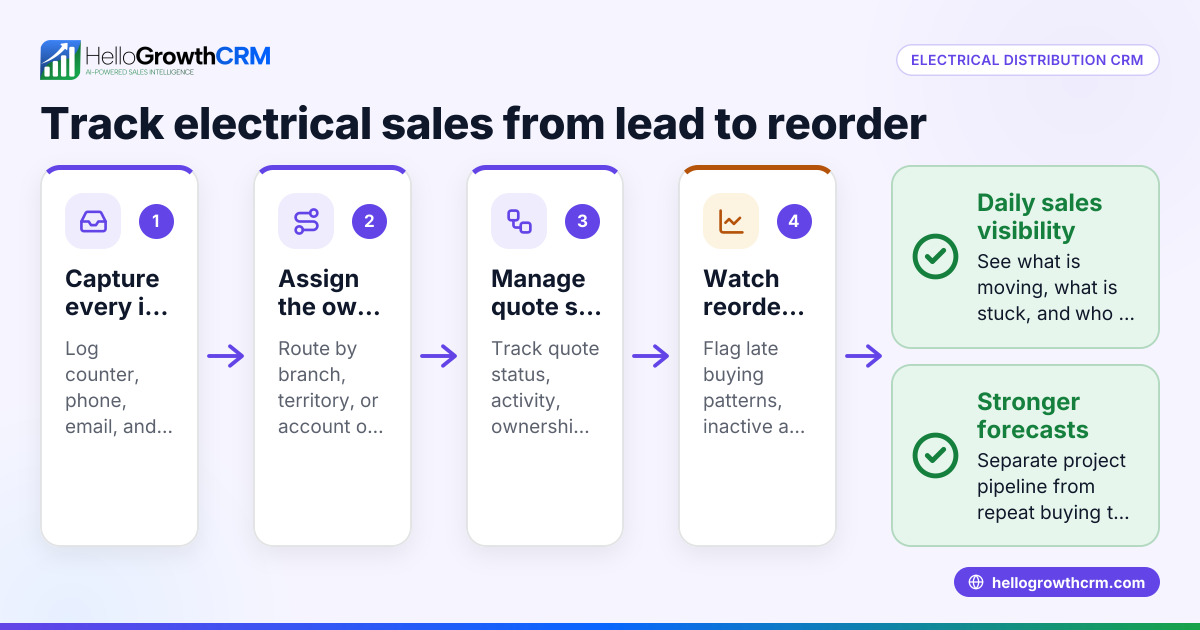
A strong intake workflow usually includes these steps:
- Capture the inquiry from forms, email, or manual entry.
- Tag the source, territory, and product line.
- Assign the record to the right owner.
- Set a target response time.
- Create the first follow-up task automatically.
- Move the lead into a qualified project or quote stage.
This is where automation helps. If your team handles a high volume of requests, AI lead scoring can help surface the most promising inbound opportunities based on fit and behavior. That does not replace rep judgment. It helps your team prioritize.
Construction suppliers also need clear qualification rules. Not every inquiry should become a full opportunity. A rep should know:
- Is this a real project?
- Is there a defined timeline?
- Are we quoting the right scope?
- Is the buyer in our territory?
- Do we want this business?
When those answers live in the CRM, your pipeline gets cleaner and your forecast gets more honest.
How should quote follow-ups work?
Set automatic reminders after every quote, assign clear owners, and use a simple cadence of calls and emails. Most quotes do not die because of price alone. They die because no one follows up well.
Quote follow-up is where revenue slips through the cracks.
In many supply businesses, estimators send pricing and move on to the next urgent request. Reps assume someone else is handling the follow-up. Managers only find out a quote went cold after the job is awarded.
A better workflow ties every quote to a project and next action.
Build a consistent follow-up cadence
You do not need a complex sequence. You need a reliable one. For example:
- Send the quote.
- Create a follow-up task for 2 business days later.
- Call to confirm receipt and answer questions.
- Send a short follow-up email.
- Set another task based on project timing.
- Update the deal stage after each touch.
That structure matters because construction buying cycles vary. Some jobs move in days. Others sit for months. Your CRM should support both without forcing reps into busywork.
For teams that send a lot of quote follow-ups, email automation can help standardize reminders while still allowing reps to personalize the message. The goal is not to spam contractors. The goal is to keep real deals moving.
Track quote versions clearly
Construction quotes often change. Quantities shift. Alternates are added. Specs change. Delivery assumptions move. If your team cannot see the latest version, confusion follows.
Your CRM should show:
- Original quote date
- Most recent revision date
- Current amount
- Status
- Linked contacts
- Notes on scope changes
This keeps the account team aligned and gives managers better visibility into what is still active.
Logging contractor calls and field activity
Contractor calls are often the most valuable signals in the sales process. A short phone conversation can reveal whether the job is funded, whether the buyer is shopping your number, or whether the project just got delayed by 60 days.
If those details live only in a rep’s notebook, the business loses visibility.
That is why mobile-friendly activity logging matters. Reps should be able to log a call in under a minute. They should be able to update the project stage, add notes, and set the next task before they drive to the next stop.
For construction suppliers, the most useful activity fields usually include:
- Call type
- Contact reached
- Project discussed
- Outcome
- Next action
- Follow-up date
This does not need to be complicated. It needs to be adopted.
If your team uses phone, email, and branch-based outreach, a CRM with calling and communication tracking can help keep the customer history complete. Before you commit, review the available features and make sure activity tracking is practical for field reps, not just inside sales.
Keep outreach compliant and organized
Construction sales is relationship-driven, but outreach still needs discipline. For email marketing and promotional outreach in the United States, teams should understand CAN-SPAM requirements. For phone and text outreach, TCPA considerations can matter depending on how your team communicates.
A CRM does not replace legal advice. It does help you keep cleaner records, manage opt-outs, and centralize communication history.
Building a pipeline your team will actually use
Many CRM projects fail because the stages look good to management but make no sense to reps. In construction supply, pipeline stages should match the real selling process.
A practical pipeline might include:
- New inquiry
- Qualified
- Quoting
- Quote sent
- Follow-up active
- Budgetary hold
- Verbal commit
- Won
- Lost
That is enough detail for reporting without making updates painful.
Keep required fields tight
If you ask for 20 fields on every update, reps will stop using the system. Start with the fields that directly affect action and forecasting:
- Account
- Main contact
- Project name
- Stage
- Quote amount
- Expected close date
- Next step
- Owner
You can always add detail later.
Separate customer records from project records
A contractor may have 15 active jobs with you at once. If your CRM treats the customer as one flat deal, reporting becomes useless. The account is the relationship. The job is the opportunity.
This is one of the biggest design choices for a CRM for construction suppliers. Get it right and your pipeline becomes clear. Get it wrong and managers cannot trust the numbers.
What makes pipeline forecasts accurate for construction suppliers?
Forecasts get accurate when every open job has a realistic amount, stage, and close date. If reps do not update those three fields, the forecast is just optimism in a spreadsheet.
Forecasting in construction supply is hard because jobs move. Bid dates slip. Funding changes. Scope changes. Buyers disappear and return later. But a CRM still helps if the process is grounded in reality.
Use weighted stages
Not every open quote has the same chance to close. A project in early quoting should not count the same as one with a verbal commitment. Stage weighting can help management estimate likely revenue more conservatively.
That said, weights only work if stages are used consistently. If reps leave everything in “quote sent,” the model breaks.
Forecast by rep, branch, and product line
Leaders usually need more than one view. They may want to see:
- This month’s expected bookings
- Next quarter by branch
- Pipeline by outside rep
- Open quote value by product category
- Win rates by market
That level of reporting is difficult in spreadsheets. It is much easier when the underlying records are clean and structured. A tool with sales forecasting can make this easier for sales leaders who need visibility without chasing updates from every rep every Friday.
Review forecasts weekly
Forecasting is not just a dashboard. It is a management rhythm. Hold a short weekly pipeline review and ask:
- What changed since last week?
- Which quotes need action?
- Which jobs slipped?
- Which deals are most likely to close this month?
- What support does each rep need?
This keeps the CRM alive and helps managers coach the team.
Implementation tips for US construction suppliers
The best CRM rollout is not the one with the most customization. It is the one your team adopts in the first 30 days.
Start with one branch or one sales team
If you have multiple branches or territories, do not force a company-wide rollout on day one. Start with one group. Tighten the stages, fields, and workflows. Then expand.
Import only the data you trust
Old contact lists are usually messy. Before migration, clean basic fields like account names, contacts, phone numbers, and owners. Do not load years of duplicates into a new system.
Connect the tools you already use
Most suppliers already rely on tools like QuickBooks, Stripe, and ERP systems for finance or operations. A CRM should fit that stack where useful. Review available integrations before rollout so sales data does not get trapped in one system.
Consider support, not just software
Many growing teams do not have a full in-house RevOps function. They need help designing fields, stages, reports, and handoff rules. In that case, software alone may not solve the problem. A service like managed RevOps can help teams set up the process behind the CRM.
Choosing the right ai crm for your sales team
A good ai crm should reduce admin work, not create more of it. For construction suppliers, that means easier lead capture, cleaner follow-ups, and faster visibility into what is likely to close.
When evaluating options, ask practical questions:
- Can reps log activity quickly from the field?
- Can the system track accounts and projects separately?
- Can it support quote follow-up tasks automatically?
- Can managers forecast by rep and branch?
- Is setup simple enough for a small team?
- Will the team actually use it after month one?
These questions matter more than flashy features.
You should also think about buyer expectations. More B2B customers now expect organized communication, fast responses, and professional handoffs. In larger deals, operational maturity matters. Some buyers may also ask about security practices, and SOC 2 readiness can become part of vendor trust.
The right system helps you look organized internally and externally.
If you are comparing tools, check the pricing only after you confirm the workflow fits your business. A cheaper CRM that your team ignores is expensive in the long run.
Ready to put this into practice?
Set up your pipeline, WhatsApp follow-ups, and AI lead scoring in minutes — free, no credit card.
Try HelloGrowthCRM freeGet CRM tips in your inbox
Join thousands of sales professionals who get weekly insights on CRM strategy, AI automation, and pipeline optimization.

The HelloGrowthCRM team publishes guides on CRM strategy, AI sales tools, and revenue operations for small business sales teams.