HelloGrowthCRM software
Built for real small-business sales teams
HelloGrowthCRM helps reps qualify faster, follow up on time, and close more deals—with practical automation in one place.
- AI lead scoring and pipeline visibility
- Built-in dialer, WhatsApp, and email automation
- Sales forecasting and RevOps-ready reporting
A CRM pipeline inspection framework is a repeatable method B2B sales teams use inside their CRM to review deal quality, verify next-step evidence, flag stalled opportunities, and improve forecast accuracy by checking every open deal against clear qualification, activity, timing, risk, and ownership criteria.
Key Takeaways
- A strong CRM pipeline inspection framework checks evidence, not rep opinion.
- The best inspection cadence blends weekly manager reviews with live CRM automation.
- Forecast slippage usually starts with weak qualification, vague next steps, or stale close dates.
- HelloGrowthCRM helps enforce inspection rules with AI Pipeline Management, AI Deal Insights, and Sales Forecasting.
- Good pipeline inspection should reduce admin burden, not create more spreadsheet work.
- Managed process design matters when teams want consistent execution across managers and regions.
Why B2B sales teams need a CRM pipeline inspection framework
A CRM pipeline inspection framework helps B2B sales teams find bad deals, stale opportunities, and weak forecasts before they hurt revenue because it turns pipeline review from a subjective conversation into a consistent operating system based on evidence, stage exit criteria, deal risk signals, and inspection cadence.
Many teams say they inspect pipeline. Few do it in a way that changes forecast outcomes.
In practice, most pipeline reviews fail for three reasons:
- Managers review too many deals with no standard checklist
- Reps update CRM after the meeting, not before it
- Forecast calls depend on optimism instead of evidence
When I have audited pipelines like this, I usually find the same pattern. Stage names look clean. Close dates look current. But the underlying deal records are missing buying committee detail, next meeting dates, mutual action plans, or proof of budget authority. That is where forecast slippage starts.
A useful framework fixes this by defining what must be true for a deal to remain in stage, remain in forecast, or move out of commit.
According to Gartner’s CRM topic overview, CRM effectiveness depends on adoption and process discipline, not just software selection. That matches what we see in real rollouts. The CRM is rarely the problem by itself. The operating model around it is.
What forecast slippage usually looks like in the CRM
Forecast slippage is not only “deal pushed to next quarter.” It often appears earlier as:
- Stage age increasing beyond norm
- No executive contact logged
- No meeting scheduled in the next 14 days
- Close date changed multiple times
- Opportunity amount rising without new evidence
- Late-stage deal lacking confirmed business case or procurement path
These are trackable in a modern AI CRM. The point is to catch them early enough to coach, requalify, or remove the deal.
What a good CRM pipeline inspection framework includes
A good CRM pipeline inspection framework includes standardized stage definitions, inspection criteria by deal stage, risk scoring rules, review cadence, owner accountability, and CRM automation that flags missing evidence or stalled movement so managers can coach the right deals instead of debating incomplete records.
Think of the framework as five layers working together.
1. Stage entry and exit criteria
Each pipeline stage needs objective conditions. Not opinions.
Examples:
- Discovery complete only when pain, current process, and business impact are logged
- Qualified only when MEDDPICC elements are partially confirmed
- Proposal only when commercial scope and decision process are documented
- Commit only when next step, buying group alignment, and target decision date are confirmed
If your team uses HelloGrowthCRM, these criteria can be enforced through required fields, guided workflows, and Sales Task Boards.
2. Deal inspection criteria
Every open deal should be checked against core questions:
- Is there a real problem worth solving now?
- Is the economic buyer known?
- Is there a documented next meeting?
- Has the rep mapped the buying committee?
- Is the close date supported by a buyer action plan?
- Has legal, security, or procurement risk been discussed?
This is where AI Deal Insights helps. It surfaces missing signals without forcing managers to read every note manually.
3. Risk thresholds
You need red, yellow, and green logic for deals.
Common rules include:
- Red if no activity in 14 days
- Yellow if stage age exceeds benchmark by 25%
- Red if close date changed twice in 30 days
- Yellow if no decision maker contact exists
- Red if next step field is blank or vague
In one rollout we did with a 12-person sales team, simply flagging “late-stage deal with no scheduled next meeting” removed nearly all false commits within two forecast cycles. The biggest win was not more deals. It was cleaner visibility.
4. Inspection cadence
A repeatable cadence matters more than a heroic end-of-quarter cleanup.
Use a layered rhythm:
- Reps self-inspect weekly
- Managers inspect priority deals weekly
- Leadership reviews forecast categories biweekly
- RevOps audits rule adherence monthly
For teams scaling globally, Managed RevOps can help design that operating rhythm and keep managers aligned.
Which deal criteria matter most during pipeline inspection
The deal criteria that matter most during pipeline inspection are qualification quality, buying committee coverage, next-step clarity, stage age, activity recency, close-date integrity, and risk evidence because these factors show whether an opportunity is truly progressing or simply sitting in the CRM with a hopeful amount and date.
Not every field matters equally. Focus on the criteria with the strongest link to forecast confidence.
Qualification quality
Qualification should go beyond “budget, authority, need, timeline.”
For B2B teams, stronger inspection usually means checking for:
- Pain tied to business metrics
- Champion strength
- Economic buyer access
- Decision criteria
- Decision process
- Competition
- Paper process
- Implementation constraints
If your team follows MEDDPICC, inspect the actual evidence behind each element. Do not accept checkbox completion.
Next-step clarity
The best single inspection question is simple: “What is the next customer-accepted action, and when is it happening?”
Weak answers include:
- Follow up next week
- Awaiting response
- Send pricing
- Touching base soon
Strong answers include:
- Security review with IT lead on 14 May
- Pricing review with CFO and procurement on Tuesday
- Mutual action plan approved and shared with buyer group
This is exactly the kind of structure that works well with Meeting Scheduler, Smart Inbox, and Email Automation.
Stage age and movement
Stage age is one of the most useful inspection metrics because it shows whether the deal is advancing at a normal pace for your sales cycle.
According to Harvard Business Review’s sales topic collection, sales performance improves when leaders focus on process quality and coaching, not just outcomes. Stage-age inspection gives managers a concrete coaching lever.
Forecast category confidence
Forecast confidence should not be guessed. It should be earned.
A practical way to inspect forecast categories:
| Forecast Category | Minimum Evidence Required | Common Removal Trigger |
|---|---|---|
| Pipeline | Qualified problem, active contact, next step set | No activity or weak need |
| Best Case | Buying process known, multi-threading started, target date plausible | No decision path |
| Commit | Confirmed next meeting, buyer timeline, commercial alignment, identified risk plan | Close date slips or champion weakens |
| Closed | Signed agreement and confirmed handoff | N/A |
How to run pipeline inspection reviews without creating admin burden
You can run pipeline inspection reviews without adding admin burden by making the CRM the single source of inspection evidence, automating risk flags, limiting live review to exception deals, and requiring reps to update critical fields before meetings instead of discussing incomplete opportunities in real time.
This is where many teams overcomplicate things. They create long review decks. They ask reps for spreadsheet summaries. Then the CRM becomes a record system, not an operating system.
Use pre-meeting inspection rules
Before any manager review, require the CRM to contain:
- Updated amount
- Updated close date
- Next step with date
- Last meaningful customer activity
- Risk note
- Stage justification
In HelloGrowthCRM, teams can use AI Pipeline Management and Sales Forecasting to highlight deals that do not meet review readiness.
Review only exception deals
Managers should not inspect every deal in depth every week. They should focus on exceptions, such as:
- Stage age over threshold
- No future meeting booked
- Large amount increase
- Forecast category change
- No executive contact
- New legal or procurement blocker
This reduces review time and improves coaching quality.
Push routine follow-up into automation
Routine reminders and rep nudges should not depend on memory.
Useful automation rules include:
- Alert rep if no customer activity in seven days
- Alert manager if commit deal has no next meeting
- Auto-create task when close date moves out
- Trigger review if proposal sent but no follow-up logged
- Send Slack notice through the Slack integration for commit-risk deals
When integrated with Gmail, Google Meet, or Microsoft Teams, activity capture becomes much easier. That keeps reps from spending time on duplicate admin.
How to build a CRM pipeline inspection framework: Step-by-Step
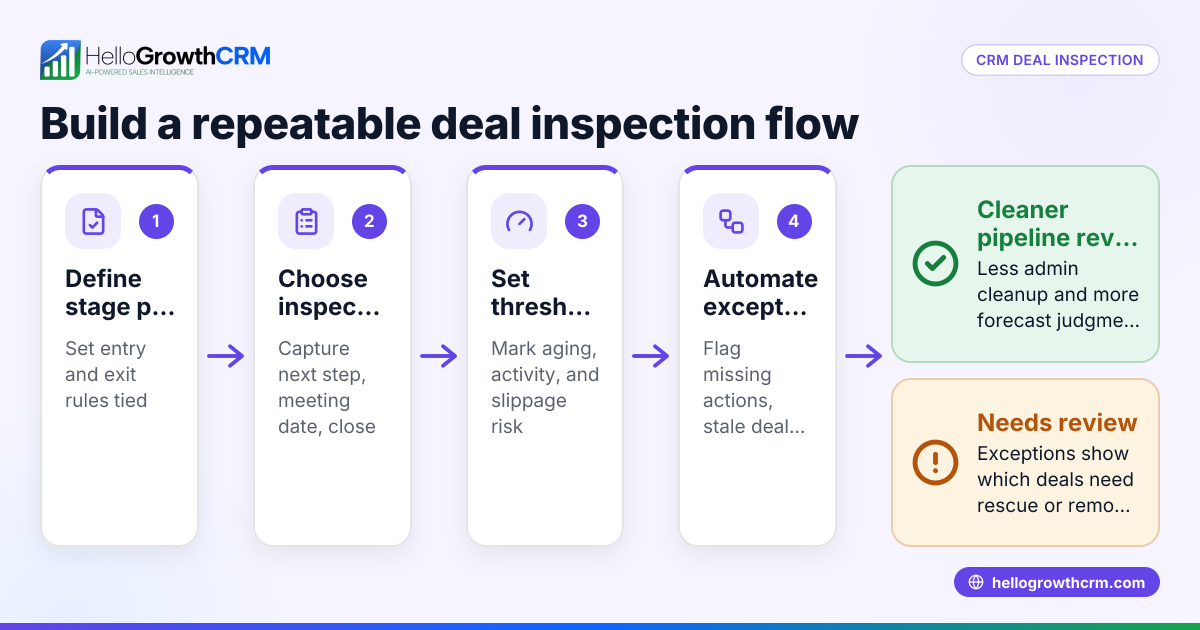
Building a CRM pipeline inspection framework means defining your sales stages, choosing evidence-based inspection criteria, setting risk rules, assigning review cadence, and automating enforcement inside the CRM so managers coach the right deals while reps maintain clean pipeline data with minimal extra effort.
- Define stage outcomes
Write one sentence for what must be true for a deal to enter and exit each stage. Keep it observable and specific. - Choose inspection fields
Pick the few fields that truly affect forecast confidence. Examples include next step date, champion status, decision process, and stage age. - Set risk rules
Create red and yellow triggers for stalling, weak multi-threading, close-date changes, and inactivity. Use these to drive manager attention. - Map forecast categories
Define the evidence required for Pipeline, Best Case, and Commit. Do not let reps choose categories based on gut feel. - Automate data capture
Connect email, calendar, calling, and meeting systems through All Integrations so activity logs update automatically. - Create manager review views
Build filtered views for stalled deals, commit risk, and no-next-step opportunities. This keeps one-on-ones focused and fast. - Train reps on evidence standards
Show examples of strong and weak opportunity records. Reps need clarity on what good looks like. - Audit monthly and refine
Review which rules catch real risk and which create noise. Adjust thresholds as your team and sales cycle evolve.
In one pipeline redesign I led, the breakthrough was not adding more fields. It was deleting nine low-value fields and making four high-value fields mandatory. Adoption improved almost immediately.
Which CRM automations improve pipeline discipline and forecast confidence
The CRM automations that improve pipeline discipline and forecast confidence most are inactivity alerts, required next-step enforcement, close-date change tracking, stage-age monitoring, forecast-category rules, and AI-based risk detection because they turn pipeline hygiene from a manager request into a system-level habit.
The right automation should support reps, not punish them.
High-impact automation rules
Start with these:
- Required next-step text and date before stage advancement
- Auto-flag deals with no logged meeting in 14 days
- Alert when commit deals move close date
- Notify manager when amount changes above a set threshold
- Trigger requalification if a deal sits too long in one stage
- Surface missing stakeholder coverage using AI Lead Scoring and account signals
AI support for inspections
HelloGrowthCRM’s AI Sales Copilot and Deal Risk Agent are especially useful for managers who need faster reviews. They help summarize deal movement, identify weak signals, and point out where rep notes do not support forecast status.
That matters because inspection quality usually breaks when managers have too many deals and too little time.
Where managed RevOps helps most
This framework works well for teams under 50 reps with a relatively consistent sales process. Above that, expect more variation by region, segment, or product line. That is often where Managed RevOps becomes valuable.
A managed RevOps partner can help with:
- Stage design
- Forecast governance
- Dashboard setup
- SLA definitions
- Inspection meeting design
- Manager enablement
How HelloGrowthCRM supports pipeline inspection better than spreadsheet-based reviews
HelloGrowthCRM supports pipeline inspection better than spreadsheet-based reviews by combining live CRM data, activity capture, AI-driven risk signals, workflow automation, and forecast views in one system so sales leaders can inspect real deal evidence instead of chasing updates across spreadsheets, inboxes, and manager notes.
Spreadsheets are familiar, but they fail fast in growing teams.
CRM inspection vs spreadsheet review
| Area | Spreadsheet-Based Review | HelloGrowthCRM Approach |
|---|---|---|
| Data freshness | Manual updates | Live activity sync and CRM records |
| Risk detection | Manager memory | Automated rules and AI alerts |
| Forecast consistency | Subjective | Standardized category criteria |
| Coaching speed | Slow meeting prep | Filtered review views and summaries |
| Rep admin burden | High | Automated capture and guided workflows |
| Scale across teams | Hard | Repeatable process with permissions and workflows |
Because HelloGrowthCRM is our product, that comparison is not neutral. But it is also practical. If your team is evaluating systems, inspect how each one handles stage governance, risk automation, and forecast evidence. Those capabilities matter more than a long feature list. You can review the broader platform on the Features page, compare costs on Pricing, or book a Demo to see a pipeline inspection workflow live.
If you want a repeatable way to spot stalled deals, improve forecast confidence, and enforce sales discipline without adding more admin, HelloGrowthCRM is built for that job. Start with a Free Trial or talk to our team about a tailored Managed RevOps rollout.
About the author
Arjun Mehta is a Revenue Operations Lead at HelloGrowthCRM with 10 years of experience in B2B SaaS sales operations, forecasting, and CRM design. He has led pipeline governance and forecast redesign projects for sales teams ranging from 8 to 120 reps. One project that informed this article was a multi-region pipeline inspection rollout that standardized stage-exit rules, manager reviews, and forecast categories after repeated quarter-end slippage.
Frequently Asked Questions
Q: What is a CRM pipeline inspection framework?
A: A CRM pipeline inspection framework is a structured method for reviewing deal quality, stage accuracy, and forecast risk inside the CRM. It gives managers a repeatable checklist so they can coach based on evidence, not opinion, and catch stalled deals earlier.
Q: How often should B2B sales teams inspect pipeline?
A: B2B sales teams should inspect pipeline weekly at the rep-manager level and biweekly at the leadership forecast level. The exact cadence depends on deal size and sales cycle length, but weekly inspection is the safest default for active pipelines.
Q: What metrics should be included in pipeline inspection?
A: Pipeline inspection should include stage age, next-step date, activity recency, close-date changes, stakeholder coverage, forecast category, and qualification quality. These metrics show whether a deal is moving forward in a real buying process or just staying open in the CRM.
Q: How do you reduce forecast slippage in CRM?
Frequently Asked Questions
Ready to put this into practice?
Set up your pipeline, WhatsApp follow-ups, and AI lead scoring in minutes — free, no credit card.
Try HelloGrowthCRM freeGet CRM tips in your inbox
Join thousands of sales professionals who get weekly insights on CRM strategy, AI automation, and pipeline optimization.

The HelloGrowthCRM team publishes guides on CRM strategy, AI sales tools, and revenue operations for small business sales teams.