HelloGrowthCRM software
Built for real small-business sales teams
HelloGrowthCRM helps reps qualify faster, follow up on time, and close more deals—with practical automation in one place.
- AI lead scoring and pipeline visibility
- Built-in dialer, WhatsApp, and email automation
- Sales forecasting and RevOps-ready reporting
A CRM pipeline inspection checklist is a repeatable audit framework B2B sales teams use to check pipeline hygiene, enforce stage discipline, verify next steps, flag stale deals, and spot forecast risk signals inside the CRM so forecast calls rely on current evidence instead of rep opinion or outdated deal records.
Key Takeaways
- A strong pipeline inspection checklist focuses on data quality, stage accuracy, next-step compliance, deal aging, and forecast risk.
- Forecast accuracy drops when CRM stages do not match buyer reality, not just when reps forget admin.
- Weekly inspections work best when managers review a small set of leading indicators, not dozens of fields.
- AI can reduce manual inspection work by surfacing stale deals, missing follow-ups, and at-risk opportunities automatically.
- HelloGrowthCRM combines AI Pipeline Management, AI Deal Insights, and Managed RevOps to help teams improve forecast confidence without adding admin load.
Why a CRM pipeline inspection checklist matters for forecast accuracy
A CRM pipeline inspection checklist matters for forecast accuracy because forecasts become unreliable when deal stages, close dates, values, and next steps are not updated consistently. The checklist gives sales leaders a standard way to inspect deal quality, remove false pipeline, and base forecast calls on observable buyer movement.
Most forecast misses are not caused by a bad spreadsheet. They come from bad pipeline behavior inside the CRM.
When I have audited pipelines like this, I usually find the same pattern. Reps are active. Meetings are happening. But the CRM tells an incomplete story. Deals stay in the wrong stage. Close dates roll forward every week. “Next step” fields are vague. Managers still forecast from gut feel.
That is risky because forecast confidence depends on pipeline integrity. If stage criteria are loose, every downstream metric gets weaker:
- weighted pipeline
- commit coverage
- stage conversion rates
- sales cycle trends
- manager call accuracy
Gartner’s CRM topic page highlights CRM as a core system for improving commercial execution, but that only works when the underlying pipeline data is trustworthy.
According to Harvard Business Review, high-performing sales organizations use structured process discipline to improve execution quality, not just rep activity volume.
What pipeline inspection should actually answer
A useful inspection should answer a short list of management questions:
- Are deals in the correct stage based on buyer evidence?
- Does every active opportunity have a dated next step?
- Which deals are stale based on inactivity or age in stage?
- Which close dates are likely to slip?
- Which forecast categories are inflated?
- Which reps or segments show repeated hygiene issues?
If your CRM cannot answer those quickly, your forecast is already at risk.
What to include in a CRM pipeline inspection checklist
A CRM pipeline inspection checklist should include the minimum set of controls that reveal whether opportunities are real, current, and forecastable. For most B2B teams, that means stage entry criteria, next-step compliance, stale-deal rules, close-date realism, amount confidence, and risk indicators tied to buyer activity and qualification evidence.
Think of the checklist as a management operating system. It should be short enough to use every week but strict enough to catch weak deals.
1. Stage discipline
Every stage should map to a real buyer milestone. Good examples include:
- discovery completed
- business pain confirmed
- economic buyer identified
- mutual action plan agreed
- security or legal review started
- verbal agreement reached
Bad stage definitions are internal only. “Rep feels good” is not stage evidence.
In one rollout we did with a 12-person sales team, forecast accuracy improved after we rewrote stage criteria around MEDDPICC-style evidence. We removed vague transitions and required specific buyer signals before a deal could move.
If you want to operationalize this, tie stages to Sales Task Boards and required fields inside your CRM.
2. Next-step compliance
An active opportunity should always have:
- one clear next step
- an owner
- a due date
- a customer-facing outcome
“Follow up next week” is not a next step. “Send security questionnaire by Thursday and confirm legal review meeting for Monday” is.
This is where Meeting Scheduler, Email Automation, and Smart Inbox help reduce update gaps.
3. Stale deal detection
Stale deals are opportunities that stay open without meaningful movement. Your checklist should define staleness by:
- no logged activity for X days
- no stage movement for Y days
- repeated close-date pushes
- no confirmed buyer meeting scheduled
- no recent decision-maker engagement
A simple rule works well for small and mid-sized teams. For example, flag any deal with no activity in 14 days or more than 2x normal stage age.
4. Forecast risk signals
Inspect forecast categories using objective evidence, not rep optimism. Look for:
- missing next meeting
- low multi-threading
- no economic buyer access
- low response rates
- overdue mutual action plan tasks
- contract or security blockers
- unusually large amount changes late in cycle
This is exactly where AI Deal Insights and Deal Risk Agent are useful. They surface hidden execution gaps without forcing managers to review every record manually.
The core pipeline inspection checklist B2B sales leaders can use weekly
The core pipeline inspection checklist B2B sales leaders can use weekly is a practical set of review points that checks whether each deal is qualified, current, and forecastable. Used consistently, it helps managers separate real revenue from inflated pipeline and coach reps on execution before quarter-end misses happen.
Use this checklist in weekly pipeline reviews, forecast calls, and one-on-ones.
| Checklist Area | What to Inspect | Good Signal | Risk Signal | Action |
|---|---|---|---|---|
| Stage accuracy | Buyer evidence matches stage | Clear exit and entry criteria met | Stage based on rep opinion | Move deal backward or mark at risk |
| Next step | Dated, specific customer-facing step exists | Meeting or deliverable scheduled | “Follow up” or blank field | Require concrete next action |
| Activity recency | Recent logged activity | Touchpoint within SLA | No activity in 14+ days | Trigger re-engagement or close lost |
| Stage aging | Days in stage within norm | Velocity near historical average | 2x normal stage age | Escalate for review |
| Close date realism | Date matches buying process | Milestones support timeline | Repeated slips without new evidence | Push date or remove from commit |
| Qualification depth | MEDDPICC or equivalent fields complete | Buyer pain, champion, criteria known | Major gaps in authority or timing | Re-qualify |
| Amount confidence | Amount tied to real scope | Proposal or pricing alignment | Late-stage value changes | Review scope and probability |
| Multi-threading | Several stakeholders engaged | Economic and user roles involved | Single-threaded deal | Expand stakeholder map |
| Forecast category | Commit, best case, pipeline reflect evidence | Category matches execution reality | Commit with weak evidence | Reclassify forecast |
| System hygiene | Required fields complete and current | CRM reflects last real interaction | CRM lags email and calls | Automate capture and coach rep |
What good managers do during inspection
Good managers do not inspect everything. They focus on exceptions.
Start with:
- largest deals in commit
- oldest deals by stage
- deals with no next meeting
- deals with repeated close-date changes
- deals with low engagement signals
That approach saves time and improves coaching quality. You can also use Pipeline Health Score and Sales Forecasting to turn inspection into a repeatable weekly view.
Common pipeline hygiene issues that destroy forecast confidence
Common pipeline hygiene issues destroy forecast confidence because they make the CRM look fuller and healthier than the underlying deals really are. The result is false coverage, inflated commit numbers, and last-minute forecast misses that surprise leadership even though the warning signs were already visible in the data.
Here are the failures I see most often.
Stage inflation
This happens when reps move deals forward to reflect effort, not buyer progress. Discovery becomes proposal. Proposal becomes negotiation. But the buyer has not confirmed budget, timeline, or decision process.
Close-date rolling
A deal that slips once may still be healthy. A deal that slips every Friday is not. Repeated rolling often means the rep is preserving pipeline value rather than updating the true buying timeline.
Empty or vague next steps
If a deal has no dated next step, it should not be considered active. If the next step does not involve a customer commitment, it is weak.
Single-threaded opportunities
Many B2B deals stall because one champion goes quiet. If only one contact is engaged, the forecast should reflect that risk.
CRM lag
Reps often work from inboxes, call notes, and chat threads. The CRM gets updated later, or not at all. That gap is why connected systems matter. HelloGrowthCRM links Gmail, Slack, Google Meet, and Microsoft Teams so pipeline reviews rely on fresher signals.
The U.S. Securities and Exchange Commission notes that revenue-related reporting depends on accurate underlying records and controls, a principle that also applies to internal sales forecasting discipline in growing companies: https://www.sec.gov.
How to build a CRM pipeline inspection checklist into your operating rhythm
To build a CRM pipeline inspection checklist into your operating rhythm, define simple inspection rules, assign owners, automate data capture where possible, and review exceptions every week. The goal is not more admin. The goal is a clean, evidence-based pipeline that managers and finance leaders can trust.
Set inspection cadence by layer
Use different cadences for different audiences:
- Weekly manager review: active deals, commit deals, stale opportunities
- Biweekly rep coaching: qualification gaps, next steps, stakeholder mapping
- Monthly RevOps audit: stage aging, conversion trends, field completion, rule compliance
- Quarterly leadership review: forecast accuracy by segment, rep, and stage
Define owner and action for each signal
Every inspection item needs an owner:
- rep updates next step
- manager reclassifies forecast category
- RevOps updates stage rules
- system automates reminders or risk flags
This is where Managed RevOps is valuable. Many teams know what to inspect but lack the bandwidth to maintain rules, dashboards, automations, and stage governance.
Automate low-value admin
A checklist should not become a burden. Use automation for:
- activity syncing
- stale-deal alerts
- follow-up reminders
- required-field checks
- risk scoring
- forecast rollups
With AI CRM, AI Lead Scoring, and Revenue Attribution, teams can reduce manual cleanup while keeping managers focused on coaching.
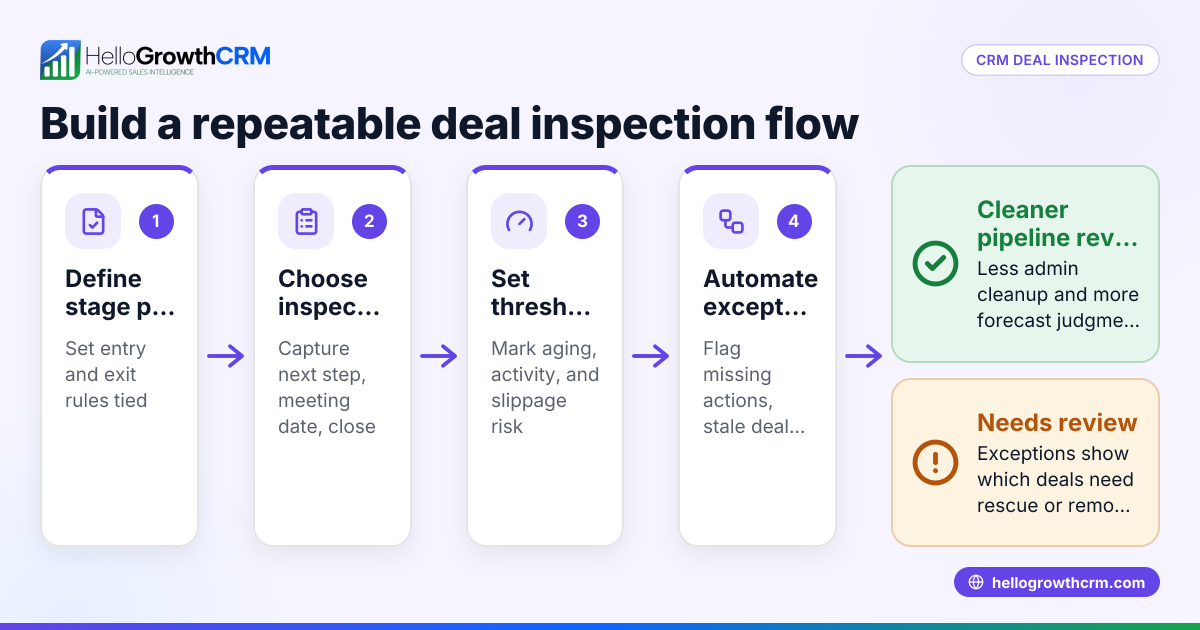
How to create a crm pipeline inspection checklist: Step-by-Step
Creating a crm pipeline inspection checklist starts with defining what a valid deal looks like at each stage, then setting review rules for activity, next steps, aging, and forecast categories. Once those rules are embedded in CRM workflows and dashboards, managers can inspect pipeline quality quickly and consistently each week.
- Map your real sales stages
List every stage in your pipeline and define the buyer evidence required to enter and exit each one. Remove vague stage names that do not reflect actual deal progress. - Set required fields for active opportunities
Require core fields such as next step, next-step date, close date, amount, decision process, and primary contact. Keep the required set short so reps actually maintain it. - Define stale-deal thresholds
Set a clear inactivity rule by segment or deal size. For example, SMB deals may go stale faster than enterprise deals with legal review. - Create stage-aging benchmarks
Measure median days per stage from won and lost data. Then flag deals that exceed a reasonable threshold, such as 1.5x or 2x median stage age. - Add forecast evidence rules
Define what qualifies a deal for pipeline, best case, or commit. Tie commit to buyer-backed proof, not rep confidence. - Build dashboards and alerts
Use exception views for missing next steps, no activity, close-date slips, and stale stage age. AI Pipeline Management can surface these automatically. - Run weekly manager inspections
Review the same checklist every week. Focus first on commit deals and the largest open opportunities. - Audit forecast misses monthly
Compare predicted close dates and categories against outcomes. Then update stage criteria, inspection rules, and coaching based on what actually slipped.
Why HelloGrowthCRM is a practical choice for pipeline inspection
HelloGrowthCRM is a practical choice for pipeline inspection because it combines CRM execution, AI-based risk detection, and RevOps support in one system. That helps B2B teams improve forecast confidence without forcing reps and managers to spend more time on manual cleanup, spreadsheet reviews, or disconnected tools.
For many teams, the problem is not knowing what good looks like. The problem is keeping the CRM current at scale.
HelloGrowthCRM is built for that reality. It brings together:
- AI Pipeline Management for stage health and deal movement
- AI Deal Insights for risk signals and coaching prompts
- Sales Forecasting for cleaner rollups
- CRM Dialer and WhatsApp & SMS CRM for activity capture across channels
- Managed RevOps for teams that need process design and ongoing governance
- CRM ROI Calculator to estimate the impact of better CRM adoption and forecast control
This approach works especially well for B2B teams under 50 reps. Above that, expect more complex territory, product-line, and approval logic. HelloGrowthCRM can still fit, but you should plan a tighter operating model and deeper integration review through a Demo.
If your team is losing forecast accuracy because the CRM does not reflect execution reality, try HelloGrowthCRM. Explore the Features, review Pricing, or start a Free Trial to build a cleaner pipeline inspection process with less admin.
About the author
I’m Arjun Mehta, Sales Operations Lead at HelloGrowthCRM, with 11 years of experience in B2B SaaS revenue operations. I have led CRM redesigns, forecast governance projects, and pipeline inspection programs for sales teams from 8 to 120 reps. One project that shaped this article was a pipeline recovery rollout for a global SaaS company where we rebuilt stage criteria, stale-deal rules, and weekly forecast inspection dashboards after two consecutive quarters of commit misses. I write from hands-on experience inside the systems and review cadences sales leaders use every week.
Frequently Asked Questions
Q: What is a CRM pipeline inspection checklist?
A: A CRM pipeline inspection checklist is a standardized review framework for checking whether deals in your CRM are current, qualified, properly staged, and safe to include in the forecast. It usually covers stage discipline, next steps, inactivity, aging, close dates, and risk signals.
Q: How often should B2B sales teams inspect pipeline hygiene?
A: B2B sales teams should inspect pipeline hygiene weekly because forecast risk builds quickly when next steps, stage movement, and close dates are not updated. Most teams also benefit from a monthly RevOps audit to catch trend-level issues.
Q: What are the most important fields to inspect in a sales pipeline?
A: The most important fields to inspect in a sales pipeline are stage, close date, amount, next step, next-step date, qualification data, and recent activity. Those fields show whether a deal is real, current, and forecastable.
Q: How do you identify stale deals in a CRM?
Frequently Asked Questions
Ready to put this into practice?
Set up your pipeline, WhatsApp follow-ups, and AI lead scoring in minutes — free, no credit card.
Try HelloGrowthCRM freeGet CRM tips in your inbox
Join thousands of sales professionals who get weekly insights on CRM strategy, AI automation, and pipeline optimization.

The HelloGrowthCRM team publishes guides on CRM strategy, AI sales tools, and revenue operations for small business sales teams.