HelloGrowthCRM software
Built for real small-business sales teams
HelloGrowthCRM helps reps qualify faster, follow up on time, and close more deals—with practical automation in one place.
- AI lead scoring and pipeline visibility
- Built-in dialer, WhatsApp, and email automation
- Sales forecasting and RevOps-ready reporting
In Canada, the right CRM is one that can keep your sales process organized while also preserving the records you need for taxes, consent, payments, language obligations and scheduling across provinces.
The original topic behind this article mentions Chicago, but if you run a clinic, contractor, agency or professional practice in Canada, the real buying decision is local. A CRM here has to cope with GST or HST and, depending on the province, PST or QST; it has to store consent evidence in a way that stands up under CASL; it has to avoid time-zone errors when your team books across the country; and if you serve Quebec, customer-facing communication may need French as a matter of law and business reality. Those are not add-ons. They shape what data you capture from the first inquiry.
That means choosing CRM software is less about a long feature checklist and more about whether the system matches how money, communication and service delivery actually work in Canada.
Province of supply matters more than a single tax field
Many businesses first feel CRM pain when quoting and invoicing seem fine, but month-end reporting is messy. In Canada, a sale is not just an amount and a customer. For indirect tax, the province tied to the supply can change which tax applies: GST, HST, provincial sales tax, and in Quebec, QST administered by Revenu Québec. The legal framework comes from the Excise Tax Act for GST and HST, provincial sales tax rules in the relevant province, and Quebec’s sales tax regime under Revenu Québec.
For CRM selection, that means your records should preserve the location facts behind each transaction, not merely the billing total. A Calgary HVAC contractor serving customers in Alberta and British Columbia, for example, should be able to see where each job was supplied when finance reviews closed work. A single generic “tax” note field is weak evidence and poor operational design.
Deposits create another reason to care about record structure. The Canada Revenue Agency publishes guidance on the timing of tax obligations and on how deposits and forfeited amounts are treated, and those are not identical questions. If your business takes booking deposits, cancellation fees or retainers, the CRM should make it easy to distinguish an estimate, a deposit received, a completed job and a cancelled job. Otherwise the accounting team ends up reconstructing events from email threads.
Even if your accounting system is the formal book of record, the CRM is often where the underlying facts begin. If it cannot hold province-of-supply information and payment status cleanly, someone later has to guess.
CASL turns consent history into a core CRM record
In Canada, email and text outreach are not just marketing preferences; they are governed by Canada’s anti-spam law, commonly called CASL. The regulator most businesses recognize is the CRTC, alongside the Competition Bureau and the Office of the Privacy Commissioner of Canada in their respective areas. For CRM buyers, the practical point is simple: you need a consent record, not just an opt-in checkbox.
A useful record includes when consent was obtained, how it was obtained, whether it was express or implied, and what message channel it covered. CASL also requires sender identification and a working unsubscribe mechanism for commercial electronic messages. Implied consent does not last forever, so the CRM should help your team see when it may lapse rather than treating every contact as marketable forever.
This becomes important in ordinary service businesses. A dental office in Vancouver may send an appointment reminder that is operational, but if a promotional offer is tucked into the same message, the communication can move into CASL territory. That is why transactional templates and marketing templates should remain separate in the system.
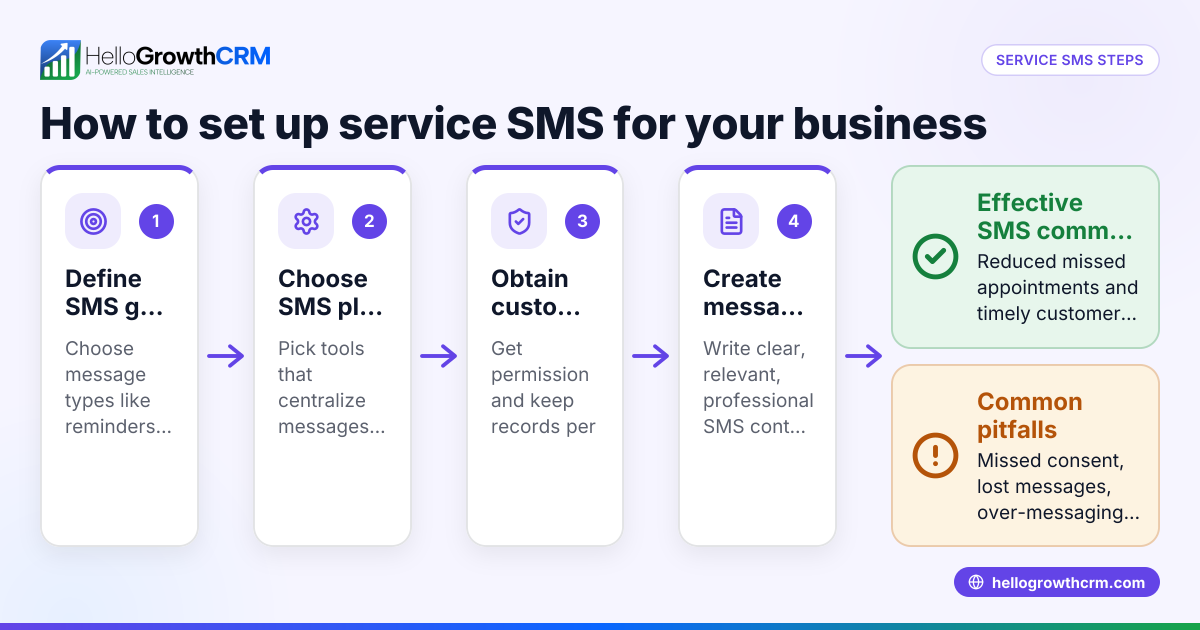
If your team plans to use SMS and WhatsApp messaging tools or email sequences and campaigns, check whether you can store the source and date of consent at contact level and suppress outreach when consent is withdrawn or uncertain. The software does not make your legal judgment for you, but it should preserve the evidence your business needs.
Quebec changes the conversation on privacy and language
A Canada-wide CRM rollout often fails when the buyer treats Quebec as “just another province.” It is not. Private-sector privacy obligations are shaped federally by PIPEDA, but Quebec’s Law 25 adds its own requirements around consent, transparency and reporting of confidentiality incidents, with oversight from the Commission d’accès à l’information. If you collect leads in Montreal or serve Quebec customers from elsewhere, your CRM design should reflect that from the start.
Two practical consequences follow. First, customer-facing forms, confirmations and reminders may need French, not as a courtesy but as part of operating properly in Quebec. Second, your team should know exactly what personal information is being collected, why it is collected and who can access it. A CRM with loose free-text habits tends to produce over-collection because staff dump sensitive details into notes.
This is especially relevant for regulated or sensitive services. A staffing agency in Montreal or a physiotherapy clinic in Mississauga serving Quebec residents should think carefully about what fields are truly necessary in the CRM, what belongs in another system, and how incident handling would work if information were exposed. The Office of the Privacy Commissioner of Canada and Quebec’s Commission both publish guidance that should inform configuration.
If you are comparing vendors, ask one concentrated set of questions before you move data:
- Can we control which roles see contact details, notes and documents?
- Can forms, confirmations and reminders be produced in English and French where needed?
- Can we document consent source, date and withdrawal without relying on staff memory?
- Can we separate marketing communications from operational messages?
- Can we export our data cleanly if our compliance design changes later?
Canadian payment habits expose weak CRM-to-cash workflows
A CRM chosen around card payments alone will misstate reality for many Canadian businesses. Customers here often pay by Interac e-Transfer, pre-authorised debit, credit card, cheque or wire transfer. Interac e-Transfers in particular land in the bank rather than flowing through a card processor, so teams that only mark card receipts in the CRM systematically under-record what has been paid.
This matters because sales staff use the CRM to decide who needs a reminder call, who can be booked again, and which jobs are truly complete. If a contractor receives an Interac e-Transfer but the CRM still shows the invoice as open, your follow-up becomes inaccurate and embarrassing.
The arithmetic below is illustrative; the figures are made up to show the shape of the decision. Suppose a Mississauga physiotherapy clinic bills C$240 for an assessment, takes a C$60 booking deposit, then receives the remaining C$180 by Interac e-Transfer on the day of service. If the CRM records only the appointment and final invoice, staff may think C$240 remains outstanding until someone checks the bank. If the CRM records the deposit as money received against the booking and then reconciles the C$180 final payment against the invoice, the front desk sees the true balance immediately. What this leaves out: insurer payments, chargebacks, tax treatment, and how your accounting platform posts the transaction.
That is why quoting, invoices and payment status should connect back to the deal or customer record. If you want a sales system that does more than hold contacts, look at whether it can support quotes, invoices and payments received tied to CRM records. The goal is not to replace finance advice. It is to stop your operations team from working from stale information.
Canada’s time zones and holidays can break booking logic
Scheduling sounds easy until you operate beyond one city. Canada has six time zones, one uses a half-hour offset, and daylight saving is not observed in the same way everywhere. Saskatchewan is the classic trap. A booking made in October for service in March can drift by an hour if the system stores the wrong assumption or if staff rely on manual calendar math.
For businesses that sell appointments, this is not a small annoyance. A law practice in Halifax booking consultations with clients in Alberta, or a Vancouver dental office handling reminders for snowbirds and out-of-province patients, can create missed meetings simply through poor time handling. Provincial statutory holidays also differ. A reminder cadence that is sensible in Ontario may land on a holiday in another province.
So when you review CRM scheduling, do not just look at whether a calendar exists. Look at whether booking pages and reminders preserve the intended local time, whether staff can see where the contact is based, and whether follow-up tasks can be assigned sensibly across regions. A good starting point is to review meeting scheduling and booking tools with your own cross-province scenarios rather than the vendor’s demo script.
Lead sources in Canada are uneven, and your CRM should show that honestly
Canadian businesses rarely get leads from a single clean source. In practice, inquiries may arrive through Google Business Profile, Kijiji, Facebook, LinkedIn, HomeStars, referrals and even Yellow Pages. The mix differs sharply by trade and region. An HVAC contractor in Calgary may depend heavily on Google Business Profile and referrals, while a staffing agency may care more about LinkedIn and inbound email.
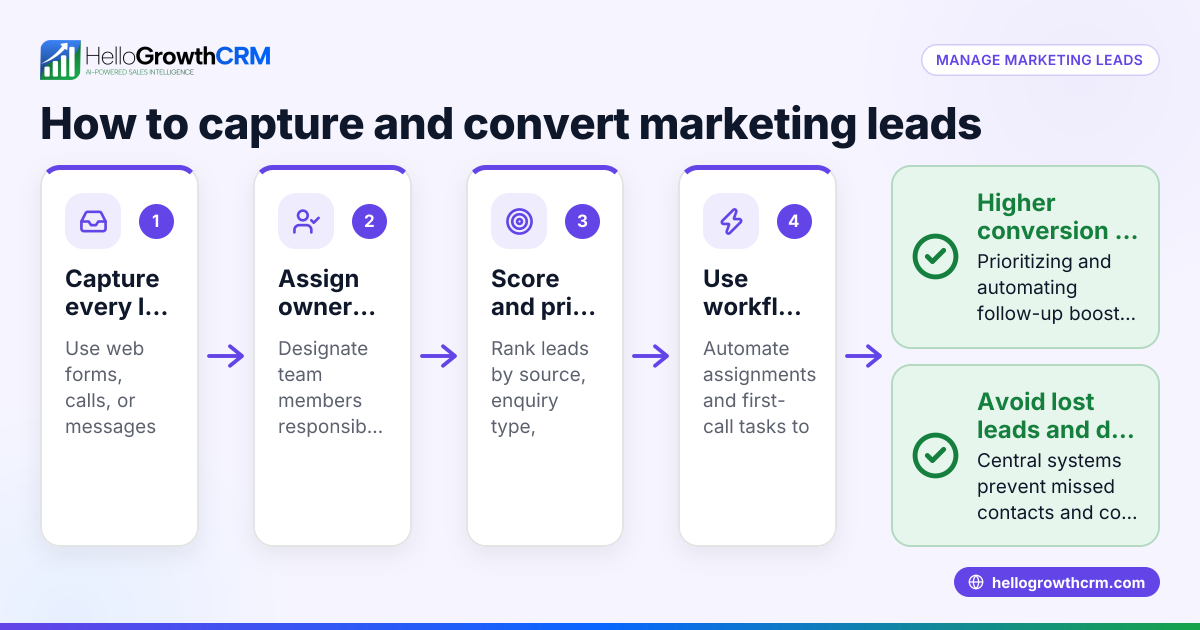
This is where CRM choice affects management quality. If every lead enters the same generic bucket, you cannot tell whether low close rates come from poor source quality, slow response, bad territory routing or weak quoting. Source needs to be captured at entry, and qualification should happen early enough that the pipeline reflects real opportunities rather than raw inquiries.
For that reason, it is worth checking whether the system gives you structured lead capture, qualification and pipeline entry and whether the pipeline itself can track open opportunities from first contact to close. If your team works across regions, territory ownership may matter too, especially for field service businesses where geography determines response time and conversion odds.
A CRM cannot create demand, but it should let you compare lead sources in a way that fits Canada’s fragmented local channels instead of pretending every inquiry came from a web form.
What implementation should look like in a Canadian business
The best CRM decisions are made from a small set of real operating scenarios. Start with one sales path that actually matters: first inquiry, qualification, booking or quote, payment, follow-up, and future marketing eligibility. Then test the software against a Canadian version of that path.
For example, if you run a professional practice, can staff see whether a contact may be emailed under your consent rules before sending a campaign? If you serve more than one province, can the deal record preserve where the service was supplied? If you take Interac e-Transfer, can the person following up on unpaid invoices tell what has actually reached the bank? If Quebec is in scope, are your forms and reminders ready for French? If your teams span provinces, do tasks and bookings stay pinned to the intended local time?
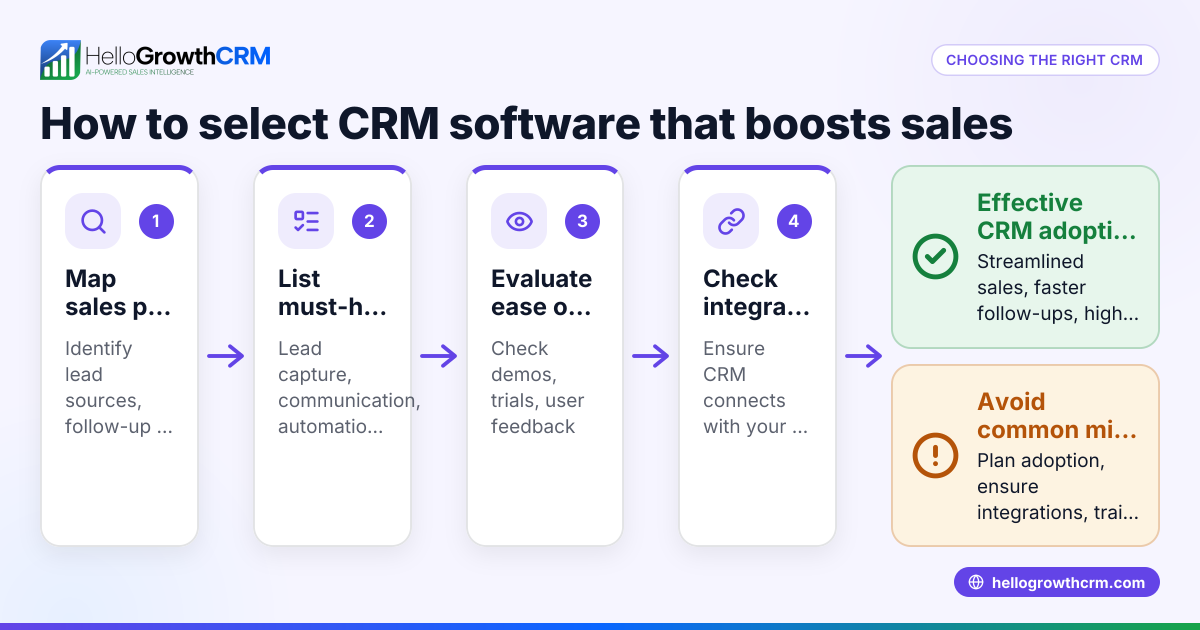
Only after those answers are clear should you compare broad feature sets. For many small and midsize businesses, the practical foundation is straightforward: organized lead intake, a visible deal pipeline, task history on each record, booking pages, and messaging that can be controlled carefully. HelloGrowthCRM covers those basics with a free CRM plan and expands into pipeline management, task boards, scheduling, messaging and workflows as needs grow. If your stack already includes other tools, its integration options matter because Canadian compliance and payment processes are often split across systems.
Choose the CRM that fits how your business operates in Canada, not the one with the most generic boxes ticked.
Ready to put this into practice?
Set up your pipeline, WhatsApp follow-ups, and AI lead scoring in minutes — free, no credit card.
Try HelloGrowthCRM freeGet CRM tips in your inbox
Join thousands of sales professionals who get weekly insights on CRM strategy, AI automation, and pipeline optimization.

The HelloGrowthCRM team publishes guides on CRM strategy, AI sales tools, and revenue operations for small business sales teams.