HelloGrowthCRM software
Built for real small-business sales teams
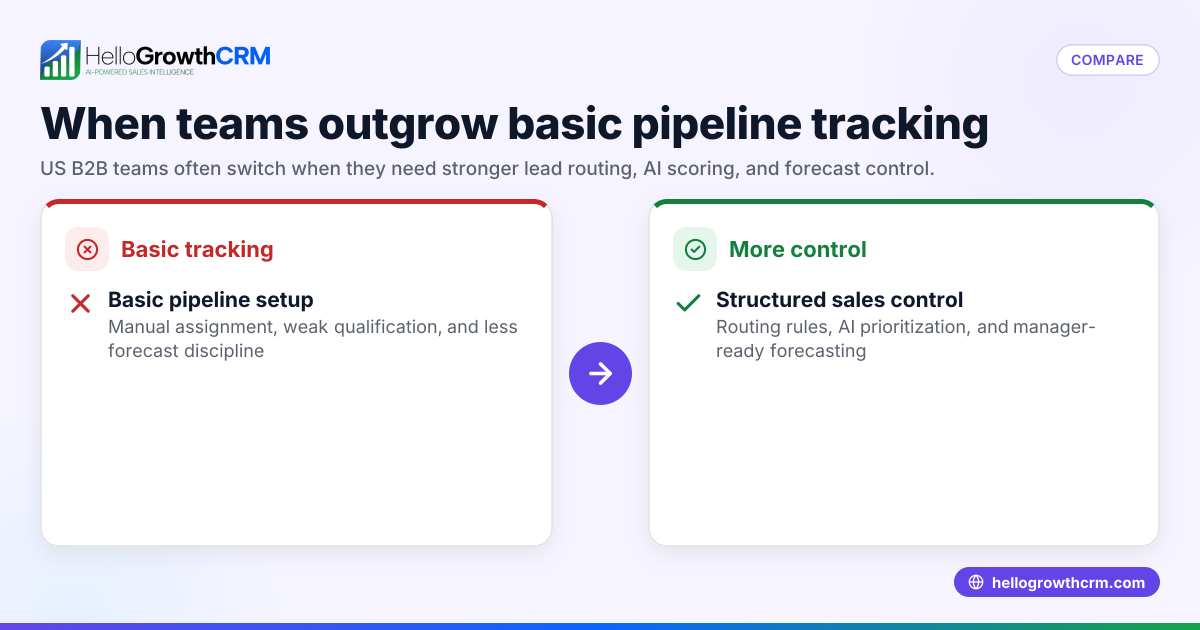
HelloGrowthCRM helps reps qualify faster, follow up on time, and close more deals—with practical automation in one place.
- AI lead scoring and pipeline visibility
- Built-in dialer, WhatsApp, and email automation
- Sales forecasting and RevOps-ready reporting
If you are comparing HelloGrowthCRM vs Adapt, the core difference is scope. HelloGrowthCRM is built to run day-to-day B2B sales in one place, while Adapt is often used earlier in the process for contact data and prospecting. For a U.S. sales team, the right choice depends on whether you need better lead capture and pipeline execution, or mainly a larger list of contacts.
Key takeaways
- HelloGrowthCRM is better suited for U.S. B2B teams that want one system for lead capture, scoring, outreach, pipeline, and forecasting.
- Adapt is typically considered when a team wants prospecting data first and plans to use other tools for CRM workflows.
- If your reps already struggle with CRM adoption, fewer tools usually means cleaner data and more accurate reporting.
- AI scoring is most useful when it connects directly to inbound leads, sales activity, and pipeline stages.
- U.S. teams should also consider compliance and workflow fit for email, calling, and text outreach, including CAN-SPAM and TCPA expectations.
- The best choice comes down to your sales motion, your tech stack, and how much RevOps support you need.
HelloGrowthCRM vs Adapt for U.S. B2B sales teams
When U.S. buyers search for hellogrowthcrm vs adapt, they are usually trying to answer a practical question. Which platform will help the team capture more leads, qualify them faster, and move deals through the pipeline without creating extra admin work?
That matters because many B2B teams do not have a tool problem. They have a workflow problem. Leads come in from forms, referrals, events, email replies, and outbound efforts. Then those leads get pushed across different systems. Data gets messy. Reps stop updating the CRM. Forecasts turn into guesswork.
In that context, HelloGrowthCRM and Adapt usually sit in different parts of the stack.
HelloGrowthCRM is an AI CRM with managed RevOps support for growing B2B sales teams in the United States. It is designed to help teams capture leads, score them, manage opportunities, automate outreach, and report on pipeline health inside one system.
Adapt is commonly evaluated as a prospecting and contact data tool. Teams often use it to find contacts and build lists. In many cases, they still need a separate CRM, automation setup, and reporting process to run sales execution.
That does not make one tool universally better. It means the comparison should start with your actual sales process.
What is the biggest difference between HelloGrowthCRM and Adapt?
HelloGrowthCRM is built to manage the full sales workflow after and during lead capture. Adapt is more often used to source contacts for outbound prospecting. If your team needs one place to capture, score, route, and work deals, HelloGrowthCRM usually fits better.
A useful way to think about this comparison is simple. Are you trying to improve prospecting volume, or are you trying to improve revenue operations?
For many small and mid-sized B2B teams in cities like Chicago, Houston, and Detroit, the second question matters more. They already have lead sources. Their real issue is response time, rep follow-up, duplicate records, stale pipelines, and weak forecasting.
HelloGrowthCRM focuses on those operating problems. It supports lead capture from multiple channels, AI-based prioritization, pipeline management, communication workflows, and reporting. That means your reps can work from one place instead of bouncing between disconnected apps.
Adapt can still play a role if your outbound motion depends heavily on finding new accounts and contacts. But if your team then needs to move those contacts into a separate CRM, assign owners, score leads manually, and manage reporting elsewhere, your stack becomes harder to maintain.
For founders and sales leaders, tool sprawl is expensive. It costs time, creates lower data quality, and makes forecasting less reliable. It can also create handoff issues between marketing, SDRs, AEs, and RevOps.
Where this comparison matters most
This comparison matters most for teams with one or more of these issues:
- Inbound leads are not getting followed up quickly.
- Reps are working from spreadsheets or inboxes.
- Pipeline stages are inconsistent across the team.
- Forecast calls rely on rep opinions instead of live activity.
- Marketing and sales data do not match.
- Leaders want fewer tools, not more.
If that sounds familiar, you are not just evaluating a contact database. You are evaluating your sales operating system.
How do lead capture and inbound workflows compare?
HelloGrowthCRM is designed to capture and route leads into active sales workflows. Adapt is more commonly part of outbound list building. If inbound response time, assignment, and pipeline creation matter, HelloGrowthCRM has the stronger fit.
Lead capture is where a lot of U.S. B2B revenue gets lost. A prospect fills out a form. A referral comes in by email. A rep meets someone at a trade event. Then nobody follows up for two days. Or the lead enters the CRM without the right owner, source, or next step.
HelloGrowthCRM is built to reduce that friction. Instead of treating leads as static records, it helps teams turn new interest into a managed process. That includes capturing lead data, assigning ownership, scoring priority, and pushing the lead into a pipeline workflow fast.
That is especially important for service businesses, manufacturers, agencies, software firms, and distributors that rely on fast, consistent follow-up. If your team sells into U.S. businesses with longer cycles and multiple stakeholders, clean intake matters because every missed handoff slows the deal.
By contrast, Adapt is usually more relevant when the team wants to build outbound lists from contact data. That can help at the top of the funnel. But it does not by itself solve what happens after a lead shows interest or enters an active deal cycle.
What strong lead capture should include
For a U.S. B2B team, good lead capture should support:
- Automatic lead creation from key channels
- Clear lead ownership rules
- Source tracking for reporting
- Duplicate prevention
- Fast rep notifications
- Lead scoring tied to actual buying signals
- Pipeline creation without manual re-entry
If your current process depends on exports, imports, and manual cleanup, your team will feel the pain every week.
Why this matters for RevOps
RevOps leaders often inherit systems where one tool handles contacts, another sends email, another tracks calls, and another manages reporting. That setup can work for a large team with dedicated admins. It often breaks down for growing companies that need speed and simplicity.
HelloGrowthCRM’s managed RevOps approach is relevant here because many teams do not just need software. They need the process configured correctly. Routing rules, fields, stages, ownership, lifecycle definitions, and reporting need to match how the business actually sells.
How does AI scoring compare in HelloGrowthCRM vs Adapt?
HelloGrowthCRM uses AI scoring as part of the CRM workflow, so teams can prioritize leads based on real engagement and pipeline context. Adapt is more often associated with contact discovery, not a full sales execution system with AI-driven prioritization.
The phrase ai hellogrowthcrm vs is really about where AI creates value for your team. AI is useful when it helps reps decide what to do next. It is less useful when it only adds another score that sits outside the main sales workflow.
That is why integration matters. If a lead score is disconnected from the pipeline, rep activity, and communication history, the score becomes harder to trust. Reps may ignore it. Managers may not use it in reviews. Over time, it becomes one more field nobody updates.
HelloGrowthCRM’s AI lead scoring is more compelling for teams that want prioritization built into daily work. If a lead comes in, engages by email, responds to outreach, or moves through stages, the score can support action. It becomes part of who gets called first, who gets routed to an AE, and which deals need attention.
What to look for in AI scoring
Before choosing any AI scoring setup, ask these questions:
- What inputs affect the score?
- Does the score update as behavior changes?
- Can reps see why a lead is high priority?
- Is the score connected to routing and follow-up?
- Does it improve speed to lead?
- Does it help managers inspect pipeline risk?
These questions matter more than whether a vendor uses the term AI in marketing. Sales leaders need practical outputs, not abstract promises.
Why AI scoring often fails
AI scoring often fails for simple reasons:
- The score lives outside the CRM
- Reps do not trust the criteria
- Data quality is poor
- No workflow changes happen after scoring
- Managers do not coach from it
If your team wants scoring that shapes behavior, it should sit inside the sales process, not beside it.
Which platform is better for pipeline management?
HelloGrowthCRM is generally the stronger choice for pipeline management because it is designed for deal movement, rep activity, and forecasting. Adapt is usually not the center of pipeline execution for a U.S. B2B sales team.
Pipeline management is where sales software either becomes useful or gets ignored. Reps need a system that is easy to update. Managers need visibility without chasing people on Slack or in meetings. Founders need to know which revenue is real.
HelloGrowthCRM is built around that operating reality. It supports structured stages, activity tracking, follow-up workflows, and reporting that connects lead quality to pipeline outcomes. That is a better fit for teams trying to improve conversion rates, rep accountability, and forecast accuracy.
A contact data platform can help generate names. But a pipeline system helps your team close business.
Signs your pipeline process needs a real CRM workflow
You likely need stronger pipeline management if:
- Deals sit idle without next steps
- Reps skip stage updates
- Forecast categories are inconsistent
- Managers rely on spreadsheets for reviews
- Conversion reports take too long to build
- Leadership cannot trust quarter-end projections
That is where sales forecasting and pipeline visibility matter. A system should help you see not only how much pipeline exists, but how healthy it is.
Pipeline management is also about adoption
A CRM only works if reps use it. That sounds obvious, but it is the heart of many failed software rollouts. If logging activity feels like busywork, reps stop doing it. Then dashboards fall apart.
HelloGrowthCRM’s value is tied to reducing that friction. When lead capture, communication, scoring, and pipeline live together, reps have fewer reasons to work outside the system. That usually leads to better data and cleaner reporting.
What should U.S. B2B sales teams consider before switching?
Choose based on your sales motion, not the longest feature list. U.S. teams should look at workflow fit, data quality, compliance needs, reporting, and whether they want one platform or a stack of separate tools.
Before making a switch, define your current bottleneck clearly. Is the team missing target because there are not enough contacts to prospect? Or is revenue slipping because leads are not routed well, follow-up is inconsistent, and the pipeline is unreliable?
That difference matters because the software decision should match the actual problem.
A practical evaluation framework
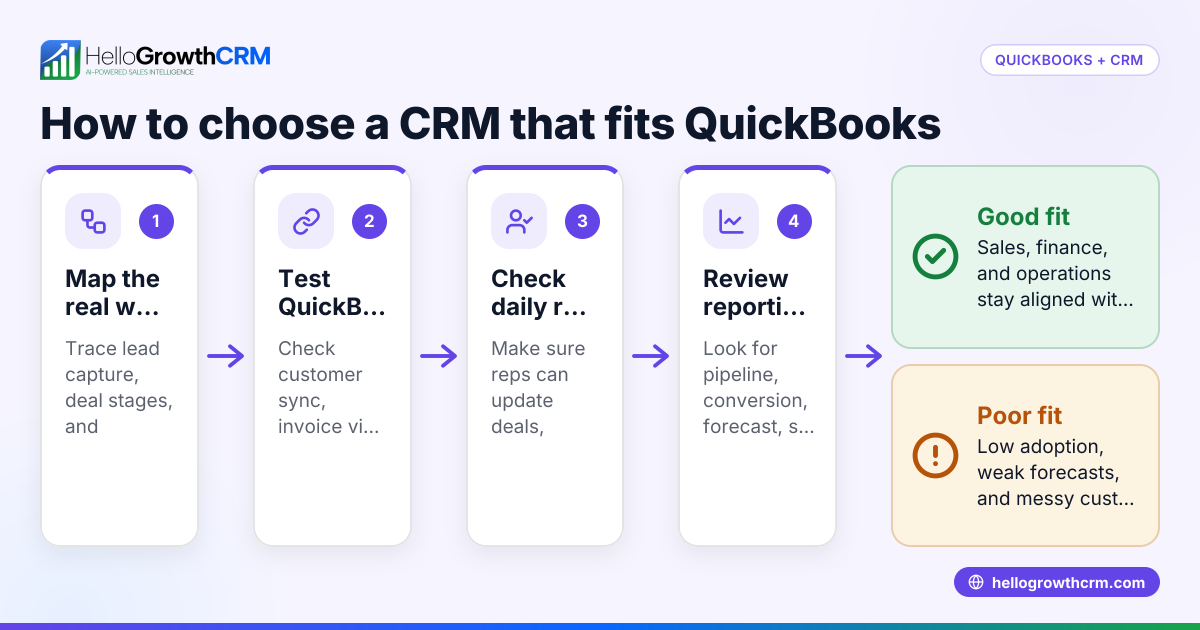
Use this five-step framework:
- Map your funnel. List where leads come from today. Include forms, referrals, outbound, events, partners, and email inquiries.
- Find workflow gaps. Look for delays, duplicate entry, unclear ownership, and poor visibility.
- Review your stack. Note what already handles email, calling, reporting, finance sync, and integrations with tools like QuickBooks or Stripe if relevant.
- Assess compliance needs. For outreach, make sure your process supports CAN-SPAM for email and TCPA considerations for phone and text.
- Define success. Pick a few outcomes. Faster speed to lead. Higher conversion. Better forecast accuracy. Fewer manual tasks.
This process helps avoid buying a tool for the wrong reason.
Consider your buyer expectations
U.S. B2B buyers often expect clean follow-up, professional outreach, and secure handling of business data. In some sales cycles, procurement or IT may ask about security expectations such as SOC 2. They may also care whether your team can keep communication history and deal status organized.
That does not mean every team needs a complex enterprise stack. It means your sales system should support trust, speed, and consistency.
Integration and execution matter
You should also review integrations and implementation support. A product can look strong in a demo and still fail if your fields, routing, stages, and reports are not configured well. That is why many growing teams value a combination of product plus operational guidance.
Feature-by-feature view: where each option tends to fit
Below is a practical way to think about fit.
HelloGrowthCRM tends to fit better when you need:
- One system for lead capture through forecast
- AI scoring connected to real sales workflows
- Pipeline visibility for managers and founders
- Built-in communication workflows for email, WhatsApp, and calling
- Sales automation without heavy admin effort
- RevOps support as part of the rollout
Teams that want to consolidate tools should also review the features page and see whether the workflow matches how they already sell.
Adapt tends to fit better when you need:
- More contacts for outbound prospecting
- Data enrichment or list building as the main use case
- A prospecting layer that sits alongside other sales systems
- Less emphasis on all-in-one CRM execution
That fit can make sense for a team with a mature CRM and RevOps function already in place. It is usually less attractive for a growing business that wants to simplify the stack.
When HelloGrowthCRM is likely the better choice
HelloGrowthCRM is likely the better choice if your business is asking questions like these:
- Why are inbound leads not converting?
- Why do reps update the CRM late?
- Why is our pipeline review taking so long?
- Why are forecasts changing every week?
- Why do we use three tools to do one workflow?
If that is where you are, then this is not only a database decision. It is a system design decision.
For many U.S. B2B sales teams, the biggest gains come from tighter lead handling, smarter prioritization, and cleaner execution after the lead enters the funnel. That is the area where HelloGrowthCRM is strongest.
You may also find value in connected outreach, such as email automation, when follow-up consistency is part of the problem.
Final verdict on HelloGrowthCRM vs Adapt
For most growing U.S. B2B sales teams, HelloGrowthCRM is the stronger option when the goal is to run sales in one place. It covers lead capture, AI scoring, pipeline management, outreach, and forecasting in a way that supports daily execution. Adapt is more likely to fit teams that mainly want prospecting data and already have the rest of the sales stack figured out.
Read next
This article covers one part of a bigger topic. For the complete picture, read our guide to hellogrowthcrm vs.
Ready to put this into practice?
Set up your pipeline, WhatsApp follow-ups, and AI lead scoring in minutes — free, no credit card.
Try HelloGrowthCRM freeGet CRM tips in your inbox
Join thousands of sales professionals who get weekly insights on CRM strategy, AI automation, and pipeline optimization.

The HelloGrowthCRM team publishes guides on CRM strategy, AI sales tools, and revenue operations for small business sales teams.