Skip to content
KRA Full Form

KRA Full Form: Key Result Area, With Examples for Sales Teams

What KRA stands for, how it differs from a KPI, examples you can adapt for sales and customer-facing roles, and how to write KRAs that survive an appraisal.

Last updated:

Free Forever • No Credit Card Required

Quick answer

What is the full form of KRA?

The full form of KRA is Key Result Area. In HR it means one of the three to six areas of work in which a role must deliver results, such as new business or collections. Each KRA is measured by one or more KPIs. In Indian offices it is also expanded as Key Responsibility Area, with the same meaning.
  • In HR and appraisals: Key Result Area, also called Key Responsibility Area
  • A KRA is the area of responsibility. A KPI is the number that measures it
  • In securities markets: KYC Registration Agency. In Kenya: Kenya Revenue Authority

Sales KPIs guideSales executive job description

01

KRA full form and meaning

KRA stands for Key Result Area. A key result area is one of the few areas of work in which a role must produce results for the business to do well. It is not a task and it is not a number. It is the heading under which tasks are done and numbers are measured: new business, collections, customer service, team development.

In Indian offices the same abbreviation is often expanded as Key Responsibility Area. Human resources teams use the two phrases for the same thing, and an appraisal form that asks for your KRAs wants the same answer either way: the handful of outcomes you own.

A role normally has three to six KRAs. Fewer than three and the description is too vague to appraise. More than six and nothing is key any more.
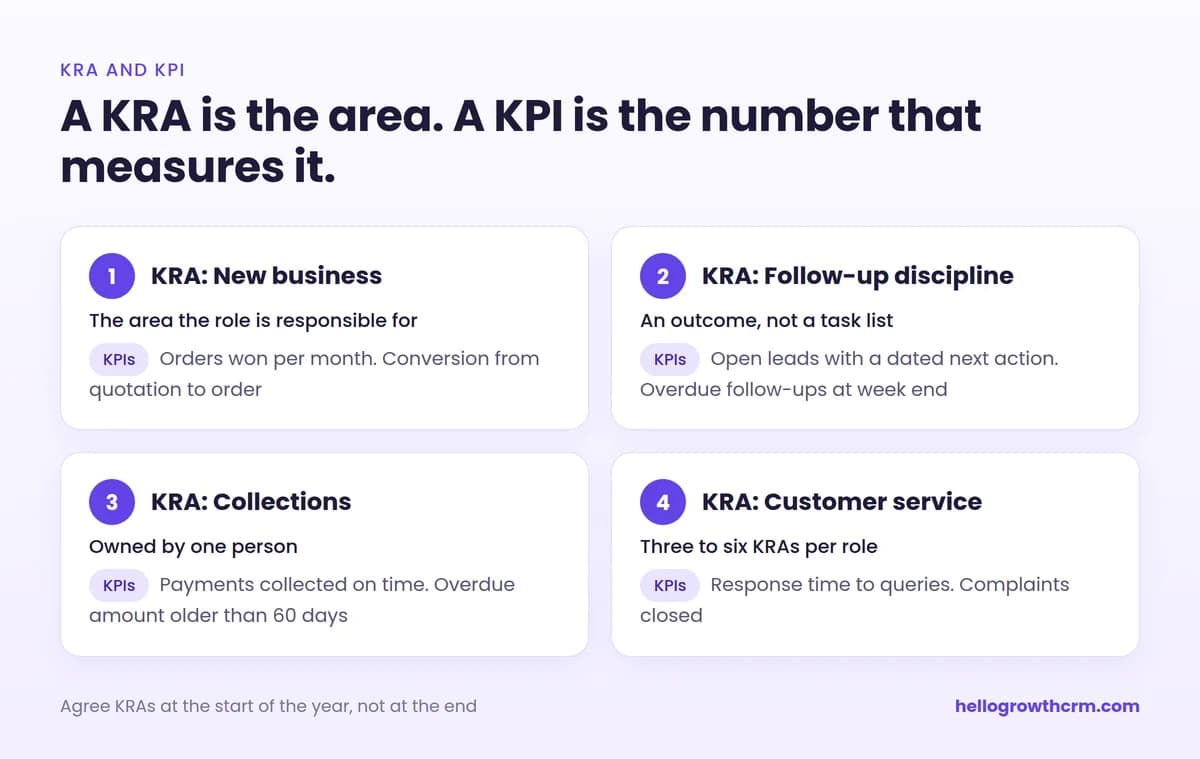
KRA versus KPI with a sales example: the KRA is new business, the KPIs are orders won per month and conversion from quotation to order
A KRA is the area. A KPI is the number that measures it.
02

KRA and KPI: the difference

The two terms travel together and are often confused. A KRA says what the role is responsible for. A KPI, or key performance indicator, is the measure that shows how well that responsibility is being met. Every KPI should sit under a KRA, and a KRA without a KPI cannot be appraised fairly.

KRAKPI
What it isAn area of work the role is responsible forA number that shows how well that area is going
Answers the questionWhat am I here to deliver?How do we know it is being delivered?
How manyUsually 3 to 6 per role1 to 3 per KRA
ChangesRarely, when the role changesTargets are reset every quarter or year
ExampleNew customer acquisitionOrders won per month, conversion from lead to order

For the measures themselves, see our guide to sales KPIs.

03

KRA examples for sales and customer-facing roles

These examples are written the way a small Indian business would use them. Take the ones that fit the role and set the target figures yourself; a target copied from another company means nothing.

RoleKRAKPIs that measure it
TelecallerLead contact and qualificationShare of new leads called within the agreed time; connected calls per day; qualified leads passed on
Sales executiveNew businessOrders won and order value against target; conversion from quotation to order
Sales executiveFollow-up disciplineOpen leads with a dated next action; overdue follow-ups at week end
Business development executivePipeline creationNew opportunities added per month; meetings booked with the right kind of customer
Sales managerTeam target and forecastTeam revenue against target; forecast accuracy for the month
Sales managerPeopleTime to productivity for new hires; attrition; coaching sessions held
CRM executiveCustomer service after the saleResponse time to customer queries; documents sent on time; complaints closed
Accounts receivableCollectionsPayments collected on time; overdue amount older than 60 days

Job descriptions that put these into practice: telecaller, sales executive, business development executive, sales manager and CRM executive.

04

How to write KRAs in five steps

  1. Start from the purpose of the role. Write one sentence on why the job exists. Every KRA must serve that sentence.
  2. List the outcomes, not the activities. Making calls is an activity. Qualified leads passed to sales is an outcome.
  3. Keep three to six. Merge small items and drop anything the person cannot influence.
  4. Attach one to three KPIs to each KRA, with the source of the number. If the figure cannot be pulled from a system or a register, it will be argued about at appraisal time.
  5. Give each KRA a weight that adds up to 100, so the person knows what matters most, and review the list when the role changes.
05

Using KRAs in appraisals

An appraisal built on KRAs compares the agreed KPIs with what happened, KRA by KRA, and multiplies each score by its weight. The method is simple. What makes it fair is agreeing the KRAs at the start of the year, not at the end, and keeping the numbers visible during the year so the final conversation holds no surprises.

Four mistakes that make KRAs useless

Writing tasks as KRAs, so the list reads like a to-do list. Setting KPIs nobody can measure. Giving a person a KRA that depends on another team. And changing the list after the results are known. Each one turns the appraisal into an argument.

06

KRA full form in other fields

Outside human resources the letters have other meanings. In Indian securities markets a KRA is a KYC Registration Agency, an agency registered with SEBI that keeps investor know-your-customer records so that an investor does not repeat KYC with every intermediary. In Kenya, KRA is the Kenya Revenue Authority, the national tax body. If you met the term on a mutual fund form or a Kenyan tax notice, one of these is the meaning.

07

KRA meaning in Hindi

KRA का फुल फॉर्म Key Result Area (की रिज़ल्ट एरिया) है। हिंदी में इसे मुख्य परिणाम क्षेत्र कह सकते हैं। आसान शब्दों में, KRA वे तीन से छह मुख्य काम के क्षेत्र हैं जिनमें किसी कर्मचारी से नतीजे की उम्मीद की जाती है, जैसे नई बिक्री, फॉलो-अप या पेमेंट कलेक्शन। हर KRA को KPI यानी एक नंबर से नापा जाता है, और साल के अंत में अप्रेज़ल इन्हीं के आधार पर होता है।

08

Where the numbers come from

KRAs for a sales team only work if the KPIs can be read from a system, not rebuilt from memory in March. Calls made, leads contacted on time, quotations sent, orders won and overdue follow-ups are all by-products of working in a CRM. HelloGrowthCRM records them as the team works, by person and by month. See sales CRM, the sales commission calculator for the incentive side, and India pricing. Related abbreviations: BDE full form, BDM full form and CRM full form.

Challenges we solve

Four signs your KRAs are not working

A KRA sheet is only useful if the numbers behind it exist. These are the everyday problems.

  • Appraisals turn into arguments because nobody agrees what the numbers were.

    Take every KPI from a system the team works in daily. If calls, follow-ups and orders are logged as they happen, the figures are the same for the manager and the employee.Numbers from the system

  • KRAs are written in April and not looked at again until March.

    Put the KPIs on a report the team sees every week. A KRA that is visible all year needs no surprise conversation at the end of it.Weekly visibility

  • Salespeople are judged only on revenue, so follow-up and data quality are ignored.

    Add a KRA for follow-up discipline, measured by open leads with a dated next action and overdue follow-ups. What is measured gets done.Follow-up as a KRA

  • A new hire does not know what good looks like in the first three months.

    Give the KRAs and their KPIs on day one, with the first quarter targets set lower. The job description and the KRA sheet should say the same thing.Clear from day one

What you get

Why teams choose HelloGrowthCRM

AI-powered CRM with the features you need to close more deals.

  • Every enquiry from your website, WhatsApp, phone calls, ads and marketplaces lands in one list as a lead with an owner
  • A visual pipeline shows each deal by stage, so a manager can see what is open without asking anyone
  • Follow-up reminders are created for each lead, so the next call or message has a date and a person against it
  • A built-in dialer places calls from the lead record and logs them, with recording where consent applies
  • A shared WhatsApp inbox on the official Business API lets the team reply from one number, with the chat saved on the customer record
  • AI lead scoring ranks leads by how likely they are to convert, so the best ones are called first
  • Quotations and GST invoices are created from the deal, so numbers are not retyped between documents
  • Reports show leads by source, conversion by stage and activity by team member
  • Mobile apps let field staff update a lead straight after the meeting, while the details are fresh
  • A free plan for one user lets you start without paying, and paid plans start at ₹899 per user per month plus GST

HelloGrowthCRM by the numbers

$12
per user/month list price — $10/user/mo on annual billing, ₹899/user/mo in India
$0
free forever starter plan — no credit card required
14-day
trial included on paid plans
259+
live integrations, from WhatsApp to Tally and QuickBooks
500+
teams worldwide run their pipeline on HelloGrowthCRM

Frequently Asked Questions

The questions people ask most about KRAs.

More CRM guides to explore

Browse related HelloGrowthCRM guides and see how different teams run their pipelines.

Ready to grow?

Join small businesses that close more deals with HelloGrowthCRM.

Free Forever • No Credit Card Required

Take the next step

Free Forever • No Credit Card Required

Prefer email? Write to sales@hellogrowthcrm.com