HelloGrowthCRM software
Built for real small-business sales teams
HelloGrowthCRM helps reps qualify faster, follow up on time, and close more deals—with practical automation in one place.
- AI lead scoring and pipeline visibility
- Built-in dialer, WhatsApp, and email automation
- Sales forecasting and RevOps-ready reporting
Sales quota planning is essential for small and mid-sized businesses to organize sales goals clearly and drive consistent revenue growth. It involves defining realistic targets based on your business goals, sales capacity, and market conditions.
Why this comes up / what goes wrong
Many small-business owners face challenges with sales quota planning because they lack clear sales targets or rely on guesswork. Without quotas, sales teams may not focus their efforts effectively, leading to missed revenue goals or uneven workloads. Owners might also struggle to track progress or adjust targets as market conditions change, resulting in lost opportunities and frustrated sales reps.
Step-by-step
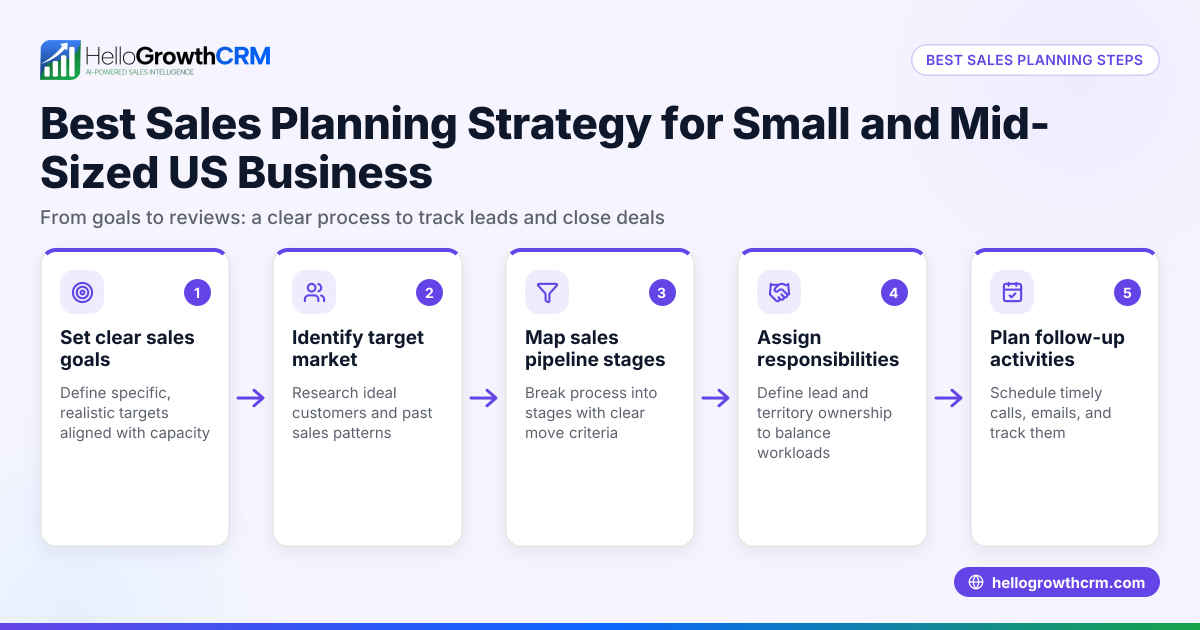
- Define your overall sales goal: Start with your revenue target for the period (month, quarter, year). Check that this goal aligns with your business plan and cash flow needs.
- Analyze past sales data: Review your previous sales numbers to understand typical performance levels and seasonality. Check for trends or patterns that affect sales.
- Segment your sales team or territories: Decide if quotas will be set by individual reps, teams, product lines, or geographic territories. Verify each segment’s capacity and market potential.
- Calculate quota per segment: Divide your overall sales goal into quotas based on factors like historical performance, territory size, or product demand. Check that quotas are challenging but achievable.
- Set quota types: Choose whether quotas are based on revenue, units sold, new customers, or other metrics. Confirm that the chosen metric aligns with your business objectives.
- Communicate quotas clearly: Share the quotas with your sales team, explaining the rationale and expectations. Check for understanding and buy-in.
- Track progress regularly: Monitor sales against quotas weekly or monthly. Check for early warning signs if quotas are not being met.
- Adjust quotas if needed: If market conditions change or sales capacity shifts, revisit and revise quotas. Check the impact on motivation and fairness.
- Reward achievement: Link commissions or bonuses to quota attainment to incentivize performance.
- Review and improve: After the period ends, analyze results and learn for the next quota cycle.
For managing quotas and sales pipelines, tools like HelloGrowthCRM offer Deals (pipeline) to track opportunities and follow-ups efficiently.
Example (fictional figures)
A two-location dental practice in Columbus, Ohio, sets a sales quota for its hygiene products and services for Q3 2026.
- Overall sales goal: $600,000 for Q3 (07/01/2026 to 09/30/2026)
- Past Q3 sales average: $550,000
- Two locations split sales roughly 60% and 40%
Calculate quotas:
Location 1 quota = $600,000 × 60% = $360,000 Location 2 quota = $600,000 × 40% = $240,000
Each location then breaks the quota into monthly targets:
Location 1 monthly quota = $360,000 ÷ 3 = $120,000 Location 2 monthly quota = $240,000 ÷ 3 = $80,000
These quotas are set based on capacity and past sales trends, giving clear targets per location and month.
Common mistakes
- Setting unrealistic quotas: Avoid overly high targets that demotivate or too low ones that waste potential. Prevent this by basing quotas on data and capacity.
- Ignoring market changes: Not adjusting quotas when demand shifts leads to missed goals. Prevent by reviewing quotas regularly.
- Lack of clear communication: Sales teams may be unclear about targets or how they are measured. Prevent by explaining quotas and expectations clearly.
- No tracking or follow-up: Without monitoring, problems go unnoticed. Prevent by using tools to track progress, like HelloGrowthCRM’s Deals pipeline.
- Ignoring individual or territory differences: Applying the same quota to all reps or regions can be unfair. Prevent by segmenting quotas appropriately using territories and field operations.
- Not linking quotas to incentives: Without rewards, motivation drops. Prevent by tying commissions or bonuses to quota attainment.
Doing this in HelloGrowthCRM
HelloGrowthCRM supports sales quota planning with its Deals (pipeline) feature, which tracks open opportunities from first contact through close. For example, a quotation sent last week appears at the 'quote sent' stage with a follow-up date, ensuring no deal is forgotten. For businesses with field sales, territories and field operations tools let reps log visits from their phones while managers see the daily beat. Founders without dedicated sales managers can use Managed RevOps to have a specialist work their follow-up queue weekly, keeping sales on track. Learn more about HelloGrowthCRM’s features for sales teams in the WhatsApp and SMS CRM and built-in CRM dialer sections.
Frequently asked questions
What is the difference between a sales quota and a sales goal? A sales quota is a specific target assigned to a salesperson or team, often broken down by time or territory. A sales goal is a broader revenue or unit target set for the whole business or department. Quotas help break down goals into actionable parts.
How often should sales quotas be set? Quotas are commonly set monthly, quarterly, or annually, depending on your sales cycle length and business needs. Regular reviews help adjust quotas for changing market conditions.
What metrics can be used for setting sales quotas? Common metrics include total revenue, number of units sold, new customer acquisitions, or specific product sales. Choose metrics that best align with your business priorities.
How do I motivate my sales team to meet quotas? Clear communication of quotas, regular progress tracking, and linking commissions or bonuses to quota achievement are key motivators. Recognize and reward performance consistently.
Can I adjust quotas mid-period? Yes, if market conditions or business priorities change significantly, adjusting quotas can keep targets realistic and fair. Communicate changes clearly to your team.
How does HelloGrowthCRM help with sales quota tracking? HelloGrowthCRM’s Deals (pipeline) feature tracks opportunities along sales stages with follow-up reminders, preventing deals from slipping through. Territory and field tools help manage quotas by region. Managed RevOps can assist with ongoing quota follow-up and pipeline hygiene.
Key takeaways
- Sales quota planning breaks overall sales goals into clear, actionable targets for reps or teams.
- Use past sales data and market analysis to set realistic, fair quotas.
- Communicate quotas clearly and track progress regularly to stay on target.
- Avoid common mistakes like unrealistic targets or lack of follow-up.
- HelloGrowthCRM features like Deals pipeline and territory management support quota tracking and sales follow-up.
Start your sales quota planning with clear targets and tools that keep your team accountable. To try managing your sales pipeline and quotas efficiently, start on the Free Forever plan (200 leads, no credit card).
Ready to put this into practice?
Set up your pipeline, WhatsApp follow-ups, and AI lead scoring in minutes — free, no credit card.
Try HelloGrowthCRM freeGet CRM tips in your inbox
Join thousands of sales professionals who get weekly insights on CRM strategy, AI automation, and pipeline optimization.

The HelloGrowthCRM team publishes guides on CRM strategy, AI sales tools, and revenue operations for small business sales teams.