HelloGrowthCRM software
Built for real small-business sales teams
HelloGrowthCRM helps reps qualify faster, follow up on time, and close more deals—with practical automation in one place.
- AI lead scoring and pipeline visibility
- Built-in dialer, WhatsApp, and email automation
- Sales forecasting and RevOps-ready reporting
UK CRM lead routing and consent rules are the practical standards B2B sales teams in the United Kingdom use to capture, enrich, assign, and follow up on leads in a CRM while staying aligned with UK GDPR, the Data Protection Act 2018, PECR, and ICO guidance on lawful marketing and record-keeping.
Key Takeaways
- B2B lead routing is not just an ops task. In the UK, it must be designed with lawful basis, consent capture, and audit trails in mind.
- Companies House data can support enrichment and routing, but it does not remove UK GDPR or PECR duties around outreach and transparency.
- HelloGrowthCRM helps British teams combine form capture, Revenue Attribution, assignment rules, and consent records in one process.
- Good routing improves forecast quality when lead stages, qualification gates, and follow-up tasks are standardised.
- Cookie-triggered attribution and email follow-up need extra care under PECR and ICO guidance, especially for first-party tracking and electronic marketing.
- The safest model is simple: collect only what you need, record why you collected it, route quickly, and keep a visible audit trail.
Why do UK CRM lead routing and consent rules matter for B2B sales teams?
UK CRM lead routing and consent rules matter because they decide whether your sales process is both usable and compliant: they govern how leads enter the CRM, what enrichment you can add, who gets the lead, how fast follow-up happens, and what evidence you hold if a regulator or buyer questions your outreach.
For most B2B teams, compliance risk does not start with a cold email. It starts much earlier with a messy form, a missing consent field, or unclear source tracking. If your London SDR team sees only “Website lead” and your Manchester AE cannot tell whether the contact opted into marketing, the problem is already inside the process.
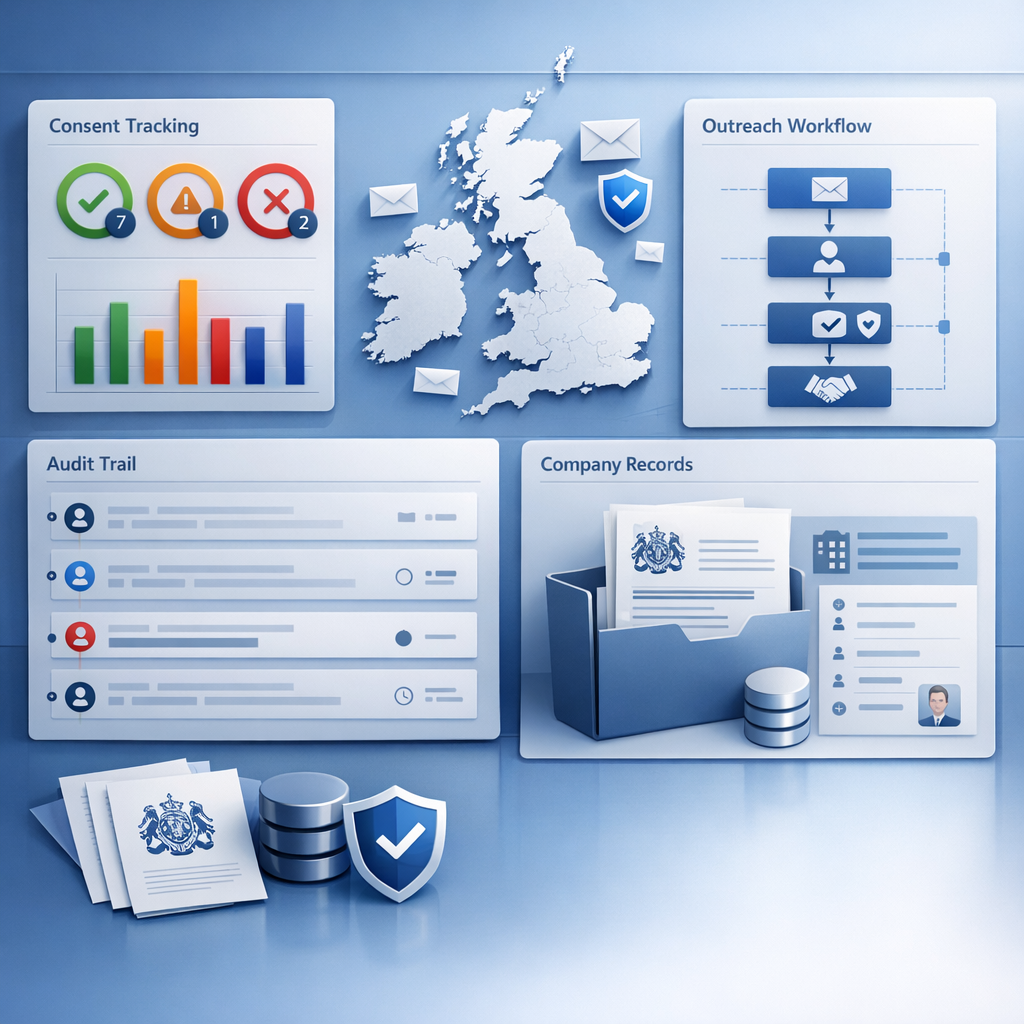
In HelloGrowthCRM, this means your lead model should connect:
- source
- lawful basis or consent status
- form version
- attribution touchpoints
- owner assignment
- lead stage
- next action
- suppression status
That structure helps sales and RevOps work from the same record. It also supports cleaner forecasting through tools like AI Pipeline Management and Sales Forecasting.
In one rollout we did with a 12-person sales team, the biggest issue was not low lead volume. It was that inbound demo requests, gated content sign-ups, and imported Companies House-enriched records all landed in the same stage. Reps treated them the same. Forecasts became unreliable within two weeks.
The UK Information Commissioner’s Office says organisations must be accountable and able to demonstrate compliance with data protection law, not just claim they intended to comply, according to its accountability guidance at ico.org.uk.
The compliance risks sales teams usually miss
The biggest blind spots are usually operational:
- no timestamped consent or lawful basis field
- no version control for forms
- routing based on enrichment before privacy checks
- cookie attribution without clear notice
- outreach triggered automatically without suppression checks
These are fixable. They just need to be designed into the CRM, not handled in spreadsheets later.
What UK laws and guidance shape CRM lead routing and consent workflows?
The UK laws and guidance that shape CRM lead routing and consent workflows are UK GDPR, the Data Protection Act 2018, PECR, and ICO guidance; together they affect what personal data you collect, your lawful basis, how you use cookies and electronic marketing, and how you prove your decisions later.
For B2B teams, the practical reading is simple. UK GDPR and the Data Protection Act 2018 guidance on GOV.UK set the broad data protection rules. PECR adds specific rules for cookies and electronic marketing. The ICO explains how those rules should work in day-to-day practice.
What this means for lead capture
When a prospect fills in a contact form, your team should know:
- why each field is needed
- whether the follow-up is sales response, marketing nurture, or both
- whether consent is required for the use case
- where that record is stored in the CRM
- how the contact can opt out later
A “Book a demo” form is different from a “Download the guide” form. The first is often easier to justify as a direct response to a request. The second often needs more care around marketing permissions and follow-up expectations.
What this means for cookies and attribution
If you use first-party cookies or tracking scripts to identify source and campaign influence, your CRM should store attribution data separately from consent status. That avoids a common mistake where teams treat tracking acceptance and marketing permission as the same thing.
The ICO’s guidance on cookies and similar technologies is clear that consent is needed for non-essential cookies in most cases, and that consent must be freely given, specific, informed, and unambiguous, as explained at ico.org.uk.
Can B2B sales teams use Companies House data in CRM lead routing?
Yes, B2B sales teams can use Companies House data in CRM lead routing, but using Companies House data does not remove your UK GDPR duties; it helps with business enrichment, account matching, territory assignment, and verification, while personal data use still needs a lawful, transparent, and proportionate process.
Companies House is useful because it gives structured business information. Teams can use it to improve record quality, especially when records come in from forms, events, or partner referrals.
Useful enrichment fields often include:
- registered company name
- company number
- SIC code
- registered office location
- company status
- filing history
The official Companies House service is available through GOV.UK and Companies House.
Where Companies House enrichment helps most
Inside HelloGrowthCRM, Companies House data can support:
- account deduplication
- territory rules with Territory Management
- lead-to-account matching
- basic firmographic scoring alongside AI Lead Scoring
- segmentation by region such as London, Manchester, or Birmingham
It is most helpful for account context, not as a shortcut to unrestricted contact marketing.
When I have audited pipelines like this, the safest pattern is to treat Companies House as a business verification layer. It is not a blanket permission layer. If your workflow confuses those two, compliance and rep behaviour both drift quickly.
Limits teams should state clearly
This works well for teams under 50 reps. Above that, expect more complex approval rules, more data sources, and a stronger need for formal governance through Managed RevOps.
How should consent, lawful basis, and audit trails work inside a CRM?
Consent, lawful basis, and audit trails should work inside a CRM as separate but linked records: consent shows permission where needed, lawful basis records why processing happens, and audit trails prove what was collected, when it was collected, and which workflow acted on it afterward.
This separation matters because many teams put a single checkbox called “marketing consent” on every form and call the job done. That creates confusion for SDRs, marketers, and compliance reviewers.
Recommended CRM fields for UK B2B teams
In HelloGrowthCRM, I recommend these core fields on every lead or contact:
| Field | Purpose | Example |
|---|---|---|
| Lead source | Original capture channel | Demo form, webinar, referral |
| Source detail | Campaign or referrer context | LinkedIn Ads, organic search |
| Consent status | Records explicit permission where needed | Granted, refused, not asked |
| Lawful basis | Documents processing reason | Legitimate interests, consent |
| Consent timestamp | Shows when consent was captured | 14/09/2026 10:12 BST |
| Form version | Proves what wording was shown | Demo-v3-UK |
| Cookie consent status | Keeps tracking separate | Analytics yes, ads no |
| Suppression status | Prevents blocked outreach | Unsubscribed |
| Assigned owner | Routes action fast | London SDR queue |
| Lead stage | Supports forecast hygiene | New, working, qualified |
These fields become more useful when paired with Smart Inbox, Sales Task Boards, and Email Automation, because activity and status stay tied to the same record.
What an audit trail should include
A usable audit trail should show:
- who created or updated the record
- when the form was submitted
- what notice or wording was shown
- which automation ran
- when assignment changed
- when outreach started
- whether the contact opted out
That level of visibility helps both compliance reviews and revenue reviews.
What is the best lead routing model for compliant, forecast-friendly sales execution?
The best lead routing model for compliant, forecast-friendly sales execution is one that assigns leads only after source, geography, record quality, and outreach eligibility are checked, then moves them through standard stages that separate new demand, active qualification, and pipeline creation.
Most teams route too early or too loosely. They assign a lead based only on postcode or company size. That may save minutes, but it creates poor follow-up and bad forecasting.
A practical routing model for UK teams
For B2B teams in London, Manchester, and Birmingham, a strong model is:
- Capture lead from form, import, event, or integration.
- Validate key fields and deduplicate against existing account and contact records.
- Enrich with Companies House business data and campaign attribution.
- Check suppression, consent status, and outreach rules.
- Assign by region, segment, account owner, or round robin.
- Stage as New, Accepted, Working, Qualified, or Disqualified.
- Trigger next action with SLA-based tasks.
HelloGrowthCRM supports this with Meeting Scheduler, AI CRM, and CRM Dialer for teams that need fast response while keeping a record of what happened.
Stage design that improves forecasting
Use lead stages that map to clear definitions:
- New: captured, not yet reviewed
- Accepted: routing checks passed and owner assigned
- Working: active outreach or response in progress
- Qualified: passed qualification gate such as MEDDPICC-lite or ICP fit plus meeting booked
- Disqualified: no fit, no authority, duplicate, or suppressed
This creates a cleaner bridge into pipeline stages and makes Pipeline Health Score reviews more reliable.
How to set up UK CRM lead routing and consent rules: Step-by-Step
Setting up UK CRM lead routing and consent rules means designing forms, fields, enrichment, routing logic, suppression checks, and audit logs as one connected workflow so every lead can be traced from first touch to forecast stage without breaking UK privacy and marketing rules.
- Map your lead sources
List every route into the CRM, including forms, imports, events, referrals, and integrations like Gmail or Calendly. Each source needs its own data and consent logic. - Define your CRM data model
Create required fields for source, lawful basis, consent status, consent timestamp, form version, region, owner, and stage. Keep cookie consent separate from outreach permission. - Build form-level notices and checkboxes carefully
Use plain language. Only ask for consent where needed. Make sure optional marketing opt-ins are not bundled into service or demo requests. - Set up cookie-triggered attribution with controls
Capture campaign and source data only in line with your cookie setup and notice. Store attribution for reporting in Revenue Attribution without overwriting contact permissions. - Add Companies House enrichment after capture
Match by company name, domain, or submitted company number where available. Pull business fields for account context, not as a proxy for personal outreach permission. - Create assignment rules
Route by territory, named account, round robin, or segment. Use Territory Management if you split ownership across London, Manchester, and Birmingham teams. - Apply suppression and outreach checks
Before Email Automation or calling tasks trigger, check unsubscribes, bounces, previous objections, and restricted statuses. This step prevents the worst compliance mistakes. - Standardise lead stages and SLAs
Define how long a lead can sit in New or Accepted. For example, demo requests might need a 15-minute target while content leads may allow a same-day review. - Log every workflow action
Keep timestamps for routing, reassignment, field changes, and first outreach. This is essential for auditability and for manager coaching. - Test with real scenarios
Run examples from a London inbound form, a Manchester webinar lead, and a Birmingham imported target account. Confirm both routing speed and record quality before launch.
What should teams compare when choosing a compliant CRM workflow setup?
Teams choosing a compliant CRM workflow setup should compare not just features but control points: form versioning, consent fields, suppression checks, audit history, attribution visibility, assignment logic, and how well lead stages support accurate forecasting for managers and finance.
Because HelloGrowthCRM is our product, I should be clear about the limitation here: every vendor will say they support compliance. What matters is whether your team can actually operate the process without custom workarounds.
Comparison table: compliant workflow essentials
| Capability | Basic CRM setup | HelloGrowthCRM approach |
|---|---|---|
| Form consent capture | Often limited to one generic checkbox | Flexible fields and clearer workflow mapping |
| Cookie-based attribution | Often split across tools | Connected with Revenue Attribution and CRM records |
| Companies House-style enrichment workflow | Usually external and manual | Easier to structure through integrations and field mapping |
| Assignment rules | Simple round robin | Territory, segment, account owner, and SLA-based routing |
| Audit trail | Activity history only | Better operational visibility across routing and follow-up |
| Forecast-friendly lead stages | Often inconsistent by rep | Standard stage design tied to qualification and forecasting |
| Follow-up execution | Separate inboxes and tools | Unified workflows with Smart Inbox and tasking |
| UK team rollout support | Self-serve only in many tools | Option for Demo, Free Trial, or Managed RevOps |
What good looks like in practice
A good setup lets a manager answer these questions in seconds:
- Where did this lead come from?
- What notice or consent status applied?
- Why was it assigned to this rep?
- Has first follow-up happened inside SLA?
- Is this a forecastable qualified lead yet?
If your CRM cannot answer those quickly, the workflow is not mature enough.
British B2B teams that want a compliant, forecast-friendly sales process can explore HelloGrowthCRM Features, review Pricing, or book a Demo to see how lead capture, routing, attribution, and auditability work together in one system.
About the author
Oliver Grant is a Sales Operations Lead at HelloGrowthCRM with 11 years of experience in B2B SaaS revenue operations, CRM design, and pipeline governance. He has led CRM and lead management rollouts for UK sales teams ranging from five to 80 reps. One project that informed this article was a rebuild of a multi-region inbound routing process for a London-based software company, where Companies House enrichment, form governance, and SLA routing were tied directly to forecast stages and compliance reviews.
Frequently Asked Questions
Q: Can I use Companies House data to cold email business contacts in the UK?
A: Companies House data can support account research and enrichment, but it does not automatically give you permission to cold email business contacts in the UK. You still need to assess UK GDPR and PECR duties, your lawful basis, and whether your outreach is fair, targeted, and properly documented.
Q: Do B2B sales forms always need a consent checkbox in the UK?
A: B2B sales forms do not always need a consent checkbox in the UK, because the right setup depends on the purpose of the form and the follow-up you plan. A demo request and a marketing newsletter sign-up are different cases, so your form design should reflect that.
Q: What should I store in my CRM as proof of consent or compliance?
A: You should store consent or compliance proof in your CRM as timestamps, source records, form version, notice wording, lawful basis, and audit history. That makes it easier to explain why a contact was processed and what happened after capture.
Q: How fast should routed inbound leads be followed up?
A: Routed inbound leads should be followed up as fast as your team can realistically maintain with quality and consistency. High-intent demo requests often need near-immediate action, while lower-intent content leads can follow a slower, controlled review path.
Q: Does cookie consent affect CRM attribution data?
A: Cookie consent does affect CRM attribution data when your attribution relies on non-essential cookies or similar tracking technologies. The safest setup is to keep attribution data and marketing permissions as separate records so reporting does not override privacy choices.
Q: What lead stages work best for forecasting in a UK B2B CRM?
A: The lead stages that work best for forecasting in a UK B2B CRM are stages with clear entry and exit rules, such as New, Accepted, Working, Qualified, and Disqualified. This structure helps managers separate raw demand from leads that have genuinely passed qualification.
Q: Is HelloGrowthCRM suitable for smaller British sales teams?
A: HelloGrowthCRM is suitable for smaller British sales teams when they need one system for capture, routing, follow-up, and reporting without heavy admin overhead. It is especially useful for teams that want compliance visibility without stitching together many point tools.
Q: What is the biggest compliance mistake in CRM lead routing?
A: The biggest compliance mistake in CRM lead routing is treating data capture, attribution, routing, and outreach as separate tasks with no shared record. That gap leads to missing consent evidence, poor suppression controls, and unclear accountability when problems appear.
Frequently Asked Questions
Ready to put this into practice?
Set up your pipeline, WhatsApp follow-ups, and AI lead scoring in minutes — free, no credit card.
Try HelloGrowthCRM freeGet CRM tips in your inbox
Join thousands of sales professionals who get weekly insights on CRM strategy, AI automation, and pipeline optimization.

The HelloGrowthCRM team publishes guides on CRM strategy, AI sales tools, and revenue operations for small business sales teams.