Overview
ActiveCampaign pairs email marketing with a powerful automation builder — and its automations are only as good as the signals feeding them. The HelloGrowthCRM integration syncs contacts and fires tag and field updates as leads move through your pipeline, so ActiveCampaign automations can react to sales reality: a lead qualifying, a quote going out, a deal stalling, a customer closing.
Teams typically run this in one of two shapes. Marketing-led teams capture and nurture in ActiveCampaign, then hand qualified leads into the CRM pipeline with history attached. Sales-led teams work everything in the CRM and use ActiveCampaign purely as the nurture engine, triggered by stage changes and tags. Both work; the integration's field and tag mapping is flexible enough to support either without double data entry.
What data is involved
- Contacts synced between CRM and ActiveCampaign matched on email address.
- CRM pipeline stages pushed as ActiveCampaign tags or custom fields to trigger automations.
- CRM tags mapped to ActiveCampaign tags for shared segmentation.
- Deal-won and deal-lost events available as automation triggers.
- Owner and source fields synced for routing and attribution.
- Unsubscribe status honoured both ways so consent stays consistent.
Step-by-step setup
Setup at a glance (3-5 bullets)
- In ActiveCampaign, open Settings → Developer and copy your API URL and API key.
- Open Settings → Integrations → ActiveCampaign and paste both values.
- Pick the ActiveCampaign list new CRM contacts should join, and map field pairs — name, email, phone, and any custom fields.
- Decide which CRM changes apply tags or fire automations, such as tagging proposal-sent when a deal reaches that stage; enable deal-stage webhooks if available.
- Sync a test contact, confirm it lands in the list with fields and tags intact, and watch the automation trigger in ActiveCampaign.
Sign in or sign up at HelloGrowthCRM. Open the login page, enter your credentials (or use Google), or choose Sign up if you need a new account. You must be signed in before you can open Settings and connect this integration.
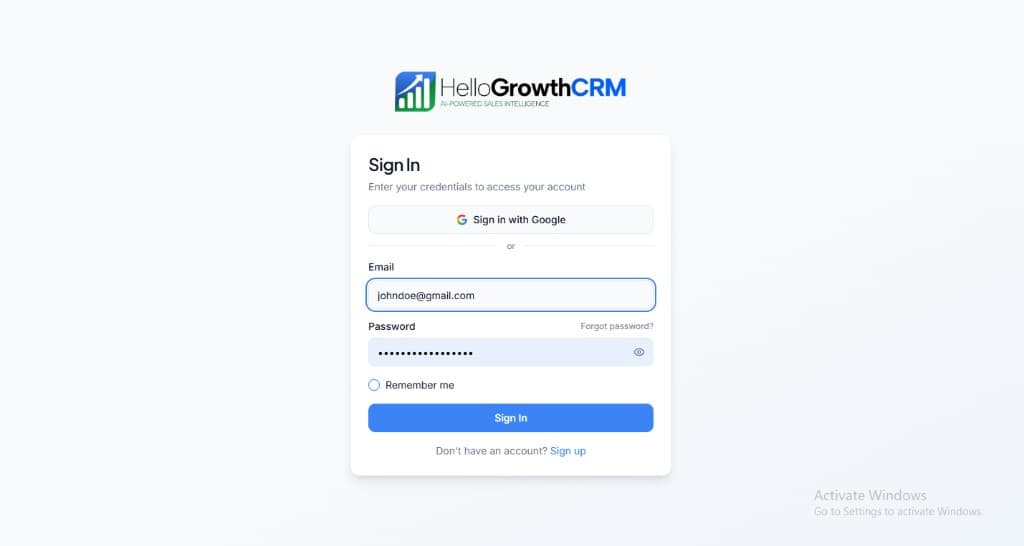
Open login page(opens in a new tab)app.hellogrowthcrm.com/login
Open Settings. In the left sidebar, under Admin, click Settings (you will land on the Settings area; the URL is app.hellogrowthcrm.com/settings).
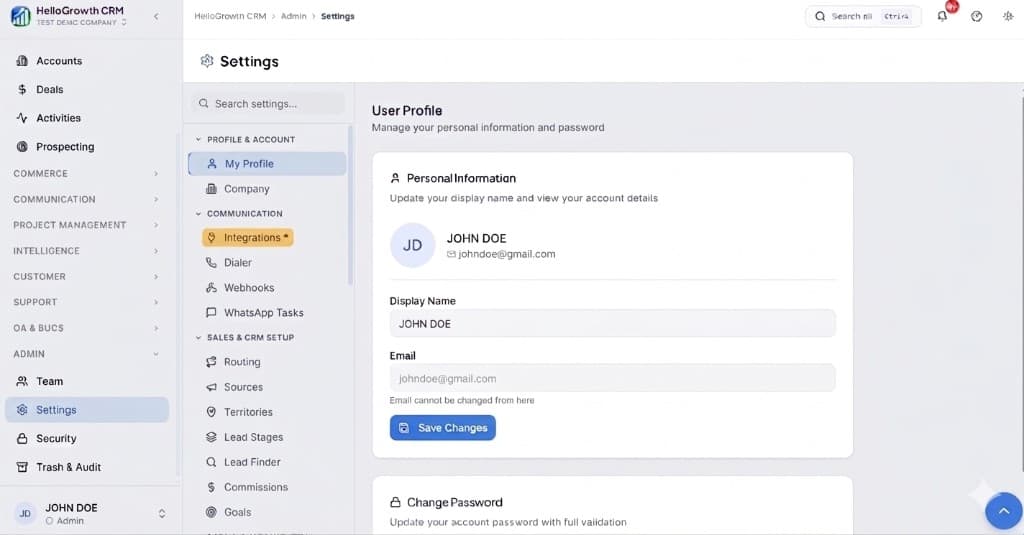
Open Settings(opens in a new tab)app.hellogrowthcrm.com/settings
Go to Integrations. On the Settings screen, use the middle settings menu. Under COMMUNICATION, click Integrations (star icon). Then find and configure this connector—the connector-specific steps below pick up from here.
Open Settings (Integrations)(opens in a new tab)app.hellogrowthcrm.com/settings
- In ActiveCampaign, open Settings → Developer and copy your API URL and API key.
- Open Settings → Integrations → ActiveCampaign and paste both values.
- Pick the ActiveCampaign list new CRM contacts should join, and map field pairs — name, email, phone, and any custom fields.
- Decide which CRM changes apply tags or fire automations, such as tagging proposal-sent when a deal reaches that stage; enable deal-stage webhooks if available.
- Sync a test contact, confirm it lands in the list with fields and tags intact, and watch the automation trigger in ActiveCampaign.
Best practices
- Pick one direction of truth per field — let the CRM own lifecycle stage and ActiveCampaign own email engagement, and map accordingly.
- Use tags, not lists, as the main automation trigger surface; tags map cleanly to CRM pipeline events.
- Suppress active-deal contacts from broad campaigns so nurture email never undercuts a live negotiation.
- Trigger a win-back automation off deal-lost with a reason field, and tailor the sequence to why the deal was lost.
- Audit automations quarterly against your current pipeline stages — renamed stages silently orphan old triggers.
Best for & common use cases
Small marketing-plus-sales teams running nurture automations in ActiveCampaign while pipeline ownership stays in the CRM.
- Start a re-engagement automation when a rep marks an opportunity lost or recycled.
- Tag contacts by deal stage so ActiveCampaign sends stage-appropriate emails.
- Suppress marketing sends once a deal hits negotiation so reps own the conversation.
Expected outcomes
- Faster lead handoff between tools and CRM owners
- Cleaner activity history for follow-up and reporting
- Lower manual copy-paste errors in the pipeline
Troubleshooting
- Automation didn't fire: the trigger tag name in ActiveCampaign doesn't exactly match the tag the CRM sends — tag matching is exact, check spelling and case.
- Fields overwriting each other: both systems are set as writers for the same field — set one side to read-only in the field mapping.
- Sync stopped after password change: the API key was regenerated — paste the new key from ActiveCampaign's Developer settings into the CRM integration page.
FAQ
Governance
Treat API keys and webhooks as production secrets. Align field mapping with your privacy policy and regional regulations (GDPR, marketing consent, telemarketing rules). Your admin controls which roles can install or edit integrations.
Related integrations in this category

Developer-friendly transactional email API with high deliverability for CRM notifications and system mail.

Syncs CRM leads and contacts to Mailchimp audiences with a one-way push.

Creates and updates contacts in Brevo lists with field mapping and tags.
Pushes customer profiles and CRM lifecycle events (lead created, deal won, etc.) to Klaviyo.
Syncs CRM contacts to Constant Contact lists for email campaigns, event marketing, and list segmentation with field mapping.
High-volume transactional and marketing email delivery with CRM-triggered sends and bounce/engagement webhooks.
Rich CRM notifications in Slack channels (new leads, deal updates, task reminders).

CRM notifications with rich embeds via webhook to your server channels.