Overview
Zoho Inventory manages stock, orders, and fulfilment for product businesses — and product businesses have a question sales teams ask forty times a day: "do we have it, and when can they get it?" The HelloGrowthCRM integration connects pipeline to stock, so reps see item availability from the deal, and confirmed orders flow into inventory without the retyping step where quantity errors are born.
The customer-facing payoff is honest commitments. A rep quoting delivery on stock they can see commits accurately; one quoting blind commits optimistically and apologises later. For businesses selling from a catalog — distributors, wholesalers, D2C brands with B2B channels — the integration turns the sales conversation into one grounded in what the warehouse actually holds.
What data is involved
- Item availability from Zoho Inventory visible when composing quotes and deals.
- Won deals convertible to sales orders in Zoho Inventory without re-entry.
- Customer records aligned between CRM accounts and Zoho Inventory contacts.
- Order and fulfilment status reflected back on the CRM deal timeline.
- Product catalog and pricing referencable from CRM line items.
- Stock-out and low-stock signals available to sales before committing dates.
Step-by-step setup
Setup at a glance (3-5 bullets)
- Settings → Integrations → Zoho Inventory → OAuth or API → mapping.
Sign in or sign up at HelloGrowthCRM. Open the login page, enter your credentials (or use Google), or choose Sign up if you need a new account. You must be signed in before you can open Settings and connect this integration.
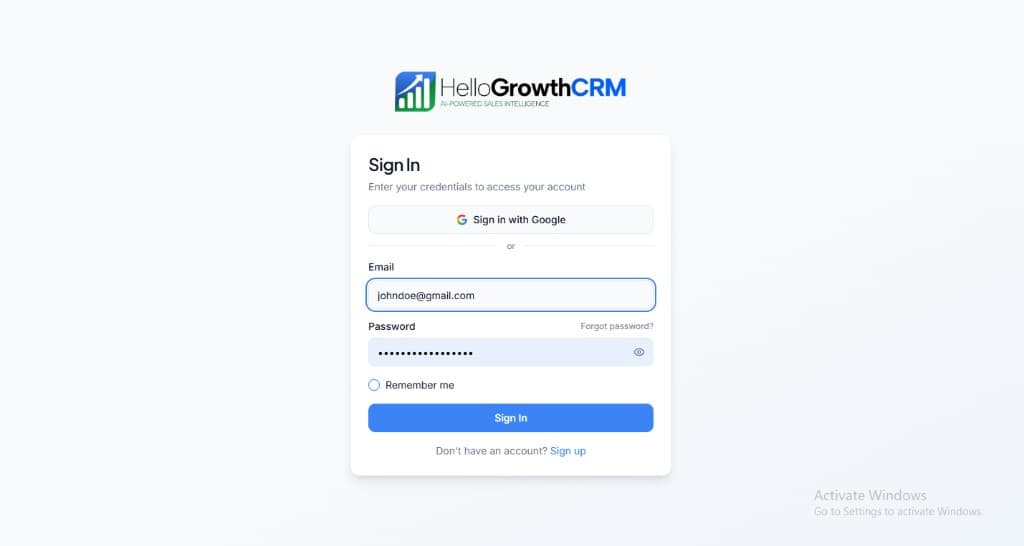
Open login page(opens in a new tab)app.hellogrowthcrm.com/login
Open Settings. In the left sidebar, under Admin, click Settings (you will land on the Settings area; the URL is app.hellogrowthcrm.com/settings).
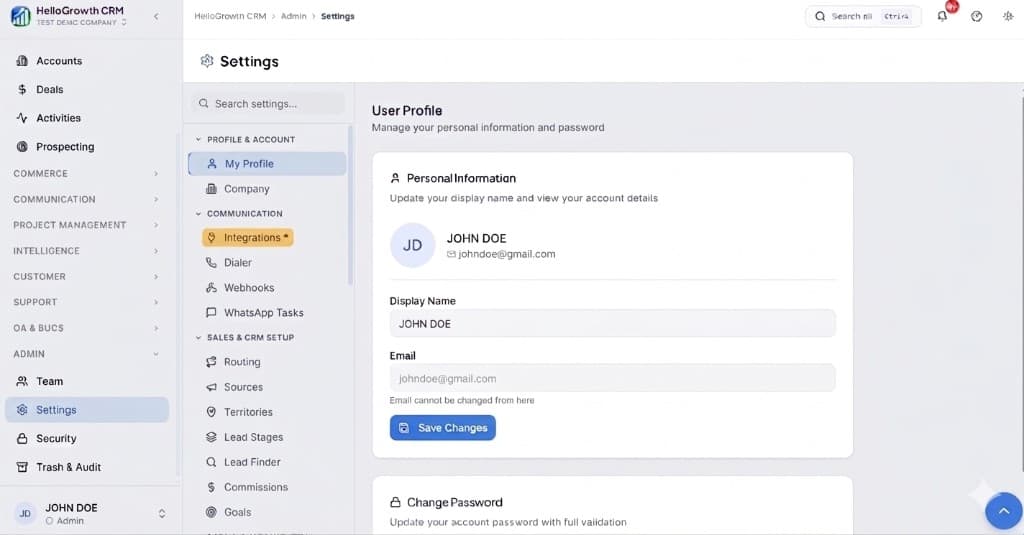
Open Settings(opens in a new tab)app.hellogrowthcrm.com/settings
Go to Integrations. On the Settings screen, use the middle settings menu. Under COMMUNICATION, click Integrations (star icon). Then find and configure this connector—the connector-specific steps below pick up from here.
Open Settings (Integrations)(opens in a new tab)app.hellogrowthcrm.com/settings
- Settings → Integrations → Zoho Inventory → OAuth or API → mapping.
Best practices
- Quote from the synced catalog, not memory — price and availability drift is where margin quietly leaks.
- Convert won deals to sales orders automatically and keep edits in Zoho Inventory; one writer per document class keeps audits sane.
- Surface low-stock flags to reps so they sell what's fulfillable this week and backorder the rest deliberately.
- Keep the CRM as the source of truth for customer contact details and push to Inventory, mirroring the accounting-integration pattern.
- Reconcile order statuses weekly at first; trust in the sync is built by checking it early, then automating confidently.
Best for & common use cases
Real-time stock when talking to customers.
- Available-to-promise conversations on calls.
Expected outcomes
- Faster lead handoff between tools and CRM owners
- Cleaner activity history for follow-up and reporting
- Lower manual copy-paste errors in the pipeline
Troubleshooting
- Stock showing stale: sync interval too wide for fast-moving SKUs — tighten it, or check the Zoho API limits on your plan.
- Order creation failing: an item on the deal doesn't exist in Inventory — align SKUs or add the item before converting.
- Duplicate customers in Inventory: pre-existing records spelled differently — merge in Zoho Inventory once; matching holds thereafter.
FAQ
Governance
Treat API keys and webhooks as production secrets. Align field mapping with your privacy policy and regional regulations (GDPR, marketing consent, telemarketing rules). Your admin controls which roles can install or edit integrations.
Related integrations in this category
Marketplace orders, inventory, fulfillment, returns, and channel data.
Order shipment status, courier assignment, tracking milestones, and exception visibility inside CRM timelines.
Shipment tracking with AWB, status, NDR, returns, and ETA.
Waybill tracking, delivery attempts, POD, and returns.
Syncs customers, quotations, orders, invoices, items, stock, warehouses, and payment status.
AI models powering CRM features: drafting, classification, summarization, and workflow copilots.
AI call transcription and diarization for dialer recordings with searchable text in CRM.
Custom OpenAI key for tenant's AI features