HelloGrowthCRM software
Built for real small-business sales teams
HelloGrowthCRM helps reps qualify faster, follow up on time, and close more deals—with practical automation in one place.
- AI lead scoring and pipeline visibility
- Built-in dialer, WhatsApp, and email automation
- Sales forecasting and RevOps-ready reporting
AI lead qualification workflows are automated CRM processes that capture inbound signals, score fit and intent, route leads to the right owner, and trigger timely follow-up so sales teams can respond faster, prioritize better, and increase pipeline coverage without hiring more SDRs.
For B2B teams, the goal is not to replace judgment. It is to remove repetitive work that slows response time, causes routing mistakes, and leaves good inbound leads untouched. In HelloGrowthCRM, that usually means combining AI Lead Scoring, automated assignment rules, and guided follow-up inside an AI CRM so reps spend more time talking to qualified buyers.
Key Takeaways
- AI lead qualification workflows help teams reduce manual SDR tasks by automating scoring, routing, enrichment, and follow-up triggers.
- The best workflows combine fit data, intent signals, and response-time rules instead of relying on one static lead score.
- Speed-to-lead improves when qualification and next-step automation happen in the same CRM, not across disconnected tools.
- Teams should start with a narrow workflow, measure SLA adherence and meeting conversion, then expand to more channels and segments.
- HelloGrowthCRM fits best when you need one system for AI scoring, workflow automation, rep execution, and optional Managed RevOps support.
What are AI lead qualification workflows?
AI lead qualification workflows are rule-based and model-assisted sequences that decide whether a lead matches your ideal customer profile, how urgent it is, who should own it, and what action should happen next. They help sales teams qualify faster by turning raw inbound activity into prioritized, actionable work.
In practice, these workflows sit between lead capture and human outreach. They pull in form data, campaign source, firmographic details, website behavior, meeting requests, and prior email engagement. Then they evaluate the lead against clear criteria.
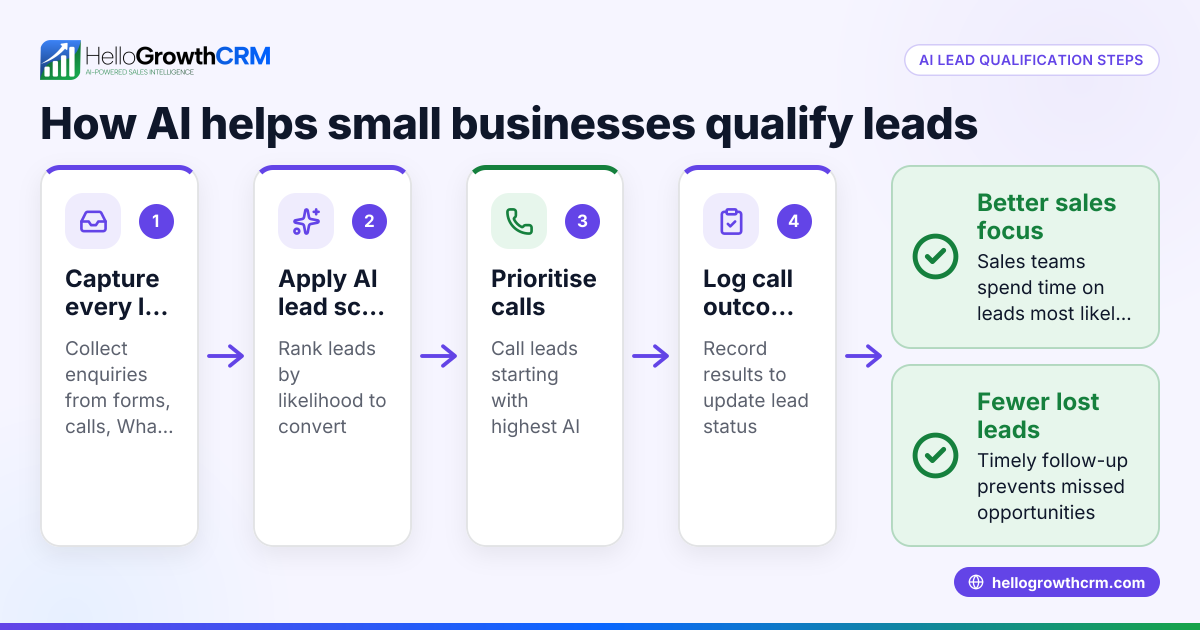
A simple workflow might do four things in under a minute:
- Score account fit by company size, industry, region, and role.
- Score intent by page visits, form type, reply behavior, or demo request.
- Route the lead to the right queue, rep, or territory.
- Trigger a follow-up sequence if the lead meets a threshold.
That sounds basic, but it solves a common revenue problem. In many teams, inbound volume grows faster than SDR capacity. When that happens, reps cherry-pick, SLAs slip, and MQLs pile up. A structured workflow inside Features can prevent that operational drift.
What AI should actually decide
AI should support decision-making, not hide it. For qualification, I recommend using AI for:
- Pattern detection in conversion history
- Lead score weighting updates
- Suggested next actions
- Risk flags for incomplete or conflicting data
- Auto-generated summaries for rep handoff
It should not fully replace your qualification framework. If your team uses BANT, MEDDPICC, or custom ICP criteria, keep those definitions visible and auditable.
Why do sales teams use AI lead qualification workflows now?
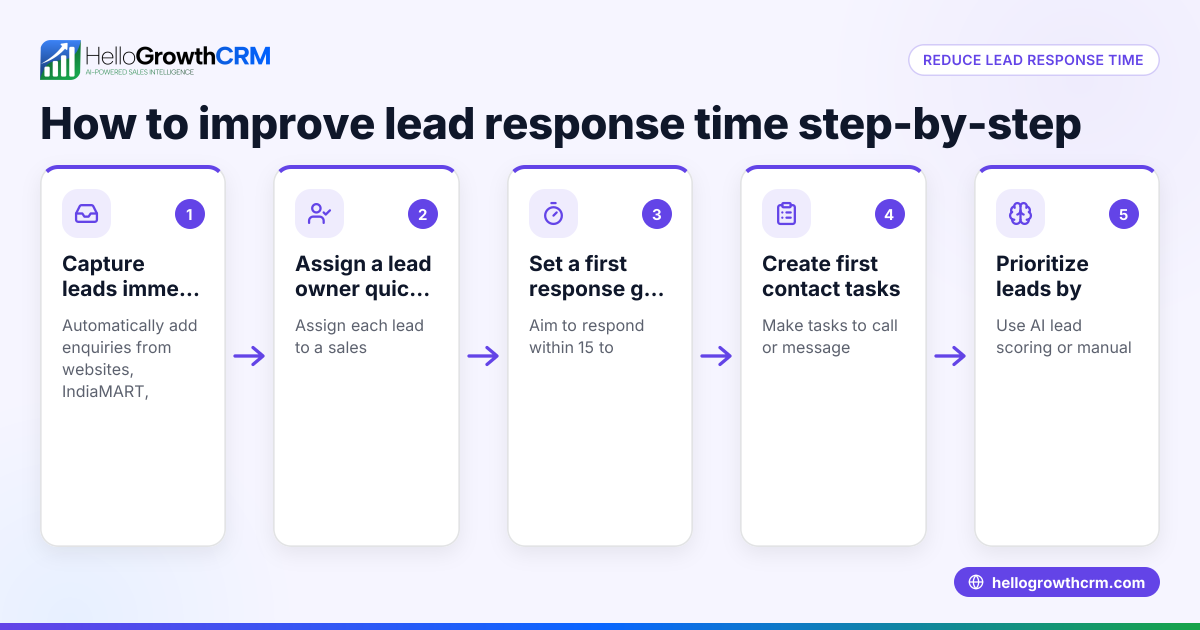
Sales teams use AI lead qualification workflows now because inbound volume, channel complexity, and buyer expectations have outgrown manual triage. These workflows help teams respond within SLA, focus rep time on higher-probability leads, and create consistent qualification logic without adding headcount every time demand increases.
Speed matters more than most teams admit. When I have audited inbound funnels like this, the issue is rarely a total lack of leads. It is usually delayed action. Leads wait in a generic queue. Routing rules break. Reps do not know which inbound requests deserve immediate attention.
Harvard Business Review reported that firms that tried to contact potential customers within an hour were nearly seven times as likely to have meaningful conversations with decision-makers as those that waited even an hour longer.
That finding is old, but the operating truth still holds. Faster response improves connect rates. Better prioritization improves rep focus. AI helps with both when it is attached to execution.
Manual qualification breaks at predictable points
Most teams feel the pain in the same places:
- Form fills from mixed buyer quality
- Uneven follow-up by rep
- Duplicate records across tools
- Routing errors by geography or segment
- No clear action for mid-score leads
- SDR time spent on data cleanup instead of outreach
In one rollout we did with a 12-person sales team, the biggest gain came from removing manual assignment from demo requests. Before automation, leads sat unowned for hours when managers were in meetings. After automated routing and task creation, reps started outreach far more consistently.
The real business case
The business case is not “AI is faster.” It is more specific:
- Lower cost per qualified meeting
- Better SLA compliance
- More pipeline from existing demand
- Less dependence on SDR headcount growth
- Cleaner handoff between marketing and sales
If you want to estimate the financial impact, use a tool like the CRM ROI Calculator before changing your process.
Which parts of lead qualification should be automated first?
The best parts of lead qualification to automate first are scoring, routing, SLA alerts, and first-touch follow-up because they are repetitive, measurable, and easy to govern. Start there before automating complex nurture logic or multi-touch qualification paths that require more data quality and tighter cross-team alignment.
Start with the tasks that create delay, not the tasks that look impressive in a demo.
1. Fit scoring
Use explicit attributes such as:
- Company size
- Industry
- Region
- Revenue band
- Role seniority
- Existing tech stack if available
This is where AI Lead Scoring does useful work. It helps weight attributes based on what actually converts, not just what your team assumes matters.
2. Intent scoring
Intent signals often separate casual interest from active evaluation. Good signals include:
- Demo request submission
- Pricing page visits
- Repeat visits in a short window
- Email reply or meeting click
- High-value content downloads
- Product page depth
A lead with moderate fit and high intent often deserves faster action than a perfect-fit lead with weak activity.
3. Automated routing
Routing should follow practical ownership rules:
- Territory
- Segment
- Product line
- Round-robin within team
- Named-account overrides
- Partner or channel paths
If routing happens outside the CRM, errors multiply. Keeping it inside HelloGrowthCRM, with Territory Management and task automation, shortens time to first touch.
4. Follow-up triggers
Not every qualified lead needs an SDR call first. Some need a scheduler link, some need a short email sequence, and some need instant rep notification through Slack or Gmail.
Gartner identifies CRM as a core sales technology for managing customer interactions and improving commercial execution across the funnel.
What does a high-performing AI lead qualification workflow look like?
A high-performing AI lead qualification workflow combines clear qualification criteria, reliable data inputs, dynamic lead scoring, instant routing, and channel-specific follow-up triggers. It works best when every step has an owner, a measurable SLA, and a defined fallback path for incomplete or ambiguous leads.
The biggest mistake is treating this as one score and one handoff. Strong workflows are branching systems. They adapt based on fit, urgency, source, and rep availability.
| Workflow layer | What it does | Best practice | Common mistake |
|---|---|---|---|
| Capture | Collects inbound lead and activity data | Standardize forms and source mapping | Missing UTM or owner fields |
| Enrichment | Adds firmographic or account context | Validate key fields before scoring | Scoring incomplete records |
| Scoring | Ranks fit and intent | Use separate fit and intent scores | One opaque score with no explanation |
| Routing | Assigns owner or queue | Apply territory and segment rules | Manual reassignment after delay |
| Action | Triggers follow-up | Match action to lead urgency | Same sequence for every lead |
| Review | Measures outcomes | Audit SLA, meetings, and conversion | No closed-loop learning |
The minimum workflow most B2B teams need
For many teams under 50 reps, this baseline is enough:
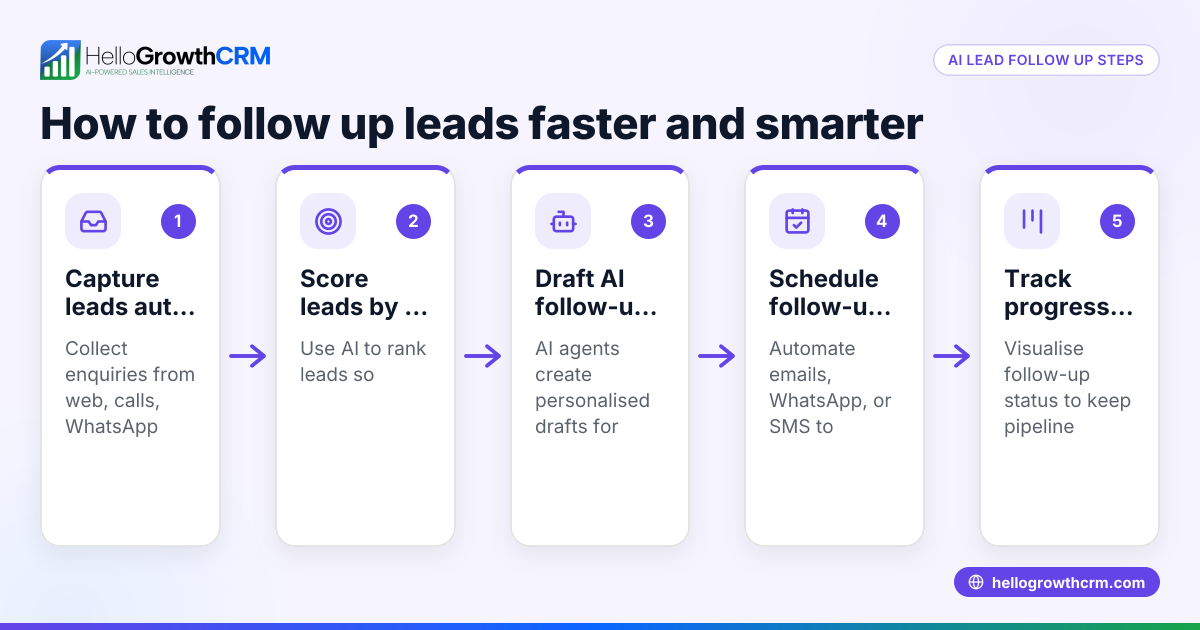
- Capture every inbound source into one AI CRM
- Score fit and intent separately
- Route hot leads instantly
- Trigger task plus email for warm leads
- Send low-fit leads to nurture
- Alert managers when SLA is missed
That setup is often more valuable than a complex AI stack with weak adoption.
Where HelloGrowthCRM fits
HelloGrowthCRM is strongest when you want one environment for qualification, execution, and reporting. You can combine AI Pipeline Management, Smart Inbox, Meeting Scheduler, and Revenue Attribution without stitching together multiple point tools.
Disclosure: HelloGrowthCRM is our product, so this article reflects that operating model. If you already run a mature enterprise stack, you may still keep some external enrichment or BI tools. But for most growth-stage B2B teams, fewer systems usually means better speed and cleaner accountability.
How to build ai lead qualification workflows: Step-by-Step
Building AI lead qualification workflows starts with clear ICP and SLA definitions, then adds data capture, scoring logic, routing rules, follow-up automation, and reporting. The fastest path is to launch one inbound workflow first, prove conversion impact, and refine thresholds weekly with sales and RevOps input.
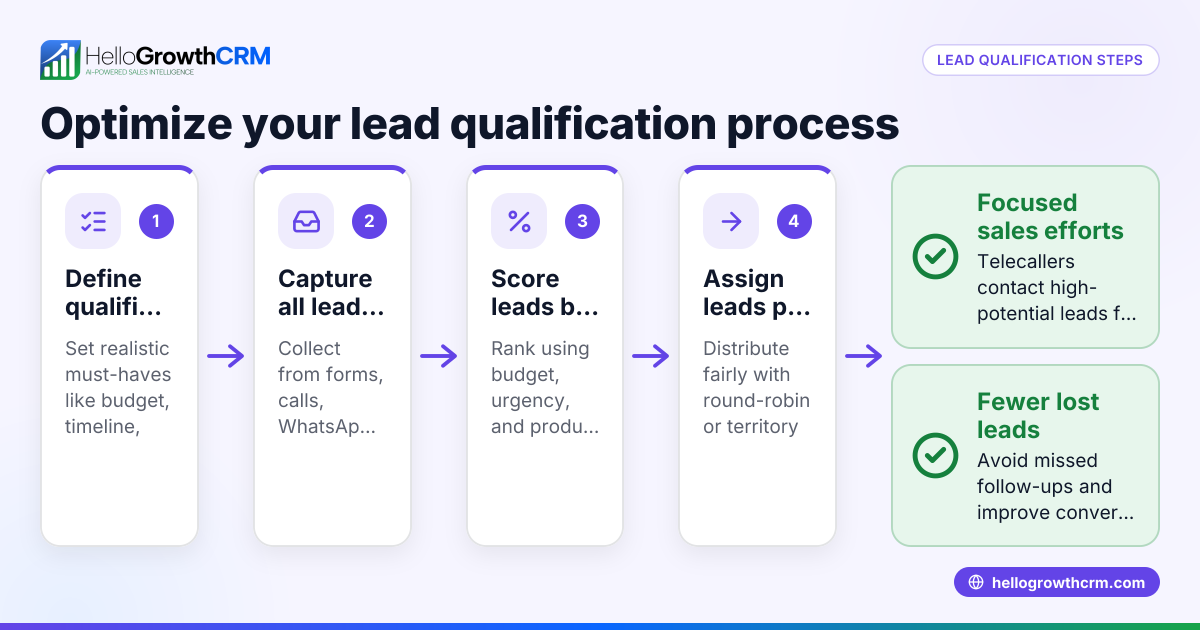
- Define qualification criteria
Set your ICP, disqualifiers, and urgency signals. Use explicit fields like employee count, geography, role, and demo intent. - Map inbound sources
List every path into the CRM, including forms, chat, email, ads, referrals, and partner leads. If needed, connect sources through Zapier or All Integrations. - Create separate fit and intent scores
Do not hide everything in one number. Fit shows strategic value. Intent shows timing. This split helps reps know why a lead is prioritized. - Set routing rules and exceptions
Build ownership by segment, region, account list, or round-robin. Include fallback rules for missing data and rep absence. - Trigger first-touch actions
For hot leads, create a rep task, alert the owner, and start immediate outreach. For warm leads, use Email Automation or a scheduler path. - Add rep guidance
Provide a short AI summary with source, pages viewed, score reason, and recommended talk track. AI Sales Copilot helps reduce prep time before first contact. - Monitor operational metrics weekly
Review speed-to-lead, contact rate, meeting rate, and stage conversion. Use a tool like Pipeline Health Score to catch bottlenecks early. - Refine with closed-loop feedback
Reps should tag false positives and false negatives. That feedback improves routing logic and score quality over time.
Metrics to track from day one
Track a small set of metrics first:
- Median speed-to-lead
- SLA attainment rate
- Contact rate by source
- Meeting booked rate
- Qualified opportunity rate
- False-positive rate in lead scoring
In one implementation I led for a SaaS team selling into mid-market operations leaders, we found the highest-scoring leads were not always the fastest-converting. Demo request type and repeat website visits predicted urgency better than company size. Once we separated fit from intent, rep prioritization improved quickly.
What are the biggest mistakes with AI lead qualification workflows?
The biggest mistakes with AI lead qualification workflows are automating bad process, relying on weak data, hiding scoring logic from reps, and measuring only volume instead of revenue outcomes. These mistakes create false confidence, poor adoption, and more operational work instead of less.
AI does not fix unclear qualification. It scales it.
Mistake 1: Starting with too many branches
If your workflow needs a diagram to explain basic inbound triage, it is too complex. Start simple. Add nuance after you have clean data and stable routing.
Mistake 2: Ignoring rep trust
Reps need to know why a lead is marked hot. If they cannot see the score drivers, they will override the system or ignore it.
Mistake 3: Failing to define a fallback path
Some leads arrive with partial data. Decide what happens when key fields are missing. Common fallback paths include:
- Assign to a review queue
- Trigger enrichment
- Send a clarification email
- Route by source owner temporarily
Mistake 4: No RevOps owner
Someone must own workflow quality. For smaller teams, that may be a sales ops manager. For leaner teams, Managed RevOps can be a practical way to keep qualification logic, routing, and reporting aligned without hiring a full internal operations function.
This also has limits. If you have complex enterprise account hierarchies, strict regional compliance needs, or many product lines, expect more implementation work and tighter governance than a simple growth-stage setup.
Ready to improve response time without adding SDR headcount? Explore HelloGrowthCRM’s AI CRM, review Pricing, or start a Free Trial. If you want help designing the workflow itself, book a Demo and we can show how scoring, routing, and follow-up work together in one system.
About the author
Rohan Mehta is a Sales Operations Lead at HelloGrowthCRM with 10 years of experience in B2B SaaS revenue operations, CRM design, and pipeline management. He has led inbound routing, lead scoring, and SLA improvement projects for sales teams ranging from 5 to 80 reps. One project that shaped this article was a full qualification workflow redesign for a 12-person SaaS sales team that needed to improve speed-to-lead without expanding SDR headcount. His work focuses on practical automation that sales teams actually adopt.
Frequently Asked Questions
Q: What are ai lead qualification workflows?
A: AI lead qualification workflows are automated CRM processes that score, route, and trigger follow-up for inbound leads based on fit and intent. They help sales teams respond faster, reduce manual SDR work, and focus rep time on leads with a higher chance of converting.
Q: Can AI qualify leads without human SDRs?
A: Yes, AI can qualify many leads without human SDRs for initial triage, scoring, routing, and first-touch actions. Most B2B teams still need human reps for nuanced discovery, complex buying signals, and exception handling on strategic accounts.
Q: How does AI lead scoring differ from lead qualification?
A: AI lead scoring differs from lead qualification because scoring is one input, while qualification is the full decision process. Qualification also includes routing, ownership, SLA handling, follow-up actions, and disqualification rules based on your sales process.
Q: What data is needed for ai lead qualification workflows?
A: AI lead qualification workflows need firmographic, demographic, behavioral, and source data to work well. The most useful inputs are company size, role, region, form type, page visits, reply behavior, and historical conversion outcomes.
Q: How quickly should inbound leads be contacted?
A: Inbound leads should be contacted as quickly as possible, ideally within minutes for high-intent requests like demos. Faster response usually improves connect and meeting rates, especially when the lead is actively evaluating vendors.
Q: Are ai lead qualification workflows only for large sales teams?
A: No, AI lead qualification workflows are not only for large sales teams. Smaller teams often benefit more because automation protects rep time, enforces follow-up discipline, and delays the need to hire more SDRs.
Q: How do I know if my workflow is working?
A: You know your workflow is working when speed-to-lead, SLA attainment, contact rate, and qualified meeting rate improve without a matching increase in headcount. You should also see fewer unowned leads and clearer routing accountability.
Frequently Asked Questions
Ready to put this into practice?
Set up your pipeline, WhatsApp follow-ups, and AI lead scoring in minutes — free, no credit card.
Try HelloGrowthCRM freeGet CRM tips in your inbox
Join thousands of sales professionals who get weekly insights on CRM strategy, AI automation, and pipeline optimization.

The HelloGrowthCRM team publishes guides on CRM strategy, AI sales tools, and revenue operations for small business sales teams.