HelloGrowthCRM software
Built for real small-business sales teams
HelloGrowthCRM helps reps qualify faster, follow up on time, and close more deals—with practical automation in one place.
- AI lead scoring and pipeline visibility
- Built-in dialer, WhatsApp, and email automation
- Sales forecasting and RevOps-ready reporting
Cold outreach CRM workflow for US B2B sales teams is the process of running prospecting in one system, from lead capture to reply handling to pipeline updates. Done well, it keeps email, calling, and WhatsApp activity tied to the right account, contact, and rep so your team can scale outbound without losing follow-up, compliance, or forecast accuracy.
Key takeaways
- A strong cold outreach workflow starts with clean lists, clear stages, and firm ownership rules.
- Email, calling, and WhatsApp work better when every touchpoint updates the same CRM record.
- Reps need simple sequence rules for next steps, reply handling, and disqualification.
- Managers need activity, conversion, and stage data to spot bottlenecks early.
- US teams should build outreach with CAN-SPAM and TCPA in mind, especially for email and phone.
- The best CRM workflow is the one your reps will actually follow every day.
What is a cold outreach CRM workflow for US B2B sales teams?
A cold outreach CRM workflow for US B2B sales teams is a structured process for prospecting into target accounts using email, phone, and WhatsApp while keeping every action inside the CRM. It connects list building, lead routing, sequencing, reply handling, meetings, and pipeline movement.
In practice, that means a rep in Chicago can send an introductory email, place a call, log a voicemail, send a WhatsApp follow-up when appropriate, and book a meeting without opening five disconnected tools. The manager sees the account history, the next task, and the likely deal path in one place.
This matters because outbound breaks down fast when channels are scattered. One rep tracks follow-ups in a spreadsheet. Another keeps notes in their inbox. A third forgets to update the opportunity. Soon the pipeline looks fuller than it is, forecast calls become guesswork, and good leads go cold.
A CRM workflow fixes this by defining:
- Who enters the system
- How records are assigned
- Which sequence starts
- When a prospect moves stages
- What counts as a positive signal
- When an account becomes a real opportunity
- How managers review performance
For US teams, there is another reason to be disciplined. Outreach rules matter. Your process should support CAN-SPAM for email and TCPA considerations for calling and texting. A CRM will not replace legal advice, but it can help your team use the right guardrails and records.
Why do US B2B sales teams lose pipeline control during cold outreach?
Teams lose pipeline control when outreach happens outside the CRM, when stage rules are vague, and when reps are forced to do too much manual admin. The result is simple: activities happen, but the pipeline does not reflect reality.
The first problem is tool sprawl. A rep may source leads in one app, send email in another, call from a dialer, and message from a personal device. If those tools do not sync well, managers cannot trust the data. You get missing activities, duplicate contacts, and opportunities with no recent touchpoints.
The second problem is poor record structure. Many teams have too many statuses and no clear definitions. One rep marks a lead as "working." Another uses "contacted." A third jumps straight to "opportunity" after one reply. Reporting becomes useless because stages mean different things to different people.
The third problem is weak ownership. If inbound, outbound, partner, and event leads all enter the same CRM with loose assignment rules, records sit unworked. Or two reps contact the same account. That creates a bad buyer experience and wastes rep time.
The fourth problem is channel chaos. Email, calling, and WhatsApp each have a role, but most teams never define when to use which channel. Reps improvise. Some over-email. Others call too early. Others send messages with no context. Activity volume goes up, but conversation quality goes down.
The fifth problem is no reply management. Cold outreach is not just about sending. It is about what happens when someone opens, clicks, replies, asks to reconnect later, or says no. If the workflow does not tell reps what to do next, leads get stuck between marketing and sales.
Build the workflow around one source of truth
Your CRM should be the system where prospecting starts, not the place where data gets dumped later. Every contact, company, owner, activity, note, and opportunity should live in the same workflow.
That does not mean the CRM must do everything by itself. It does mean that the CRM should receive and organize the data your team needs to act. If a rep calls a manufacturer in Detroit, the call outcome should update the contact and create the right next task. If a buyer in Houston asks for pricing, that should move the deal forward in a defined way.
Here is the simplest way to structure your records.
Core objects you need
Use at least these core record types:
- Account or company
- Contact
- Lead or prospect status
- Opportunity
- Activity
- Task
The account gives context. The contact gives you the person. The status tells you where they are in outreach. The opportunity starts only when there is a real sales motion underway. Activities and tasks make follow-up visible.
Keep stages simple
For outbound, a simple model often works best:
- New prospect
- Sequenced
- Replied
- Qualified conversation
- Opportunity
- Closed won
- Closed lost
- Disqualified
Avoid bloated stage lists. If your team argues about the meaning of a stage every week, you have too many.
Define entry rules
Not every record belongs in cold outreach. Decide what qualifies for entry:
- Fits your ideal customer profile
- Has a valid business email or phone
- Has a clear owner
- Is not already in an active opportunity
- Is not a recent disqualification
- Is not on a suppression or do-not-contact list
This alone will improve sequence quality and reduce internal confusion.
How should email, calling, and WhatsApp fit into one workflow?
Use email for scalable first touches, calling for live discovery and urgency, and WhatsApp for timely follow-up when it fits your sales motion and buyer expectations. The key is not the channel itself. The key is that every step changes the CRM record in a predictable way.
Once the channels are tied together, your reps stop guessing. They know when to send the next email, when to call, and when to pause outreach because the prospect engaged.
A practical sequence structure
Here is a simple outbound sequence many US B2B teams can adapt:
- Day 1: Intro email with a clear reason for outreach
- Day 2: Call attempt and voicemail if appropriate
- Day 4: Follow-up email with a customer problem angle
- Day 6: Call attempt with a different hook
- Day 8: WhatsApp follow-up if your process allows it and the number is valid
- Day 10: Breakup email or value summary
- Day 14: Final call attempt or recycle to nurture
This structure is not magic. The point is consistency. Reps should not create a new sequence every time.
What should happen after each touch?
Each action should trigger one of four outcomes:
- Continue sequence
- Pause sequence
- Route for review
- Move stage
Examples help here:
- No reply after an email: continue sequence
- Positive reply: pause sequence and create a meeting task
- Out of office reply: pause and reschedule next touch
- Wrong contact: route for account research
- Not interested: disqualify with reason
- Asked for proposal: move to opportunity if qualification is met
Without these rules, your reps will keep touching active conversations or forget hot leads.
Where ai cold outreach helps
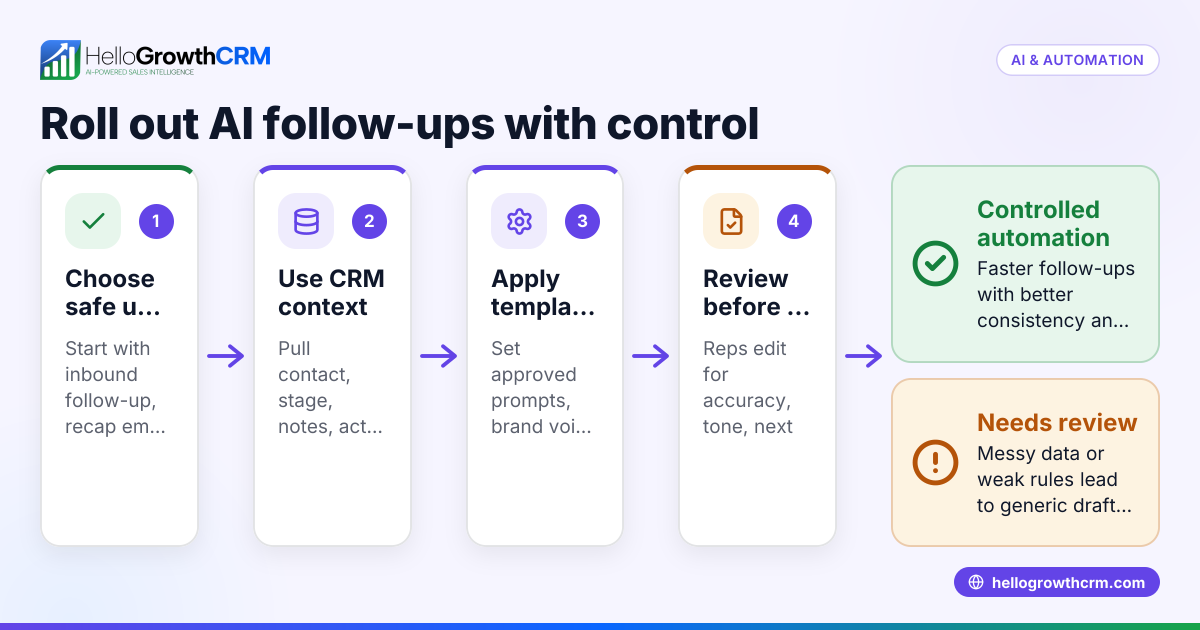
AI can support research, message drafting, lead prioritization, and next-step suggestions. Good ai cold outreach does not replace your reps. It reduces the manual work that causes missed follow-up and sloppy record keeping.
For example, AI can help score which accounts should enter a sequence first, suggest message variants by industry, and flag buying signals from replies. Inside an AI CRM, that intelligence is more useful because it sits next to the pipeline, not outside it.
Step-by-step cold outreach CRM workflow
A practical workflow should be easy to audit and easy to train. If a new SDR joins on Monday, they should understand the process by Friday.
1. Build the target list carefully
Start with account selection, not contact volume. Define the firmographic traits that matter:
- Industry
- Employee count
- Revenue band
- Location in the United States
- Tech stack
- Buying trigger
- Role titles
Then review duplicates, existing customers, open opportunities, and suppression lists before records enter outreach.
2. Enrich and clean the data
Before a sequence starts, make sure the basics are right:
- Company name
- Website
- Contact name
- Job title
- Work email
- Work phone if available
- Territory or owner
- Source
- Segment
Bad data creates bad outreach. It also hurts reporting.
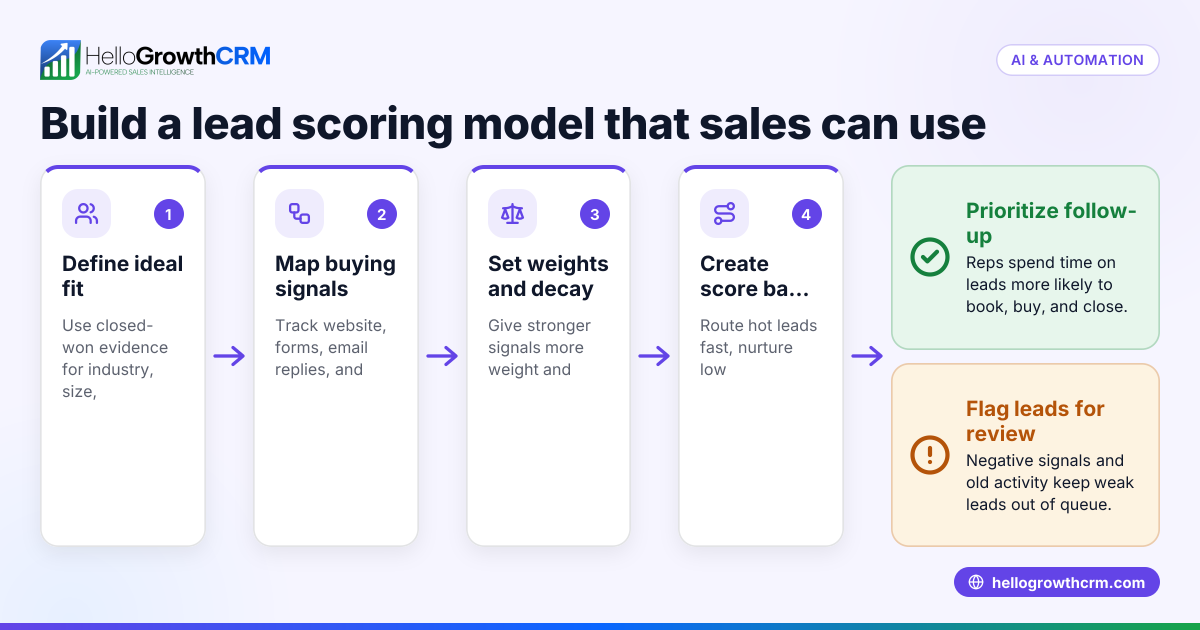
3. Score and prioritize leads
Not every prospect deserves the same effort. Use a simple scoring model based on fit and signal. Fit includes company profile and title. Signal includes page visits, replies, event attendance, or recent hand-raisers.
This is where AI lead scoring can help teams focus on leads with a higher chance of engaging instead of working the list in random order.
4. Enroll prospects in the right sequence
Create separate sequences by segment, not by rep preference. A CFO at a software company should not get the same message as an operations leader at a distributor.
At minimum, segment by:
- Industry
- Persona
- Deal size
- Region
- Trigger event
Keep enrollment rules strict. A record should only be in one active outbound sequence at a time.
5. Capture replies and route next steps
Once a prospect engages, the sequence should pause automatically or through a required rep action. The CRM should prompt the next task, meeting booking, or qualification step.
This is where many teams fail. They celebrate the reply but lose momentum. The workflow should make the next step obvious.
6. Convert to opportunity only when qualified
Do not turn every warm reply into pipeline. Use a qualification checkpoint. The exact framework can vary, but there should be a shared standard for what counts as a real opportunity.
That keeps your pipeline cleaner and your forecast more accurate.
7. Review activity and conversion every week
Managers should review:
- Sequence volume
- Reply rates
- Meetings booked
- Opportunity conversion
- Stage aging
- No-touch opportunities
- Disqualification reasons
If a sequence books meetings but never creates qualified opportunities, the messaging may be fine but targeting is off.
What metrics matter most?
Track activity, reply quality, meetings, qualified opportunities, stage conversion, and aging. Activity alone can mislead you. The best outbound workflow shows which touches lead to real pipeline, not just which reps send the most emails.
Go deeper than open rates. For US B2B teams, these metrics usually matter more:
Leading indicators
- New prospects enrolled per rep
- Email reply rate
- Positive reply rate
- Call connect rate
- Conversations per account set
- Tasks completed on time
Pipeline indicators
- Meetings booked
- Meetings held
- Qualified opportunity rate
- Pipeline created in $
- Average days from first touch to opportunity
- Opportunity stage conversion
Hygiene indicators
- Duplicate rate
- Missing owner rate
- Missing next step rate
- Stale records with no activity
- Opportunities with no recent contact
If you need stronger reporting discipline, tie outbound review into sales forecasting so the activity data supports real revenue planning rather than separate dashboards nobody trusts.
What compliance issues should US sales teams watch?
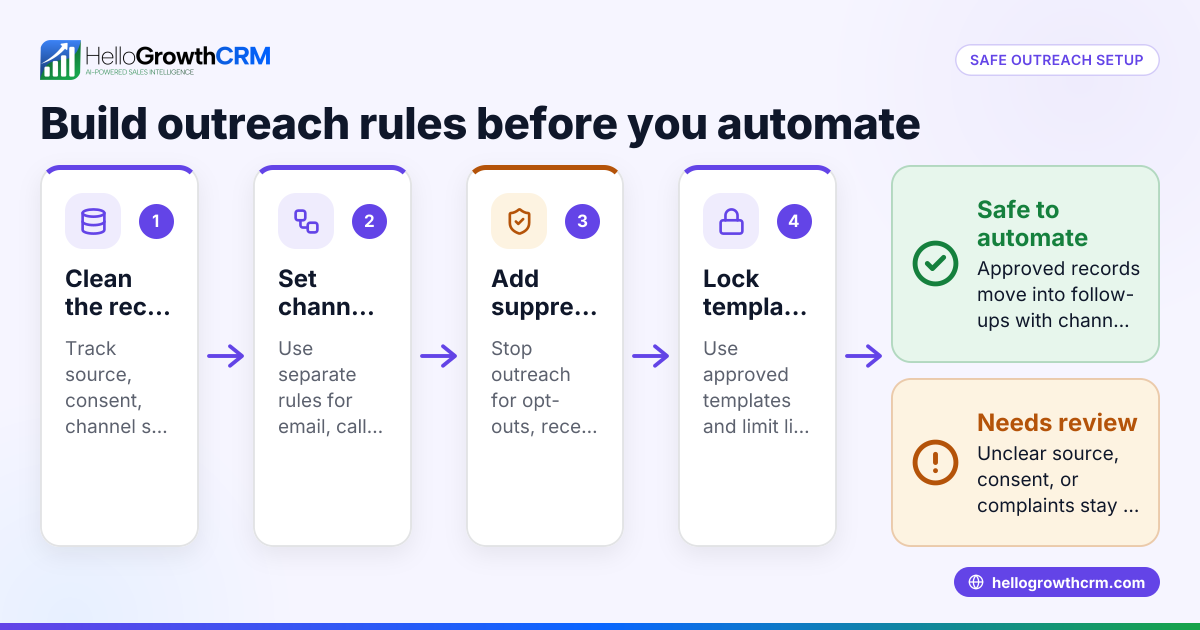
US teams should build outbound around consent, unsubscribe handling, sender identification, and call or text rules. Email and phone outreach are not just workflow choices. They carry legal and reputational risk if your process is loose.
For email, your workflow should support CAN-SPAM basics such as accurate sender information and unsubscribe handling. For calling and texting, your team should account for TCPA considerations and internal do-not-contact processes. If you use WhatsApp in outreach, make sure your contact policies are reviewed carefully.
A few practical controls help:
- Store unsubscribe and opt-out status on the contact record
- Suppress opted-out records from future sequences
- Require business contact data, not random scraped notes
- Log call outcomes and contact preferences
- Use approved templates and approved sender identities
- Review outreach policies with legal counsel
A CRM cannot decide your legal position. It can enforce process and create records that help your team follow the process consistently.
How do you keep reps using the workflow every day?
Make the workflow easier than going around it. If reps can complete outreach, log activity, and move deals in a few clicks, adoption rises fast.
The biggest mistake sales leaders make is adding too many fields, too many stages, and too many exceptions. Reps do not reject CRM because they hate structure. They reject it because the structure slows them down.
Design for rep speed
A rep should be able to:
- See today's tasks
- Launch the next step in sequence
- Log call outcomes quickly
- Access account context before outreach
- Pause or exit a sequence with one clear reason
- Book meetings and create opportunities without duplicate entry
If your CRM needs ten manual updates after a three-minute call, reps will avoid it.
Use automation where it matters
Good automation handles the repetitive parts:
- Lead assignment
- Sequence enrollment
- Task creation
- Reply detection
- Stage updates
- Follow-up reminders
- Manager alerts for stalled deals
That is where email automation and connected workflow design can save hours each week.
Add managed support when your team is stretched
Many growing companies do not have a full-time RevOps hire yet. In those cases, a service layer can help set up stages, routing, reports, and automation without adding internal overhead. That is the value of managed RevOps when the sales team needs process discipline but cannot build everything from scratch.
Choosing a CRM workflow that supports real outbound execution
A CRM for outbound should do more than store contacts. It should support the full operating model of your sales team.
Look for these capabilities:
- Unified contact and account history
- Built-in sequencing or strong channel coordination
- Clear ownership and routing rules
- Activity logging across email, phone, and WhatsApp
- Lead scoring and prioritization
- Flexible reporting
- Opportunity and forecast visibility
- Reliable integrations with your existing stack
For many US B2B teams, the challenge is not picking more tools. It is reducing the number of disconnected tools the team already uses. Start by mapping your current outbound motion. Then remove steps that require manual copying, duplicate updates, or side spreadsheets.
If you are evaluating systems, review the product features against your actual rep workflow, not a generic CRM checklist. The right setup is the one that helps reps prospect, managers inspect, and leadership trust the pipeline.
Read next
This article covers one part of a bigger topic. For the complete picture, read our guide to cold outreach.
Ready to put this into practice?
Set up your pipeline, WhatsApp follow-ups, and AI lead scoring in minutes — free, no credit card.
Try HelloGrowthCRM freeGet CRM tips in your inbox
Join thousands of sales professionals who get weekly insights on CRM strategy, AI automation, and pipeline optimization.

The HelloGrowthCRM team publishes guides on CRM strategy, AI sales tools, and revenue operations for small business sales teams.