HelloGrowthCRM software
Built for real small-business sales teams
HelloGrowthCRM helps reps qualify faster, follow up on time, and close more deals—with practical automation in one place.
- AI lead scoring and pipeline visibility
- Built-in dialer, WhatsApp, and email automation
- Sales forecasting and RevOps-ready reporting
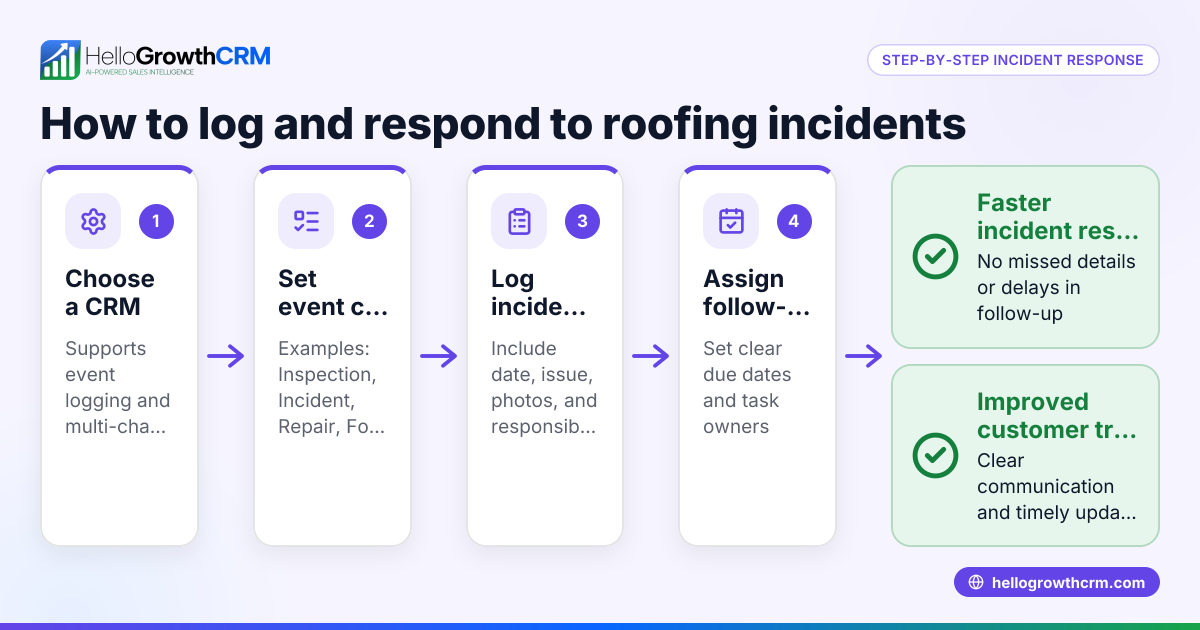
For roofing businesses in Singapore, CRM event logging and incident response means systematically recording all customer interactions and incidents related to roofing projects, then managing follow-up actions efficiently. This article explains why this is important for roofing service providers, outlines step-by-step how to implement it, highlights common mistakes, and shows how HelloGrowthCRM supports these tasks.
Why this comes up / what goes wrong
Roofing companies often face challenges in tracking incidents such as damage reports, repair requests, or safety issues during roofing projects. Without proper event logging, details can be lost, delays happen, and customer satisfaction drops. Business owners and accountants struggle to keep a clear record of incidents and follow-ups when communications happen over WhatsApp, phone calls, emails, and spreadsheets. This fragmentation leads to slow responses, missed tasks, and lost leads or repeat business. A CRM tailored for local service businesses can centralise this data and streamline incident response.
Step-by-step
- Capture all customer and incident details in one place. Use your CRM to log every roofing-related event such as inspection dates, damage reports, repair progress, and customer communications. Check that notes are detailed and timestamped.
- Link communications to the right customer record. Whether the interaction happens on WhatsApp, SMS, email, or phone, ensure the CRM records the conversation under the correct lead or client. Verify that no messages are lost or scattered.
- Create follow-up tasks for incident responses. Assign tasks with due dates for repairs, inspections, or customer callbacks. Confirm that your team sees these tasks clearly on a shared task board to avoid missed deadlines.
- Automate follow-up sequences for common incidents. For example, set up a five-step follow-up workflow over two weeks to check on repair progress or customer satisfaction. Monitor that the sequence stops as soon as the customer replies.
- Review and update incident records regularly. After each follow-up, update the CRM with new information or resolutions. Check for completeness and accuracy to maintain a reliable incident history.
- Analyse incident trends and response times. Use CRM reports to identify frequent issues or delays in response. Validate that insights lead to process improvements.
For local service businesses like roofing companies, these steps ensure efficient incident management and better customer service. Learn more about CRM solutions for local service businesses.
Example (fictional figures)
Roofing Solutions Pte Ltd, based in Tanjong Pagar, logs an incident where a customer reports roof leakage on 01/03/2024. They use CRM to track the case as follows:
- Incident reported on 01/03/2024
- Inspection scheduled for 03/03/2024
- Repair estimated cost S$1,200
- Repair completed on 10/03/2024
Step 1: Log incident date and details 01/03/2024 = Incident reported
Step 2: Schedule inspection task Inspection date = 03/03/2024
Step 3: Record repair estimate Repair cost = S$1,200
Step 4: Complete repair and update record Repair completion date = 10/03/2024
Step 5: Follow-up sequence triggered Five-step customer follow-up over two weeks to confirm satisfaction
This structured logging and follow-up ensure Roofing Solutions Pte Ltd responds promptly and documents every stage, improving accountability and customer trust.
Common mistakes
- Scattered communication channels: Prevent this by linking all WhatsApp, SMS, and email conversations to the CRM lead record to avoid lost information. See how WhatsApp and SMS CRM can help at WhatsApp and SMS CRM.
- No follow-up task management: Avoid missed deadlines by using task boards so every repair or inspection has a due date visible to the team. Learn about activities and task boards at HelloGrowthCRM for Singapore.
- Manual follow-ups only: Prevent delays by automating sequences that follow up on incidents without manual effort.
- Incomplete incident details: Always update records after every interaction to keep the incident history comprehensive.
- Ignoring reporting: Use CRM reports to spot trends and improve processes instead of reacting only to individual incidents.
Doing this in HelloGrowthCRM
HelloGrowthCRM supports roofing businesses with features to log all WhatsApp conversations with leads on their CRM record, ensuring no message is missed. Follow-ups become tasks with due dates on team boards, so calls and repairs are tracked without relying on memory. Automated sequences can run a five-step follow-up over two weeks, stopping immediately when the customer replies. These tools help roofing companies respond quickly and keep incident records organised. Learn more about these features at WhatsApp and SMS CRM.
Frequently asked questions
How does CRM event logging improve roofing incident response? CRM event logging centralises all customer and incident data, making it easier to track repairs, schedule inspections, and manage communications. This reduces delays and errors in response.
Can I use WhatsApp for logging conversations in a roofing CRM? Yes, many CRMs, including HelloGrowthCRM, log WhatsApp conversations directly on the lead record, ensuring all messages are stored and follow-ups can be automated.
What should I look for in a CRM for roofing services? Look for features like integrated messaging, task boards for follow-ups, automated sequences for incident response, and easy reporting to track trends and team performance.
How can automated follow-up sequences help my roofing business? They reduce manual work by sending timed messages to customers, ensuring consistent communication and stopping as soon as the customer replies, saving time and improving engagement.
Is HelloGrowthCRM suitable for small roofing teams in Singapore? Yes, it is designed for small and mid-sized businesses, helping teams manage leads, tasks, and customer conversations efficiently on familiar channels like WhatsApp.
Key takeaways
- Centralise all roofing incident details and communications in your CRM.
- Link WhatsApp and SMS conversations to customer records for full visibility.
- Use task boards to assign and track follow-ups with due dates.
- Automate multi-step follow-ups to maintain consistent customer contact.
- Regularly update incident records and review CRM reports to improve service.
Start organising your roofing incident responses today with HelloGrowthCRM. Start on the Free Forever plan (200 leads, no credit card).
Ready to put this into practice?
Set up your pipeline, WhatsApp follow-ups, and AI lead scoring in minutes — free, no credit card.
Try HelloGrowthCRM freeGet CRM tips in your inbox
Join thousands of sales professionals who get weekly insights on CRM strategy, AI automation, and pipeline optimization.

The HelloGrowthCRM team publishes guides on CRM strategy, AI sales tools, and revenue operations for small business sales teams.