HelloGrowthCRM software
Built for real small-business sales teams
HelloGrowthCRM helps reps qualify faster, follow up on time, and close more deals—with practical automation in one place.
- AI lead scoring and pipeline visibility
- Built-in dialer, WhatsApp, and email automation
- Sales forecasting and RevOps-ready reporting
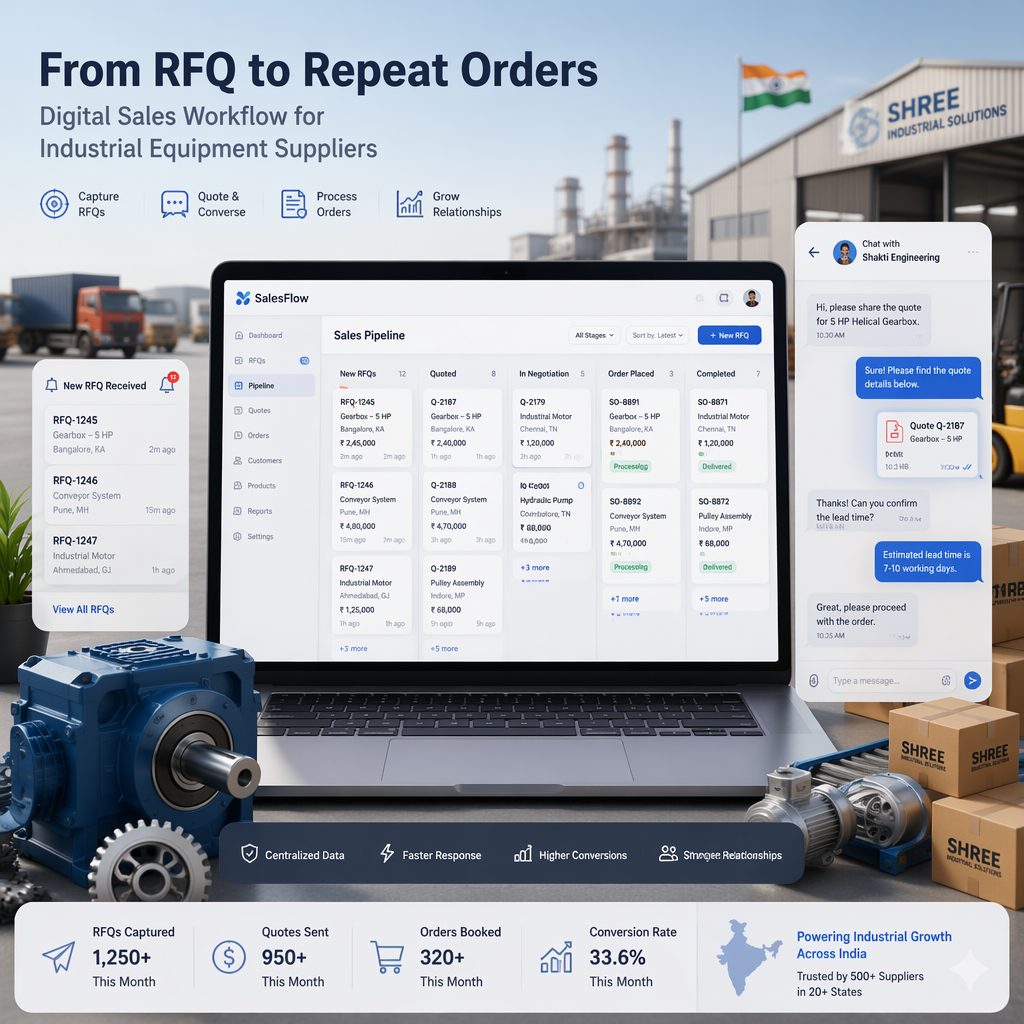
A CRM for manufacturers managing RFQs, distributors, quotes and repeat orders in one pipeline is a customer relationship system built to track complex B2B sales from first inquiry to reorder. Instead of splitting activity across email, spreadsheets, ERP notes, and distributor portals, it gives manufacturing teams one place to manage request-for-quote workflows, partner relationships, pricing approvals, production handoffs, and recurring demand. For teams selling through both direct reps and channel partners, this kind of pipeline control helps reduce quote delays, missed follow-ups, and forecast gaps.
Key Takeaways
- Manufacturers need a CRM that handles RFQs, direct accounts, distributors, quotes, and repeat orders in one workflow.
- A unified pipeline helps sales, operations, and account teams see where every opportunity stands.
- HelloGrowthCRM can support manufacturer workflows with AI CRM, Email Automation, AI Lead Scoring, and Sales Forecasting.
- The right setup should track quote value, product interest, approval status, distributor ownership, and reorder timing.
- Repeat orders should not live outside the CRM. They should feed forecasting, renewal outreach, and expansion plans.
- Manufacturers can improve response speed and pipeline accuracy by standardizing stages, automating follow-up, and connecting systems through Integrations.
Why manufacturers need a different kind of CRM pipeline
Many CRM setups are built for simple sales cycles. Manufacturing sales rarely work that way. A buyer may ask for a quote, send revised specs, involve engineering, request samples, and then place an initial order through a distributor. Months later, the same account may reorder directly or through a different channel.
That is why crm for manufacturers managing rfqs distributors quotes and repeat orders in one pipeline matters. The problem is not just contact management. The problem is workflow control.
Manufacturers usually need to manage several moving parts at once:
- RFQs from new and existing buyers
- Product, volume, and specification details
- Direct sales reps and channel distributors
- Quote approvals and version changes
- Long buying cycles with silent periods
- Repeat orders tied to production timing
- Forecasts that depend on both new business and existing demand
Without one pipeline, teams often fall back on disconnected tools. Sales may track opportunities in spreadsheets. Customer service may log reorder requests in inboxes. Distributor updates may stay in private email threads. Leadership then gets an incomplete forecast.
With HelloGrowthCRM, manufacturers can create a more usable operating system for revenue. Instead of forcing every opportunity into a generic sales process, teams can map their actual buying journey using configurable Features, connected Sales Tools, and flexible Pricing that fits growing B2B teams.
The core manufacturing pipeline: RFQ to reorder
A strong manufacturing CRM pipeline should reflect how buyers actually move. It should also show when deals stall, who owns the next action, and which accounts are most likely to buy again.
Stage 1: RFQ intake and qualification
The first stage starts when a prospect, customer, or distributor sends an RFQ. This is more than a lead capture event. It is the point where speed and accuracy start shaping win rate.
At this stage, your CRM should capture:
- Company and buyer contact details
- Product category or SKU family
- Required volumes
- Specs, tolerances, or certifications
- Need-by date
- Channel type, such as direct or distributor-led
- Estimated quote value
- Strategic fit and account priority
This is where AI Lead Scoring can help. Not every RFQ deserves the same level of urgency. A high-volume repeat buyer should not sit behind a low-fit inquiry with unclear specs.
Stage 2: Quote creation and review
Once the RFQ is qualified, the team needs to move fast. But speed without control creates pricing errors. Manufacturers often need quote approvals based on margin, custom terms, geography, or distributor pricing rules.
A CRM pipeline should show quote status clearly:
- Draft
- Awaiting internal approval
- Sent to buyer
- Under revision
- Negotiation
- Won or lost
This prevents the common problem of “quoted but not really active” opportunities clogging the pipeline. It also gives leaders a cleaner view when using Sales Forecasting to predict likely revenue.
Stage 3: Distributor and channel coordination
Manufacturers that sell through distributors need visibility without losing ownership. The CRM should record whether the opportunity came from a distributor, is fulfilled through one, or involves shared account responsibility.
This matters because channel conflict can quietly damage revenue. If a direct rep and distributor both touch the same account without visibility, response times slow down and trust drops.
HelloGrowthCRM works well here because teams can structure account ownership, communication logs, and handoff rules in one system. If you need more support designing the process, Managed RevOps can help standardize it.
Stage 4: Order conversion and post-quote follow-up
Not every quote turns into an order right away. Some buyers pause for budget, approval, or inventory timing. A manufacturer CRM should not treat these as dead deals too early.
Instead, it should trigger follow-up based on real buying signals, such as:
- Quote age
- Open questions
- Sample shipment status
- Competitive review window
- Distributor update
- Expected reorder cycle
Using Email Automation, teams can send timed check-ins, reminders, and value-based follow-ups without relying on manual memory.
Stage 5: Repeat order management
Repeat business is often where manufacturing revenue becomes predictable. Yet many teams track repeat orders outside the CRM because they see them as “operations,” not “sales.”
That is a mistake. Reorders belong in the pipeline because they affect forecast, customer health, capacity planning, and expansion potential.
A repeat-order view should show:
- Last order date
- Typical reorder interval
- Average order value
- Product mix changes
- Open service issues
- Growth opportunities by account or region
Common problems when RFQs, quotes, and reorders live in separate systems
A disconnected process creates hidden costs. Some are easy to see, like delayed quote response. Others show up later as weak forecasting or lost distributor trust.
Missed follow-up after quote delivery
A quote is sent. Then nothing happens. Sales assumes the buyer is reviewing it. The buyer assumes the manufacturer is not interested. The distributor thinks the account is already covered. Weeks pass.
A pipeline with task automation and status rules solves this. Every quote should have a next step and owner.
Poor forecast accuracy
Manufacturing forecasts often fail because they mix active quotes, soft distributor estimates, and likely repeat orders in one messy report. Leadership then makes production or hiring decisions from weak data.
When every opportunity follows one structured process in HelloGrowthCRM, forecast categories become more dependable. That makes Sales Forecasting more useful for real planning.
No visibility into distributor-led opportunities
Channel sales often break down because manufacturers only see final orders, not the activity before them. If distributor-led RFQs are not logged, the pipeline misses important demand signals.
A better CRM setup tracks the full opportunity, even when the route to market is indirect.
Repeat orders get ignored until they are late
If no one owns reorder timing, customers may reorder later than expected or switch suppliers. A manufacturer CRM should flag accounts approaching their normal purchase window and create proactive outreach.
What a high-performing manufacturing CRM should track
The best CRM for manufacturers does more than store contacts. It creates a working model of demand.
Account-level data
At the account level, you should track:
- Industry and segment
- Plant or location details
- Direct vs distributor relationship
- Annual revenue potential
- Buying team contacts
- Existing product lines in use
- Contract or pricing terms
Opportunity-level data
At the quote or deal level, you should track:
- RFQ source
- Quote number and revision count
- Product family or configuration
- Estimated margin
- Expected order date
- Competitors involved
- Required approvals
- Win probability
Repeat-order signals
For existing customers, the CRM should track:
- Last shipment or order date
- Reorder frequency
- Usage or consumption pattern
- Cross-sell opportunities
- Service or support issues
- Risk of churn or channel shift
With an AI CRM, these signals become easier to act on. The system can surface which accounts need attention, which quotes are aging, and which repeat buyers may be ready for outreach.
How to build one pipeline for direct sales and distributors
Manufacturers often worry that one pipeline will oversimplify channel sales. It does not have to. The key is to use one framework with different paths inside it.
Use shared stages with channel-specific fields
Keep the main pipeline simple. For example:
- RFQ received
- Qualified
- Quote in progress
- Quote sent
- Negotiation or review
- Expected order
- Won
- Lost
- Repeat order monitoring
Then add fields that separate direct and distributor motion. These may include partner name, channel margin, account owner, and fulfillment path.
Separate ownership from visibility
A distributor may own the local relationship, while your internal team owns pricing approval. Your CRM should allow both sides of that process to be visible without confusion.
That makes handoffs cleaner and reduces duplicate outreach.
Trigger workflows based on account type
Direct accounts may need rep follow-up. Distributor-led opportunities may need partner check-ins. Existing customers may need reorder reminders. Automation should reflect those differences.
This is where HelloGrowthCRM stands out. Teams can use Integrations and workflow logic to route tasks, emails, and updates based on account and pipeline conditions.
How to manage crm for manufacturers managing rfqs distributors quotes and repeat orders in one pipeline: Step-by-Step
- Map your real sales motion
List how RFQs arrive, who reviews them, how quotes are approved, and how repeat orders are tracked today. Build the CRM around reality, not an ideal future process. - Define one standard pipeline
Create one master set of stages from RFQ to reorder. Keep it simple enough for adoption but detailed enough for forecasting and accountability. - Add required manufacturing fields
Track specs, volumes, quote revisions, distributor ownership, expected order dates, and reorder intervals. These fields turn the CRM into an operational tool. - Set ownership rules
Decide who owns each stage for direct, distributor-led, and existing-customer opportunities. Clear ownership prevents stalled quotes and missed reorders. - Automate follow-up and reminders
Use timed tasks and Email Automation for quote follow-up, approval nudges, and reorder outreach. This cuts manual chasing. - Connect key systems
Sync the CRM with email, ERP, forms, and reporting tools through Integrations. The goal is one working pipeline, not another isolated database. - Build forecast categories
Separate early RFQs, active quotes, committed orders, and likely reorders. This gives leadership a cleaner revenue view. - Review pipeline health weekly
Look at aging quotes, distributor activity, stalled approvals, and accounts nearing reorder windows. Small weekly reviews prevent large revenue leaks.
Practical B2B examples of this pipeline in action
Example 1: Custom components manufacturer
A prospect submits an RFQ for a custom part with a six-month volume estimate. Sales logs it in HelloGrowthCRM, tags the product family, and assigns engineering review. Once approved, the quote moves to “sent,” and an automated follow-up is scheduled for seven days later. If the buyer goes quiet, the rep gets a task instead of relying on memory.
Example 2: Industrial supplier with distributors
A regional distributor brings in an opportunity from an existing end customer. The manufacturer logs the RFQ under the account, marks it as distributor-led, and assigns internal pricing review. Everyone sees the same timeline. The distributor gets faster answers, and the manufacturer avoids channel confusion.
Example 3: Repeat-order heavy business
An account usually reorders filters every 90 days. HelloGrowthCRM tracks the last order date and expected reorder window. If no new order appears by day 75, the account manager gets a task and email sequence trigger. That simple workflow helps protect recurring revenue.
What to look for when choosing a CRM for manufacturing sales
Not every platform can support these workflows well. Before choosing a system, look for these capabilities:
- Flexible pipeline stages
- Custom fields for product and quote data
- Automation for follow-up and approvals
- Visibility across direct and distributor activity
- Forecasting tied to actual pipeline movement
- Easy reporting for quote aging and reorder health
- Fast setup and admin simplicity
HelloGrowthCRM is built for B2B teams that need execution, not just record keeping. If your team is comparing options, reviewing Features and booking a Demo can help you see how a unified manufacturing pipeline would work in practice.
Manufacturers grow faster when RFQs, distributors, quotes, and repeat orders are managed in one connected system. HelloGrowthCRM helps B2B teams turn scattered selling motions into one clear pipeline with better follow-up, stronger forecasting, and more predictable repeat revenue. Start with a Free Trial or explore Pricing to see how HelloGrowthCRM can fit your sales process.
Frequently Asked Questions
Q: What is the main benefit of using a CRM for manufacturers?
A: The main benefit is visibility across the full sales cycle, from RFQ to repeat order. Manufacturers can track quotes, distributor activity, follow-up tasks, and reorder timing in one place instead of relying on scattered spreadsheets and inboxes.
Q: Can a manufacturing CRM handle both direct sales and distributors?
A: Yes, a good manufacturing CRM should support both. It should let teams track account ownership, partner involvement, pricing paths, and handoffs without forcing direct and channel sales into separate systems.
Q: Why should repeat orders be tracked in the CRM?
A: Repeat orders affect revenue forecasting, account planning, and customer retention. When reorders sit outside the CRM, teams miss signals about buying cycles, growth opportunities, and accounts that may be at risk.
Q: How does HelloGrowthCRM help with RFQ and quote management?
A: HelloGrowthCRM helps teams structure pipeline stages, assign owners, automate follow-up, and report on quote progress. It also supports related workflows like lead scoring, forecasting, and email automation so RFQs do not get lost after intake.
Q: What data should manufacturers capture for each opportunity?
A: Manufacturers should capture RFQ source, product family, quote value, expected close date, revision count, distributor involvement, and approval status. These details make the pipeline more accurate and help teams forecast revenue more reliably.
Q: How often should manufacturing teams review pipeline health?
A: Weekly reviews are usually the best starting point. A weekly rhythm helps teams catch stalled quotes, overdue follow-up, inactive distributors, and delayed repeat orders before they become revenue problems.
Frequently Asked Questions
Ready to put this into practice?
Set up your pipeline, WhatsApp follow-ups, and AI lead scoring in minutes — free, no credit card.
Try HelloGrowthCRM freeGet CRM tips in your inbox
Join thousands of sales professionals who get weekly insights on CRM strategy, AI automation, and pipeline optimization.

The HelloGrowthCRM team publishes guides on CRM strategy, AI sales tools, and revenue operations for small business sales teams.