HelloGrowthCRM software
Built for real small-business sales teams
HelloGrowthCRM helps reps qualify faster, follow up on time, and close more deals—with practical automation in one place.
- AI lead scoring and pipeline visibility
- Built-in dialer, WhatsApp, and email automation
- Sales forecasting and RevOps-ready reporting
Customer relationship management (CRM) for manufacturing SMEs in India is a system that helps manufacturers capture distributor inquiries, manage RFQs (requests for quotations), track dealer conversations, and move deals from inquiry to purchase order in one organized sales pipeline. Instead of juggling spreadsheets, emails, and WhatsApp chats, a manufacturing CRM centralizes lead sources such as IndiaMART, trade fairs, dealer networks, and website forms so sales teams can respond faster and close more distributor partnerships.
Key Takeaways
- Manufacturing SMEs in India often lose distributor opportunities because RFQs and inquiries are scattered across spreadsheets, emails, and WhatsApp.
- A dedicated CRM centralizes RFQs, distributor conversations, and follow-ups into one structured pipeline.
- Automation helps sales teams respond faster to IndiaMART leads, trade fair inquiries, and dealer messages.
- AI-powered features like AI Lead Scoring help prioritize high-value distributor deals.
- HelloGrowthCRM helps manufacturing companies move opportunities from inquiry to purchase order with clear pipeline visibility.
Why Indian Manufacturing SMEs Struggle with Distributor Lead Management
Many manufacturing businesses in India still run their sales operations through a mix of Excel sheets, email threads, and WhatsApp chats. This setup works when inquiries are few. But it quickly breaks when distributor interest grows.
A typical scenario looks like this:
- An inquiry arrives from IndiaMART.
- A dealer asks for pricing through WhatsApp.
- A prospect visits your booth at a trade fair in Delhi or Mumbai.
- A regional distributor sends an RFQ through email.
Each lead enters a different communication channel. Sales teams then manually track everything in spreadsheets.
This approach causes several problems.
Leads Get Lost Across Channels
Manufacturing sales cycles often involve multiple conversations. Distributors ask about pricing tiers, logistics timelines, product samples, and credit terms.
When these conversations live across email, WhatsApp, and call logs, it becomes easy to lose track of them. A CRM with a unified communication hub like Smart Inbox ensures all conversations appear in one place.
RFQs Are Hard to Track
RFQs often arrive as attachments or email threads. Teams manually create quotations and then struggle to track which RFQs are still active.
Without a structured system, sales managers cannot see:
- Which RFQs are pending
- Which distributors are evaluating proposals
- Which deals are likely to close
Tools like AI Pipeline Management help manufacturing teams track each opportunity through stages such as inquiry, RFQ, negotiation, and purchase order.
Follow-Ups Depend on Memory
Distributor deals rarely close after one call. Follow-ups are required for:
- Product specification discussions
- Pricing negotiations
- MOQ confirmation
- Payment terms
Without automated reminders, sales reps forget to follow up. This leads to lost distributor partnerships.
A CRM with built-in Sales Task Boards ensures follow-ups are scheduled and completed.
Where Manufacturing Leads Usually Come From in India
Indian manufacturing SMEs generate distributor and dealer leads from multiple sources. A good CRM captures all of them in one pipeline.
B2B Marketplaces
Platforms like IndiaMART and TradeIndia generate high volumes of inquiries.
However, many manufacturers manually copy leads from these platforms into spreadsheets. This wastes time and increases the chance of errors.
With integrations through tools like Zapier, inquiries can automatically flow into a CRM pipeline.
Trade Shows and Industrial Exhibitions
Events such as:
- IMTEX in Bengaluru
- Auto Expo in Delhi
- PlastIndia in Ahmedabad
generate hundreds of distributor contacts.
Instead of storing visiting cards in drawers, sales teams can add leads directly into a CRM and schedule follow-ups using the built-in Meeting Scheduler.
Dealer and Channel Networks
Manufacturers often rely on regional distributors in cities like Pune, Coimbatore, Rajkot, and Ludhiana.
Managing these relationships requires consistent communication. Integrations such as WhatsApp allow teams to manage dealer conversations directly from the CRM.
Website and Inbound Leads
Many manufacturers receive inquiries from website forms or email.
When connected with systems like Gmail, these inquiries automatically create leads in the CRM.
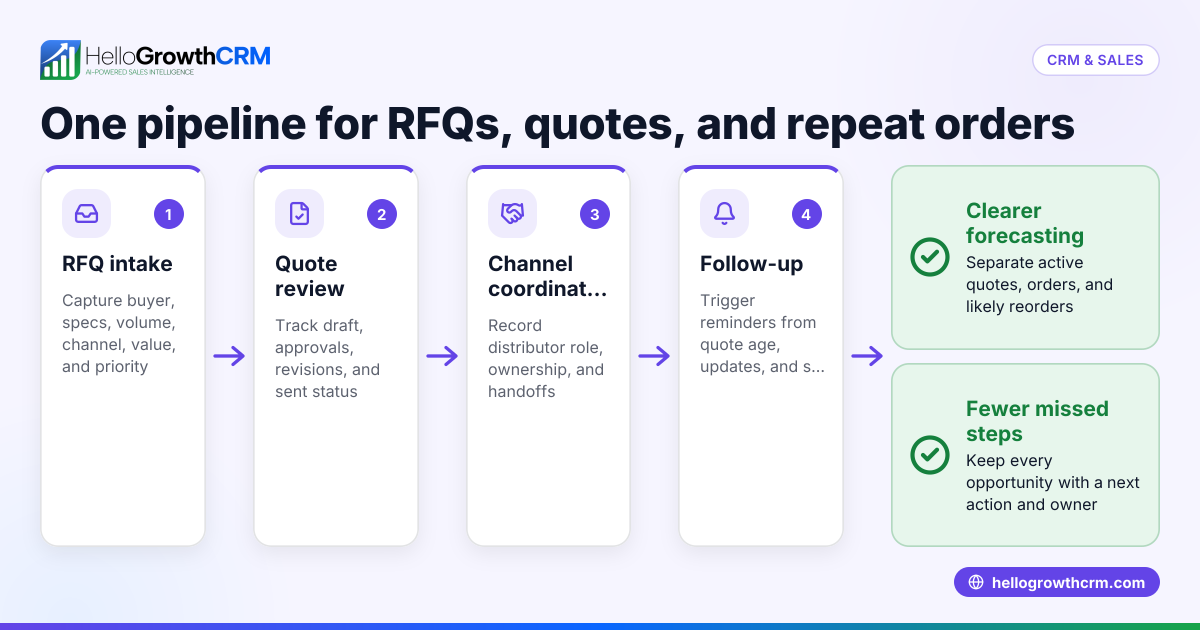
Managing RFQs and Distributor Deals in One Pipeline
Manufacturing sales is not the same as SaaS or retail sales. Deals move through unique stages that involve technical discussions, pricing approvals, and distributor agreements.
A CRM pipeline tailored for manufacturing makes these stages visible.
Typical pipeline stages include:
- Inquiry Received
- Distributor Qualification
- RFQ Submitted
- Proposal Sent
- Negotiation
- Purchase Order Received
HelloGrowthCRM allows teams to customize pipeline stages while using AI insights from AI Deal Insights to identify deals that may stall.
This visibility helps sales managers answer key questions:
- Which distributors are close to placing an order?
- Which RFQs require follow-ups?
- Which sales reps need support to close deals?
Forecasting tools like Sales Forecasting also help estimate monthly order volumes from distributor pipelines.
Automating Distributor Follow-Ups Without Losing the Personal Touch
Consistent follow-ups are critical in manufacturing sales.
Distributors evaluate multiple suppliers before choosing one. If your team responds slowly, competitors step in.
Automation solves this problem.
Email Follow-Ups
Sales reps can send quotation summaries, product catalogs, and pricing sheets using automated sequences powered by Email Automation.
This ensures every RFQ receives a timely response.
WhatsApp Communication
In India, distributors prefer WhatsApp for quick communication.
HelloGrowthCRM supports structured messaging through WhatsApp & SMS CRM, allowing teams to:
- Share quotations
- Confirm delivery timelines
- Send reminders about offers
All messages stay linked to the distributor record.
AI Sales Assistance
Manufacturing sales teams often need help prioritizing leads.
AI tools such as AI Sales Copilot can recommend:
- Which distributors need follow-ups
- Which deals are at risk
- Which RFQs have the highest closing probability
This helps small sales teams focus on the most valuable opportunities.
How CRM Improves Sales Visibility for Manufacturing Owners
Many Indian manufacturing SMEs are owner-led businesses. The founder often handles both production and sales oversight.
Without a CRM, sales visibility is limited.
Owners depend on daily updates from sales reps or manually review spreadsheets.
A centralized system solves this.
Real-Time Pipeline Visibility
Manufacturing leaders can see:
- Distributor leads by region
- RFQs currently under negotiation
- Purchase orders expected this month
Dashboards within an AI CRM provide a clear view of the entire sales pipeline.
Performance Tracking
Managers can also measure:
- Lead response times
- RFQ conversion rates
- Distributor onboarding timelines
These insights help identify bottlenecks in the sales process.
Revenue Attribution
Understanding where deals originate helps manufacturers invest in the right marketing channels.
Tools like Revenue Attribution show whether deals came from trade fairs, IndiaMART, referrals, or digital marketing campaigns.
How to Implement CRM for Manufacturing SMEs in India: Step-by-Step
1. Define Your Sales Pipeline
Map the stages from inquiry to purchase order. Include stages like RFQ received, quotation sent, and negotiation.
2. Import Existing Distributor Leads
Upload leads from spreadsheets, email lists, and dealer directories into your CRM database.
3. Connect Communication Channels
Integrate systems like Gmail, WhatsApp, and website forms so inquiries automatically become CRM leads.
4. Set Up RFQ and Quotation Workflows
Create standardized quotation templates using tools such as Proposal Builder to send professional proposals quickly.
5. Automate Follow-Up Reminders
Assign follow-up tasks and reminders using CRM workflows to ensure no RFQ goes unanswered.
6. Use AI to Prioritize Deals
Enable features like AI Lead Scoring to focus on distributor inquiries most likely to convert.
7. Track Pipeline and Forecast Revenue
Use analytics tools such as Sales Forecasting to monitor expected purchase orders and monthly revenue.
Why HelloGrowthCRM Is Built for Indian Manufacturing Teams
Manufacturing SMEs in cities like Ahmedabad, Coimbatore, Rajkot, and Faridabad face unique sales challenges.
Distributor networks are fragmented. RFQs come from many channels. Follow-ups require constant coordination.
HelloGrowthCRM helps solve these challenges by combining:
- AI-driven lead prioritization
- Structured RFQ pipelines
- WhatsApp and email communication tracking
- Automated follow-ups
- Real-time revenue forecasting
Unlike generic CRM tools, HelloGrowthCRM focuses on sales workflows used by Indian businesses.
Manufacturing teams can also integrate external tools through All Integrations, connect distributor communications, and manage the entire inquiry-to-order journey inside one system.
If your manufacturing business still tracks RFQs and distributor leads in spreadsheets, it is time to upgrade your process. Explore the full Features of HelloGrowthCRM or start a Free Trial to see how Indian manufacturing teams manage distributor pipelines more efficiently.
Frequently Asked Questions
Q: What is the best CRM for manufacturing SMEs in India?
A: The best CRM for manufacturing SMEs in India is one that supports distributor management, RFQ tracking, and multi-channel communication. HelloGrowthCRM provides pipeline management, AI lead scoring, and WhatsApp integration designed for Indian sales teams.
Q: How does CRM help manage RFQs for manufacturing companies?
A: A CRM captures RFQs from email, web forms, or marketplaces and stores them in a structured pipeline. Sales teams can track RFQ status, send quotations, and schedule follow-ups so no opportunity is missed.
Q: Can a CRM integrate with WhatsApp for distributor communication?
A: Yes. Many Indian manufacturers communicate with dealers via WhatsApp. A CRM with WhatsApp integration allows teams to send messages, track conversations, and attach them to distributor records for complete visibility.
Q: How can manufacturing SMEs track distributor deals more efficiently?
A: A structured sales pipeline helps track deals from inquiry to purchase order. Tools like AI pipeline management and automated reminders ensure every RFQ moves forward with timely follow-ups.
Q: Is CRM useful for small manufacturing businesses?
A: Yes. Even small manufacturing businesses benefit from CRM because it organizes leads, automates follow-ups, and tracks distributor communication in one system. This helps small teams close more deals without increasing manual work.
Q: Can CRM integrate with IndiaMART or lead generation platforms?
A: Yes. Manufacturing businesses can connect platforms like IndiaMART to CRM systems using integrations such as Zapier. This allows inquiries from marketplaces to automatically appear as leads in the CRM pipeline.
Q: How long does it take to implement CRM for a manufacturing SME?
A: Most manufacturing SMEs can implement CRM in a few days by importing leads, defining pipeline stages, and connecting communication channels. Cloud-based systems like HelloGrowthCRM make setup fast and simple.
Frequently Asked Questions
Ready to put this into practice?
Set up your pipeline, WhatsApp follow-ups, and AI lead scoring in minutes — free, no credit card.
Try HelloGrowthCRM freeGet CRM tips in your inbox
Join thousands of sales professionals who get weekly insights on CRM strategy, AI automation, and pipeline optimization.

The HelloGrowthCRM team publishes guides on CRM strategy, AI sales tools, and revenue operations for small business sales teams.