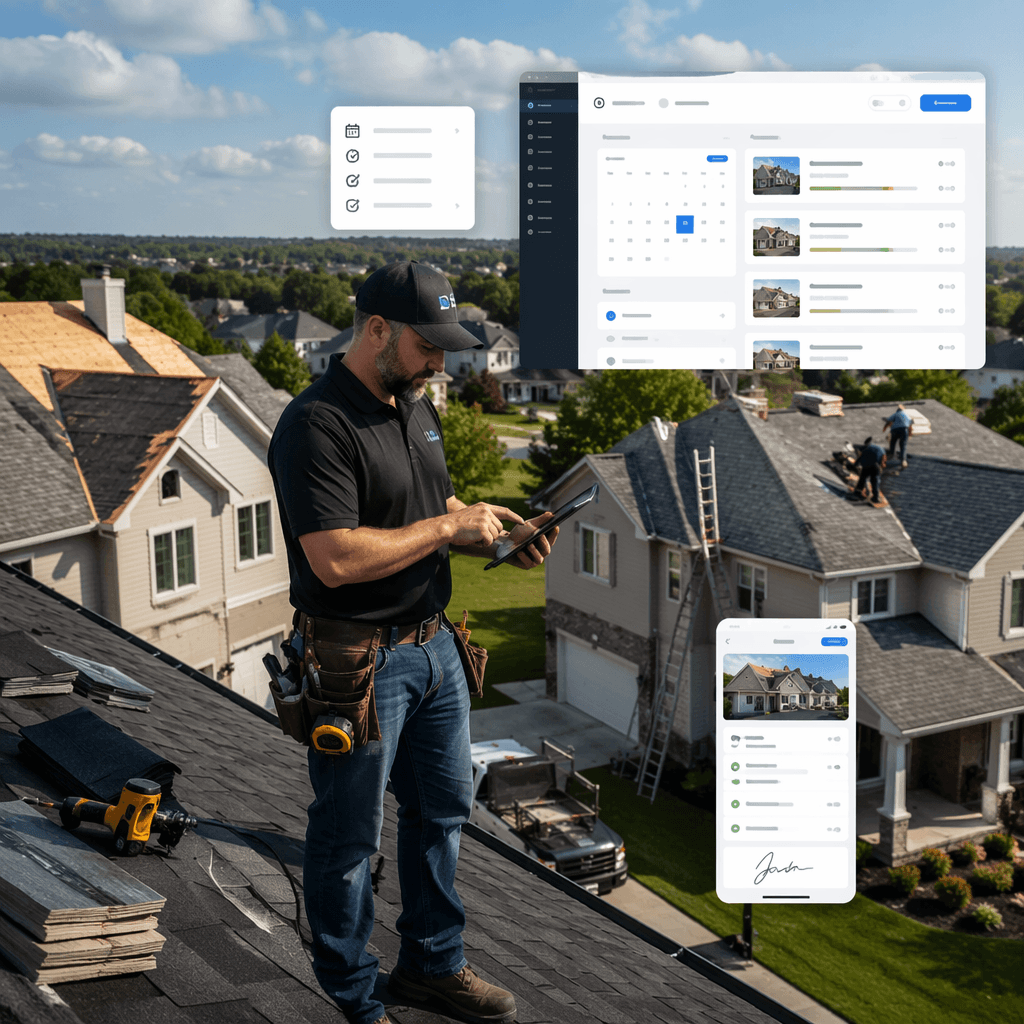
HelloGrowthCRM software
Built for real small-business sales teams
HelloGrowthCRM helps reps qualify faster, follow up on time, and close more deals—with practical automation in one place.
- AI lead scoring and pipeline visibility
- Built-in dialer, WhatsApp, and email automation
- Sales forecasting and RevOps-ready reporting
A CRM for roofing contractors is a customer relationship management system designed to capture inspection requests, track roof assessments and insurance claims, manage estimates, and move projects from inspection to signed contract and installation—so roofing companies can organize leads, schedule crews, automate follow‑ups, and convert more inspections into booked roofing jobs.
Key Takeaways
- Roofing CRMs centralize inspection requests from phone calls, website forms, ads, and field reps into one pipeline
- Contractors can track the full inspection → estimate → insurance approval → job schedule workflow
- Automated reminders and follow-ups help convert more inspections into signed roofing contracts
- Field and office teams share the same job data, photos, and communication history
- HelloGrowthCRM adds AI tools like lead scoring, pipeline health insights, and automated outreach to improve close rates
Why Roofing Contractors Need a CRM
A CRM for roofing contractors helps roofing companies capture inspection requests, organize job pipelines, and manage estimates, insurance claims, and installation schedules in one place instead of scattered spreadsheets, phone logs, and emails, making it easier to convert inspections into paying roofing projects.
Roofing businesses operate in a constant flow of leads and jobs. Requests come from:
- Website inspection forms
- Phone calls from homeowners
- Facebook or Google Ads
- Insurance claim referrals
- Door‑to‑door field reps
Without a structured system, these leads often get lost. Field inspectors might keep notes on their phones. Office teams track estimates in spreadsheets. Sales reps follow up manually.
That fragmentation causes real revenue leakage.
When I audited a roofing company's pipeline last year, their team had 40+ inspection requests across text messages and paper notes that never received follow-up estimates. That alone represented more than $300,000 in potential jobs.
A CRM designed for roofing solves this by centralizing:
- Lead capture
- Inspection scheduling
- Photo documentation
- Estimate generation
- Insurance claim tracking
- Job scheduling
The entire process becomes visible inside one system like an AI CRM.
Companies that implement CRM technology often see measurable sales improvements.
CRM systems can increase sales by up to 29% and sales productivity by 34%, according to Salesforce research.
https://www.salesforce.com/resources/research-reports/state-of-sales/
For roofing contractors, those gains usually come from better follow-up and clearer pipeline visibility.
The Typical Roofing Sales Pipeline
The typical roofing sales pipeline moves a homeowner from an initial inspection request through roof assessment, estimate delivery, insurance approval, and finally installation scheduling, allowing contractors to track deal progress and forecast revenue from upcoming roofing jobs.
Roofing deals follow a predictable progression. Mapping this pipeline inside a CRM ensures every opportunity moves forward.
Common Roofing Pipeline Stages
Most contractors use stages similar to these:
- New Lead
- Inspection Scheduled
- Inspection Completed
- Estimate Sent
- Insurance Approval (if applicable)
- Contract Signed
- Installation Scheduled
- Job Completed
Inside HelloGrowthCRM, these stages are visualized through Sales Task Boards and AI Pipeline Management, which show every inspection and estimate moving toward closing.
Why Pipeline Visibility Matters
Roofing contractors often struggle to answer simple questions:
- How many inspections happened this week?
- How many estimates are pending?
- What revenue is likely to close this month?
When I helped implement a CRM for a 12‑person roofing sales team, the biggest shift wasn't automation. It was visibility. For the first time, the owner could see exactly:
- inspection-to-estimate conversion rate
- estimate-to-contract close rate
- average days from inspection to job start
That data made hiring and marketing decisions much easier.
Tools like Sales Forecasting and Revenue Attribution help quantify which lead sources actually produce booked roofing jobs.
Managing Inspection Requests from Multiple Channels
Managing roofing inspection requests across calls, forms, ads, and referrals requires a centralized lead capture system that automatically records each inquiry, assigns it to the right rep, and schedules follow-up tasks so no homeowner request gets missed.
Roofing contractors often generate leads from many channels:
- Google Ads
- Facebook campaigns
- Referral partners
- Website forms
- Phone calls
- SMS inquiries
Without a CRM, teams manually transfer these leads into spreadsheets or notebooks.
That delay creates problems:
- slow response times
- missed inspection appointments
- lost homeowner contact details
With HelloGrowthCRM, incoming leads automatically appear inside the pipeline using integrations such as:
AI Lead Scoring for Roofing Leads
Not every inspection request has equal value.
Some homeowners are researching. Others need urgent repairs after a storm.
Using AI Lead Scoring, roofing contractors can prioritize leads based on:
- property location
- urgency signals
- insurance involvement
- lead source
- response speed
High‑priority inspection requests can be routed directly to senior reps.
Automated Scheduling
Inspection scheduling often requires multiple back-and-forth messages.
A CRM solves this using integrated tools like the Meeting Scheduler, allowing homeowners to book inspection slots instantly.
This alone can significantly increase appointment completion rates.
Turning Inspections into Estimates and Contracts
Turning roofing inspections into signed contracts requires structured follow-ups, clear estimate delivery, and systematic tracking of homeowner decisions, ensuring that inspection opportunities do not stall due to delayed proposals, missed communication, or unclear next steps.
Many roofing companies perform plenty of inspections but struggle to convert them into jobs.
Common reasons include:
- slow estimate turnaround
- poor follow-up
- lost documentation
- unclear pricing communication
Automating Estimate Follow-Ups
After an inspection, homeowners often take days or weeks to decide.
CRM automation ensures consistent communication.
For example:
- Day 1: Estimate sent
- Day 3: Follow-up email
- Day 7: SMS reminder
- Day 14: final check-in
Tools like Email Automation and WhatsApp & SMS CRM make these sequences automatic.
When I helped a roofing company build this follow-up system, their estimate-to-contract conversion rate improved from 22% to 34% within two months simply because every homeowner received consistent follow-up.
AI Insights on Deal Risk
Roofing deals sometimes stall because:
- insurance approval delays
- homeowner hesitation
- missing documents
Features like AI Deal Insights and the Deal Risk Agent flag opportunities that may require attention.
This allows sales managers to intervene early instead of discovering stalled deals weeks later.
CRM vs Spreadsheets for Roofing Businesses
A CRM for roofing contractors provides structured pipelines, automated follow-ups, and shared visibility across office staff and field reps, while spreadsheets require manual updates, lack automation, and make it difficult to track inspections, estimates, and job scheduling reliably.
Many roofing companies start with spreadsheets. It works for very small teams but quickly breaks down.
Here is a practical comparison.
| Feature | Spreadsheets | Generic CRM | HelloGrowthCRM |
|---|---|---|---|
| Lead capture from forms and ads | Manual | Partial | Automated |
| Inspection scheduling | Manual | Basic | Built-in scheduling |
| Pipeline visibility | Limited | Good | AI pipeline insights |
| Follow-up automation | None | Limited | Advanced automation |
| Field rep coordination | Difficult | Moderate | Shared CRM + mobile workflows |
| Lead prioritization | None | Basic | AI lead scoring |
| Revenue forecasting | Manual | Standard | AI forecasting |
Transparency note: HelloGrowthCRM is the product discussed in this article, so comparisons reflect its positioning against simpler tools.
For small roofing teams, even a simple CRM is better than spreadsheets. But once a company runs multiple crews and marketing channels, advanced pipeline management becomes critical.
How to Use a CRM for Roofing Contractors: Step-by-Step
Using a CRM for roofing contractors involves capturing inspection requests automatically, scheduling field inspections, documenting roof assessments, sending estimates, tracking insurance approvals, and managing installation schedules through a structured pipeline so every roofing opportunity moves from inquiry to completed job.
1. Capture Inspection Leads
Connect website forms, ads, and phone inquiries into the CRM using integrations like Zapier or marketing tools.
2. Automatically Assign Leads
Route leads to the right territory rep using Territory Management based on zip code or region.
3. Schedule Roof Inspections
Use the built‑in Meeting Scheduler to let homeowners choose available inspection times.
4. Record Inspection Results
Field reps log roof condition notes, damage photos, and homeowner needs directly in the CRM.
5. Send Roofing Estimates
Create proposals quickly using tools like the Proposal Builder.
6. Automate Follow-Ups
Set automated email and SMS sequences using Email Automation.
7. Track Insurance Claims
Use pipeline stages to track claim status and required documentation.
8. Schedule Installation
Once a contract is signed, move the opportunity to installation scheduling and assign crews.
Many roofing contractors combine these workflows with AI assistants like the AI Sales Copilot to summarize calls and suggest next actions.
How AI Improves Roofing Sales Operations
AI-powered CRM systems help roofing contractors prioritize leads, predict deal outcomes, automate follow-ups, and analyze pipeline health, enabling sales teams to focus on high-value inspections and close more roofing projects with less manual administrative work.
Artificial intelligence is changing how field-service sales teams operate.
According to McKinsey, AI adoption across sales functions continues to grow as companies seek productivity improvements in lead qualification and forecasting.
https://www.mckinsey.com/capabilities/growth-marketing-and-sales/our-insights/the-state-of-ai
For roofing contractors, AI helps in several areas:
Lead Prioritization
AI identifies which inspection requests are most likely to convert.
Pipeline Health Monitoring
Tools like the Pipeline Health Score show when deals are stalled.
Call and Message Analysis
AI tools can summarize conversations and extract key homeowner concerns.
Revenue Forecasting
With enough data, forecasting models predict upcoming roofing job revenue.
In my experience working with service businesses under 50 sales reps, these insights dramatically improve forecasting accuracy. Larger enterprise contractors may require deeper ERP integrations.
Why Roofing Companies Choose HelloGrowthCRM
Roofing contractors choose HelloGrowthCRM because it centralizes lead capture, inspection scheduling, estimate management, and job pipelines in a single AI-powered platform built for revenue operations, helping roofing teams convert more inspections into signed roofing contracts while keeping office staff and field reps aligned.
Key advantages include:
- AI-powered pipeline insights
- built-in automation for follow-ups
- integrated communication tools
- flexible job pipeline management
- strong integration ecosystem via All Integrations
Contractors can also evaluate potential ROI using tools like the CRM ROI Calculator.
If your roofing business currently manages leads across spreadsheets, emails, and text messages, a centralized CRM can dramatically improve visibility and conversion.
Start exploring the platform by reviewing the full Features, checking Pricing, or requesting a live Demo. You can also start a Free Trial to see how inspection-to-job pipelines work in practice.
About the author
Daniel Reyes is a Sales Operations Lead in B2B SaaS with over 11 years of experience building CRM systems and revenue operations frameworks for service and construction companies. He currently works with HelloGrowthCRM on pipeline architecture and AI-driven sales automation. Earlier in his career, he helped implement a CRM rollout for a regional roofing contractor with 12 sales reps and three installation crews, which informed many of the workflows described in this guide.
Frequently Asked Questions
Q: What is the best CRM for roofing contractors?
A: The best CRM for roofing contractors is one that tracks inspection requests, estimates, insurance claims, and installation scheduling in a single pipeline while automating follow-ups and lead capture. Platforms like HelloGrowthCRM specialize in managing the inspection‑to‑contract workflow roofing companies rely on.
Q: How does a CRM help roofing companies get more jobs?
A: A CRM helps roofing companies get more jobs by capturing every inspection request, automating estimate follow-ups, and tracking opportunities through a structured pipeline so no lead is forgotten. This improves inspection-to-contract conversion rates and increases overall job bookings.
Q: Can a CRM manage roofing inspection scheduling?
A: Yes, a CRM can manage roofing inspection scheduling by allowing homeowners to book inspection times online while automatically assigning appointments to field reps. Integrated scheduling tools reduce back-and-forth communication and prevent missed appointments.
Q: Do roofing contractors need a CRM if they are a small company?
A: Small roofing contractors benefit from CRM systems because they centralize leads, track estimates, and automate follow-ups even for teams with just a few sales reps. This prevents missed opportunities and helps smaller companies compete with larger contractors.
Q: How do roofing companies track insurance claims in a CRM?
A: Roofing companies track insurance claims in a CRM by adding pipeline stages for claim review, adjuster inspection, and approval status. This allows contractors to monitor which projects depend on insurance decisions and follow up accordingly.
Q: Can a CRM automate roofing estimate follow-ups?
A: Yes, a CRM can automate roofing estimate follow-ups through scheduled emails, SMS messages, and reminders that trigger after an estimate is sent. Automation ensures homeowners receive consistent communication without requiring manual outreach from sales reps.
Q: What features should roofing contractors look for in a CRM?
A: Roofing contractors should look for lead capture, inspection scheduling, pipeline tracking, estimate management, automated follow-ups, and mobile access for field reps. AI features like lead scoring and pipeline insights can further improve close rates.
Q: How long does it take to implement a roofing CRM?
A: Implementing a roofing CRM typically takes one to four weeks depending on pipeline complexity, integrations, and team size. Most contractors can start capturing leads and scheduling inspections within a few days of setup.
Frequently Asked Questions
Ready to put this into practice?
Set up your pipeline, WhatsApp follow-ups, and AI lead scoring in minutes — free, no credit card.
Try HelloGrowthCRM freeGet CRM tips in your inbox
Join thousands of sales professionals who get weekly insights on CRM strategy, AI automation, and pipeline optimization.

The HelloGrowthCRM team publishes guides on CRM strategy, AI sales tools, and revenue operations for small business sales teams.