HelloGrowthCRM software
Built for real small-business sales teams
HelloGrowthCRM helps reps qualify faster, follow up on time, and close more deals—with practical automation in one place.
- AI lead scoring and pipeline visibility
- Built-in dialer, WhatsApp, and email automation
- Sales forecasting and RevOps-ready reporting
CRM lead scoring for IndiaMART, JustDial, website, and WhatsApp leads in India is a practical CRM method for assigning points based on source, fit, intent, geography, and response urgency so B2B sales teams can prioritize follow-up, route enquiries correctly, stay compliant, and forecast pipeline in INR with more confidence.
Key Takeaways
- Indian B2B teams should score leads on five inputs: source, profile fit, buying intent, territory, and engagement speed.
- IndiaMART and JustDial leads need different treatment from WhatsApp and website leads because buyer intent and data quality vary.
- A simple 100-point model works better than an overbuilt AI model for most SME teams under 50 reps.
- Routing rules for Mumbai, Pune, and tier-2/tier-3 markets should sit inside the CRM, not in spreadsheets or rep memory.
- DPDPA 2023-safe lead capture matters, especially for WhatsApp opt-ins, call logging, and downstream data sync.
- HelloGrowthCRM can connect scoring, routing, follow-up, forecasting, and payment/accounting sync in one workflow.
What is CRM lead scoring for IndiaMART, JustDial, and WhatsApp leads in India?
CRM lead scoring for IndiaMART, JustDial, and WhatsApp leads in India is the process of giving each enquiry a score inside your CRM so sales teams know who to call first, which rep should own the lead, and how likely the lead is to become revenue.
In practice, Indian SME teams do not need a fancy model on day one. They need a usable one. Most inbound teams I have worked with in Mumbai and Pune were losing deals for a simple reason: every lead looked urgent, so nothing was truly prioritized.
A good lead score solves three day-to-day problems:
- It improves first-response speed
- It increases qualification accuracy
- It gives cleaner pipeline forecasting
For Indian B2B sales, lead scoring should reflect the real buying pattern of each channel:
IndiaMART leads
IndiaMART leads often show active buying intent, but data quality can be uneven. Many buyers are comparing 3-5 vendors at once. That means source intent is high, but fit still needs validation.
JustDial leads
JustDial leads can work well for local services, distributors, and regional B2B categories. They often need fast call-back and tighter territory routing.
WhatsApp leads
WhatsApp leads usually convert when the response is fast and contextual. They also need stronger consent handling and conversation tracking through tools like WhatsApp & SMS CRM.
Website leads
Website demo or contact requests usually carry stronger brand familiarity. They often deserve a higher baseline score than cold directory traffic.
If you are evaluating systems, HelloGrowthCRM combines AI Lead Scoring, Smart Inbox, and Meeting Scheduler so teams do not have to patch scoring together across forms, spreadsheets, and phones.
Why do Indian B2B sales teams need a channel-specific scoring model?
Indian B2B sales teams need a channel-specific scoring model because IndiaMART, JustDial, website, and WhatsApp leads behave differently in terms of intent, data quality, response expectations, and conversion path, so one flat scoring rule usually creates false priorities and slower pipeline movement.
A common mistake is giving every new enquiry the same score. That creates noise. A buyer from Bangalore who asks for pricing on WhatsApp is not the same as a generic IndiaMART enquiry with no company name.
When I have audited pipelines like this, I usually find three hidden issues:
- Reps chase the newest lead, not the best lead
- Managers cannot explain stage-to-stage conversion by source
- Forecasts are inflated because weak leads enter pipeline too early
A channel-specific model lets you measure:
- Lead-to-MQL rate by source
- MQL-to-opportunity rate by source
- Stage-velocity in days
- Average deal size in INR
- Win rate by city or territory
DPDP Act rules and consent expectations in India are outlined by MeitY. That matters most when you collect mobile numbers, use call recordings, or move enquiry data into outreach tools.
WhatsApp’s Business Platform documentation also makes it clear that businesses should use approved messaging practices and templates where required. For Indian teams, that means your CRM process should not treat WhatsApp like an ungoverned personal chat channel.
Which lead score factors matter most for IndiaMART, JustDial, website, and WhatsApp enquiries?
The lead score factors that matter most for IndiaMART, JustDial, website, and WhatsApp enquiries are source quality, ICP fit, buyer intent, territory readiness, and engagement behavior, because these five variables predict both short-term response priority and downstream pipeline value better than vanity form-fill volume.
I recommend a 100-point model for most Indian B2B teams. It is simple enough to manage and strong enough to improve rep behavior.
Recommended 100-point lead scoring model
| Factor | Weight | What to score | Example |
|---|---|---|---|
| Source | 25 | IndiaMART, JustDial, website demo, WhatsApp inbound | Website demo = 20, WhatsApp existing referral = 22, IndiaMART generic = 12 |
| ICP fit | 25 | Industry, company size, use case, location | Manufacturing SME in Pune = 18, non-target category = 5 |
| Intent | 20 | Pricing asked, urgency, requirement detail, meeting request | “Need in 15 days” = 18 |
| Territory/serviceability | 15 | Mumbai, Pune, Bangalore, tier-2/tier-3 coverage | In active sales zone = 15 |
| Engagement | 15 | Reply speed, call connect, email open, WhatsApp response | Replied twice in 1 day = 15 |
This is not theoretical. In one rollout we did with a 12-person sales team selling industrial services into Maharashtra, the biggest lift came from reducing score complexity. We cut the model from 14 fields to 5 factors. Rep adoption improved in a week because everyone understood why a lead got priority.
Sample scoring rules by source
Use clear rules that reps can explain:
- IndiaMART
- +12 if product category matches target offering
- +5 if company name and city are present
- +5 if enquiry mentions quantity, budget, or timeline
- -5 if phone is unreachable after 2 attempts
- JustDial
- +10 for category match
- +8 if serviceable city
- +5 if answered the first call
- -3 if only asking for “best price” without need details
- Website
- +20 for demo request
- +10 if business email is present
- +5 if form includes team size or use case
- +15 if inbound message references a product or campaign
- +5 if opted in through ad, form, or referral
- +10 if conversation continues beyond the first reply
You can layer this into AI CRM and enrich prioritization with AI Sales Copilot or AI Pipeline Management once the manual logic is working.
How should you route leads for Mumbai, Pune, and tier-2/tier-3 follow-up motions?
You should route leads for Mumbai, Pune, and tier-2/tier-3 follow-up motions based on geography, product complexity, language needs, and expected sales cycle, because local response patterns in India differ sharply and a single follow-up playbook usually lowers connect rates and meeting conversion.
Geography should affect both ownership and cadence.
Mumbai follow-up motion
Mumbai leads often move fast and compare vendors quickly. Route these to your fastest closers or inside sales reps with strong call discipline.
Best practices:
- First call within 5 minutes for high-score leads
- WhatsApp recap after missed call
- Meeting booking link through Meeting Scheduler
- Same-day second attempt if unreachable
Pune follow-up motion
Pune often has a strong mix of SaaS, manufacturing, and services. Buyers usually respond well to consultative discovery, especially if the requirement is operational.
Best practices:
- First call within 10 minutes
- Qualification on use case, current system, and timeline
- Send a relevant case note, not a generic brochure
- Create tasks in Sales Task Boards
Tier-2 and tier-3 follow-up motion
Tier-2 and tier-3 leads need a different motion. Language comfort, trust-building, and distributor or field support often matter more than polished email sequences.
Best practices:
- Prioritize phone and WhatsApp over email
- Route by language or nearest territory owner
- Use shorter messages with clear next step
- Confirm service coverage before advancing stage
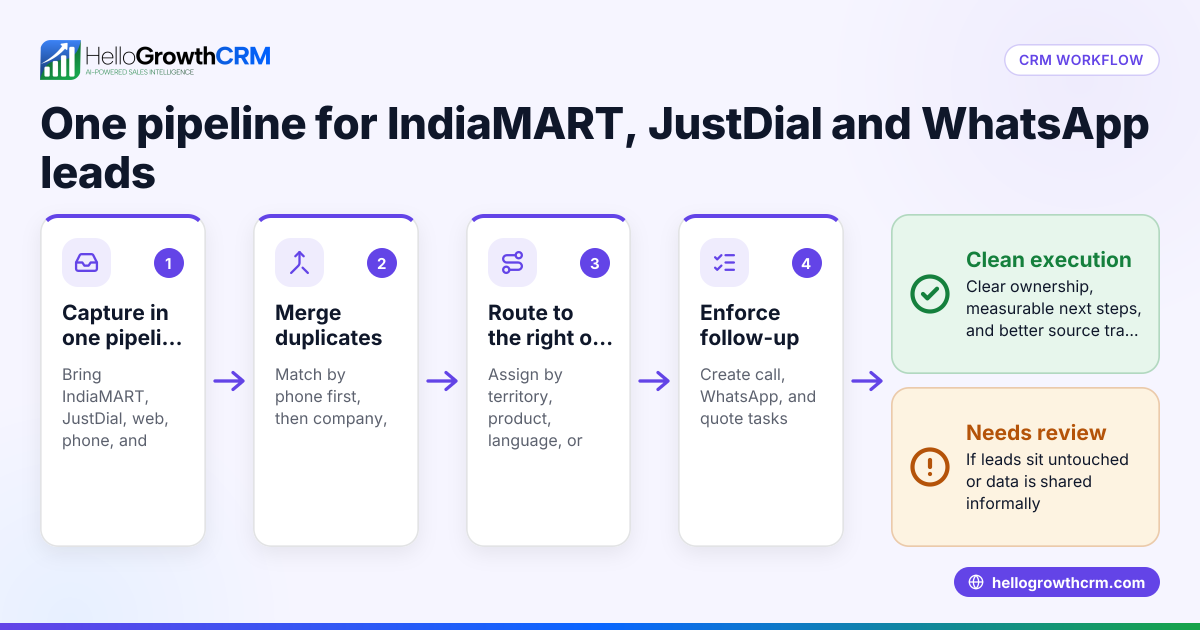
A good Territory Management setup prevents ownership disputes and improves response speed. If your team still routes leads manually in a shared sheet, that is usually where conversion starts leaking.
How to set up CRM lead scoring for IndiaMART, JustDial, and WhatsApp leads: Step-by-Step
Setting up CRM lead scoring for IndiaMART, JustDial, and WhatsApp leads works best when you map sources, define score rules, automate routing, and review conversion outcomes weekly, because the model only improves when scoring is tied to actual qualification, meetings booked, and revenue won.
- List every lead source
Include IndiaMART, JustDial, website forms, WhatsApp ads, referrals, and outbound callbacks. Keep source names clean inside the CRM. - Define your ICP fields
Capture industry, city, company size, use case, and serviceability. If data is missing often, make key fields progressive instead of mandatory. - Build a 100-point scorecard
Use source, fit, intent, territory, and engagement. Keep the logic visible to managers and reps. - Set score bands
Example: 80-100 = hot, 60-79 = warm, 40-59 = nurture, below 40 = low priority. These bands should trigger different SLAs. - Create routing rules
Route Mumbai and Pune leads to city owners. Route tier-2 and tier-3 leads by region, language, or partner coverage. - Attach follow-up cadences
Use fast phone-first sequences for high-score leads. Build cadences with the Follow-Up Cadence Builder and automate messages with Email Automation. - Track response and qualification
Measure first-response time, connect rate, MQL rate, and stage-velocity. Add call logging through CRM Dialer if your reps live on the phone. - Review scores every week
Check if high-scoring leads actually convert. If not, adjust the weight, not just rep behavior. - Connect forecasting and revenue data
Push qualified deals into pipeline stages and monitor future revenue through Sales Forecasting and Revenue Attribution. - Audit data sync and compliance
Make sure lead capture, consent logs, payment status, and accounting sync are traceable. This matters when operations scale.
How do you keep lead capture DPDPA 2023-safe and operationally clean?
Keeping lead capture DPDPA 2023-safe and operationally clean means collecting only needed data, recording consent where relevant, limiting access, and maintaining clear sync rules across CRM, messaging, payments, and accounting systems so growth does not create legal or process risk.
For Indian B2B teams, the biggest risk is not theory. It is messy execution.
Practical compliance rules for SME teams
- Capture only the fields you need to qualify and serve the lead
- Store source and timestamp for every enquiry
- Record opt-in source for WhatsApp communication
- Limit broad export access to CSV files
- Mask sensitive fields for non-admin users where possible
- Define retention rules for dead leads
If you connect payments or invoices, map fields carefully. For example:
- Use Razorpay sync for payment status and customer IDs
- Sync accounting outcomes into finance workflows via QuickBooks or your Tally connector process
- Keep lead-stage data separate from payment confirmation logic
The Reserve Bank of India publishes payment system guidance and regulatory updates. If your workflow touches payment links, collection status, or settlement references, finance and sales data should not be mixed loosely.
This is also where many teams need a limitation check. A lightweight score model works very well for teams under 50 reps. Above that, you usually need stricter field governance, deduplication, and admin controls across multiple business units.
How do scoring, payments, and accounting sync improve forecasting in INR?
Scoring, payments, and accounting sync improve forecasting in INR by linking lead quality to opportunity movement, payment confidence, and actual realized revenue, which gives managers a more realistic view of expected collections instead of a pipeline full of loosely qualified enquiries.
Forecasting breaks when top-of-funnel noise enters the pipeline. If every IndiaMART lead becomes an “opportunity,” your forecast is fiction.
Build a cleaner forecasting chain
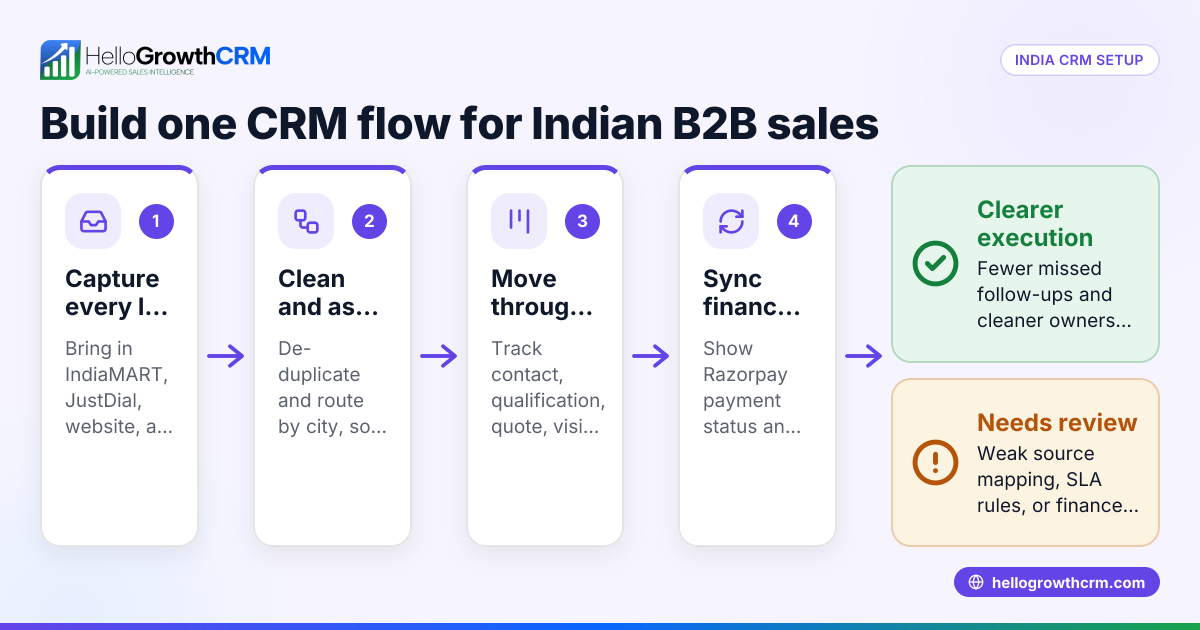
Use this sequence:
- Lead score decides response priority
- Qualification result decides MQL or SQL status
- Pipeline stage reflects real buying progress
- Quote or proposal ties to value in INR
- Payment status validates commercial progress
- Accounting sync closes the loop on realized revenue
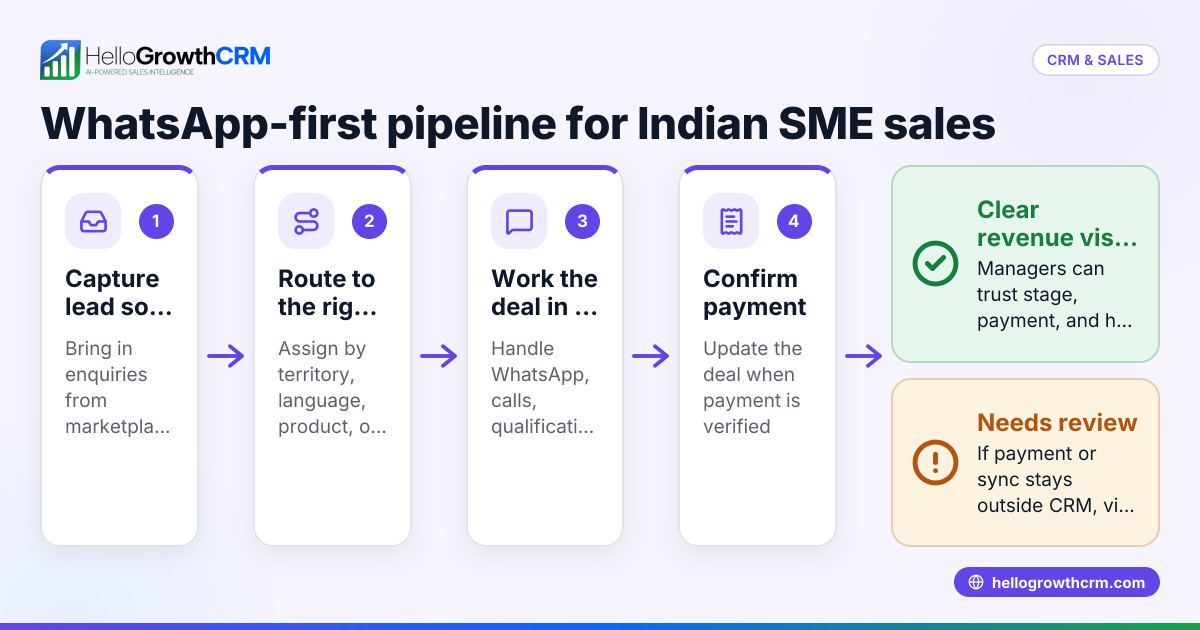
For many Indian SMEs, this flow matters when sales and finance work separately. A rep may mark a deal “won,” but the finance team may still be waiting on payment or invoice confirmation.
HelloGrowthCRM helps reduce that gap with Proposal Builder, pipeline workflows, and integrations like Razorpay. If you need broader process design, Managed RevOps can help standardize lifecycle stages and source reporting.
If you want to benchmark your own setup, use the CRM ROI Calculator or Pipeline Health Score before making scoring changes.
For Indian B2B teams handling IndiaMART, JustDial, website, and WhatsApp enquiries, the best lead scoring model is not the most complex one. It is the one your reps trust, your managers can audit, and your forecast can defend. If you want to build this inside a single system, explore HelloGrowthCRM’s Features, review Pricing, or start a Free Trial built for Indian sales teams.
About the author
Rohan Mehta is a Sales Operations Lead at HelloGrowthCRM with 9 years of experience in B2B SaaS, RevOps, and CRM implementation for Indian growth teams. He has led lead-routing, scoring, and forecasting projects for SME and mid-market companies across Mumbai, Pune, and Bangalore. One project that shaped this article involved redesigning inbound workflows for a 12-person industrial sales team handling IndiaMART and WhatsApp enquiries, where routing and SLA fixes improved qualification quality within one quarter.
Frequently Asked Questions
Q: What is the best CRM lead scoring model for IndiaMART leads in India?
A: The best CRM lead scoring model for IndiaMART leads in India uses source quality, ICP fit, buying intent, geography, and engagement in a simple 100-point framework. IndiaMART leads often show demand, but you still need to verify company fit and response quality before promoting them into pipeline.
Q: Should WhatsApp leads get a higher score than JustDial leads?
A: WhatsApp leads should get a higher score than JustDial leads only when the conversation shows clear intent, consent, and active engagement. A WhatsApp lead with a detailed requirement is usually stronger than a generic directory enquiry, but source alone should never decide priority.
Q: How fast should Indian B2B teams respond to inbound leads?
A: Indian B2B teams should respond to inbound leads as fast as possible, with hot leads ideally getting a first call within 5 to 10 minutes. That matters most for IndiaMART, JustDial, and WhatsApp, where buyers often contact multiple vendors at the same time.
Q: How do I score leads from Mumbai, Pune, and tier-2 cities differently?
A: You should score leads from Mumbai, Pune, and tier-2 cities differently by factoring serviceability, rep coverage, language needs, and expected sales motion. Geography should affect routing and SLA, not just the score, because conversion depends on how the lead is worked.
Q: Is lead scoring useful for small Indian sales teams?
A: Lead scoring is useful for small Indian sales teams because it helps limited reps focus on the best opportunities first. For teams under 50 reps, a visible rule-based model usually works better than a complex setup that nobody maintains.
Q: How can I keep WhatsApp lead capture compliant in India?
A: You can keep WhatsApp lead capture compliant in India by recording consent source, storing only necessary data, and controlling who can access conversations and exports. Your CRM should also preserve source, timestamp, and ownership history for audit and process clarity.
Q: Can lead scoring improve sales forecasting in INR?
A: Lead scoring can improve sales forecasting in INR by reducing low-quality enquiries entering active pipeline stages. When scores, qualification, deal stages, and payment updates are linked, managers get a more realistic view of expected revenue and collections.
Q: Does HelloGrowthCRM support this type of lead scoring setup?
A: HelloGrowthCRM supports this type of lead scoring setup through configurable scoring, workflow automation, territory routing, WhatsApp workflows, and forecasting tools. Teams can also book a Demo to map IndiaMART, JustDial, website, and WhatsApp lead flows into one operating model.
Frequently Asked Questions
Ready to put this into practice?
Set up your pipeline, WhatsApp follow-ups, and AI lead scoring in minutes — free, no credit card.
Try HelloGrowthCRM freeGet CRM tips in your inbox
Join thousands of sales professionals who get weekly insights on CRM strategy, AI automation, and pipeline optimization.

The HelloGrowthCRM team publishes guides on CRM strategy, AI sales tools, and revenue operations for small business sales teams.