HelloGrowthCRM software
Built for real small-business sales teams
HelloGrowthCRM helps reps qualify faster, follow up on time, and close more deals—with practical automation in one place.
- AI lead scoring and pipeline visibility
- Built-in dialer, WhatsApp, and email automation
- Sales forecasting and RevOps-ready reporting
CRM pipeline exit criteria are the specific, verifiable conditions a deal must meet before it can move from one sales stage to the next in your CRM, giving B2B teams a shared standard for progression, cleaner pipeline data, faster follow-up, and more reliable revenue forecasts.
Key Takeaways
- CRM pipeline exit criteria reduce rep subjectivity by defining exactly what must be true before a deal advances.
- Strong exit criteria improve forecast accuracy because stage movement reflects buyer progress, not seller optimism.
- The best criteria are observable and enforceable through required fields, task rules, and automation inside the CRM.
- HelloGrowthCRM helps teams operationalize exit criteria with AI Pipeline Management, required data capture, workflows, and Managed RevOps support.
- Exit criteria should stay simple. If reps cannot explain or follow them quickly, adoption drops.
- Teams should review stage conversion, stage velocity, and slipped deals every quarter to refine criteria.
Why CRM pipeline exit criteria matter
CRM pipeline exit criteria matter because they turn stage progression from a rep opinion into a measurable operating standard, which helps sales managers inspect deals faster, enforce consistent qualification, and trust pipeline reports when building forecasts, coaching reps, and planning revenue targets across the business.
Without exit criteria, stages become labels. One rep moves a deal after a good call. Another waits for a technical review. A third advances anything that "feels positive." The result is pipeline noise.
When I audit pipelines like this, I usually see three problems:
- too many deals parked in mid-funnel stages
- inflated commit forecasts
- weak handoffs between SDRs, AEs, and RevOps
A CRM should reflect buying reality, not seller hope. Exit criteria fix that by making each stage earn its place.
According to Harvard Business Review, sales execution improves when frontline activity and management systems are structured around clear process discipline rather than rep improvisation. That principle applies directly to stage progression.
What exit criteria are not
Exit criteria are not generic stage names. They are not "good conversation" or "high interest." They are not vague notes in a playbook that nobody checks.
Good exit criteria are:
- specific
- observable
- tied to buyer actions
- easy to inspect in the CRM
- enforceable with workflow rules
For example, "Discovery complete" is weak. "Pain confirmed, business impact quantified, next meeting scheduled, and MEDDPICC fields updated" is much stronger.
Why forecast accuracy depends on stage discipline
Forecast quality depends on stage quality. If stage entry is loose, probability models are weak from the start. Even advanced tools cannot fix bad inputs.
In one rollout we did with a 12-person sales team, the biggest forecast improvement did not come from changing probability percentages. It came from tightening the exit criteria between discovery and solution fit. Once reps had to log pain, timeline, champion strength, and a booked next step, the pipeline shrank a bit but became much more believable.
If you want better forecasting, pair exit criteria with Sales Forecasting, AI Deal Insights, and Revenue Attribution so stage movement and forecast categories reflect the same operating logic.
What good CRM pipeline exit criteria look like
Good CRM pipeline exit criteria look like short, stage-specific rules based on buyer evidence, required data, and the next committed action, so every rep knows when a deal is ready to advance and every manager can inspect progression without debating personal judgment or selling style.
The easiest test is this: could a new manager review ten deals in five minutes and reach the same conclusion as the rep? If not, the criteria are too fuzzy.
The four parts of strong exit criteria
Most high-performing teams build stage exit rules using four components:
- Buyer evidence
Something the buyer said, shared, approved, or did. - Required CRM fields
Data that must be filled before progression, such as close date, amount, MEDDPICC fields, use case, or decision process. - Next step commitment
A scheduled meeting, mutual action plan, trial start, security review, or commercial review. - Validation rule or automation
A CRM control that blocks stage movement or triggers follow-up work.
HelloGrowthCRM is built for this operating model. Teams can combine Sales Task Boards, Meeting Scheduler, Smart Inbox, and Email Automation to make the right action easy and the wrong action harder.
Example: weak vs strong exit criteria
| Stage | Weak exit criteria | Strong exit criteria |
|---|---|---|
| Qualification | Prospect showed interest | ICP fit confirmed, primary pain identified, owner assigned, next call booked |
| Discovery | Good call completed | Pain, impact, timeline, stakeholders, and current process documented in CRM |
| Demo / Solution Fit | Demo delivered | Use case mapped, success criteria agreed, technical fit confirmed, next evaluation step scheduled |
| Proposal | Proposal sent | Commercial terms shared, decision process confirmed, buyer timeline logged, follow-up date booked |
| Commit | Deal looks likely | Champion validated, procurement path known, legal/security status recorded, close plan agreed |
Strong criteria do not need to be long. They need to be unambiguous.
How to define stage-by-stage exit criteria in a B2B sales pipeline
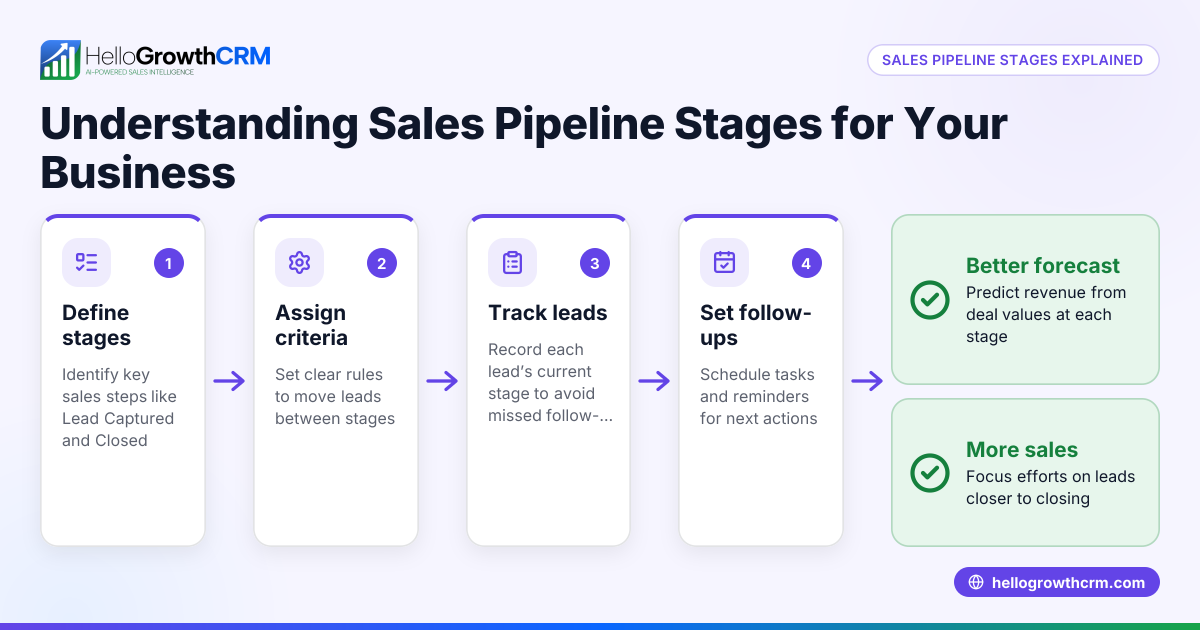
To define stage-by-stage exit criteria in a B2B sales pipeline, start with your real buying journey, identify the proof needed to leave each stage, map that proof to required CRM fields and tasks, then enforce progression with automation, inspection, and quarterly iteration based on conversion and forecast outcomes.
1. Start with the buyer journey, not your org chart
Many pipelines are designed around internal handoffs. Buyers do not care about your handoffs. They care about problem recognition, evaluation, approval, and buying confidence.
Map your stages to buyer milestones such as:
- initial qualification
- discovery completed
- solution fit confirmed
- business case or proposal reviewed
- decision and procurement underway
- closed won or lost
If your stages do not mirror buyer progress, exit criteria will always feel artificial.
2. Define the proof required to leave each stage
For each stage, ask one question: what must be true before this deal deserves the next label?
Examples of proof:
- confirmed pain with measurable business impact
- identified decision maker and champion
- agreed evaluation criteria
- documented timeline and procurement process
- mutual next step on the calendar
This is where a framework like MEDDPICC helps. Use the framework selectively. Do not force every field too early.
3. Translate proof into CRM fields and workflows
This is where most teams fail. They document stage rules in a slide deck, then leave the CRM unchanged. Reps keep doing what they always did.
Build enforcement into the system with:
- required fields before stage change
- automatic task creation
- warnings for missing next steps
- stage-specific playbooks
- manager alerts on stalled deals
HelloGrowthCRM supports this with Features, AI CRM, and AI Lead Scoring, so progression rules live inside the rep workflow instead of outside it.
4. Keep the criteria inspectable
Managers need to verify a stage quickly. That means criteria should be visible in a deal record and easy to filter in reports.
Useful inspection fields include:
- current stage age in days
- last buyer interaction date
- next scheduled meeting date
- MEDDPICC completion score
- champion status
- deal risk flags
With AI Pipeline Management and Pipeline Health Score, leaders can spot deals that advanced without enough evidence.
Common CRM pipeline stages and practical exit criteria examples
Common CRM pipeline stages should use practical exit criteria tied to qualification, buyer alignment, and documented next steps, because standard stage names only work when each one has evidence-based progression rules that managers can coach against and the CRM can enforce consistently.
Below is a simple B2B pipeline many teams can adapt.
Stage 1: Qualification
Exit criteria should confirm the account belongs in your pipeline.
Use criteria such as:
- ICP fit confirmed
- contact role identified
- high-level pain captured
- opportunity owner assigned
- next meeting scheduled
Do not require full deal qualification here. Keep it light.
Stage 2: Discovery Complete
Exit criteria should prove the rep understands the problem well enough to propose a relevant solution.
Use criteria such as:
- current process documented
- business pain and impact quantified
- timeline captured
- stakeholder map started
- next step agreed
A good rule is this: if the rep cannot write a clear problem statement, the deal should not leave discovery.
Stage 3: Solution Fit Validated
Exit criteria should show your product matches the use case and the buyer agrees on evaluation direction.
Use criteria such as:
- demo or workshop completed
- success criteria confirmed
- technical fit reviewed
- blockers logged
- evaluation meeting or trial kickoff scheduled
If your team uses product-led motions, connect this stage to Customer Health Score or usage data where relevant.
Stage 4: Proposal or Business Case
Exit criteria should indicate the buyer is evaluating commercial terms, not just collecting pricing.
Use criteria such as:
- proposal delivered to the right stakeholders
- pricing assumptions documented
- decision process confirmed
- commercial review date booked
- legal, security, or procurement path identified
This is a good place to standardize approval flows with Proposal Builder and Slack notifications.
Stage 5: Commit
Exit criteria should show the buyer is actively moving toward signature.
Use criteria such as:
- champion validated
- procurement started
- legal or security status known
- mutual close plan documented
- close date reviewed by manager
Gartner consistently emphasizes that CRM value depends on disciplined process adoption and usable data, not just system deployment.
How to enforce exit criteria without adding admin overhead
You can enforce exit criteria without adding admin overhead by making the CRM collect only the minimum proof needed at each stage, auto-filling data where possible, triggering tasks automatically, and using manager inspection dashboards instead of asking reps to maintain separate spreadsheets or checklists.
Reps resist process when it feels like duplicate work. They adopt it when the CRM helps them sell.
Use progressive data capture
Do not ask for every field at stage one. Ask only for what matters now.
A practical sequence looks like this:
- early stages: ICP fit, pain, owner, next step
- mid stages: stakeholders, timeline, use case, qualification fields
- late stages: commercial details, procurement, legal status, close plan
This reduces friction. It also improves data quality.
Automate the next action
The best exit criteria are tied to workflow, not memory.
For example:
- if a deal enters discovery, create a discovery recap task
- if no next meeting exists, prompt the rep before stage change
- if stage age exceeds threshold, alert the manager
- if proposal is sent, schedule a follow-up automatically
HelloGrowthCRM combines Email Automation, Meeting Scheduler, CRM Dialer, and Gmail workflows to reduce manual updates.
Use AI to inspect quality, not replace judgment
AI helps most when it checks for missing evidence, stale activity, or risk signals. It should not blindly move deals for reps.
That is why teams evaluating AI Sales Copilot, Deal Risk Agent, and Post-Call Agent should use them to support manager reviews and rep coaching.
This works best for teams under 50 reps. Above that, expect more complex routing, role-specific stages, and governance needs. In those cases, Managed RevOps often becomes important.
How to implement CRM pipeline exit criteria: Step-by-Step
To implement CRM pipeline exit criteria, document your current stages, define evidence-based progression rules, configure required fields and automations inside the CRM, pilot with one team, inspect adoption weekly, and refine the criteria based on conversion rates, stage aging, and forecast accuracy over one full sales cycle.
- Audit your current stages
Review every active stage and ask what buyer event it represents. Remove duplicate or unclear stages before writing rules. - List exit proof for each stage
Define 3-5 conditions that must be true before advancement. Favor buyer actions and observable data over seller opinion. - Map proof to CRM fields
Turn each condition into fields, checkboxes, task completion, or linked activities. Use only the minimum required data. - Configure enforcement rules
Set stage-change validations, alerts, and automatic follow-up tasks. In HelloGrowthCRM, this can sit alongside Sales Task Boards and AI Pipeline Management. - Pilot with one segment
Start with one team, region, or motion. Mid-market AE teams are often the best test group. - Train managers first
Managers drive adoption. Give them deal inspection views, coaching prompts, and a weekly review cadence. - Measure the impact
Track stage conversion, stage velocity in days, slipped deals, and forecast variance. A CRM ROI Calculator can help frame the business case. - Refine quarterly
Update rules after enough deal volume accumulates. Keep what predicts outcomes. Cut what creates friction.
Mistakes to avoid when standardizing stage progression
The biggest mistakes in standardizing stage progression are overengineering the criteria, forcing too many fields too early, confusing internal tasks with buyer progress, and failing to train managers to inspect and coach against the new rules inside the CRM every week.
I have seen teams spend weeks building a beautiful stage framework that reps ignore because it adds ten required fields to every deal. Simpler wins.
The most common mistakes
- Too many stages
If two stages cannot be explained clearly, merge them. - Criteria based on rep activity only
A sent email is not buyer progress. - No required next step
Deals stall when stage changes do not create motion. - No manager inspection
If leaders do not coach to the criteria, reps stop caring. - No service layer for cleanup
Legacy CRM data can distort the rollout. A RevOps Maturity Assessment can expose gaps before implementation.
If you are comparing platforms, this is where HelloGrowthCRM has a practical edge. We are not just selling a database. We combine configurable process controls, AI-supported inspection, and Managed RevOps for teams that need help operationalizing the model. HelloGrowthCRM is our product, so that is a disclosure worth making clearly.
If your team is trying to improve stage discipline, forecast trust, and rep consistency without creating more admin work, explore HelloGrowthCRM’s Demo, review Pricing, or start a Free Trial to see how pipeline rules, automation, and RevOps support work together.
About the author
Aarav Mehta is a Sales Operations Lead at HelloGrowthCRM with 11 years of experience in B2B SaaS revenue operations, CRM design, and pipeline governance. He has led CRM and forecasting rollouts for sales teams from 8 to 120 reps. One project that informed this article was a multi-region pipeline redesign for a SaaS company where stage exit rules, MEDDPICC field enforcement, and manager inspection cadences reduced forecast debate and improved pipeline hygiene within one quarter.
Frequently Asked Questions
Q: What are CRM pipeline exit criteria?
A: CRM pipeline exit criteria are the defined conditions a deal must meet before moving to the next sales stage in the CRM. They usually include buyer evidence, required fields, and a confirmed next action so stage progression reflects real deal progress.
Q: How do CRM pipeline exit criteria improve forecast accuracy?
Ready to put this into practice?
Set up your pipeline, WhatsApp follow-ups, and AI lead scoring in minutes — free, no credit card.
Try HelloGrowthCRM freeGet CRM tips in your inbox
Join thousands of sales professionals who get weekly insights on CRM strategy, AI automation, and pipeline optimization.

The HelloGrowthCRM team publishes guides on CRM strategy, AI sales tools, and revenue operations for small business sales teams.