HelloGrowthCRM software
Built for real small-business sales teams
HelloGrowthCRM helps reps qualify faster, follow up on time, and close more deals—with practical automation in one place.
- AI lead scoring and pipeline visibility
- Built-in dialer, WhatsApp, and email automation
- Sales forecasting and RevOps-ready reporting
HelloGrowthCRM CAN-SPAM & TCPA sequence templates are prebuilt outbound workflow assets for US mid-market teams that standardize consent capture, email and calling guardrails, unsubscribe handling, and revenue sync steps so reps can run compliant sequences in one CRM instead of juggling spreadsheets around Salesforce or HubSpot.
Key Takeaways
- HelloGrowthCRM gives US RevOps teams a practical template kit for compliant email, SMS, and call sequences.
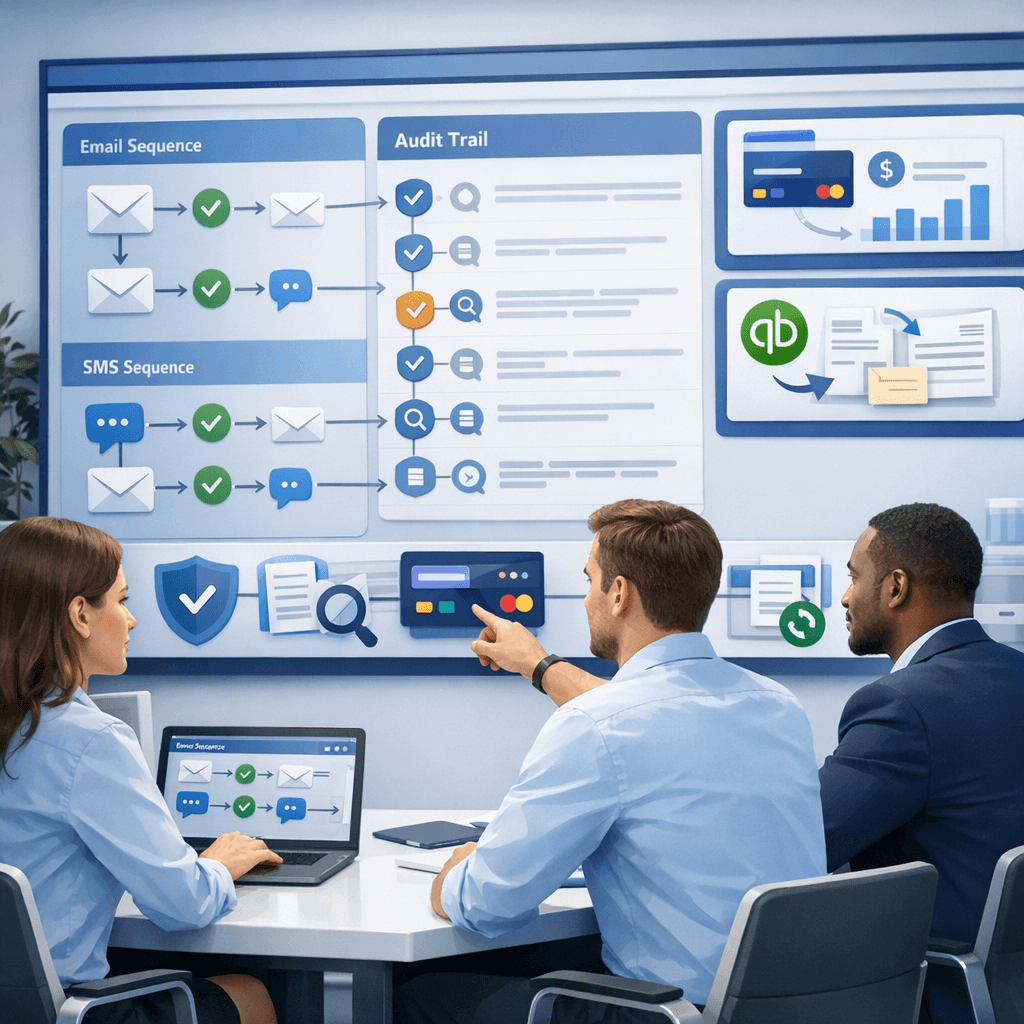
- The kit centers on consent fields, channel rules, suppression logic, and audit-friendly workflow history.
- It fits mid-market teams that still manage opt-outs, handoffs, and finance updates in spreadsheets.
- Native and connected workflows with Stripe and QuickBooks help tie closed-won deals to USD revenue operations.
- The setup is especially useful for buyers who expect clean process documentation, SOC 2 maturity, and clear outbound controls.
- Teams moving from scattered processes around Salesforce or HubSpot can launch faster with less admin debt.
What are HelloGrowthCRM CAN-SPAM & TCPA sequence templates?
HelloGrowthCRM CAN-SPAM & TCPA sequence templates are reusable outbound sequence frameworks that pair messaging steps with compliance controls, consent fields, unsubscribe rules, and channel-specific automation so US sales teams can send, text, and call prospects with clearer safeguards and better operational consistency.
This kit is not just a set of email templates. It is a controlled outbound system inside AI CRM. Each template includes:
- Contact-level consent fields
- Channel eligibility rules
- Unsubscribe and do-not-contact logic
- Rep task guidance
- Workflow ownership
- Revenue handoff triggers
For US mid-market teams, that matters because CAN-SPAM and TCPA are not the same. Email, SMS, and calling carry different risks. The FTC’s CAN-SPAM guide lays out core commercial email requirements, including accurate header information, clear ad identification when applicable, and opt-out processing. TCPA risk is often tied to calling and texting workflows, especially when teams use autodialing or promotional text outreach.
In practice, I have seen RevOps teams in New York and Austin keep unsubscribe status in one spreadsheet, call dispositions in another, and SMS approvals in a rep’s notes. That is where mistakes happen. HelloGrowthCRM replaces that patchwork with structured fields, rule-based automation, and visible workflow logs. If your team also needs channel orchestration, Email Automation, CRM Dialer, and WhatsApp & SMS CRM connect the policy layer to execution.
Why mid-market teams feel the pain first
Mid-market teams usually have enough volume to create risk, but not enough ops headcount to manage it manually. They often sit between startup informality and enterprise governance. That is exactly where sequence templates save time.
A clean template kit helps teams:
- Reduce rep-by-rep process variation
- Document outbound safeguards for procurement reviews
- Keep finance and sales systems aligned after close
- Support cleaner reporting in Revenue Attribution
Why do US RevOps teams need a structured compliance-first sequence kit?
US RevOps teams need a structured compliance-first sequence kit because spreadsheet-driven outbound breaks when volume rises, channels multiply, and procurement asks for proof of controls; a managed template system turns policy into repeatable rules that reps actually follow inside daily selling workflows.
The pressure is operational, legal, and commercial at the same time. A team in Chicago might be using Salesforce as the system of record, HubSpot for marketing sends, a separate dialer, and shared sheets for opt-outs. That stack makes ownership blurry.
HelloGrowthCRM solves this by bringing sequence logic closer to the seller and the admin. In one view, teams can manage activity, contact status, and next-step automation using Sales Task Boards, Smart Inbox, and Meeting Scheduler.
The National Institute of Standards and Technology states that the Cybersecurity Framework helps organizations manage and reduce cybersecurity risk through governance and control practices, which is often part of US buyer diligence for SaaS vendors and their internal processes alike https://www.nist.gov/cyberframework.
That does not mean CAN-SPAM or TCPA compliance equals SOC 2. It does mean buyers often expect documented controls, clear process ownership, and auditability. Sequence templates help support that expectation.
What breaks in spreadsheet-led outbound
When I have audited pipelines like this, the same issues show up repeatedly:
- Reps do not know whether SMS consent exists
- Email opt-outs do not suppress manual one-offs
- Call tasks ignore time-zone logic
- Closed-won finance steps happen late
- Managers cannot prove which rule blocked or allowed outreach
Those are not edge cases. They are normal consequences of disconnected tools.
Which HelloGrowthCRM features support CAN-SPAM and TCPA safeguards?
HelloGrowthCRM supports CAN-SPAM and TCPA safeguards through configurable consent fields, workflow rules, suppression logic, channel-specific automation, activity history, and integration triggers that let RevOps teams control who can be contacted, through which channel, and under what conditions across the sales cycle.
The core building blocks sit across Features, but a few capabilities matter most for this use case.
Consent fields and contact eligibility
Set fields for:
- Email opt-in status
- Email unsubscribe date
- SMS consent status
- SMS consent source
- Call permission notes
- State or regional restrictions
- Last compliance review date
These fields become usable in routing, sequence enrollment, and task creation. For example, an outbound SDR in Austin can enroll a contact into an email-only sequence, while SMS and dialer steps stay blocked until the right field values are present.
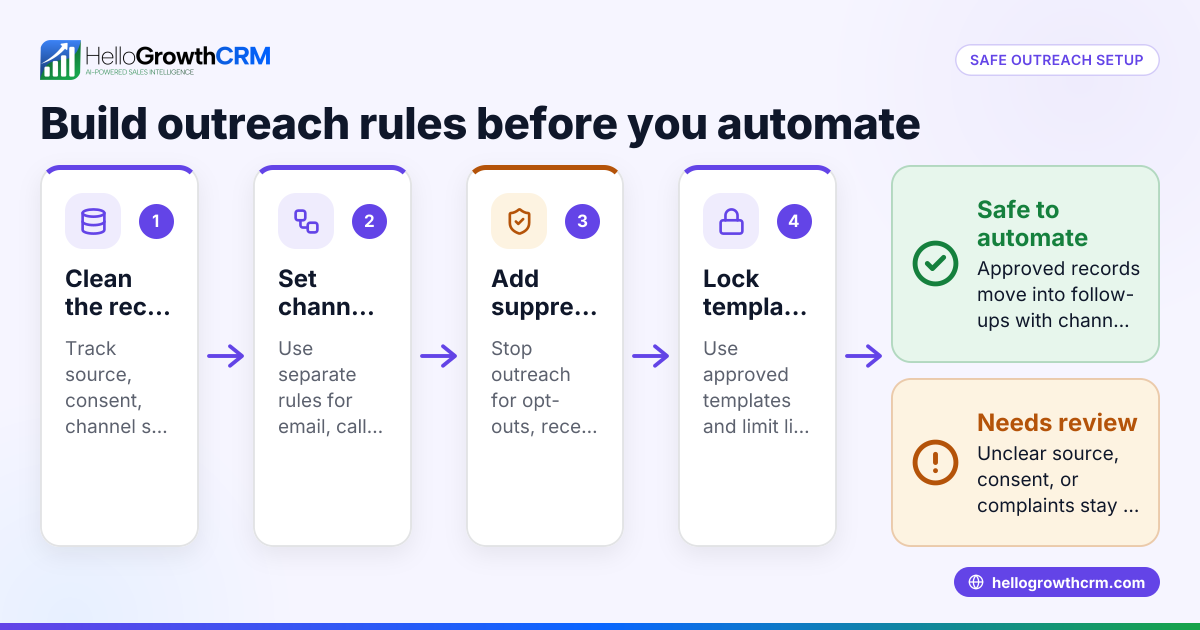
Workflow rules and suppression logic
With workflow controls, admins can:
- Stop sequence enrollment if unsubscribe is true
- Block SMS if consent source is missing
- Route high-risk records to ops review
- Pause outreach after a legal complaint or reply
- Trigger manager approval for sensitive segments
That is where AI Pipeline Management and AI Deal Insights also help. They do not make legal decisions. They help surface risk signals and missing data faster.
Controlled execution across channels
Email Automation handles send logic and reply-based exits. CRM Dialer keeps call tasks and dispositions inside the record. WhatsApp & SMS CRM supports text-centric workflows where consent and suppression should be visible before a rep sends anything.
The Federal Communications Commission explains that TCPA rules restrict certain autodialed calls, prerecorded calls, and text messages, especially without prior consent https://www.fcc.gov/general/telemarketing-and-robocalls.
Auditability for procurement and internal reviews
A strong template kit also helps with buyer trust. Mid-market procurement teams often ask for process screenshots, control descriptions, or examples of how opt-outs are honored. Centralized workflow history is much easier to defend than “we track that in a Google Sheet.”
How does HelloGrowthCRM compare with spreadsheet-based processes around Salesforce or HubSpot?
HelloGrowthCRM compares favorably with spreadsheet-based processes around Salesforce or HubSpot because it turns fragmented compliance tasks into governed, in-workflow controls, reducing manual updates, missed suppressions, and finance handoff delays while still fitting teams that need to integrate with incumbent systems rather than rip them out immediately.
This is not a claim that Salesforce or HubSpot cannot support compliant outbound. They can. The issue is often how the team has implemented them. Many mid-market orgs bolt on process with exports and sheets because it is faster at first.
HelloGrowthCRM is our product, so that bias should be clear. The practical difference is that HelloGrowthCRM packages outbound execution, controls, and revenue workflows in a simpler operating model for leaner RevOps teams.
| Capability | Spreadsheet process around Salesforce/HubSpot | HelloGrowthCRM template kit |
|---|---|---|
| Consent tracking | Often split across fields, notes, and sheets | Structured fields with workflow logic |
| Email unsubscribe handling | Manual imports or delayed syncs | Rule-based suppression in-sequence |
| SMS/call guardrails | Often rep judgment or tool-specific settings | Channel eligibility rules on the record |
| Audit trail | Hard to reconstruct across systems | Central activity and workflow history |
| Closed-won finance handoff | Manual task or ops follow-up | Triggered sync workflows to Stripe and QuickBooks |
| Rep adoption | Low when process lives outside the CRM | Higher when tasks and sends happen in one place |
| RevOps admin burden | High | Moderate and more scalable |
When the template kit is the best fit
This works best for:
- Teams with 5 to 50 quota-carrying reps
- Companies selling in the US mid-market
- RevOps leaders replacing sheet-based controls
- Firms needing better documentation for security or procurement reviews
Above that size, expect deeper custom governance needs. Enterprise legal review, multiple business units, and regional policy variations may need a more formal compliance program.
How do Stripe and QuickBooks fit into a compliant USD-based outbound workflow?
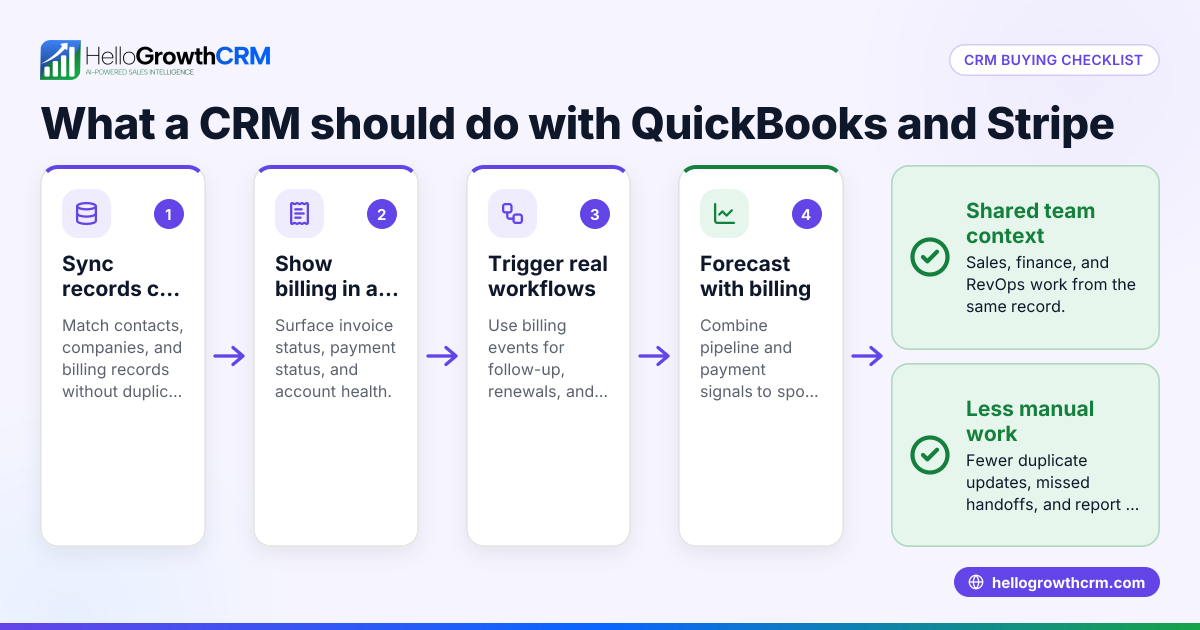
Stripe and QuickBooks fit into a compliant USD-based outbound workflow by connecting post-sale revenue events to CRM lifecycle stages, so RevOps teams can prove that approved outbound led to closed-won business, trigger billing and accounting steps, and reduce manual reconciliation after deals close.
For many US SaaS teams, the default finance stack is Stripe for billing and QuickBooks for accounting. That is common in New York, Chicago, and Austin mid-market companies. The gap usually appears after the deal closes. Sales marks an opportunity won, but finance still needs customer, plan, amount, and start-date details.
HelloGrowthCRM lets teams connect Stripe, QuickBooks, and All Integrations so the handoff is not stuck in Slack threads or spreadsheets.
Typical closed-won workflow
A common setup looks like this:
- Opportunity is marked closed-won in USD
- Workflow checks required fields
- Customer record is prepared for billing sync
- Finance owner gets an approval task if needed
- Stripe customer or invoice workflow runs
- QuickBooks sync supports accounting visibility
In one rollout we did with a 12-person sales team, the biggest gain was not faster invoicing alone. It was fewer disputes between sales and finance about what had actually been sold. The workflow forced product, amount, billing start date, and owner fields to be complete before the finance handoff fired.
If you want to quantify the impact before changing your process, the CRM ROI Calculator and RevOps Maturity Assessment are useful starting points.
How to implement HelloGrowthCRM CAN-SPAM & TCPA sequence templates: Step-by-Step
Implementing HelloGrowthCRM CAN-SPAM & TCPA sequence templates means mapping your consent rules, configuring contact fields, building channel-specific sequence logic, testing suppression behavior, and connecting closed-won revenue workflows so outbound compliance and finance operations work together inside one repeatable US sales process.
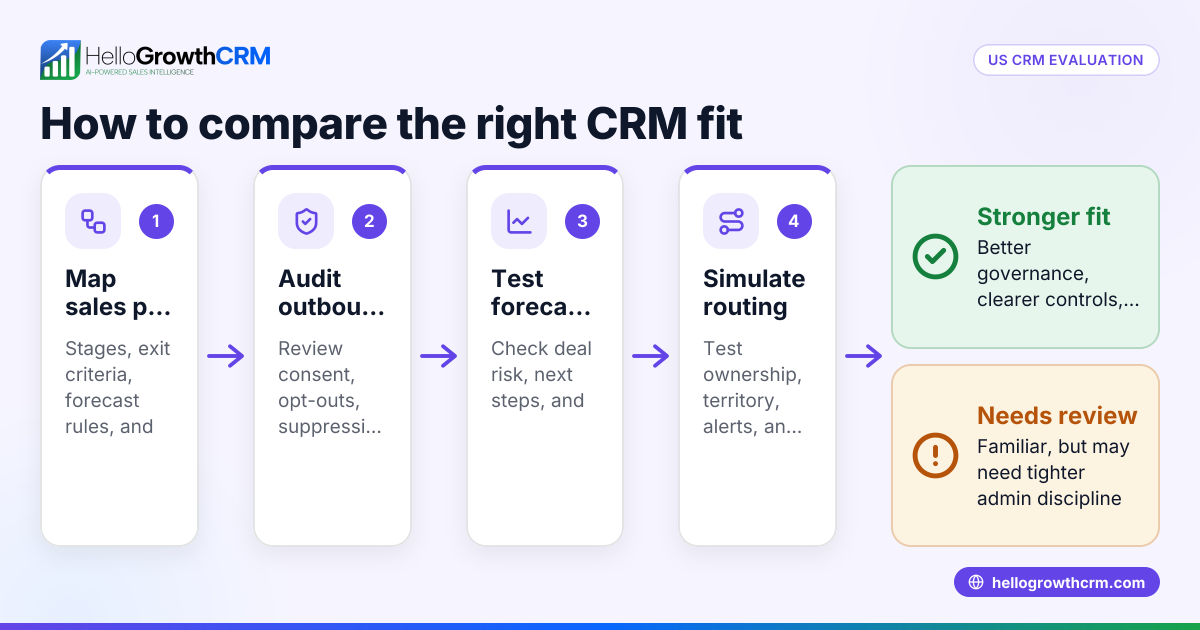
- Map your current outbound process
Document where email, call, and SMS permissions live today. Include Salesforce, HubSpot, sheets, and rep-owned notes. - Create compliance fields
Add consent and suppression fields in AI CRM. Keep naming simple and owner rules clear. - Build channel-specific templates
Create separate sequence templates for email-only, call-first, and SMS-enabled outreach. Do not mix channels until the gating logic is proven. - Set workflow guardrails
Use automation to block enrollment when consent is missing or unsubscribe is true. Route exceptions to ops review instead of letting reps guess. - Connect execution tools
Tie your templates to Email Automation, CRM Dialer, and WhatsApp & SMS CRM as needed. - Test with internal records first
Run sample records through every path. Confirm opt-outs, reply exits, and blocked sends work exactly as intended. - Add reporting and alerts
Use dashboards and workflow notifications to monitor suppression events, enrollment failures, and reply-driven exits. A Slack alert helps managers catch issues early. - Sync post-sale finance steps
Connect Stripe and QuickBooks so compliant outbound can be tied to booked revenue and billing actions.
A practical rollout checklist
Before launch, make sure you have:
- Legal or internal policy sign-off
- Field definitions in plain English
- Rep training with examples
- QA tests for every sequence path
- A rollback plan if logic fails
What should US teams document for CAN-SPAM, TCPA, and SOC 2 buyer expectations?
US teams should document field definitions, consent sources, suppression logic, unsubscribe handling, user permissions, approval rules, and workflow history because buyers and internal stakeholders rarely trust verbal assurances; they want visible controls that show how outbound policy is enforced in real operating systems.
For most mid-market teams, “documentation” should mean something practical:
Minimum documentation pack
- Sequence template names and intended use
- Definitions for every consent field
- Rules that allow or block each channel
- Opt-out and suppression workflow descriptions
- User roles and approval permissions
- Finance handoff logic for closed-won deals
- Test records and screenshots
This is especially useful when security reviews ask how your team handles customer data and workflow access. It also supports internal readiness if you later expand into Managed RevOps or add AI-assisted process layers like AI Sales Copilot.
In one audit prep project, a buyer did not ask for a perfect legal memo. They asked for screenshots, ownership, and proof that opt-outs were processed consistently. The team that could show the workflow path passed faster than the team that relied on policy documents alone.
HelloGrowthCRM helps because the product creates an operational record, not just a policy statement.
If your US team is replacing spreadsheet-led outbound and wants compliant sequence execution, clear consent controls, and cleaner Stripe and QuickBooks handoffs, start with HelloGrowthCRM. Explore Features, review Pricing, or book a Demo to see how the template kit works for American mid-market RevOps teams.
About the author
Marcus Hale is a Sales Operations Lead at HelloGrowthCRM with 9 years of experience in B2B SaaS RevOps, outbound systems, and revenue automation. He has led CRM and workflow rollouts for US sales teams ranging from 8 to 60 reps. One project that informed this article was a migration for a Chicago SaaS company that replaced spreadsheet-based opt-out tracking and manual Stripe handoffs with controlled sequence rules and finance sync automation.
Frequently Asked Questions
Q: What are HelloGrowthCRM CAN-SPAM & TCPA sequence templates used for?
A: HelloGrowthCRM CAN-SPAM & TCPA sequence templates are used to run compliant outbound email, call, and SMS workflows with clearer consent and suppression controls. They help US sales teams replace manual spreadsheets with structured rules inside the CRM.
Q: Does HelloGrowthCRM guarantee legal compliance with CAN-SPAM or TCPA?
A: HelloGrowthCRM does not guarantee legal compliance with CAN-SPAM or TCPA because legal outcomes depend on your process, counsel, and actual outreach behavior. The platform helps enforce documented rules, but teams should still review requirements with legal advisors.
Q: Can I use HelloGrowthCRM if my company still runs Salesforce or HubSpot?
A: Yes, you can use HelloGrowthCRM if your company still runs Salesforce or HubSpot as an incumbent system. Many mid-market teams use HelloGrowthCRM to standardize outbound workflows and revenue handoffs without forcing an immediate rip-and-replace.
Q: How do Stripe and QuickBooks connect to these sequence templates?
A: Stripe and QuickBooks connect to these sequence templates through post-sale workflow triggers tied to closed-won opportunities. That lets RevOps teams pass approved customer and deal data into billing and accounting steps with less manual re-entry.
Q: Are these templates a good fit for teams under 50 reps?
A: Yes, these templates are a strong fit for teams under 50 reps because they balance control and ease of setup. Larger teams can still use them, but complex governance often needs more custom policy design.
Q: What fields should I track for outbound consent in the US?
Frequently Asked Questions
Ready to put this into practice?
Set up your pipeline, WhatsApp follow-ups, and AI lead scoring in minutes — free, no credit card.
Try HelloGrowthCRM freeGet CRM tips in your inbox
Join thousands of sales professionals who get weekly insights on CRM strategy, AI automation, and pipeline optimization.

The HelloGrowthCRM team publishes guides on CRM strategy, AI sales tools, and revenue operations for small business sales teams.