HelloGrowthCRM software
Built for real small-business sales teams
HelloGrowthCRM helps reps qualify faster, follow up on time, and close more deals—with practical automation in one place.
- AI lead scoring and pipeline visibility
- Built-in dialer, WhatsApp, and email automation
- Sales forecasting and RevOps-ready reporting
HubSpot vs Pipedrive in Australia is a buyer decision about which CRM better fits your sales process, compliance needs, finance stack, and budget, with HubSpot usually offering broader marketing and service capability while Pipedrive often winning on simpler sales rollout, lower starting cost, and faster adoption for SMB teams.
Key Takeaways
- Australian SMBs should compare more than list price. You need to check onboarding effort, add-ons, user permissions, and integration costs in AUD.
- HubSpot suits teams that want one platform for marketing, sales, and service, but costs can rise fast as usage grows.
- Pipedrive suits teams that want a sales-first CRM with fast setup, clean pipelines, and less admin overhead.
- For compliance, neither tool makes you compliant by default. Your processes still need to align with the Privacy Act 1988, the APPs, and the Spam Act 2003.
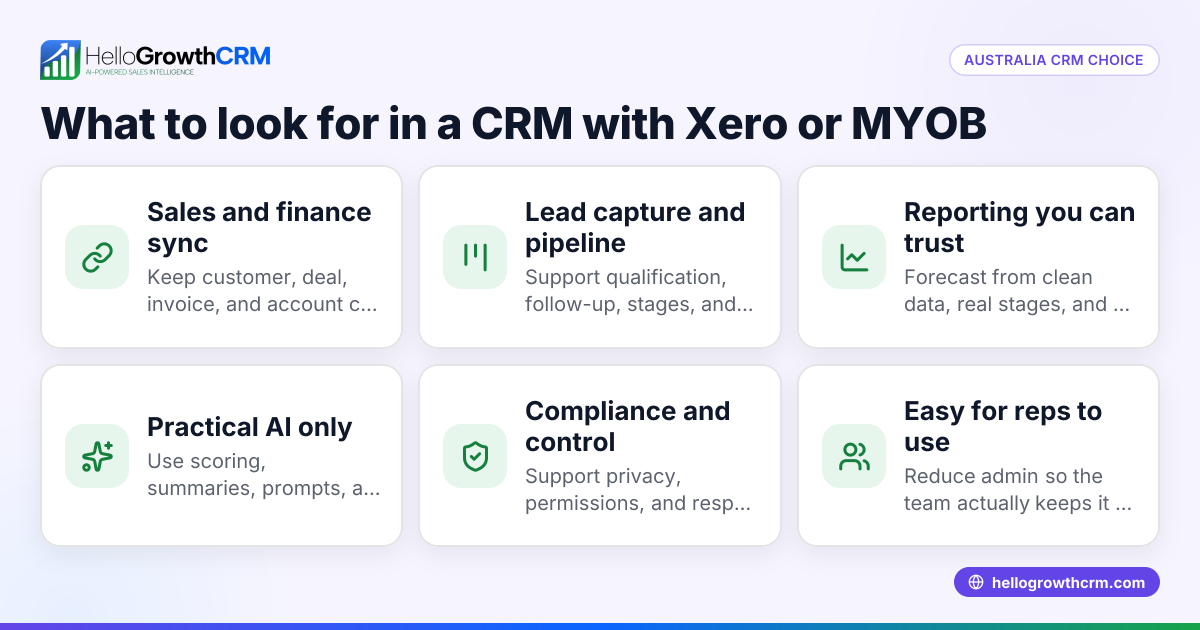
- If Xero or MYOB is central to your workflow, test invoice sync, customer record matching, and handoff between sales and finance before you buy.
- HelloGrowthCRM is worth shortlisting if you want Australian-friendly rollout, AI assistance, and revops support in one stack.
Which CRM is better for Australian SMBs: HubSpot or Pipedrive?
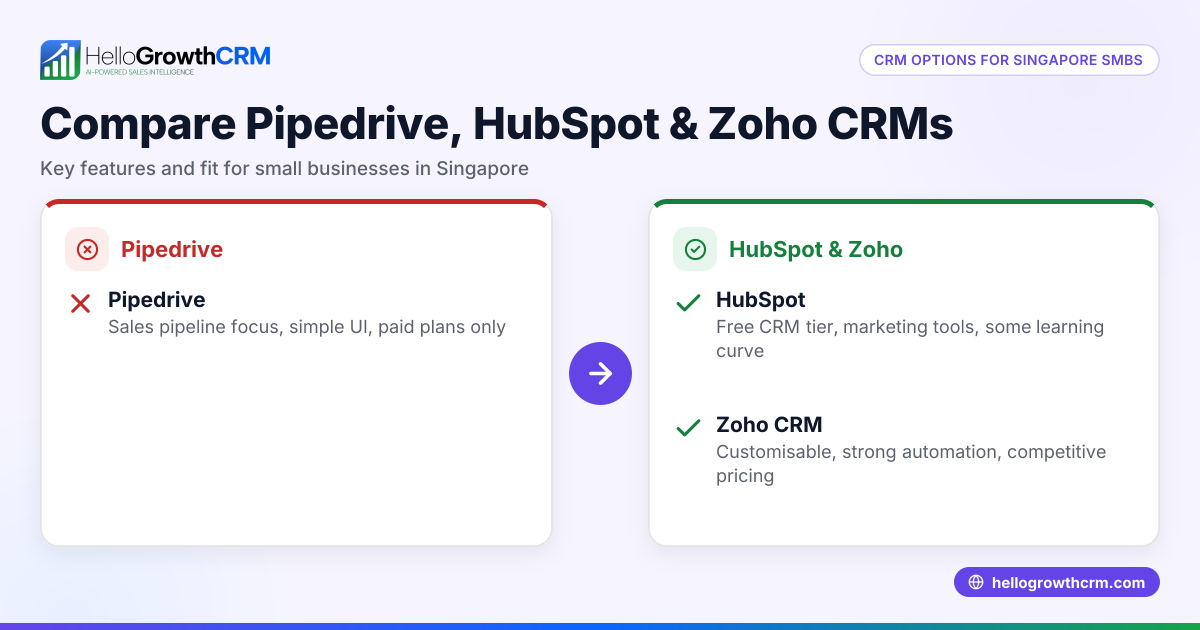
HubSpot vs Pipedrive for Australian SMBs comes down to business model and operating maturity: HubSpot is usually better for teams needing marketing, service, and reporting depth, while Pipedrive is often better for SMBs that want a lower-friction sales CRM with quicker rollout, simpler pipelines, and less ongoing admin.
The fastest way to decide is to score each platform against five practical criteria:
- Sales process fit
- Compliance and governance fit
- Xero or MYOB workflow fit
- Rollout effort for your team
- Total cost over 12 months
In my experience, most Sydney and Melbourne SMBs do not fail at CRM selection because the product is bad. They fail because they buy for feature count, then discover the setup model does not match their team discipline. A 6-rep agency with one sales manager needs a different CRM than a 20-person SaaS team running inbound, outbound, onboarding, and renewals.
When I have audited pipelines like this, the biggest issue is usually not contact storage. It is stage design, handoff rules, and follow-up consistency. If that is your real problem, a cleaner workflow often beats a broader platform.
A quick side-by-side view
| Criteria | HubSpot | Pipedrive |
|---|---|---|
| Best for | SMBs wanting sales, marketing, and service in one platform | SMBs wanting a sales-first CRM with simple pipeline management |
| Typical rollout effort | Medium to high | Low to medium |
| Ease of use for new reps | Good, but more menus and objects to learn | Very strong, especially for pipeline-focused teams |
| Marketing automation depth | Strong | Lighter |
| Xero/MYOB workflow fit | Depends on integration path and data model | Depends on integration path, often simpler for basic sales-to-invoice flow |
| Compliance controls | Good admin features, but setup complexity is higher | Simpler to manage, but may need more external process support |
| Budget predictability | Can become expensive with add-ons and tier jumps | Often more predictable for smaller teams |
| Best buyer profile in Australia | Growing SMB with multi-team GTM needs | Owner-led or sales-led SMB focused on pipeline execution |
How do HubSpot and Pipedrive compare on cost for Australian businesses?
HubSpot and Pipedrive differ sharply on cost structure for Australian businesses: HubSpot often starts attractively in some use cases but gets expensive as you add paid hubs, automation, reporting, and users, while Pipedrive is usually easier to budget for if your needs stay focused on core sales workflows.
For Australian buyers, the right question is not “What is the monthly plan price?” It is “What will this cost us in AUD over 12 months once we include implementation, integration, reporting, and admin time?”
Total cost of ownership in AUD
Review these cost layers before you commit:
- Base subscription
- Sales user seats
- Marketing contacts or automation limits
- Reporting and forecasting upgrades
- Integration tools like Zapier
- Onboarding or partner setup fees
- Internal admin time
- Data migration and cleanup
HubSpot often looks strongest when you want several functions under one vendor. That can reduce stack sprawl. But if you only need deal tracking, task management, and simple automation, Pipedrive can cost less and require fewer paid extras.
In one rollout we did with a 12-person sales team, the hidden cost was not licences. It was the time needed to define properties, rebuild lifecycle stages, and clean duplicate records before go-live. That kind of work matters more than the sticker price.
Budget questions to ask finance early
If your finance lead works in Xero or MYOB, ask:
- Will sales create invoice-ready data?
- Do we need quotes, products, and tax fields in CRM?
- Will marketing contact growth change pricing?
- How much admin time will one ops owner spend each month?
If you want a quick baseline, use a CRM ROI Calculator before comparing final quotes.
Which platform is easier to roll out for teams in Sydney and Melbourne?
For most small Australian teams, Pipedrive is easier to roll out than HubSpot because the product is more focused, the pipeline model is simpler, and reps learn it faster; HubSpot is still manageable, but rollout gets heavier when you add marketing automation, service workflows, custom properties, and reporting requirements.
Ease of rollout matters more than many buyers expect. A CRM that is powerful but half-adopted creates bad forecast data and weak compliance records.
Where Pipedrive often wins
Pipedrive tends to suit SMBs that need:
- A visible, drag-and-drop pipeline
- Fast onboarding for new reps
- Low admin overhead
- Clear task and activity management
- Shorter implementation cycles
For a Melbourne trade services business or a Sydney professional services firm, that simplicity can be enough. If your process starts with lead, moves to quote, then invoice, you may not need a large object model.
Where HubSpot often wins
HubSpot tends to suit teams that need:
- Shared sales and marketing data
- Lifecycle stages across the funnel
- Campaign attribution
- Service handoff
- Broader reporting for managers
If your team plans to connect Email Automation, landing pages, nurture sequences, and service workflows, HubSpot’s broader scope can justify the added setup effort.
This is also where buyer maturity matters. A founder-led team with inconsistent pipeline hygiene may struggle in a broad platform. A revops-led team with clear stage definitions and SLAs may benefit from the extra flexibility.
How do HubSpot and Pipedrive fit Xero and MYOB-led finance workflows?
HubSpot and Pipedrive can both fit Xero or MYOB-led finance workflows in Australia, but the better option depends on how much financial data you need inside CRM, whether invoicing starts from won deals, and how cleanly customer, product, tax, and payment fields sync across systems.
For most SMBs, the workflow matters more than the app listing. A simple “integration available” claim does not guarantee clean downstream operations.
What to test in a finance-led workflow
Before buying, test these exact scenarios:
- Won deal becomes customer record
- Quote or proposal passes the right line items
- Invoice status flows back to sales if needed
- Finance can match legal entity names
- GST and product fields map correctly
- Duplicate contacts do not create duplicate debtors
Australian SMBs often rely on Xero or MYOB as the financial source of truth. Your CRM should support that reality, not fight it. If your handoff is basic, Pipedrive may be enough. If you need broader reporting and linked customer lifecycle data, HubSpot may be the stronger long-term fit.
You should also check adjacent tooling. Many teams rely on QuickBooks globally, but in Australia, Xero and MYOB remain common decision drivers. If your operation also uses scheduling, email, and telephony, integrations like Gmail, Google Meet, and Twilio affect the final workflow as much as accounting sync does.
HelloGrowthCRM angle for finance-heavy SMBs
If your sales-to-cash process is messy, a system with Revenue Attribution, Proposal Builder, and Sales Forecasting can reduce spreadsheet handoffs. That is where some Australian SMBs shortlist HelloGrowthCRM alongside mainstream CRMs.
What should Australian SMBs check for compliance and governance?
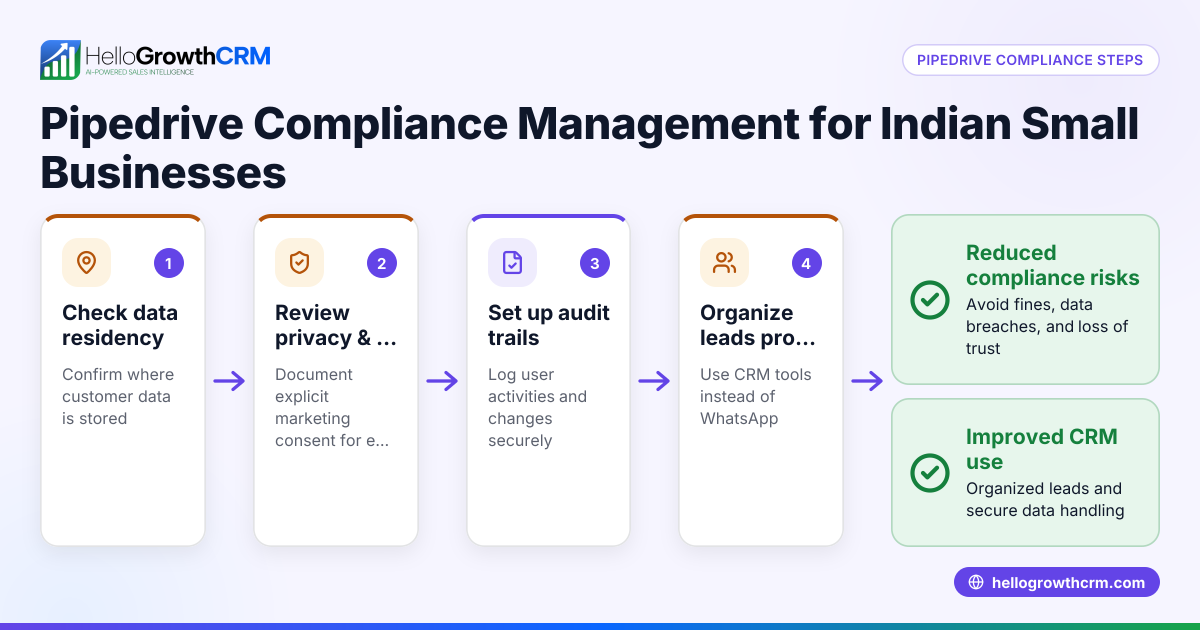
Australian SMBs should check whether HubSpot or Pipedrive can support their compliance process, not whether the software alone makes them compliant, because obligations under the Privacy Act 1988, the Australian Privacy Principles, and the Spam Act 2003 depend on how your team collects, stores, uses, and messages personal data.
This is where neutral CRM reviews often stay too shallow. The real issue is operational governance.
The Office of the Australian Information Commissioner publishes the Australian Privacy Principles that govern how many organisations handle personal information.
The Australian Communications and Media Authority enforces Australia’s spam rules, including consent and unsubscribe requirements.
Practical compliance checks
Use this shortlist during evaluation:
- Can you control user permissions by role?
- Can you log consent source and date?
- Can you track unsubscribe status across channels?
- Can you limit exports of customer data?
- Can you document retention and deletion processes?
- Can you separate marketing contacts from service records?
Under the Spam Act 2003 guidance from ACMA, commercial electronic messages must generally include consent, sender identification, and a functional unsubscribe. That affects how you set up outbound cadences and marketing automation.
If outbound is a big channel, do not just compare email sending features. Compare governance. This includes approval processes, suppression logic, and audit history. If you need help operationalising that, Managed RevOps is often more useful than another software add-on.
Limits buyers should understand
For teams under 50 reps, either platform can usually support reasonable governance if configured well. Above that, complexity rises quickly. More business units, more inboxes, and more integrations create more risk. That is where stronger revops ownership becomes essential.
Which CRM fits different Australian SMB use cases better?
The better CRM fit depends on your business type: HubSpot fits multi-team SMBs that need one customer platform across marketing, sales, and service, while Pipedrive fits sales-led SMBs that want a focused pipeline tool, fast user adoption, and lower process complexity.
Below is a practical buyer map.
Choose HubSpot if you need:
- Marketing and sales in one system
- More advanced attribution and reporting
- Service or support workflows
- More structured lifecycle management
- A platform that can expand with team complexity
If you are comparing broader AI-driven workflows, it is also worth reviewing AI CRM, AI Pipeline Management, and AI Deal Insights to see whether you need more than traditional CRM records.
Choose Pipedrive if you need:
- Fast rollout in days, not months
- A CRM for owner-led or rep-led sales teams
- Lower admin burden
- Strong pipeline visibility
- Simpler budgeting for a smaller team
Consider HelloGrowthCRM if you need:
- Sales workflow plus AI assistance in one stack
- Strong follow-up execution through AI Lead Scoring and AI Sales Copilot
- Built-in communication workflows like WhatsApp & SMS CRM and CRM Dialer
- Guided rollout and local-fit support via a Demo or Free Trial
To be clear, HelloGrowthCRM is our product, so buyers should compare it with the same rigour. That means checking pricing, workflow fit, and compliance controls against your own process.
How to choose between HubSpot and Pipedrive in Australia: Step-by-Step
Choosing between HubSpot and Pipedrive in Australia works best when you map your real sales process, compliance obligations, finance handoffs, and 12-month budget before booking demos, because the right CRM is the one your team will actually use consistently while meeting governance and reporting needs.
- Map your current process
Write down lead sources, pipeline stages, handoffs, and forecast steps. Include where Xero or MYOB enters the process. - List must-have workflows
Separate true needs from nice-to-haves. Examples include quoting, outbound sequences, consent tracking, and invoice visibility. - Check compliance requirements
Review APP handling, retention, consent capture, and unsubscribe management. Your legal or ops lead should join this step. - Run a sample integration test
Use a real customer scenario. Test contact creation, deal progression, finance sync, and duplicate handling. - Price the full 12-month cost
Include licences, onboarding, integrations, admin time, and reporting upgrades. Always calculate in AUD. - Pilot with real users
Ask two reps, one manager, and one finance stakeholder to complete daily tasks. Adoption signals matter more than demo polish. - Score each CRM objectively
Rate process fit, compliance fit, finance fit, rollout speed, and cost from 1 to 5. Keep the scorecard simple and visible.
If you want a structured way to do this, start with a RevOps Maturity Assessment and then review Features against your scorecard.
For Australian teams that want a practical CRM with AI help, clear rollout, and strong revenue operations support, HelloGrowthCRM is worth a serious look. You can explore Pricing, book a Demo, or start a Free Trial to test fit with your Sydney, Melbourne, or Brisbane workflow before making a final CRM decision.
About the author
Liam Carter is a Sales Operations Lead at HelloGrowthCRM with 11 years of experience in B2B SaaS, CRM implementation, and revenue operations. He has led CRM selection and rollout projects for Australian SMBs across software, services, and trade businesses. One project that shaped this article was a multi-office rollout for a 12-person sales team split across Sydney and Melbourne, where the hardest work was not migration but aligning pipeline stages, consent rules, and finance handoffs.
Frequently Asked Questions
Q: Is HubSpot or Pipedrive better for small business in Australia?
A: HubSpot or Pipedrive is better for a small business in Australia depending on whether you need a broad customer platform or a simple sales CRM. HubSpot suits multi-team growth plans. Pipedrive suits smaller sales-led teams that want quick setup and lower complexity.
Q: Which CRM is cheaper in Australia, HubSpot or Pipedrive?
A: Pipedrive is usually cheaper in Australia for SMBs that only need core sales CRM functions. HubSpot can cost more as you add hubs, automation, contacts, reporting, and users, so compare full 12-month cost in AUD rather than entry price alone.
Q: Does HubSpot integrate with Xero or MYOB for Australian businesses?
A: HubSpot can integrate with finance systems for Australian businesses, but you should test the exact Xero or MYOB workflow before buying. Focus on invoice creation, customer matching, GST field mapping, and whether finance or CRM remains the source of truth.
Q: Is Pipedrive good for Xero-led sales workflows?
A: Pipedrive is good for Xero-led sales workflows when your process is simple and sales mainly needs pipeline, activity, and won-deal handoff visibility. It is often a strong fit for SMBs that do not need deep marketing or service workflows in the same platform.
Q: Do HubSpot and Pipedrive help with Australian privacy compliance?
Frequently Asked Questions
Ready to put this into practice?
Set up your pipeline, WhatsApp follow-ups, and AI lead scoring in minutes — free, no credit card.
Try HelloGrowthCRM freeGet CRM tips in your inbox
Join thousands of sales professionals who get weekly insights on CRM strategy, AI automation, and pipeline optimization.

The HelloGrowthCRM team publishes guides on CRM strategy, AI sales tools, and revenue operations for small business sales teams.