HelloGrowthCRM software
Built for real small-business sales teams
HelloGrowthCRM helps reps qualify faster, follow up on time, and close more deals—with practical automation in one place.
- AI lead scoring and pipeline visibility
- Built-in dialer, WhatsApp, and email automation
- Sales forecasting and RevOps-ready reporting
If your B2B sales team in Australia uses Xero or MYOB, the best CRM is one that fits your sales process, keeps finance and sales in sync, and is simple enough that reps actually use it. The right setup should help your team capture leads, run follow-ups, manage pipeline, forecast revenue, and share clean customer data without creating more admin.
Key takeaways
- The best CRM for an Australian B2B sales team using Xero or MYOB should connect sales and finance workflows clearly.
- Look for strong lead capture, pipeline management, automation, reporting, and practical integrations before fancy extras.
- A CRM should support Australian business needs, including the Privacy Act 1988, Australian Privacy Principles, and the Spam Act 2003 where relevant.
- Clean data matters more than long feature lists. If your records are messy, your forecasts and follow-ups will be weak.
- AI can help with lead scoring, task prompts, summaries, and forecasting, but only if the basics are already working.
- Adoption is critical. A CRM your team ignores is not the best CRM Australia Xero MYOB B2B sales team leaders need.
Why this choice matters for Australian B2B sales teams
For many growing B2B businesses in Sydney, Melbourne, Brisbane, and beyond, sales and finance often sit too far apart. The sales team tracks deals in one place. Finance tracks invoices and payments in Xero or MYOB. Leadership then spends too much time trying to stitch the full picture together.
That gap creates real problems. Reps chase accounts that are already overdue. Finance teams do not have clear context on what was promised during the sales cycle. Founders cannot see whether pipeline value is turning into real revenue. Forecasts become guesswork.
A CRM should solve that. It should become the operating system for your revenue team. That means it needs to support lead capture, qualification, follow-up, account management, and reporting. It also needs to work well with your finance stack, especially if Xero or MYOB already runs the back office.
For Australian businesses, this is also about process and compliance. Customer data should be handled properly. Marketing and outbound activity should respect the Spam Act 2003. Contact records should be easy to manage and update. A system that helps your team stay organised is not just convenient. It reduces risk.
What should the best CRM do when you use Xero or MYOB?
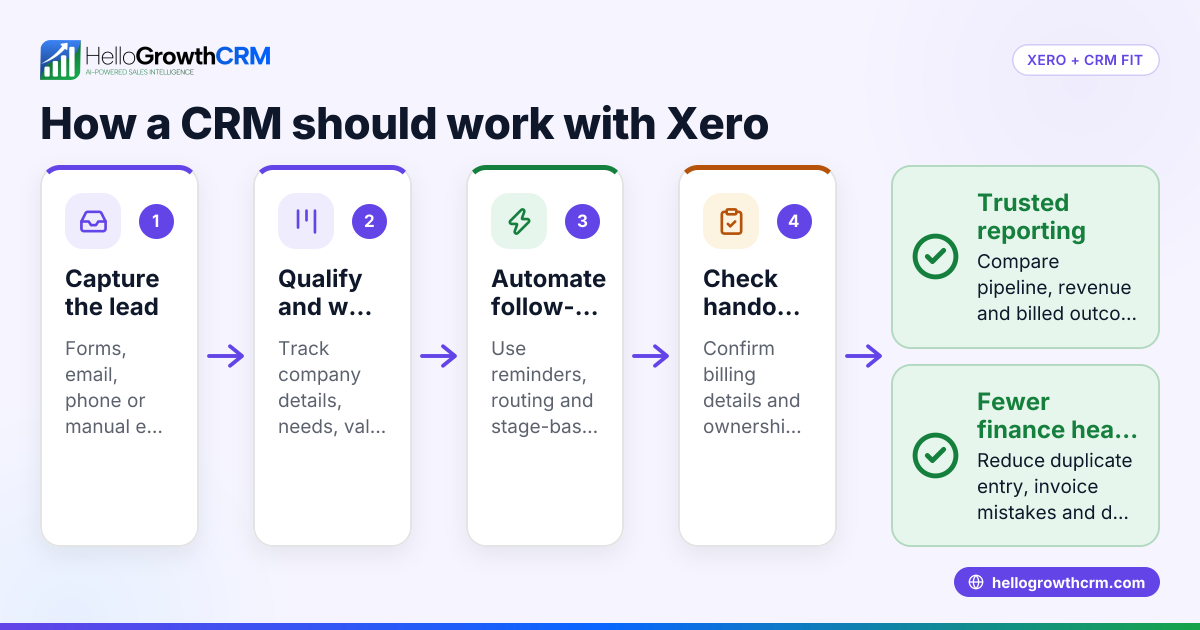
It should give your sales team one clear place to manage leads, contacts, deals, tasks, and activity, while reducing duplicate entry between sales and finance. The goal is better visibility, faster follow-up, and cleaner handover from pipeline to invoice.
When a CRM works well alongside Xero or MYOB, a few things usually improve fast:
- Fewer duplicate records
Sales and finance stop maintaining separate versions of the same customer details. - Clearer account context
Reps can see commercial history and avoid awkward conversations with customers. - Better handover after a deal closes
Finance gets the information needed to invoice correctly and on time. - More reliable revenue reporting
Leaders can compare pipeline, won deals, and recognised revenue more confidently. - Less manual admin
Teams spend less time rekeying data into multiple tools.
Not every CRM-finance setup needs deep accounting features inside the CRM itself. For most B2B sales teams, the real need is visibility and data flow. Sales should know what is happening after close. Finance should receive accurate customer and deal information. Leadership should be able to trust the numbers.
Which CRM features matter most for B2B teams in Australia?
Start with pipeline, automation, and reporting. Then check lead capture, communication tools, permissions, and integration options. If the CRM does those well, it will support your team far better than a bloated system full of unused features.
Here are the features that matter most.
1. Lead capture and qualification
Good CRMs make it easy to capture leads from forms, imports, and manual entry. Better ones also help your team qualify leads quickly. This matters when inbound leads are increasing and no one is sure which ones deserve immediate attention.
For B2B teams, qualification should include company fit, source, urgency, estimated value, and next step. A system with AI lead scoring can help sales managers prioritise follow-up, but the scoring only works if your fields and stages are set up properly.
2. Pipeline management that mirrors how you sell
Your pipeline should reflect your real sales process. If your stages are vague, reports become unreliable. If your stages are too complex, reps stop updating deals.
A practical Australian B2B pipeline might include:
- New lead
- Qualified
- Discovery booked
- Proposal sent
- Negotiation
- Closed won
- Closed lost
The CRM should make it easy to move deals, assign next actions, and spot stalled opportunities. It should also support multiple pipelines if you sell different products or work across new business and account growth.
3. Built-in communication tools
A CRM should not force reps to jump between inboxes, spreadsheets, and notes. It should support email, calling, and activity tracking in one place. If your team also uses WhatsApp for customer communication, that should be visible too.
This matters for consistency. If a rep leaves, the account history should stay with the business. Communication tools linked to records also help managers coach better and step into deals when needed. A system with email automation can also save time on routine follow-up.
4. Forecasting and reporting
Most sales teams do not need dozens of dashboards. They need a few reports they trust. That usually means pipeline by stage, expected close date, rep performance, source performance, and conversion rates.
The best systems also make forecasting easier. A good sales forecasting setup should show more than total pipeline value. It should help you judge deal quality, timing, and likely outcomes based on actual behaviour.
5. Easy integration with your finance stack
If your team uses Xero or MYOB, integration should not be an afterthought. Check what customer, invoice, and account data can sync. Also check what must still be entered manually.
Ask practical questions:
- Can customer records stay aligned?
- Can finance status be viewed by sales?
- Can won deals trigger next steps for billing or onboarding?
- Can reporting combine sales and commercial outcomes clearly?
The answer does not need to be perfect. It needs to be useful and reliable.
Is an ai best crm actually better for sales teams?
Yes, if AI helps your team act faster, keep data clean, and focus on the right deals. No, if it is just a label on features your team will never use.
AI is most useful when it removes repetitive work. That can include lead scoring, call summaries, task suggestions, activity prompts, and forecast support. These features can improve speed and consistency. They can also help new reps ramp faster.
But AI should not distract you from basics. If your team is not logging activity, keeping pipeline current, or using standard fields, AI outputs will be weak. Dirty data produces bad suggestions.
For most growing B2B teams, the winning approach is simple. Choose a CRM with practical AI baked into daily work. Then make sure your process is clear enough for that AI to be useful. A well-designed AI CRM can support that, but it still needs good setup and management.
How do Xero or MYOB integrations help a sales team?
They reduce double handling and give sales better account context. When customer and finance data flow cleanly, reps can work faster, hand over deals properly, and avoid chasing the wrong accounts.
The biggest win is shared visibility. Sales can understand what happened after the deal closed. Finance can work from cleaner customer information. Managers can connect pipeline to billing outcomes with less manual reporting.
That said, do not judge integrations by the logo alone. Many teams assume an integration solves more than it really does. Ask for exact details on what syncs, how often it syncs, and what your team still needs to do manually.
You should also check how errors are handled. If records fail to match, who gets alerted? If duplicates appear, how are they merged? If product or invoice data changes, how is that reflected? These questions matter more than a generic integration claim.
For businesses already running Xero or MYOB as the finance source of truth, the ideal CRM improves decision-making without making finance workflows messy. It should support clear ownership between teams.
What should you check before moving from spreadsheets or an older CRM?
Check data quality, sales process clarity, integration needs, and team behaviour first. If those basics are ignored, a new CRM will simply digitise the same old problems.
Before you choose a system, review these four areas.
1. Your current data
Export your contacts, companies, deals, and notes. Then inspect them honestly. Are names consistent? Are duplicate records common? Are key fields complete? Are closed deals marked correctly?
A migration is the best time to clean your data. It is also the best time to remove fields no one uses.
2. Your actual sales process
Many teams describe an ideal process that no one follows. Instead, map the real process. What happens from first enquiry to closed won? Where do deals stall? What information should always be captured?
This matters because your CRM should fit your process, not force your team into a confusing workaround.
3. Your Xero or MYOB requirements
Be specific. Do you need customer sync, invoice visibility, payment status, or a post-sale trigger for finance? Write these down in priority order. That will help you avoid overbuying.
4. Your team's willingness to adopt it
A CRM succeeds when it is easy to use and clearly useful. If reps think it is just for management reporting, they will avoid it. If it helps them close deals, they will use it.
This is where onboarding, defaults, automation, and sensible fields matter. Strong systems reduce admin rather than adding to it.
A practical checklist for choosing the right CRM
You do not need a massive procurement project. You need a shortlist and a clear way to compare options. Use this checklist.
Core product fit
- Can it manage leads, contacts, companies, and deals clearly?
- Can it support your real sales stages?
- Can reps update it quickly during the day?
- Can managers review pipeline without chasing people for notes?
Communication and automation
- Does it support email, calling, and activity history?
- Can follow-ups, reminders, and task creation be automated?
- Can leads be routed automatically to the right rep?
AI and reporting
- Does AI provide useful help, not just noise?
- Can it score leads, summarise interactions, or flag risk?
- Are reports easy to understand without building everything from scratch?
Finance integration
- Does it connect cleanly with Xero or MYOB?
- What exactly syncs?
- How are duplicates, errors, and updates handled?
Admin and adoption
- Is the interface simple?
- Can field permissions and workflows be controlled?
- How much setup support will you get?
Support and long-term value
- Will someone help with setup and process design?
- Can the system grow with your team?
- Is there a clear view of pricing and implementation effort?
Where many CRM projects go wrong
Most CRM projects fail for boring reasons, not technical ones. The system is too complex. The fields are badly designed. The pipeline stages are unclear. No one owns the rollout. Sales and finance never agree on what the data should mean.
Another common problem is buying for edge cases. A founder sees a long feature list and assumes more is better. In practice, the team ends up using ten per cent of the system and avoiding the rest.
The fix is to choose a CRM around daily behaviour. Can reps log calls quickly? Can they see what to do next? Can managers spot risk early? Can finance receive clean information after a deal closes? These are the questions that matter.
For growing teams, support also matters. Software alone does not fix process issues. In some cases, a provider that offers managed RevOps can help set up workflows, reporting, handovers, and governance so the CRM delivers value faster.
Why HelloGrowthCRM fits this use case
HelloGrowthCRM is built for growing B2B sales teams that need one place to run lead capture, scoring, pipeline, communication, automation, and reporting. It is designed to be practical for teams that want a CRM people actually use, not a system that creates more admin.
For businesses using Xero or MYOB, the important part is not just having software. It is having a system that supports cleaner process across sales and finance. HelloGrowthCRM combines CRM tools with RevOps support, which can help teams define stages, fix data issues, improve reporting, and connect workflows more sensibly.
If you are comparing systems, review the full features and available integrations. That will give you a clearer view of fit before you commit.
If your team wants stronger adoption, useful AI, and a more joined-up view of sales performance, that is where HelloGrowthCRM is likely to stand out.
Start a free trial or book a demo to see how HelloGrowthCRM can support your Australian B2B sales team using Xero or MYOB.
Frequently asked questions
Is Xero or MYOB integration enough to choose a CRM?
No. Integration matters, but it is only one part of the decision. You also need strong pipeline management, good reporting, easy adoption, and automation that saves your team time.
Should sales reps see finance information inside the CRM?
Usually, they should see the information that helps them manage accounts properly. That may include customer status or commercial context. Access should still be controlled carefully so teams only see what they need.
Does AI matter when choosing a CRM for B2B sales?
Yes, but only when it supports day-to-day work. Useful AI can help with scoring, summaries, prompts, and forecasting. It should improve action, not add confusion.
What is the biggest mistake when moving from spreadsheets to a CRM?
The biggest mistake is migrating messy data and unclear processes into a new system. Clean your records, simplify your stages, and decide who owns the rollout before you switch.
Do Australian businesses need to think about privacy and spam rules in their CRM setup?
Yes. Customer and prospect data should be handled in line with the Privacy Act 1988 and Australian Privacy Principles where relevant. Email and outbound activity should also respect the Spam Act 2003.
Frequently Asked Questions
Ready to put this into practice?
Set up your pipeline, WhatsApp follow-ups, and AI lead scoring in minutes — free, no credit card.
Try HelloGrowthCRM freeGet CRM tips in your inbox
Join thousands of sales professionals who get weekly insights on CRM strategy, AI automation, and pipeline optimization.

The HelloGrowthCRM team publishes guides on CRM strategy, AI sales tools, and revenue operations for small business sales teams.