HelloGrowthCRM software
Built for real small-business sales teams
HelloGrowthCRM helps reps qualify faster, follow up on time, and close more deals—with practical automation in one place.
- AI lead scoring and pipeline visibility
- Built-in dialer, WhatsApp, and email automation
- Sales forecasting and RevOps-ready reporting
Sales prospecting training teaches your sales team how to identify and engage potential customers who are most likely to buy. It involves learning how to research prospects, initiate contact through calls or messages, follow up consistently, and qualify leads to focus efforts on the best opportunities. This article covers why sales prospecting training is important, practical steps to implement it, a detailed example, common pitfalls to avoid, and how HelloGrowthCRM can support your prospecting efforts.
Why this comes up / what goes wrong
Many small-business owners struggle with slow or inconsistent follow-up on leads, losing potential sales. Without proper sales prospecting training, teams often waste time on unqualified leads or fail to reach prospects effectively. This leads to missed revenue and low morale. Sales prospecting training is needed to build a repeatable process that helps your team find the right prospects, connect with them promptly, and move them through the sales pipeline.
For example, a small business might rely on scattered text messages, emails, and spreadsheets to track leads, resulting in lost or forgotten opportunities. Training helps establish clear steps and accountability for each stage of prospecting.
Step-by-step
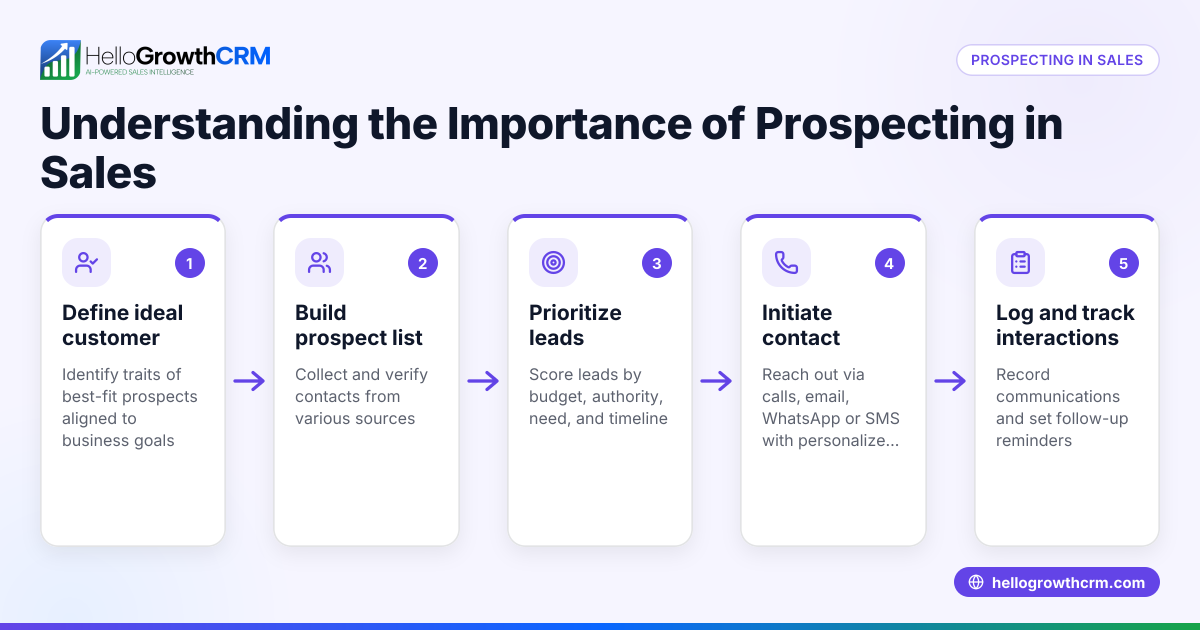
- Define your ideal customer profile (ICP)
- Identify the characteristics of prospects who benefit most from your product or service.
- Check that your team understands these traits to focus their efforts.
- Research and build a prospect list
- Use online tools, social media, referrals, and databases to find contacts matching your ICP.
- Verify contact details and segment prospects by priority or territory.
- Craft your outreach message
- Develop clear, concise scripts or templates for calls, emails, or WhatsApp messages.
- Test different approaches and refine based on response rates.
- Initiate contact promptly
- Reach out quickly after identifying a lead to increase engagement chances.
- Use a CRM or tracking tool to log all interactions.
- Follow up consistently
- Schedule follow-up tasks and reminders to avoid letting leads go cold.
- Adjust messaging based on prospect responses and objections.
- Qualify leads
- Ask questions to determine the prospect’s needs, budget, and decision timeline.
- Prioritize leads that fit your ICP and show buying intent.
- Move qualified leads into the sales pipeline
- Track progress stages clearly, from initial contact to quote sent and negotiation.
- Set follow-up dates and assign owners for accountability.
- Review and improve
- Regularly analyze which prospecting methods work best.
- Provide ongoing training and update scripts or processes as needed.
You can learn more about organizing sales processes at our CRM academy.
Example (fictional figures)
A residential real-estate team in Phoenix, Arizona, wants to improve prospecting. They define their ICP as first-time homebuyers aged 25–40 with a budget over $300,000.
- They research and list 100 prospects fitting this profile.
- They send an introductory WhatsApp message offering a free consultation.
- They follow up with a call 3 days later if no response.
- Out of 100, 30 respond, and 15 qualify as serious buyers.
- They send quotes on 10 properties averaging $350,000 each.
Calculations:
$350,000 × 10 properties = $3,500,000 total potential sales
Assuming a 5% commission:
$3,500,000 × 5% = $175,000 potential commission
This example shows how structured prospecting and follow-up can uncover valuable opportunities.
Common mistakes
- Neglecting follow-up: Leads go cold if not followed up promptly. Prevent this by scheduling reminders and using a CRM pipeline to track deals.
- Targeting too broadly: Wasting time on unqualified leads lowers efficiency. Prevent by clearly defining your ideal customer profile.
- Inconsistent messaging: Mixed messages confuse prospects. Prevent by preparing scripts or templates and training your team to use them.
- Ignoring data and feedback: Not reviewing what works wastes resources. Prevent by analyzing results regularly and adjusting tactics.
- Using scattered tools: Tracking leads in spreadsheets, texts, and emails leads to lost information. Prevent by consolidating prospect data in a centralized CRM like HelloGrowthCRM.
Learn more about managing sales pipelines effectively with HelloGrowthCRM for the United States.
Doing this in HelloGrowthCRM
HelloGrowthCRM helps by keeping your deals organized in a pipeline where every quotation sent appears at the 'quote sent' stage with a follow-up date, so no opportunity is forgotten. For businesses with field sales teams, it offers territory management and lets reps log visits from their phones, giving managers a clear view of daily activity. These features help keep your sales process on track and visible. Learn more about these capabilities at WhatsApp and SMS CRM.
Frequently asked questions
What is sales prospecting training? Sales prospecting training teaches your sales team how to identify, contact, and qualify potential customers systematically. It covers techniques for research, outreach, follow-up, and lead qualification to improve conversion rates.
How long does sales prospecting training take? Training length varies by program but typically ranges from a few hours for basics to several weeks for comprehensive skill-building. Ongoing practice and coaching help reinforce learning.
Can small businesses do sales prospecting without a big budget? Yes, small businesses can start with clear processes and free or low-cost tools. Training your team to use a CRM effectively and follow up consistently can yield significant results without large expenses.
How does a CRM help with sales prospecting? A CRM centralizes lead data, tracks interactions, schedules follow-ups, and visualizes your sales pipeline. This prevents leads from being forgotten and helps prioritize efforts on qualified prospects.
What are common challenges in sales prospecting? Challenges include reaching decision-makers, handling objections, maintaining consistent follow-up, and managing large volumes of leads. Training and tools help overcome these by providing structure and best practices.
Key takeaways
- Sales prospecting training builds skills to find and engage the right customers.
- Define your ideal customer and research prospects carefully.
- Use consistent messaging and follow-up schedules.
- Avoid common mistakes like neglecting follow-up or scattering lead data.
- HelloGrowthCRM supports prospecting with deal pipelines and territory management.
Start improving your sales prospecting today with HelloGrowthCRM. Start on the Free Forever plan (200 leads, no credit card).
Ready to put this into practice?
Set up your pipeline, WhatsApp follow-ups, and AI lead scoring in minutes — free, no credit card.
Try HelloGrowthCRM freeGet CRM tips in your inbox
Join thousands of sales professionals who get weekly insights on CRM strategy, AI automation, and pipeline optimization.

The HelloGrowthCRM team publishes guides on CRM strategy, AI sales tools, and revenue operations for small business sales teams.