Free Website Growth Audit — SEO, Speed, and Competitor Benchmarking
Run a free audit of any website and get an actionable growth report: SEO health, Core Web Vitals, competitor comparison, and top opportunities. Used by HelloGrowthCRM customers to find and fix revenue leaks.
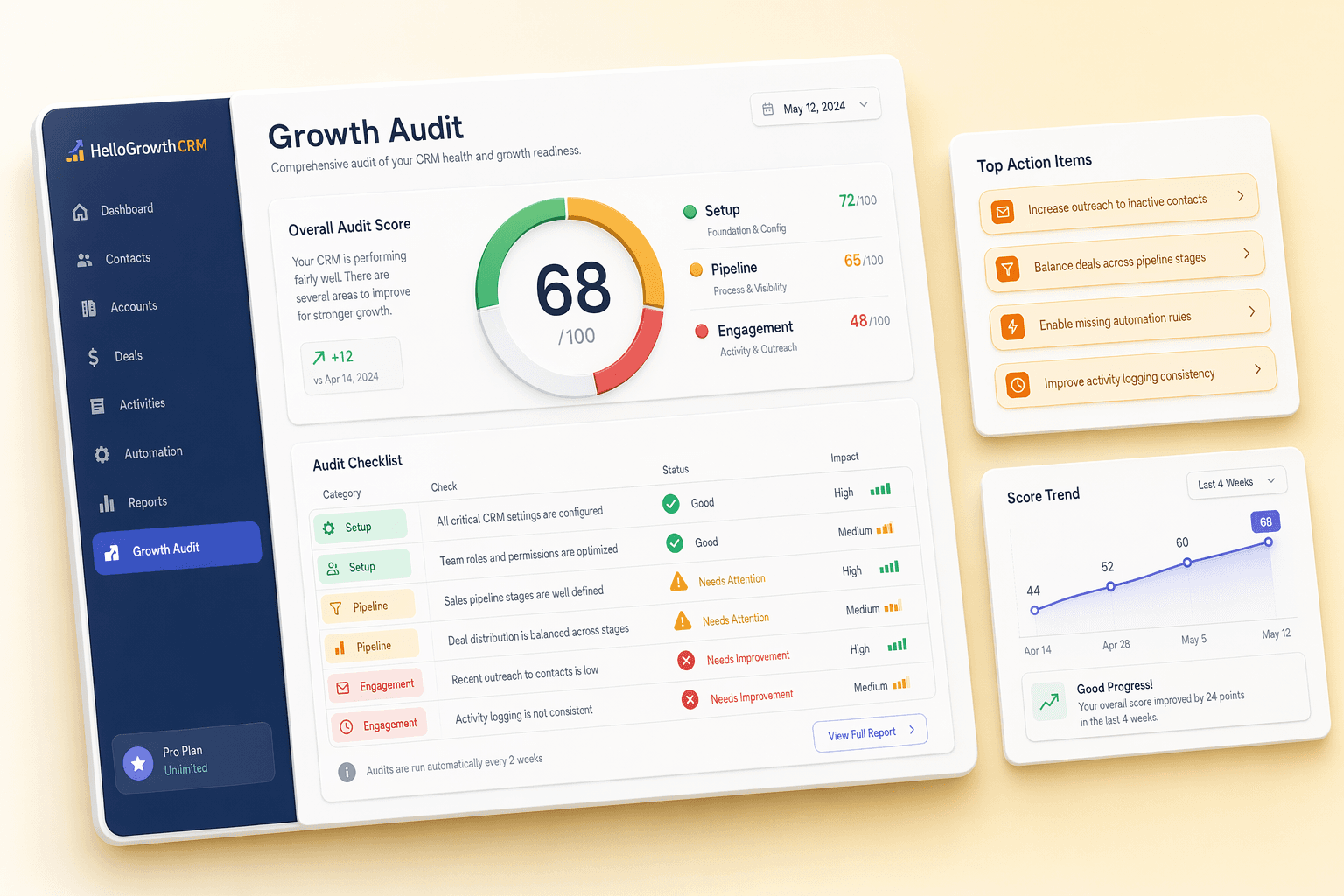
Why teams evaluate growth audit
Growth Audit usually becomes important when a repeated part of the revenue workflow is creating too much manual work, too little visibility, or too much tool-switching. Teams are rarely shopping for a feature in isolation. They are usually trying to make one meaningful workflow cleaner, faster, and easier to inspect.
That is why buyers usually look beyond the headline capability and inspect the surrounding details: SEO health score and critical issues — titles, meta descriptions, headers, structured data, Core Web Vitals analysis — LCP, INP, CLS scores and status, Competitor SEO benchmarking — compare your scores against direct competitors, Backlink gap analysis — identify backlink opportunities from competitor sources. Those details determine whether the feature actually improves day-to-day execution or simply adds another surface area to manage.
Where growth audit fits in the workflow
Most teams adopt this capability as part of practical motions such as pre-sales website review, monthly health checks, competitive research. The value tends to show up fastest when the workflow is tied to a clear owner, a clear next action, and a visible outcome that managers can review later.
It also matters how this page connects to the rest of the stack. The strongest implementations keep data, communication, and handoffs in sync instead of forcing the team to rebuild the process across disconnected tools.
What a strong rollout looks like for growth audit
The best rollout usually starts small: one high-value workflow, one clear ownership model, and one review rhythm for adoption. Once the team is consistently using the feature, managers can expand into deeper automation, reporting, or cross-functional handoffs without rebuilding the foundation.
In practice, that means evaluating not only what the feature can do, but also whether the team can maintain the process around it. Ease of use, reporting trust, and manager visibility matter just as much as the feature checklist itself.
- Use it first for pre-sales website review if that is the workflow creating the most friction today.
- Use it first for monthly health checks if that is the workflow creating the most friction today.
- Use it first for competitive research if that is the workflow creating the most friction today.
- Use it first for new client onboarding audit if that is the workflow creating the most friction today.
How It Works
Get started in three simple steps
Key Features
Use Cases
Pre-Sales Website Review
Run growth audits on prospect websites before sales calls to find problems you can help solve.
What teams care about
- Fast adoption with less manual cleanup for managers and reps.
- Clear visibility into workflow execution, outcomes, and accountability.
- Reliable handoffs into the CRM record so downstream teams keep full context.
Deep dive
Open the sections that matter most instead of scrolling through a long uninterrupted text block.
Why Website Audits Matter for Sales and Marketing
Your website is your most important sales tool — it's where most buyers land before they talk to you. If your website is slow, confusing, or ranks poorly for your keywords, you're losing deals before the conversation starts. A website audit reveals these problems and gives you a roadmap to fix them.
Growth audits combine SEO analysis, performance metrics (Core Web Vitals), and competitive benchmarking to give you a complete picture of your website's health. Instead of guessing what to fix, you get an actionable priority list ranked by impact.
Core Web Vitals and SEO Ranking Factors
Google's Core Web Vitals measure three things: page load speed (LCP), interactivity (INP), and visual stability (CLS). These metrics directly impact your SEO rankings — slow websites rank lower. Beyond SEO, poor Core Web Vitals hurt conversion because prospects abandon slow sites.
A growth audit measures your Core Web Vitals and compares them to competitor benchmarks so you know if you're losing ranking and conversion due to speed. Fixing Core Web Vitals often lifts organic traffic by 5-25% depending on baseline performance.
Your website is your most important sales tool — it's where most buyers land before they talk to you. If your website is slow, confusing, or ranks poorly for your keywords, you're losing deals before the conversation starts. A website audit reveals these problems and gives you a roadmap to fix them.
Growth audits combine SEO analysis, performance metrics (Core Web Vitals), and competitive benchmarking to give you a complete picture of your website's health. Instead of guessing what to fix, you get an actionable priority list ranked by impact.
Buyer playbook
Compare, launch, and govern the workflow with an interactive overview instead of four long generic essays.
How teams evaluate growth audit
The best pages help buyers understand fit quickly instead of forcing them through long walls of copy.
Check whether the product covers the capabilities you actually care about, such as SEO health score and critical issues — titles, meta descriptions, headers, structured data, Core Web Vitals analysis — LCP, INP, CLS scores and status, Competitor SEO benchmarking — compare your scores against direct competitors, Backlink gap analysis — identify backlink opportunities from competitor sources.
Test if it supports real execution scenarios like Pre-Sales Website Review, Monthly Health Checks, Competitive Research.
Confirm the workflow stays connected to the rest of your sales stack so reporting and handoffs remain reliable.
Frequently Asked Questions
Explore More
Related Products
Free Tools & Calculators
WhatsApp Template Generator
Draft WhatsApp message templates for intros, follow-ups, payments and support. Free.
Lead Scoring Calculator
Build a custom scoring model with weights.
CRM ROI Calculator
Calculate the revenue impact of adopting a CRM.
Pipeline Calculator
Model your pipeline stages and conversion rates.
Competitor Comparisons
What is the HelloGrowthCRM Website Growth Audit?
The HelloGrowthCRM growth audit is a free tool that analyses any website across three dimensions: SEO health, Core Web Vitals performance, and competitor benchmarking. In under 5 minutes, you get a scored report with specific, prioritised fixes — no agency engagement, no manual spreadsheets, no waiting for a PDF to land in your inbox. Enter a URL and the audit starts immediately.
For Indian startups, SMBs, and marketing teams, the growth audit solves a common problem: knowing you have SEO and speed issues but not knowing where to start or what has the most impact. The audit's priority list ranks every issue by estimated traffic recovery — so your developer and content team work on the highest-impact fixes first, not whatever appears easiest on the surface.
Key Capabilities
- SEO Health Score (0–100): A composite score across meta tags, heading structure, keyword coverage, internal linking, canonical tags, and structured data. Broken down by category so you know exactly which area is dragging your score down.
- Core Web Vitals Assessment:Largest Contentful Paint (LCP), Cumulative Layout Shift (CLS), and Interaction to Next Paint (INP) measured on mobile and desktop. Compared against Google's Good/Needs Improvement/Poor thresholds.
- Page Speed Analysis: Time to First Byte, First Contentful Paint, and Total Blocking Time. Identifies slow server response, unoptimised images, unused JavaScript, and render- blocking resources.
- Technical SEO Issue Detection: Broken links, redirect chains, duplicate content flags, missing alt text, robots.txt issues, and sitemap gaps. Each issue is listed with the affected URL and a fix recommendation.
- Competitor Benchmarking:Compare your domain's estimated traffic, domain authority, and keyword coverage against up to 5 competing domains. See where competitors outrank you and which keyword gaps represent quick wins.
- Prioritised Action List: Every issue is ranked by estimated traffic impact. The top 10 actions are highlighted with implementation difficulty and expected improvement — giving teams a clear roadmap, not an overwhelming list of every possible fix.
- Schema Markup Check: Identifies missing or malformed structured data (FAQ, Product, Article, Organisation schema) that could unlock rich results in Google search. Specific pages with schema opportunities are listed.
- Monthly Monitoring on Paid Plans:Run the audit once for free; unlock automated monthly re-runs with trend tracking on HelloGrowthCRM's Growth plan. Track your SEO score and Core Web Vitals improvement over time.
How Indian Teams Use It
- SaaS Company Pre-Campaign Baseline: A Bengaluru B2B SaaS company ran the growth audit before a content marketing push. The audit revealed a 9.2s LCP on mobile and 47 pages with duplicate meta descriptions. Fixing the LCP issue took 3 developer hours; organic traffic from mobile increased 28 percent in the next 60 days.
- Ecommerce SEO Prioritisation:A Delhi ecommerce brand selling through their own website used the competitor benchmarking feature to identify 15 high-volume keywords where competitors ranked on page 1 but their own site had no content. The content team used the gap list to plan their next quarter's blog and category page work.
- Agency Client Pitches:A Mumbai SEO agency uses HelloGrowthCRM's growth audit to generate quick audit reports for prospective clients during initial calls. Showing a prospect their specific SEO score and top 3 issues in the first meeting converts significantly better than generic pitch decks.
What To Do With Your Audit Results
An audit only pays off if it changes what you work on next. A practical routine: take the top three items from the priority list and turn each into a ticket with an owner and a date — resist the urge to distribute all forty issues at once. Fix performance items first when they affect templates (one template fix repairs hundreds of pages), then content gaps, then the long tail of technical tidiness. Re-run the audit after each batch ships so you can see the score move and confirm nothing regressed.
If you are weighing audit tools against each other, ignore the score itself — every tool scores differently — and judge the output. Does each issue name the exact affected URLs? Is the fix recommendation specific enough to hand to a developer without translation? Does the prioritisation reflect traffic impact rather than issue count? And can you re-run it freely, since an audit you hesitate to repeat becomes a one-time snapshot instead of a feedback loop? The HelloGrowthCRM audit was designed around those four tests, which is why the free tier has no run limits and no gated PDF.
Frequently Asked Questions
- What does HelloGrowthCRM's free growth audit check?
- The growth audit checks your website's SEO health (meta tags, heading structure, keyword coverage, internal linking), Core Web Vitals (LCP, CLS, INP), page speed on mobile and desktop, technical issues (broken links, redirect chains, missing schema), and competitor benchmarking across up to 5 competing domains. The audit generates a prioritised action list ranked by estimated traffic impact.
- How long does the growth audit take?
- A standard growth audit on a site of up to 100 pages takes 3 to 5 minutes to complete. Larger sites with 500+ pages take 10 to 15 minutes. Results are available immediately after the crawl completes — no waiting for a PDF report or a sales call.
- Is the growth audit really free? What is included without paying?
- Yes, the core audit is free with no credit card required. The free version includes SEO health score, Core Web Vitals, top 10 priority fixes, and competitor overview for 1 domain. HelloGrowthCRM's paid plans unlock the full competitor deep-dive, keyword gap analysis, monthly monitoring, and historical trend tracking.
- Who is the growth audit designed for?
- The growth audit is designed for startup founders, marketing managers, and agency owners who want a quick, actionable SEO and performance baseline without commissioning a full agency audit. It is particularly useful for SaaS companies, ecommerce sites, and service businesses in India looking to improve organic traffic and reduce bounce rate from slow load times.
The growth audit is free — no account required. See HelloGrowthCRM plans to unlock monthly monitoring and full competitor analysis. Explore more AI-powered growth tools or learn how SaaS teams use HelloGrowthCRM to grow faster.