Overview
Google Ads optimises toward whatever conversion you feed it — and most lead-gen accounts feed it form submissions, so Google dutifully finds more form-fillers. Offline conversion tracking fixes the incentive: the CRM uploads qualified-lead and deal-won events, tied to the original ad click via Google's click identifier (GCLID), so Smart Bidding learns from revenue rather than raw enquiries.
The mechanics: when someone clicks your ad, Google appends a GCLID to the landing URL; your form captures it into the CRM with the lead. Weeks later, when that lead qualifies or closes, the CRM reports the conversion against that GCLID with a value. Campaigns, keywords, and audiences then get judged — and bid on — by what they actually produce. For service businesses with long sales cycles, this single integration routinely changes which campaigns look profitable.
What data is involved
- GCLID captured on ad-driven leads and stored on the CRM record.
- Qualified and won events uploaded to Google Ads as offline conversions.
- Deal value attached for value-based Smart Bidding strategies.
- Conversion time reported accurately for attribution windows.
- Enhanced conversions for leads supported via hashed email where GCLID is missing.
- Upload status and errors visible for reconciliation.
Step-by-step setup
Setup at a glance (3-5 bullets)
- Settings → Integrations → Google Ads.
- Configure conversion actions in Google Ads.
- Map CRM milestones to those conversions for automatic upload.
Sign in or sign up at HelloGrowthCRM. Open the login page, enter your credentials (or use Google), or choose Sign up if you need a new account. You must be signed in before you can open Settings and connect this integration.
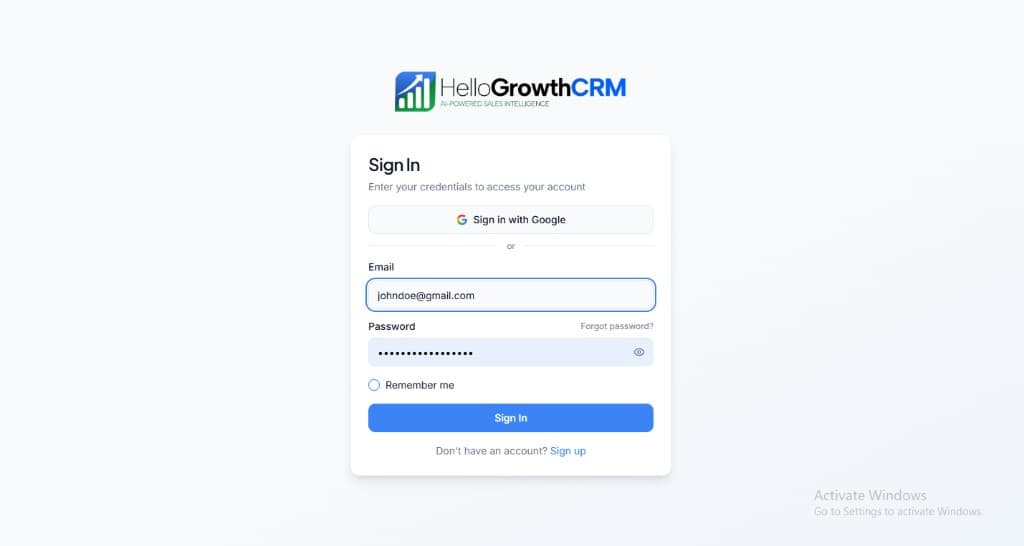
Open login page(opens in a new tab)app.hellogrowthcrm.com/login
Open Settings. In the left sidebar, under Admin, click Settings (you will land on the Settings area; the URL is app.hellogrowthcrm.com/settings).
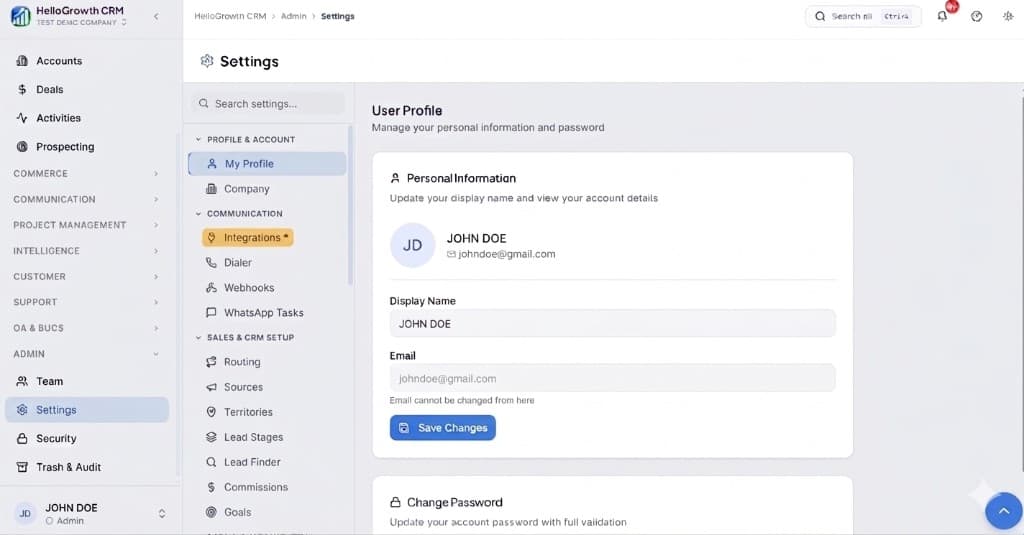
Open Settings(opens in a new tab)app.hellogrowthcrm.com/settings
Go to Integrations. On the Settings screen, use the middle settings menu. Under COMMUNICATION, click Integrations (star icon). Then find and configure this connector—the connector-specific steps below pick up from here.
Open Settings (Integrations)(opens in a new tab)app.hellogrowthcrm.com/settings
- Settings → Integrations → Google Ads.
- Configure conversion actions in Google Ads.
- Map CRM milestones to those conversions for automatic upload.
Best practices
- Capture GCLID on every form — hidden field, persisted through multi-step forms; without it there is nothing to upload against.
- Upload qualification events early (they fit attribution windows) and won events with values as they come; the pair teaches Google both speed and worth.
- Switch to value-based bidding (Maximise Conversion Value / tROAS) only after enough won-event volume — value bidding on ten conversions oscillates.
- Use enhanced conversions for leads as the fallback for phone and walk-in leads that never carried a GCLID.
- Review search terms against CRM outcomes quarterly: keywords producing leads that never qualify are the quiet budget leak this integration exposes.
Best for & common use cases
Optimizing paid search toward real revenue outcomes, not just clicks.
- B2B teams proving pipeline impact on Search and Performance Max.
Expected outcomes
- Faster lead handoff between tools and CRM owners
- Cleaner activity history for follow-up and reporting
- Lower manual copy-paste errors in the pipeline
Troubleshooting
- Uploads rejected: the conversion action in Google Ads isn't set to 'import' type — create an import-type action and map to it.
- GCLIDs missing on most leads: redirects or URL rewrites stripping parameters — preserve query strings through the landing path.
- Conversions uploaded but not counted: click older than the conversion window — shorten qualification lag or upload qualification as the primary action.
FAQ
Governance
Treat API keys and webhooks as production secrets. Align field mapping with your privacy policy and regional regulations (GDPR, marketing consent, telemarketing rules). Your admin controls which roles can install or edit integrations.
Related integrations in this category
Server-side events to Meta with hashed user data for attribution.
GA4 Measurement Protocol: send CRM lifecycle events (e.g. lead_qualified, deal_won) into Google Analytics.
Auto-ingest leads from Meta Lead Ads (Facebook and Instagram) with campaign and form attribution.
Auto-ingest leads from Google Ads lead form extensions and in-ad capture.
Auto-imports buyer inquiries from IndiaMART Lead Manager into CRM leads with source attribution.
Turns JustDial notification emails into CRM leads via forwarding rules or a direct webhook POST to the ingestion URL shown in the app.
B2B lead capture from LinkedIn Lead Gen Forms and sponsored campaigns into CRM with UTM and campaign IDs.
Form submission ingestion to CRM leads via native connectors or webhooks (Typeform, Tally.so, Google Forms).