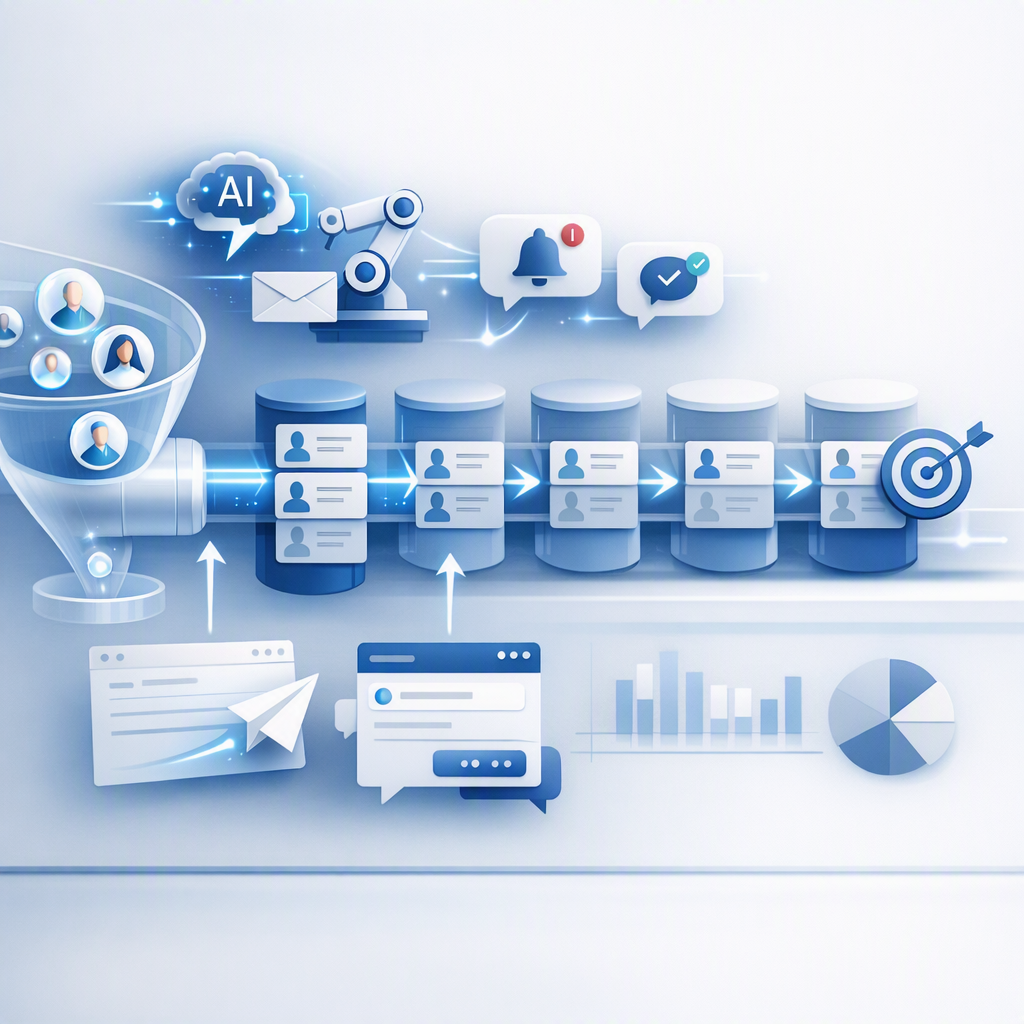
HelloGrowthCRM software
Built for real small-business sales teams
HelloGrowthCRM helps reps qualify faster, follow up on time, and close more deals—with practical automation in one place.
- AI lead scoring and pipeline visibility
- Built-in dialer, WhatsApp, and email automation
- Sales forecasting and RevOps-ready reporting
AI follow-up automation for inbound leads in a CRM is the use of artificial intelligence to instantly respond to new leads—often within minutes—by analyzing the inquiry, sending a personalized reply, scoring the lead, and routing it to the right sales rep automatically through workflow automation inside the CRM.
Key Takeaways
- AI autoresponders can respond to inbound leads in under five minutes with personalized messages and qualification questions.
- Fast response dramatically improves conversion because prospects engage while intent is highest.
- AI-powered workflows can score, segment, and route leads to the correct rep automatically.
- A well-designed workflow combines AI messaging, lead scoring, routing rules, and follow-up cadences.
- Modern AI CRMs like AI CRM unify messaging, scoring, and pipeline automation in one system.
- The best workflows balance automation speed with human sales involvement at the right moment.
Why a 5-Minute Response Window Matters for Inbound Leads
Responding to inbound leads within five minutes significantly increases the chance of converting interest into a qualified sales opportunity because the prospect is still actively researching, comparing vendors, or exploring solutions at that exact moment, making rapid follow-up one of the highest-impact sales automation improvements a team can implement.
Speed matters because inbound leads arrive with intent. Someone filled out a demo request, pricing form, or product inquiry because they want information now.
When teams respond hours later, several problems occur:
- The prospect has already contacted competitors
- Context and urgency fade
- The lead may forget the original inquiry
- Sales cycles become longer
A well-known industry study found that companies responding to leads within five minutes are far more likely to engage prospects than those responding later.
Businesses that respond within five minutes are 100× more likely to connect with a lead compared to responding after 30 minutes according to research published by Harvard Business Review.
https://hbr.org/2011/03/the-short-life-of-online-sales-leads
In real RevOps audits I’ve run, the average B2B inbound response time is usually between 4 and 24 hours. That gap is where AI follow-up automation creates an immediate advantage.
Instead of relying on a rep noticing a notification, an AI workflow triggers instantly when a lead enters the CRM.
Tools inside modern platforms like AI Lead Scoring, Smart Inbox, and Email Automation allow this process to happen automatically without sacrificing personalization.
What AI Autoresponders Actually Do Inside a CRM
AI autoresponders for inbound leads automatically analyze new inquiries, generate personalized responses, score lead intent, and route the opportunity to the correct sales rep inside the CRM while triggering follow-up sequences, ensuring every inbound lead receives immediate engagement without requiring manual intervention from sales teams.
Many people think an autoresponder just sends a canned email.
Modern AI-powered systems do much more.
A strong AI inbound workflow performs four core functions.
1. Instant Lead Response
When a form is submitted, the system automatically sends a contextual message based on:
- Form content
- Lead company data
- Traffic source
- Page context
- Previous interactions
For example, a demo request from a SaaS founder should receive a different message than a pricing inquiry from an enterprise procurement manager.
With tools like Email Automation and WhatsApp & SMS CRM, responses can occur across multiple channels simultaneously.
2. AI Lead Qualification
The system then asks intelligent follow-up questions.
Examples include:
- Company size
- Timeline to purchase
- Current tools
- Budget range
- Use case
AI analyzes these responses to determine lead quality using scoring models such as:
- Fit score (industry, company size)
- Intent score (behavior signals)
- Engagement score (reply activity)
This process is handled automatically with systems like AI Lead Scoring.
3. Intelligent Lead Routing
Qualified leads are routed automatically to the correct rep using rules such as:
- Territory
- Industry vertical
- Company size
- Deal size potential
Solutions like Territory Management and AI Pipeline Management ensure opportunities go to the best owner immediately.
4. Automated Follow-Up Sequences
If a lead does not respond immediately, AI schedules additional follow-ups.
Common cadence patterns include:
- Day 0: instant response
- Day 1: reminder message
- Day 3: helpful resource
- Day 7: case study
- Day 14: final check-in
Sales teams can design these sequences using tools like the Follow-Up Cadence Builder.
AI Autoresponders vs Traditional CRM Auto-Replies
AI follow-up automation improves significantly on traditional autoresponders because it analyzes lead context, adapts messages dynamically, and triggers routing or qualification workflows automatically, whereas traditional CRM auto-replies simply send generic messages without intelligence or downstream sales automation.
| Feature | Traditional CRM Auto-Reply | AI Follow-Up Automation |
|---|---|---|
| Response speed | Immediate | Immediate |
| Message personalization | Generic template | AI-generated contextual response |
| Lead qualification | None | Automated AI questions |
| Lead scoring | Manual | AI scoring based on signals |
| Sales routing | Manual assignment | Automated territory routing |
| Follow-up cadence | Basic email drip | Multi-channel intelligent workflow |
| Pipeline updates | Manual | Automatic deal creation |
This difference becomes significant at scale.
In one rollout I worked on with a 12-person SaaS sales team, switching from basic autoresponders to AI-based qualification reduced manual lead triage by roughly 40%. Reps spent more time on high-intent conversations instead of sorting form submissions.
Platforms like HelloGrowthCRM combine several automation layers in one place, including:
Together they turn inbound responses into actual pipeline opportunities automatically.
Core Components of an AI Inbound Follow-Up Workflow
An AI inbound lead follow-up workflow combines instant messaging, lead enrichment, AI scoring, routing rules, and automated follow-up cadences so that every inbound inquiry moves through qualification and into the sales pipeline without requiring manual review from the sales team.
Designing a strong workflow requires several building blocks.
Lead Capture and CRM Entry
Leads enter the system through sources like:
- Website demo forms
- Pricing requests
- Contact forms
- Chat widgets
- landing pages
- integrations such as HubSpot or Salesforce
These leads should automatically create a contact record and trigger the workflow.
Data Enrichment
Before responding, the system enriches the lead using available information such as:
- Company size
- Industry
- Location
- Website domain
This improves personalization and lead scoring accuracy.
AI Message Generation
Instead of static templates, AI can generate responses that reference:
- the form request
- the company
- the use case
- the next recommended step
With systems like AI Sales Copilot, responses can be dynamically generated while maintaining brand voice.
Pipeline Creation
Qualified leads automatically create opportunities in the CRM pipeline.
Tools like AI Pipeline Management then track stage progression and deal velocity.
Sales Rep Notification
Once the lead meets qualification criteria, the assigned rep receives alerts through integrations such as Slack or email.
This prevents missed opportunities.
How to Design a 5-Minute AI Follow-Up Workflow in Your CRM: Step-by-Step
Designing a five-minute AI inbound lead workflow involves capturing the lead, triggering an immediate AI-generated response, enriching the lead profile, calculating an intent score, routing the opportunity to the correct rep, and scheduling automated follow-up messages if the prospect does not immediately engage.
- Capture the inbound lead
- Trigger the AI autoresponder
- Ask qualification questions
- Calculate AI lead score
- Route to the correct sales rep
- Create a deal in the pipeline
- Offer an instant meeting link
- Trigger follow-up sequences
When I design these workflows for sales teams, the biggest improvement usually comes from step three—qualification questions. Without them, reps waste time chasing unqualified inbound leads.
Metrics to Track for AI Follow-Up Automation
Measuring AI follow-up automation performance requires tracking response speed, lead engagement, meeting bookings, and pipeline conversion rates because these metrics show whether the workflow actually turns inbound interest into revenue opportunities rather than simply sending automated replies.
The most important metrics include:
First Response Time
The average time between lead submission and first response.
Top-performing teams aim for:
- Under 5 minutes for inbound demo requests
- Under 10 minutes for contact forms
Lead-to-Meeting Rate
This measures how many inbound leads schedule a meeting.
The meeting scheduler embedded in responses can significantly increase this number.
Lead Qualification Rate
Track how many leads reach your minimum qualification threshold.
This often improves with AI scoring tools like AI Lead Scoring.
Pipeline Conversion Rate
This measures how many inbound leads become actual deals.
According to research from Gartner, improving lead management processes can significantly increase revenue productivity in sales organizations.
https://www.gartner.com/en/sales/topics/crm
Sales Rep Response Lag
Even with automation, reps must still follow up quickly once qualified leads appear.
When I audit pipelines, this is often the second biggest bottleneck after slow inbound response.
Best Practices for AI Follow-Up Automation
Designing effective AI autoresponders requires balancing automation speed with genuine personalization so that prospects feel assisted rather than processed by a robotic system, while still ensuring every lead receives fast and consistent engagement from the sales organization.
Here are several best practices from real CRM rollouts.
Keep the First Message Simple
Avoid long automated messages.
A strong first reply should:
- acknowledge the inquiry
- confirm someone will follow up
- offer a meeting option
Ask One or Two Questions
Too many questions reduce reply rates.
Focus on the two most important qualification signals.
Use Multi-Channel Follow-Up
Combine channels such as:
- SMS
- phone calls
Systems like CRM Dialer and WhatsApp & SMS CRM allow these channels inside the CRM.
Route Leads Intelligently
Bad routing causes lost deals.
Territory and account ownership rules should be clearly defined.
Monitor Workflow Performance
Use dashboards and tools like the Pipeline Health Score to detect automation failures.
Know the Limitations
AI follow-up automation works best for:
- teams under 50 reps
- inbound-driven sales motions
- standardized qualification processes
Enterprise organizations may require deeper custom workflows and RevOps governance. That is why some companies pair automation with services like Managed RevOps.
Turn Inbound Leads Into Pipeline Automatically
Inbound demand is one of the highest-intent growth channels in B2B—but only if leads receive fast and intelligent follow-up.
HelloGrowthCRM was designed specifically to solve this challenge with built-in tools for:
If your team is still responding to inbound leads manually, you are leaving pipeline on the table.
Explore the platform’s capabilities on the Features page, review plans on Pricing, or start immediately with a Free Trial.
About the author
Daniel Reeves is a Revenue Operations lead and B2B SaaS CRM strategist with 11 years of experience designing sales automation systems. He has implemented CRM and pipeline automation projects for SaaS companies ranging from early startups to 200+ employee scaleups. In one project, he led a full inbound lead automation rollout that reduced average response time from four hours to under three minutes.
Frequently Asked Questions
Q: What is AI follow-up automation for inbound leads in a CRM?
A: AI follow-up automation for inbound leads in a CRM is a system that automatically responds to new inquiries, qualifies the lead with AI-generated questions, scores intent, and routes the opportunity to a sales representative while triggering additional follow-up messages if the prospect does not reply.
Q: How fast should companies respond to inbound leads?
A: Companies should respond to inbound leads within five minutes whenever possible because response speed strongly affects engagement rates and meeting bookings. Fast responses reach prospects while interest is still high and competitors have not yet started conversations.
Q: What messages should an AI autoresponder send first?
A: An AI autoresponder should first acknowledge the inquiry, confirm that a sales specialist will follow up, and offer a quick way to schedule a meeting. Keeping the message short and helpful usually improves reply rates and meeting bookings.
Q: Can AI qualify leads automatically?
A: Yes, AI can qualify leads automatically by analyzing responses to questions, company information, behavioral signals, and engagement data. Tools such as AI Lead Scoring assign scores that help sales teams focus on high-intent prospects.
Q: Does AI follow-up replace sales reps?
A: AI follow-up does not replace sales reps; it handles the first response and early qualification steps so reps can focus on real conversations and closing deals. The goal is to remove manual administrative work from the sales process.
Q: What channels should AI follow-up use?
A: AI follow-up can use several channels including email, SMS, WhatsApp, and phone outreach depending on the buyer’s preferences. Multi-channel engagement often improves response rates compared to relying on email alone.
Q: What CRM features are required for AI follow-up automation?
A: AI follow-up automation typically requires workflow automation, AI lead scoring, messaging automation, routing rules, and pipeline management. Platforms like HelloGrowthCRM combine these features into a single AI-powered CRM environment.
Q: How do you measure the success of inbound lead automation?
A: Success is measured through metrics such as first response time, meeting booking rate, lead qualification rate, and pipeline conversion rate. These metrics show whether automation is turning inbound interest into real sales opportunities.
Frequently Asked Questions
Ready to put this into practice?
Set up your pipeline, WhatsApp follow-ups, and AI lead scoring in minutes — free, no credit card.
Try HelloGrowthCRM freeGet CRM tips in your inbox
Join thousands of sales professionals who get weekly insights on CRM strategy, AI automation, and pipeline optimization.

The HelloGrowthCRM team publishes guides on CRM strategy, AI sales tools, and revenue operations for small business sales teams.