HelloGrowthCRM software
Built for real small-business sales teams
HelloGrowthCRM helps reps qualify faster, follow up on time, and close more deals—with practical automation in one place.
- AI lead scoring and pipeline visibility
- Built-in dialer, WhatsApp, and email automation
- Sales forecasting and RevOps-ready reporting
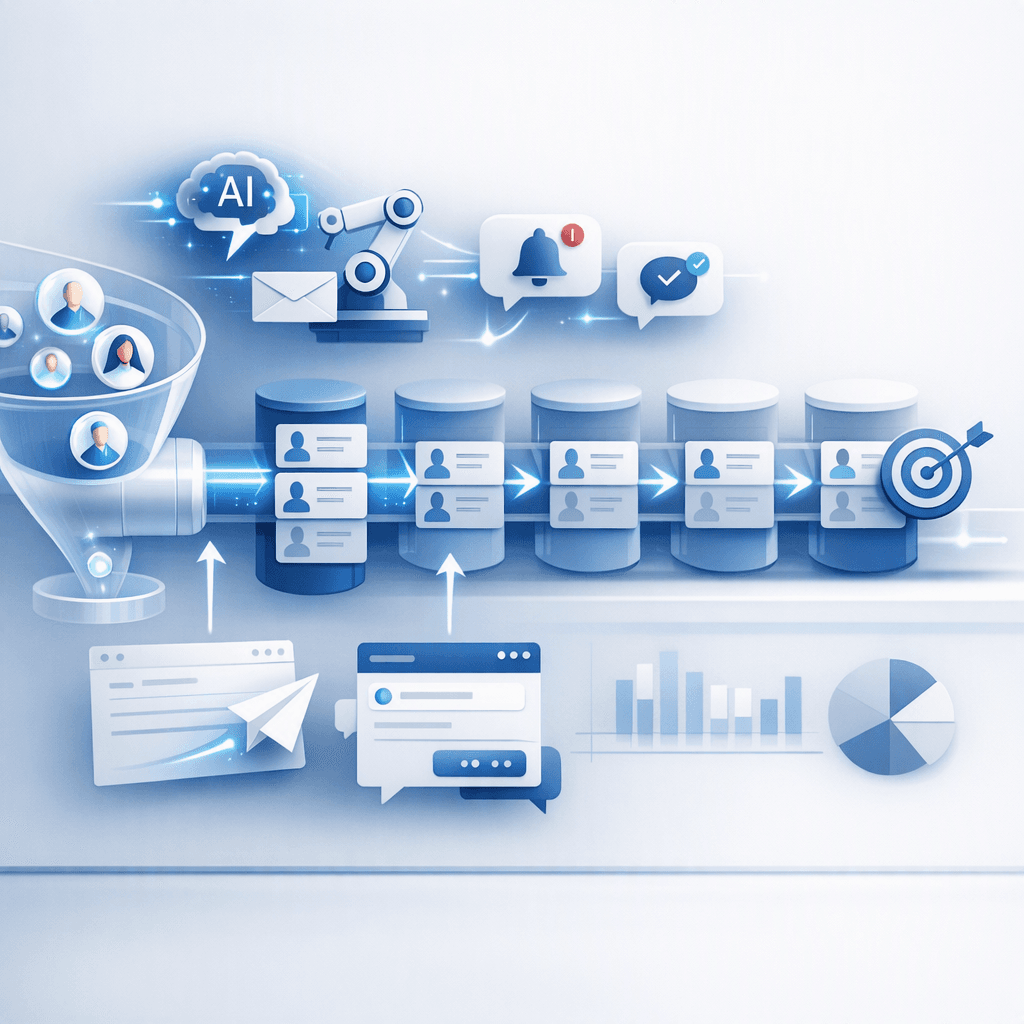
AI follow-up automation for inbound leads is the use of CRM-based triggers, lead scoring, and AI-written outreach to respond to new inquiries instantly, route them to the right owner, and keep conversations moving across email, phone, and messaging without reps manually chasing every next step.
Key Takeaways
- AI follow-up triggers help inbound leads get a response fast, even when reps are busy or offline.
- The best workflows combine trigger logic, lead scoring, channel sequencing, and clear ownership rules.
- Automation should not mean generic outreach. AI can personalize messages using source, page intent, industry, and form data.
- Good follow-up systems need ongoing tuning as lead volume, team structure, and conversion patterns change.
- HelloGrowthCRM brings follow-up automation, scoring, routing, and AI workflows together in one system.
- Managed support like Managed RevOps helps keep automations accurate as your funnel grows.
What is AI follow-up automation for inbound leads?
AI follow-up automation for inbound leads is a CRM workflow that detects new inquiries, scores intent, assigns ownership, and sends personalized next-touch actions automatically so leads do not sit untouched in a queue, and sales teams can respond at speed without depending on manual reminders or spreadsheet-based handoffs.
At a practical level, this means your CRM does four jobs at once:
- Captures a new lead from a form, chat, ad, or inbound message
- Decides how important that lead is
- Starts the right sequence on the right channel
- Sends the lead to the right rep or team
This is where a modern AI CRM beats a basic contact database. A legacy CRM stores records. An AI-driven CRM actively moves records forward.
In my experience, inbound pipelines usually break in the first 15 minutes. A lead comes in, nobody owns it yet, the rep is in a meeting, and the follow-up waits until the next day. By then, intent has cooled. That is why automated response logic matters more than another dashboard.
When teams set this up well, they reduce three common losses:
- Slow first response
- Random rep assignment
- Generic follow-up that ignores context
According to Harvard Business Review, firms that tried to contact potential customers within an hour of receiving a query were nearly seven times as likely to qualify the lead as those that tried even an hour later.
That finding is old, but the operating lesson still holds. Speed wins. Relevance wins. Consistency wins.
Why do inbound leads go cold without AI triggers?
Inbound leads go cold without AI triggers because most teams rely on manual queue checks, delayed assignment, and rep memory, which creates gaps between inquiry, response, and follow-up; those gaps are exactly where intent drops, competitors reply first, and pipeline value leaks away before a conversation starts.
Most B2B teams do not lose inbound leads because reps do not care. They lose them because the system is too manual.
The five most common failure points
1. No instant acknowledgment
The lead fills out a form and hears nothing. Even a simple confirmation matters. It tells the buyer the request was received and sets expectations.
2. Weak routing logic
If ownership depends on a manager checking Slack or forwarding an email, leads pile up. Better systems use Territory Management, segment rules, and fallback queues.
3. One-size-fits-all messaging
A demo request from a VP at a mid-market software company should not get the same outreach as a content download from a student.
4. No next-step sequencing
Many teams send one email and stop. Good follow-up uses timed, multi-channel touches through Email Automation, CRM Dialer, and even WhatsApp & SMS CRM where that channel fits buyer behavior.
5. Dirty scoring and stale data
If your model cannot tell a high-intent lead from a low-fit lead, the sequence will be wrong from the start.
In one rollout we did with a 12-person sales team, nearly 30 percent of inbound demo requests sat unworked for over two hours because ownership only changed during a twice-daily queue review. The fix was not hiring more reps. It was event-based routing and an immediate first-touch sequence.
Which triggers should start an AI inbound follow-up workflow?
The best triggers for AI inbound follow-up workflows are high-intent actions and meaningful profile changes, such as form submissions, pricing-page visits, meeting intent, repeat website sessions, and hand-raises from existing contacts, because these events give the CRM a clear signal that timing and context matter now.
Think in terms of trigger classes, not just single events.
High-intent event triggers
These are your strongest starts for automation:
- Demo request submitted
- Contact us form completed
- Pricing page form completed
- Trial signup started or completed
- Meeting booked through Meeting Scheduler
- Reply received in shared inbox or Smart Inbox
Behavioral triggers
These matter when the lead already exists in your CRM:
- Multiple visits within 7 days
- Return to pricing or integration pages
- Opened key emails but did not reply
- Viewed proposal or sales collateral again
- Reached a lead score threshold via AI Lead Scoring
Data-change triggers
Use these for routing or sequence changes:
- Company size updated
- Country or territory changed
- Job title mapped to buyer persona
- Existing customer identified from billing or product data
- Lead source changed after enrichment
When I have audited pipelines like this, I usually find too many weak triggers and too few strong ones. Teams often automate ebook downloads aggressively but leave demo requests in a human queue. That is backward. Start with the highest buying signals first.
How should lead scoring shape AI follow-up?
Lead scoring should shape AI follow-up by deciding message urgency, channel mix, ownership path, and rep involvement based on fit and intent, so your CRM treats a high-intent, high-fit inbound lead differently from a low-fit hand-raiser that needs slower nurture or marketing review.
Scoring only helps if it changes action. If the score exists only on a dashboard, it is not doing enough.
Use both fit and intent inputs
A strong inbound scoring model usually combines:
- Fit signals: company size, industry, region, role seniority, technology stack
- Intent signals: form type, page depth, repeat visits, reply behavior, meeting activity
- Negative signals: personal email domain, student role, unsupported geography, competitor domain
A simple model works better than an overbuilt one. I prefer a visible scoring design that sales and marketing can both explain.
Example scoring logic
| Signal | Type | Example Weight | Follow-up impact |
|---|---|---|---|
| Demo request | Intent | +40 | Start instant sequence and rep task |
| Pricing page revisit | Intent | +20 | Add same-day email touch |
| VP/Director title | Fit | +15 | Prioritize SDR or AE ownership |
| Target industry match | Fit | +10 | Use industry-specific message |
| Personal email domain | Negative | -15 | Route to lower-priority queue |
| Unsupported region | Negative | -25 | Suppress sales handoff |
This is where tools like Lead Scoring Calculator and Pipeline Health Score are useful. They help teams pressure-test whether scoring logic matches real conversion patterns.
For broader CRM value planning, many teams also use a CRM ROI Calculator before rolling out automation at scale.
Which channels work best in an AI follow-up sequence?
The best channels for an AI follow-up sequence are email, phone, calendar scheduling, and business messaging, used in a timed order based on lead intent and buyer preference, because no single channel works for every inbound lead and fast handoffs often need more than one touch.
Channel choice should match urgency and expected response pattern.
A practical sequence for most B2B inbound leads
For a high-intent inbound lead, a strong baseline sequence looks like this:
- Instant confirmation email
- Rep alert and task creation
- Personalized email within minutes
- Call task for high-score leads
- SMS or WhatsApp only where consent and market fit are clear
- Reminder and resurface if no reply
Inside HelloGrowthCRM, this can be coordinated across Email Automation, CRM Dialer, Meeting Scheduler, and WhatsApp & SMS CRM.
Manual follow-up vs AI-triggered follow-up
| Dimension | Manual follow-up | AI-triggered follow-up |
|---|---|---|
| First response time | Depends on rep availability | Near-instant after trigger |
| Personalization | Varies by rep | Consistent, data-driven personalization |
| Coverage | Misses nights, weekends, busy periods | Runs continuously |
| Ownership | Often manual | Rules-based routing |
| Reporting | Hard to audit | Easy to measure and improve |
| Scale | Breaks as volume grows | Expands with workflow tuning |
A useful benchmark comes from Gartner’s CRM topic overview, which highlights CRM’s role in unifying customer data and improving seller productivity across the funnel. That is exactly the foundation follow-up automation needs.
How do ownership rules keep automated follow-up accurate?
Ownership rules keep automated follow-up accurate by making sure every new lead has a clear responsible seller, fallback path, and escalation logic, so sequences do not fire without human accountability and high-intent inquiries do not stall in unassigned or duplicated records.
Automation does not remove ownership. It makes ownership more explicit.
Core ownership rules to define
Primary assignment rule
This is usually based on territory, segment, product line, or account status. Use Territory Management if your routing is geographic or account-based.
Fallback assignment rule
If the primary owner is out of office, over capacity, or undefined, route to a queue or backup rep.
Existing-account protection
If the lead belongs to an open account or active customer, route it to the account owner or customer team. This avoids awkward duplicate outreach.
SLA escalation
Create a trigger if no human action happens within a defined window. A Slack alert through Slack or reassignment rule can save deals.
In one inbound setup for a global SaaS team, we used three layers: region owner first, named account owner second, and pooled SDR queue as backup. That cut assignment exceptions sharply because no lead could remain ownerless.
How to set up AI follow-up automation for inbound leads: Step-by-Step
Setting up AI follow-up automation for inbound leads means mapping inbound events, scoring fit and intent, designing channel sequences, assigning ownership rules, and creating reporting loops so your CRM can respond instantly, personalize outreach, and stay reliable as lead volume, team size, and funnel complexity increase.
- Map your inbound sources
List every entry point, including forms, chat, partner referrals, ads, and direct inbound email. Connect them into your CRM through native capture or integrations like Zapier, Gmail, or All Integrations. - Define your high-intent triggers
Start with demo requests, contact-us forms, trial signups, and meeting requests. Avoid automating too many low-intent actions at first. - Build a simple lead scoring model
Combine fit, intent, and negative signals. Then tie each score band to a specific follow-up path. - Write sequence rules by score band
High-score leads may get an email plus call task in minutes. Medium-score leads may get AI-personalized email and a delayed rep task. - Set ownership and fallback logic
Use segment, geography, account ownership, or round robin. Always include a backup owner and an SLA breach alert. - Create AI personalization fields
Pull in industry, role, page viewed, ad source, use case, and recent activity. This gives your AI Sales Copilot or messaging workflow enough context to write relevant outreach. - Add task and alert automation
Create rep tasks, manager alerts, and no-response reminders. Sales Task Boards help keep these visible. - Test edge cases before launch
Check duplicates, existing customers, unsupported geographies, and form spam. These are common workflow breakers. - Track response and conversion metrics
Measure first response time, meeting rate, MQL-to-SQL conversion, stage-velocity in days, and no-owner exceptions. Sales Forecasting and Revenue Attribution help connect follow-up activity to revenue. - Tune monthly as volume grows
Review trigger accuracy, lead score drift, and sequence performance. This is where ongoing RevOps discipline matters most.
When does managed RevOps matter for inbound automation?
Managed RevOps matters for inbound automation when lead volume rises, routing gets more complex, and scoring logic starts drifting from real buyer behavior, because automations that worked for one team or region often break quietly once more channels, reps, and lifecycle rules enter the system.
Most teams can launch a basic workflow themselves. Fewer teams maintain it well for six months.
Signs you need RevOps support
- Leads are assigned late or to the wrong owner
- Duplicate records create duplicate outreach
- Scores no longer match close rates
- New products or regions are not reflected in routing
- Marketing and sales dispute lead quality every week
- Reporting cannot explain where handoffs fail
This is where Managed RevOps can help. It gives you operational ownership beyond the initial setup. That includes scoring reviews, routing audits, field governance, SLA reporting, and handoff redesign.
This is also where I like to be candid. If you have under 500 inbound leads per month and a small sales team, you may not need a full managed service yet. A solid CRM admin and clear workflow documentation may be enough. Above that level, complexity usually compounds fast.
What should you measure to improve AI follow-up performance?
You should measure AI follow-up performance using speed, coverage, engagement, and pipeline outcomes, because fast automation is only valuable if it reaches the right leads, earns replies, creates meetings, and improves conversion without creating noise, duplicates, or rep distrust.
Do not stop at email opens. Measure what changes revenue.
The most useful metrics
Speed metrics
- Median first response time
- Time to owner assignment
- Time to first human action
Coverage metrics
- Percent of inbound leads touched within SLA
- Percent of leads with assigned owner
- Sequence enrollment rate by source
Quality metrics
- Reply rate by score band
- Meeting booked rate
- Disqualification rate by source and persona
Revenue metrics
- MQL-to-SQL conversion
- SQL-to-opportunity conversion
- Pipeline created per inbound source
- Won revenue influenced by follow-up program
HelloGrowthCRM makes these easier to track in one place because scoring, outreach, tasks, and pipeline activity live together. That matters. Disconnected tools make root-cause analysis much harder.
If you want to build faster inbound response without adding more manual work, HelloGrowthCRM gives your team the tools to score, route, and automate follow-up in one system. Explore the Features, review Pricing, or start a Free Trial. If you want help designing the workflow and keeping it accurate as volume grows, book a Demo or talk to our Managed RevOps team.
About the author
Riya Malhotra is a Revenue Operations Lead at HelloGrowthCRM with 10 years of experience in B2B SaaS sales operations, CRM design, and funnel automation. She has led inbound routing, scoring, and SLA redesign projects across SDR, AE, and customer teams. One project that informed this article was a global inbound workflow rebuild for a multi-region SaaS company that needed instant response, cleaner ownership rules, and better lead-to-meeting conversion reporting. HelloGrowthCRM is the product she works on and writes about.
Frequently Asked Questions
Q: What is ai follow-up automation for inbound leads?
Ready to put this into practice?
Set up your pipeline, WhatsApp follow-ups, and AI lead scoring in minutes — free, no credit card.
Try HelloGrowthCRM freeGet CRM tips in your inbox
Join thousands of sales professionals who get weekly insights on CRM strategy, AI automation, and pipeline optimization.

The HelloGrowthCRM team publishes guides on CRM strategy, AI sales tools, and revenue operations for small business sales teams.