HelloGrowthCRM software
Built for real small-business sales teams
HelloGrowthCRM helps reps qualify faster, follow up on time, and close more deals—with practical automation in one place.
- AI lead scoring and pipeline visibility
- Built-in dialer, WhatsApp, and email automation
- Sales forecasting and RevOps-ready reporting
In Canada, automated real estate lead follow-up only works if it is built around consent, bilingual communication where required, and the practical messiness of leads arriving across provinces, time zones and channels.
Many Canadian brokerages and solo agents already know the basic playbook: respond fast, book a call, send listings, keep nudging. The problem is that a system copied from a generic US template can create legal risk and bad customer experience here. A Facebook lead from Montreal should not get the same sequence as a referral in Calgary. A service update that quietly includes a promotional line can move into the scope of CASL. A booking created in October for a March viewing can shift by an hour if the calendar setup is sloppy. If your automation ignores these details, speed will not save it.
The useful way to think about follow-up is not “how many messages can we send?” but “what record do we need for each lead so the next action is correct?” That means source, consent type, language, province, time zone, property interest, and whether the person is a buyer, seller, investor or landlord. A CRM with lead capture and qualification tools helps keep those records consistent from the first inquiry instead of trying to reconstruct them later.
CASL changes the design of every email and text sequence
Canada’s Anti-Spam Legislation, administered by the CRTC, is not a side note for real estate follow-up. It shapes the structure of your automation. If you send commercial electronic messages, CASL requires consent, sender identification and a working unsubscribe mechanism. The rule matters for email, and it also matters when your team uses text-based outreach in a promotional context.
The practical implication is that your CRM needs a consent record for each lead: when consent was obtained, whether it was express or implied, and where it came from. “Website form” is better than nothing; “Google Business Profile form on property valuation page” is better because it gives your team context if the record is later reviewed. Implied consent does not last forever, so follow-up logic should not be “keep sending until someone replies.” It should stop or switch channels when the consent basis is no longer valid under CASL and the current guidance from the CRTC.
Real estate teams also blur transactional and marketing content more often than they realise. A pure viewing confirmation or document delivery may sit outside the main promotional sequence. Add a line about a new condo launch or a valuation offer, and the message may need to be treated as a commercial electronic message. Keep marketing templates separate from operational messages, and train staff not to improvise promotional add-ons in appointment reminders.
Quebec leads need French-first customer communication and tighter privacy handling
If you operate in Quebec, follow-up automation is not just a translation project. Quebec’s Charter of the French Language affects customer-facing communication, and in practice that means French pages, confirmations and reminders should be part of the normal workflow for Quebec leads, not an exception that depends on who is on shift. For real estate, where speed matters, a lead who asks for details in French should not have to wait for manual intervention because the default sequence is English only.
Privacy is also sharper in Quebec. PIPEDA applies federally in many private-sector contexts, but Quebec’s Law 25 adds obligations around consent, transparency and reporting of confidentiality incidents. The Office of the Privacy Commissioner of Canada and the Commission d’accès à l’information both matter here depending on the issue. For automation design, that means your forms and templates should collect only the data needed for the follow-up purpose. If a home valuation request only needs address, contact details and timing, do not stuff the form with unrelated lifestyle questions just because the CRM has spare fields.
For brokerages covering Gatineau, Montreal or Quebec City, language preference should be a required field at intake. That one field affects who gets assigned, which template set is used, and whether the confirmation page the lead sees is acceptable for the market they are in.
Canada's time zones can quietly break response-time promises
Canada spans six time zones, including Newfoundland’s half-hour offset, and daylight saving is not observed uniformly. Saskatchewan is the standing trap because teams often assume a single national calendar rule that does not exist in practice. For automated lead follow-up, this matters in two places: message timing and booking logic.
If your rule says “send a text at nine in the morning the next business day,” the CRM has to know whose morning you mean. The lead’s local time is usually the right answer for outward communication. The agent’s time matters for task creation and call blocks. If those are mixed together, a Toronto team can accidentally text Vancouver leads before breakfast or send “same-day” follow-up after the recipient’s working day is over.
Booking links need the same discipline. A viewing consultation booked in October for March should retain the intended local time after the seasonal clock change. If your team works across Ontario, Alberta and British Columbia, test future bookings around the switch dates, not only next-week appointments. Also remember that statutory holidays differ by province. A workflow that delays outreach until “the next business day” needs a provincial holiday calendar or a manual override rule, especially for national teams rotating leads between offices.
Lead source should decide the first message, not just the salesperson
Canadian real estate leads do not all arrive with the same intent. Google Business Profile inquiries often come from people ready to speak now. Facebook and Instagram leads can be earlier-stage and require faster clarification of budget, area and timing. Kijiji can bring rental and investor traffic that needs a different route from owner-occupier buyer leads. LinkedIn is more likely to support referral and commercial relationships than first-home-buyer interest. Referrals usually justify a more personal opening because trust has already been transferred.
Automation improves when it reflects that difference. A Google Business Profile lead asking about a listing should receive a short confirmation, a direct scheduling option, and a task for a call attempt. A Facebook lead who downloaded a neighbourhood guide may need a softer sequence that qualifies intent before an agent spends time on a live consultation. A referral should capture the referring person’s name at source so the first reply can mention it naturally rather than sounding like a mass campaign.
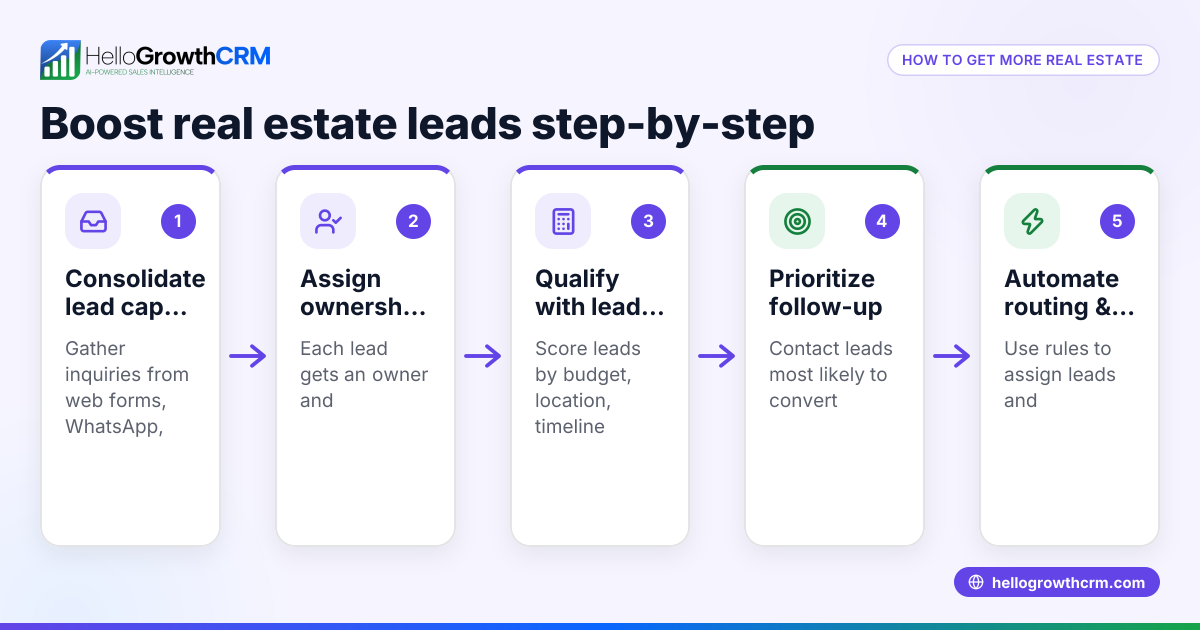
This is where scoring and routing are useful if they are tied to evidence, not guesswork. A system with workflow and routing rules can assign downtown Toronto condo inquiries to one queue and Calgary detached-home seller leads to another, while still preserving a consistent record of source, stage and next action.
Inquiry forms need fields that help with compliance and handoff
Real estate teams often overbuild forms for marketing and underbuild them for operations. The right Canadian intake form is short, but each field earns its place. You need enough data to respect consent rules, route correctly, and avoid a clumsy first conversation.
- Where did this lead come from, in the customer’s own path: referral, Google Business Profile, Facebook ad, Kijiji listing, sign call, website valuation page?
- What type of consent was obtained, on what date, and through which form or conversation?
- Which province is the property in, and which province is the lead located in if they differ?
- What language should customer communication use?
- What is the preferred contact channel: phone, email, SMS or WhatsApp?
- Is this about buying, selling, leasing, property management or investment?
Those fields let your automation do real work. They determine template choice, timing, queue assignment and compliance evidence. They also reduce avoidable handoff friction inside the team because the first agent does not need to leave a note saying “I think they prefer French” or “possibly investor.”
If you use a CRM with task boards and activity history, tie every form field to a visible record the next person can trust. That matters in real estate because several people may touch the same lead: ISA, agent, admin and transaction coordinator.
Deposits, pre-construction fees and payment records need province data
Some real estate lead flows turn into paid services before a sale closes: valuation retainers in niche markets, tenant-placement fees, consulting for investors, or deposits connected to pre-construction or other ancillary services. Once money enters the process, Canadian tax handling becomes more specific than “record the amount received.”
The applicable mix of GST, HST, PST and, in Quebec, QST depends on where the supply takes place. The Canada Revenue Agency publishes GST and HST rules, and Revenu Québec publishes Quebec sales tax guidance. CRA also distinguishes between the timing of the tax obligation and the treatment of deposits and forfeited amounts; those are not the same question. For a business operating across provinces, the CRM should capture province of supply per transaction, not just customer province and not just gross amount.
Payment method matters too. Canadian businesses commonly receive funds by Interac e-Transfer, pre-authorised debit, credit card, cheque and wire transfer. If your process assumes card payments are the complete record, you will systematically miss money that lands directly in the bank via Interac e-Transfer. That creates reconciliation problems and weakens your reporting on which lead sources actually produce paid work.
The arithmetic below is illustrative; the figures are made up to show the shape of the decision. Suppose a Vancouver brokerage runs a relocation package for incoming executives and charges C$1,200 for a rental search retainer, later bills C$3,800 for a tenant-placement service, and receives C$500 by Interac e-Transfer as an initial deposit. If the first payment is logged only as “money received” without province of supply, payment rail or whether it is a deposit for tax purposes, the admin team may not know how to classify it when the final invoice is raised. A better record stores the C$500 against the contact and deal, identifies the province connected to the service, and keeps the payment method visible. This example leaves out the legal structure of the service, any trust-account issues, and the current tax treatment, which should be checked against CRA or Revenu Québec guidance before invoicing.
Provincial real estate regulators shape what can be automated
Real estate is not only a sales process; it is a regulated profession. The exact regulator depends on the province, and brokerage rules are not identical across Canada. That matters because follow-up content can drift into representation, advice or disclosure territory. A high-volume sequence that is harmless for a general contractor may create issues for a licensed real estate professional if it implies commitments the brokerage has not approved.
Keep automation focused on contact, scheduling, factual updates and clearly framed offers to speak. Material statements about agency relationships, representation terms, referrals, remuneration or property facts should come from approved templates and reviewed processes that fit the province’s regulator and the brokerage’s own policies. The same caution applies to advertising claims in listing promotion. If a sequence republishes listing language or project details, someone should own review and version control.
This is one reason many Canadian teams route early contact through approved templates and then hand over to an agent once the lead reaches a clear stage. The automation should move the lead to the right human with context, not try to replace regulated judgment.
A CRM should reduce admin work, not create another compliance gap
For Canadian real estate teams, the useful CRM setup is the one that stores evidence and shortens the path to conversation. HelloGrowthCRM can help with lead capture, qualification and pipeline entry, plus timed outreach through sequences and campaigns, booking through scheduling pages, and call activity through its built-in dialer. The point is not to automate every touch. It is to make sure each lead has a visible history: source, consent, language, stage, tasks and next appointment.
If you are comparing tools, pay attention to whether the system can support your actual operating model in Canada: bilingual templates, province-aware routing, time-zone-safe scheduling, and records that survive handoffs. A free starting point can be useful while you standardise intake and follow-up rules; see the free CRM plan if you want to test your process before a larger rollout.
In Canada, the best automated real estate follow-up is not the loudest sequence; it is the one that contacts the right person, in the right language, at the right local time, with a record your brokerage can stand behind.
Ready to put this into practice?
Set up your pipeline, WhatsApp follow-ups, and AI lead scoring in minutes — free, no credit card.
Try HelloGrowthCRM freeGet CRM tips in your inbox
Join thousands of sales professionals who get weekly insights on CRM strategy, AI automation, and pipeline optimization.

The HelloGrowthCRM team publishes guides on CRM strategy, AI sales tools, and revenue operations for small business sales teams.