HelloGrowthCRM software
Built for real small-business sales teams
HelloGrowthCRM helps reps qualify faster, follow up on time, and close more deals—with practical automation in one place.
- AI lead scoring and pipeline visibility
- Built-in dialer, WhatsApp, and email automation
- Sales forecasting and RevOps-ready reporting
CRM pricing in India for B2B sales teams is the full monthly and annual cost of running your sales process in one system, including user licenses, onboarding, WhatsApp messaging, IndiaMART and JustDial lead capture, Razorpay and Tally workflows, admin time, data compliance, and forecasting value in INR.
Key Takeaways
- Per-user CRM pricing is only one part of total cost for Indian B2B sales teams.
- WhatsApp, lead-source integrations, payment sync, and admin overhead often decide the real ROI.
- Teams in Mumbai, Pune, Bangalore, and tier-2 markets need CRM workflows that match Indian buying behavior.
- DPDPA 2023 readiness matters when you store customer data, call logs, and message history.
- A cheaper CRM can cost more if forecasting is weak and manual work stays high.
- HelloGrowthCRM is best evaluated on total execution cost, not just sticker price.
What does CRM pricing in India for B2B sales teams actually include?
CRM pricing in India for B2B sales teams includes far more than a per-seat fee because Indian sales teams usually need lead capture, WhatsApp follow-up, calling, quote sharing, payment visibility, accounting sync, and reporting in one flow, plus setup effort, support cost, and ongoing admin time.
Most buyers start with the license line item. That is a mistake.
For Indian SMEs, total CRM cost usually has six parts:
- Base subscription
- One-time setup and migration
- Integration cost
- Communication cost
- Admin and training time
- Revenue impact from better execution
If your team buys leads from IndiaMART, works inbound callbacks from JustDial, chases payments through WhatsApp, and wants closed-won visibility after Razorpay collections, the real question is not “What is the per-user price?” It is “What will this system cost us to run every month without breaking process?”
In many audits, I have seen teams in Pune and Mumbai pay for a CRM and still track key follow-ups in Excel. That doubles hidden cost. You pay the software bill and still carry manual work.
A practical Indian cost model should include:
- License cost in INR
- Implementation partner or internal setup cost
- WhatsApp messaging or provider cost
- Telephony or CRM Dialer cost
- API or connector charges
- Data cleanup and migration cost
- Sales manager reporting time
- Missed-revenue cost from poor pipeline visibility
If you want a quick baseline before shortlisting vendors, use a CRM ROI Calculator and compare it with your current manual effort.
The hidden line items Indian buyers miss
The most ignored costs are not software fees. They are operational leakages.
Common hidden costs include:
- Re-entering leads from IndiaMART emails
- Assigning JustDial leads manually
- Logging WhatsApp replies by hand
- Chasing collections without payment visibility
- Updating Tally or finance sheets separately
- Rebuilding forecast reports every week
In one rollout we did with a 12-person sales team, manual lead assignment alone took one coordinator nearly two hours per day. After automation, that time dropped sharply and the manager got same-day source-wise reporting.
Why per-user pricing is not enough for Indian SMEs
Per-user pricing is not enough for Indian SMEs because the biggest cost difference between CRMs comes from how much manual work they remove, how well they fit WhatsApp-led selling, and whether they support local integrations, fast onboarding, and manager visibility without extra tools or consultants.
A ₹1,200 per-user tool can be more expensive than a ₹1,800 tool if the cheaper option needs three add-ons and one full-time admin.
This is especially true for:
- Industrial distributors in Mumbai
- Manufacturing sellers in Pune
- SaaS and services firms in Bangalore
- Multi-city teams selling into tier-2 and tier-3 markets
These teams often rely on quick lead response, repeat follow-up, and owner-led reviews. If the CRM cannot automate Email Automation, WhatsApp outreach through WhatsApp & SMS CRM, and stage updates through AI Pipeline Management, the team falls back to manual work.
A simple total cost formula in INR
Use this working formula:
Total CRM cost = Annual license + setup + integration fees + communication costs + admin overhead + training time + reporting effort - value of time saved - value of pipeline improvement
That last part matters. A CRM is not only a cost center.
If better qualification, follow-up, and forecast accuracy help you close faster, your effective cost falls. Sales Forecasting and AI Deal Insights matter because they change decision quality, not just reporting convenience.
A sourced reality check on digital adoption
India had over 954 million internet subscribers as of March 2024, according to TRAI’s telecom subscription data, which explains why digital lead capture and fast mobile follow-up now shape SME sales execution across India TRAI.
That does not prove CRM ROI by itself. It does show why mobile-first, WhatsApp-friendly process design matters in India.
Which cost components matter most when comparing CRM options in India?
The cost components that matter most when comparing CRM options in India are setup, lead-source automation, messaging, finance sync, admin overhead, and forecasting quality, because these areas decide whether your team gets daily usage, reliable reporting, and measurable revenue gains after go-live.
Here is a practical buyer view for Indian B2B teams.
| Cost Component | What to check | Why it matters in India | HelloGrowthCRM angle |
|---|---|---|---|
| License fee | Per user per month in INR | Base budget control | Compare plans on Pricing |
| Setup cost | Migration, fields, pipeline, training | SMEs often lack dedicated CRM admins | Fast onboarding via Demo and Managed RevOps |
| WhatsApp workflow | Messaging, templates, automation, inbox | WhatsApp is a primary business channel | Built for WhatsApp & SMS CRM and Smart Inbox |
| IndiaMART/JustDial capture | Email parsing, API, routing, source tagging | Lead response speed drives conversion | Use Zapier or custom workflows |
| Payment workflow | Invoice/payment visibility | Sales and finance alignment is critical | Razorpay integration helps closed-loop visibility |
| Accounting sync | Tally or finance export process | Manual reconciliation slows teams | Evaluate current export or integration path with All Integrations |
| Forecasting | Stage probability, velocity, manager views | Owners need practical forecast reviews | Sales Forecasting and Revenue Attribution |
| Admin overhead | Workflow changes, reports, cleanup | Hidden people cost grows fast | Lower drag with AI CRM tools |
Setup cost is usually underpriced during evaluation
Vendors often make setup sound simple. Real setup is process design.
You need to decide:
- Lead stages
- Qualification rules
- Territory assignment
- Follow-up SLAs
- Quote workflow
- Payment status visibility
- Renewal or repeat-sale logic
When I have audited pipelines like this, the biggest failure is copying old spreadsheets into a new CRM without redesigning the funnel. That preserves chaos.
Admin overhead decides long-term ROI
A CRM that needs constant manual cleanup becomes expensive by month three.
Watch for these warning signs:
- Managers export data weekly to make reports
- Duplicate leads keep piling up
- Reps update stages only before review meetings
- Finance and sales disagree on closed-won status
- Owners cannot trust monthly forecasts
If those issues remain, your software fee is not your real cost.
How should Indian B2B teams evaluate WhatsApp, IndiaMART, JustDial, Razorpay, and Tally fit?
Indian B2B teams should evaluate WhatsApp, IndiaMART, JustDial, Razorpay, and Tally fit by mapping each source and handoff to one CRM workflow, then checking automation, visibility, and failure points so no lead, message, payment, or finance update depends on manual copying.
Start with the actual operating motion of your team.
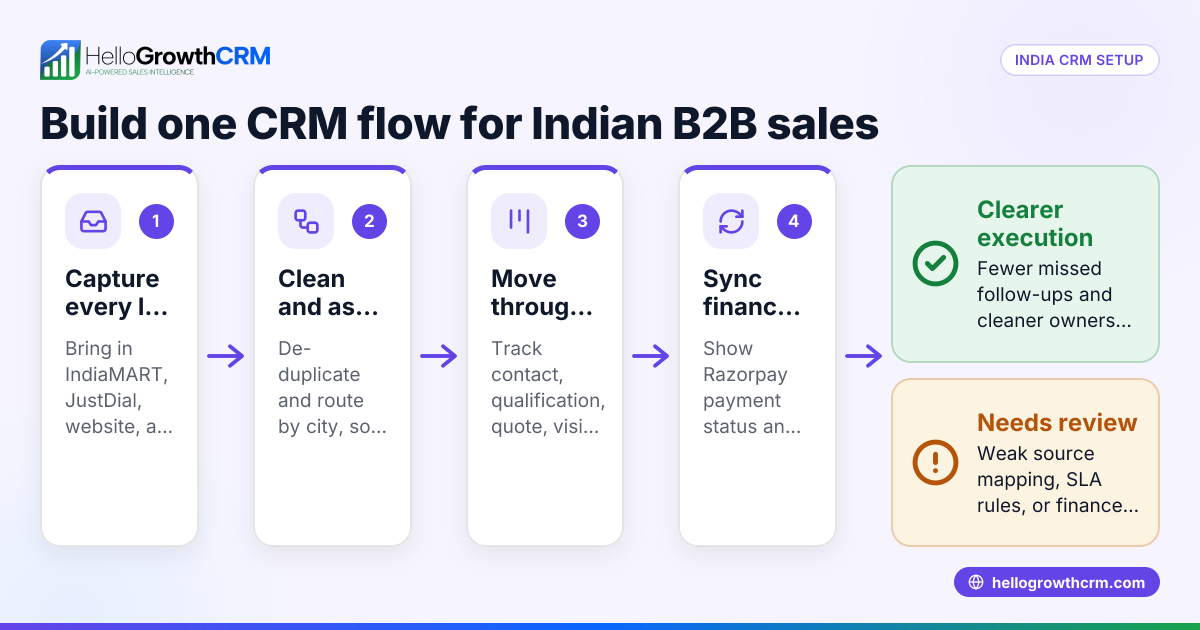
For many Indian SMEs, a lead journey looks like this:
- Lead arrives from IndiaMART or JustDial
- Sales rep calls within 5 to 15 minutes
- Follow-up moves to WhatsApp
- Quote is shared
- Payment or token arrives through Razorpay
- Finance updates books in Tally
- Sales wants visibility without calling accounts
Your CRM should support this entire path.
What to ask about WhatsApp workflows
Ask vendors these direct questions:
- Can inbound and outbound WhatsApp chats sit beside deal history?
- Can reps use shared templates with approval controls?
- Can replies trigger tasks or stage changes?
- Can managers see response time and pending chats?
- Can the team avoid using personal numbers?
For many Indian teams, Smart Inbox plus Meeting Scheduler can remove a lot of back-and-forth after first contact.
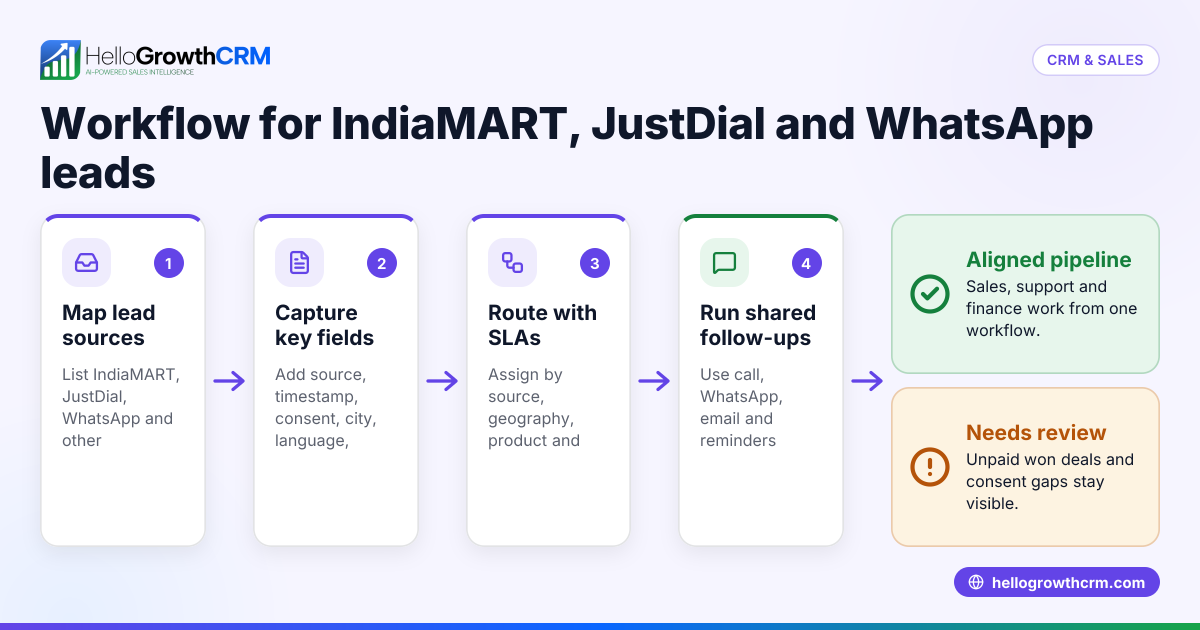
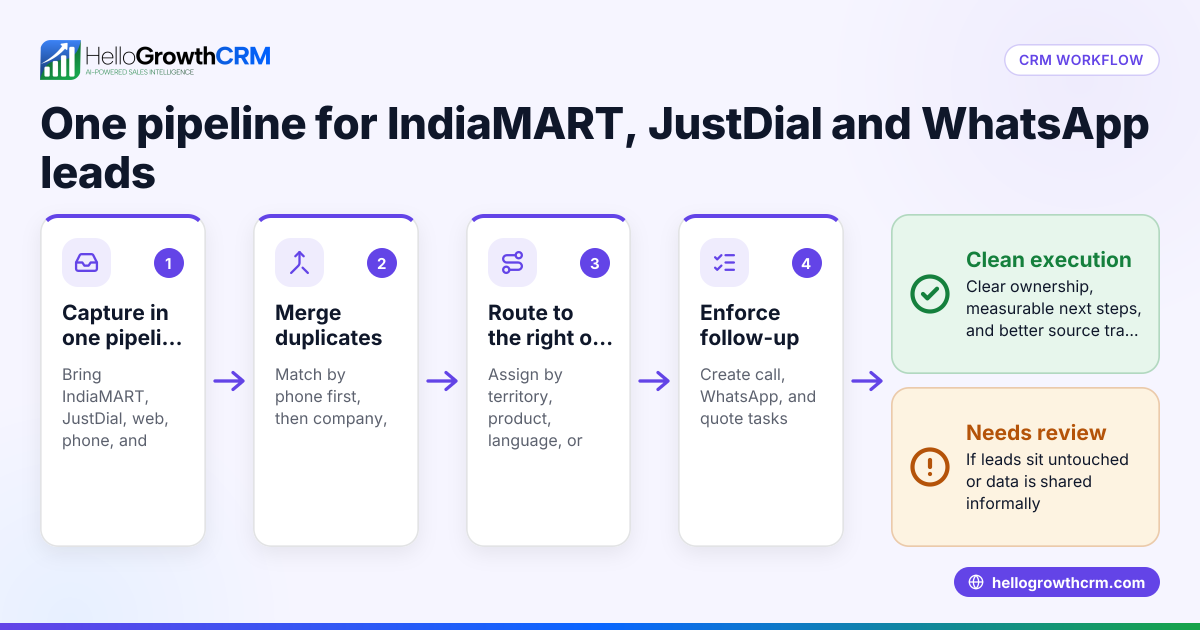
What to ask about IndiaMART and JustDial lead capture
Ask how the CRM handles:
- New lead parsing
- Source attribution
- Duplicate checking
- Auto-assignment by city, product, or pincode
- SLA alerts for untouched leads
If routing is weak, lead quality will look bad even when response discipline is the real problem. AI Lead Scoring also helps once basic capture is clean.
What to ask about Razorpay and Tally workflows
Ask whether sales can see:
- Payment link sent status
- Payment received status
- Order or invoice reference
- Finance confirmation timing
- Closed-won logic tied to payment milestones
The RBI remains the most authoritative source on India’s payment system framework and regulatory environment, so buyers should treat payment-data handling and reconciliation controls seriously.
For Tally, some teams will use direct sync while others will use export or middleware. The right choice depends on transaction volume and finance discipline. If you process low volume, a controlled daily sync may be enough. If volume is high, manual export creates risk.
What does DPDPA 2023 readiness mean for CRM pricing and vendor selection?
DPDPA 2023 readiness means your CRM pricing and vendor choice should account for consent handling, access controls, auditability, data retention, and secure processing because these requirements affect workflow design, legal comfort, and operational risk when your team stores contact records, messages, and payment-linked activity.
This is not just a legal checkbox.
If your team stores customer phone numbers, call notes, WhatsApp transcripts, and payment-linked records, your CRM becomes part of your compliance surface.
India’s Ministry of Electronics and Information Technology provides the official policy context for the country’s data protection framework at MeitY.
What buyers should verify
Check these items during evaluation:
- Role-based access for sales, managers, and finance
- Audit logs for key record changes
- Data export and deletion process
- Consent-aware outreach workflows
- Vendor support for retention policies
- Integration controls with third-party apps
For smaller teams under 50 reps, practical governance is usually enough if processes are clear. Above that, expect more formal admin controls, approval workflows, and integration reviews.
Be honest about your internal maturity. A CRM cannot fix weak policy ownership on its own.
How to calculate CRM pricing in India for B2B sales teams: Step-by-Step
Calculating CRM pricing in India for B2B sales teams means adding software, setup, messaging, integration, admin, and compliance costs, then subtracting time saved and revenue gained from faster response, cleaner pipeline management, and better forecasting across your actual Indian sales workflow.
- List your users and roles
Count reps, managers, founders, finance viewers, and support users. Not every person needs the same license level. - Map your lead sources
Include website forms, IndiaMART, JustDial, referrals, events, and channel partners. Note lead volume per month and source handling time. - Add communication costs
Estimate WhatsApp usage, calling, SMS, and email automation needs. If your team relies heavily on follow-up, this line item matters. - Price setup and migration
Include field design, pipeline setup, imports, templates, reports, and training. Ask whether the vendor or your team owns each task. - Estimate integration effort
Include Razorpay, Gmail, Slack, WhatsApp, and any Tally workflow. Some integrations are plug-and-play. Others need process design. - Calculate admin overhead
Estimate weekly hours spent on cleanup, reports, duplicate removal, and manager troubleshooting. Multiply by internal salary cost. - Estimate revenue upside
Model gains from faster lead response, higher follow-up completion, and more reliable forecasting. Use a Pipeline Health Score if pipeline quality is unclear. - Compare three scenarios
Compare your current process, a low-cost CRM, and HelloGrowthCRM. This shows whether lower sticker price really wins.
What does a practical CRM cost model look like for teams in Mumbai, Pune, Bangalore, and tier-2 cities?
A practical CRM cost model for teams in Mumbai, Pune, Bangalore, and tier-2 cities should reflect lead volume, response speed, manager bandwidth, and field reality because inside-sales SaaS motions differ from distributor, manufacturing, and service-led sales in regional Indian markets.
Here is a simple way to think about fit.
Mumbai and Bangalore teams
These teams often have:
- Higher inbound velocity
- More channel overlap
- Faster review cycles
- Stronger need for forecasting accuracy
They should prioritize:
- Source-wise dashboards
- AI Pipeline Management
- Revenue Attribution
- Tight integration with finance and communications
Pune and industrial clusters
These teams often have:
- Longer sales cycles
- Quote-heavy process
- Multi-contact buying groups
- Repeat follow-up over weeks
They should prioritize:
- Structured qualification
- Quote visibility
- Task discipline through Sales Task Boards
- Payment-stage visibility tied to Proposal Builder
Tier-2 and tier-3 market teams
These teams often rely more on calls and WhatsApp than email. They need mobile-first adoption, easy manager oversight, and simple reports owners can trust.
In one deployment with a regional B2B service business, adoption improved only after we simplified stage names in Hindi-friendly business terms and moved follow-up control into one shared inbox view. Fancy dashboards did not solve the basic usage problem. Clear process did.
Why HelloGrowthCRM is a strong shortlist for Indian B2B teams
HelloGrowthCRM is a strong shortlist for Indian B2B teams because it aligns with Indian sales execution realities such as WhatsApp-first follow-up, multi-source lead capture, manager-led pipeline reviews, and practical automation without forcing SMEs into heavyweight enterprise complexity or disconnected add-ons.
This article is about pricing, but pricing only matters if the system gets used.
HelloGrowthCRM is built for revenue teams that want:
- CRM plus execution in one place
- WhatsApp-led engagement
- AI-assisted pipeline visibility
- Better forecast discipline
- Faster rep adoption
- Less admin drag
If you are comparing options, be aware that HelloGrowthCRM is our product. That said, the buyer framework above is the same one I would use in any CRM audit.
Explore Features, compare plans on Pricing, or start a Free Trial if you want to test your own IndiaMART, JustDial, WhatsApp, and payment workflows in a real environment. For teams that need help redesigning process, Managed RevOps can speed up rollout.
For Indian teams that want one practical system for sales execution, forecasting, and local workflow fit, HelloGrowthCRM is worth a serious look.
About the author
Rahul Mehta is a Sales Operations Lead at HelloGrowthCRM with 10 years of experience in B2B SaaS, CRM implementation, and revenue operations. He has led CRM audits and pipeline redesign projects for Indian SMEs across Mumbai, Pune, and Bangalore. One recent project involved rebuilding lead routing, WhatsApp follow-up, and forecast reviews for a 12-person industrial sales team, which informed the cost framework used in this article. He writes from direct implementation experience, not vendor theory.
Frequently Asked Questions
Q: What is the average CRM pricing in India for B2B sales teams?
A: Average CRM pricing in India for B2B sales teams usually starts with a per-user monthly fee, but the real average cost depends on setup, WhatsApp usage, integrations, and admin effort. Most SMEs should compare annual total cost, not just seat price.
Q: Why does CRM total cost in India go beyond per-user pricing?
A: CRM total cost in India goes beyond per-user pricing because Indian B2B teams often need WhatsApp workflows, lead-source capture, payment visibility, accounting sync, and reporting support. These extra layers often decide actual cost and adoption.
Q: Is WhatsApp integration necessary for Indian B2B CRM buyers?
A: WhatsApp integration is necessary for many Indian B2B CRM buyers because a large share of follow-up, quote discussion, and customer response happens there. If WhatsApp stays outside the CRM, activity tracking and manager visibility become weak.
Q: How should I evaluate IndiaMART and JustDial integration in a CRM?
A: You should evaluate IndiaMART and JustDial integration in a CRM by checking lead capture speed, duplicate handling, source tagging, and auto-assignment rules. The best test is whether reps can act on new leads without manual copying.
Q: Does Razorpay and Tally integration affect CRM ROI?
A: Razorpay and Tally integration affects CRM ROI because payment status and finance visibility help sales teams close loops faster and reduce manual reconciliation. This matters even more for SMEs where sales and finance work closely.
Q: What should Indian SMEs check for DPDPA 2023 readiness in a CRM?
A: Indian SMEs should check role-based access, audit logs, data handling controls, retention options, and vendor process clarity for DPDPA 2023 readiness in a CRM. The goal is practical governance, not just a marketing claim.
Q: Is HelloGrowthCRM a good fit for small and mid-sized Indian sales teams?
A: HelloGrowthCRM is a good fit for small and mid-sized Indian sales teams that need WhatsApp-first execution, structured pipeline management, and local workflow fit. It is especially useful when teams want lower admin overhead and stronger forecast visibility.
Q: How can I estimate CRM ROI before buying?
A: You can estimate CRM ROI before buying by calculating current manual effort, lead leakage, follow-up delays, and reporting time, then comparing that with expected automation and conversion gains. A structured trial usually gives the clearest answer.
Frequently Asked Questions
Ready to put this into practice?
Set up your pipeline, WhatsApp follow-ups, and AI lead scoring in minutes — free, no credit card.
Try HelloGrowthCRM freeGet CRM tips in your inbox
Join thousands of sales professionals who get weekly insights on CRM strategy, AI automation, and pipeline optimization.

The HelloGrowthCRM team publishes guides on CRM strategy, AI sales tools, and revenue operations for small business sales teams.