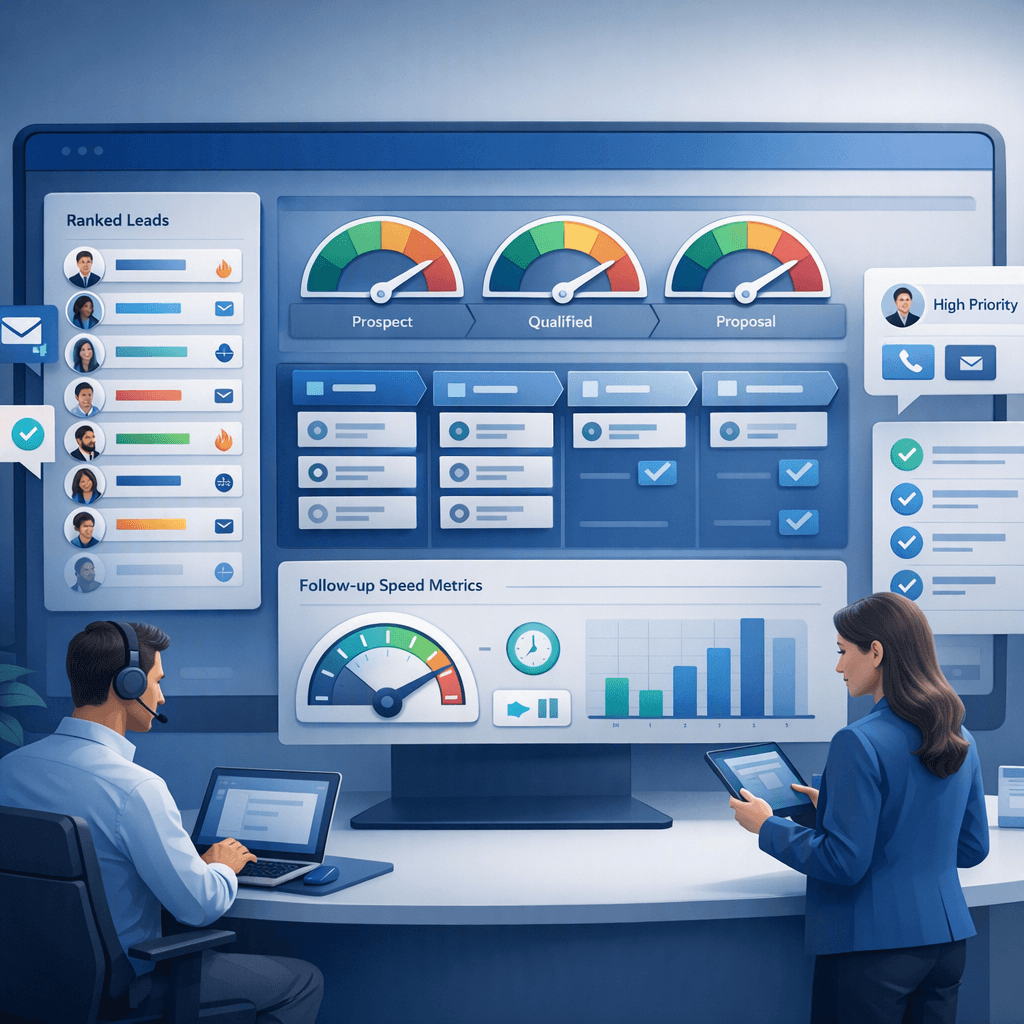
HelloGrowthCRM software
Built for real small-business sales teams
HelloGrowthCRM helps reps qualify faster, follow up on time, and close more deals—with practical automation in one place.
- AI lead scoring and pipeline visibility
- Built-in dialer, WhatsApp, and email automation
- Sales forecasting and RevOps-ready reporting
AI lead scoring setup is the process of training your CRM to rank leads using real buying signals like fit, intent, engagement, and response behavior so sales teams can prioritize the right accounts, route them faster, and improve follow-up speed and conversion without relying on noisy manual point rules.
Key Takeaways
- The best AI lead scoring setup uses four signal groups: fit, intent, engagement, and response-time risk.
- Generic point systems often create noise because they reward activity instead of buying likelihood.
- High scores only matter when they trigger action through routing, alerts, and Email Automation.
- Teams should measure score quality using speed-to-lead, meeting rate, stage conversion, and pipeline velocity.
- In HelloGrowthCRM, AI Lead Scoring works best when paired with AI Pipeline Management and workflow automation.
- Start with a simple model, review false positives weekly, and tune signals by segment.
Why does AI lead scoring setup matter for follow-up speed and conversion?
AI lead scoring setup matters because it helps sales teams answer one core question fast: which lead should we contact now? When scoring reflects true buying signals instead of generic activity points, teams respond faster to high-intent leads, reduce wasted outreach, and improve conversion across the funnel.
Most B2B teams do not have a lead volume problem. They have a prioritization problem. Reps often work the newest lead, the loudest request, or the account they recognize. That creates uneven response times and poor coverage.
A good setup fixes that by making the next best action clear. Instead of saying, “this lead opened two emails, add 10 points,” it asks better questions:
- Does this company match your ICP?
- Is there fresh intent or hand-raise behavior?
- Did the lead respond quickly or go cold?
- Has engagement happened across multiple channels?
- Is the account already active in your pipeline?
In one rollout we did with a 12-person sales team, the biggest issue was not lack of lead volume. It was that reps treated all demo requests the same. Once we separated pricing-page visits, reply behavior, and territory fit from vanity engagement, the queue became far easier to manage.
This is where an AI CRM changes the game. The score is not just a number. It becomes an operating signal. In HelloGrowthCRM, teams can connect scores to Sales Task Boards, Meeting Scheduler, and CRM Dialer workflows so high-priority leads move immediately.
Which signals actually improve lead scoring quality?
The signals that actually improve lead scoring quality are signals tied to buying likelihood and sales readiness, not just marketing activity. In practice, the strongest mix usually includes fit signals, intent signals, engagement depth, and response-time behavior, because together they show who should buy and who is ready now.
1. Fit signals
Fit signals tell you whether the account and contact match your ICP.
Common fit variables include:
- Company size
- Industry
- Geography
- Tech stack
- Team structure
- Role seniority
- Use case alignment
- Existing customer segment patterns
If you sell to mid-market SaaS revenue teams, a student downloading a guide should not outrank a VP of Sales from a 200-person software company. That sounds obvious, yet weak scoring models miss it.
Use fit first as a gating layer. Then let AI rank leads within that layer.
2. Intent signals
Intent signals show active buying behavior.
Useful intent signals include:
- Demo request submissions
- Pricing page visits
- High-value product page visits
- Repeat sessions from the same company
- Trial start behavior
- “Contact sales” actions
- Inbound replies with problem-aware language
A standalone fact matters here: buyers are often deep into research before talking to sales, according to Gartner’s guidance on modern B2B buying and sales engagement.
That is why pageview count alone is weak. Page sequence and page type matter more. A pricing-page visit after a comparison-page visit is stronger than five blog visits.
3. Engagement depth
Engagement depth is different from raw activity. It asks whether the lead is moving closer to a sales conversation.
Higher-quality engagement includes:
- Email replies
- Meeting bookings
- Form completion quality
- Multi-channel engagement
- Return visits within a short window
- Content consumption tied to evaluation, not education
In HelloGrowthCRM, Smart Inbox and WhatsApp & SMS CRM data can strengthen this layer because replies and conversation continuity are usually stronger indicators than passive opens.
4. Response-time and follow-up behavior
This signal group is often missed. It should not be.
When I have audited pipelines like this, one repeated pattern appears: the best-converting inbound leads are often the ones contacted fastest. So your model should score not just the lead, but the risk of delay.
Useful response signals include:
- Time since hand raise
- Time to first rep touch
- Time to first human reply
- Number of unanswered attempts
- Lead re-engagement after silence
Harvard Business Review has repeatedly covered how sales execution and process discipline affect outcomes, and response speed remains one of the clearest operational levers.
5. Negative signals
Good models also subtract.
Negative signals include:
- Personal email when business email is required
- Student or consultant mismatch
- Spammy form patterns
- Long inactivity windows
- Repeated low-intent content only
- Existing open opportunity with another owner
Without negative signals, your AI score becomes inflated and noisy.
Why do generic point systems fail?
Generic point systems fail because they reward easy-to-track activity instead of true purchase likelihood. When every email open, page visit, or content download adds points without context, sales gets bloated priority queues, slower follow-up, and lower trust in the scoring model itself.
Here is the core problem: manual point systems are static, but buying behavior is contextual.
A generic model might look like this:
- Ebook download: +10
- Email open: +5
- Webinar signup: +20
- Pricing page visit: +15
That looks neat, but it often breaks in real funnels.
Where point systems create noise
- They overvalue top-of-funnel activity
- They ignore account fit
- They treat all forms equally
- They miss sequence and recency
- They do not learn from outcomes
- They rarely include sales follow-up speed
AI scoring vs manual scoring
| Dimension | Manual point scoring | AI lead scoring setup |
|---|---|---|
| Logic | Fixed rules | Pattern-based and adaptive |
| Signal use | Mostly activity counts | Fit, intent, engagement, timing, negatives |
| Maintenance | Manual rule updates | Ongoing tuning with outcome feedback |
| Context | Low | High |
| Rep trust | Often weak over time | Higher when tied to conversion outcomes |
| Automation potential | Limited | Strong with routing and next actions |
This does not mean manual rules are useless. They are useful for early-stage teams with limited data. But once you have enough inbound volume, multi-channel activity, and closed-won history, AI usually gives a cleaner ranking.
A practical limitation is worth stating. For teams with very low lead volume or inconsistent CRM hygiene, AI scoring may not outperform simple segmentation at first. In those cases, start with a hybrid model and improve data capture before adding complexity.
How should you structure an AI lead scoring model?
You should structure an AI lead scoring model in layers, starting with fit, then intent, then engagement depth, and finally response-time urgency. This layered approach reduces noise, makes routing easier, and helps teams explain why a lead is ranked highly enough to deserve immediate follow-up.
A simple model that works
Use four weighted buckets:
- Fit score
Measures ICP alignment by account and persona. - Intent score
Measures recent buying behavior and hand-raise actions. - Engagement score
Measures depth and continuity across channels. - Urgency score
Measures follow-up sensitivity and delay risk.
Then add a fifth hidden layer:
- Exclusion or penalty rules
Suppress obvious low-quality leads.
What to measure after launch
Do not judge success by average score. Judge it by downstream performance.
Track:
- Speed-to-lead in minutes
- First-response SLA attainment
- Meeting booked rate
- MQL-to-SQL conversion
- SQL-to-opportunity conversion
- Stage-velocity in days
- Win rate by score band
In HelloGrowthCRM, this becomes easier when scoring is connected to Revenue Attribution and Sales Forecasting, because you can compare score bands against real pipeline and revenue outcomes.
What high-performing teams do differently
High-performing teams keep the model interpretable. Reps do not need to see every weight, but they do need confidence in what the score means.
That is why I prefer score bands like:
- Hot: needs follow-up in 5 minutes
- Warm: same-day follow-up
- Nurture: automated sequence first
- Disqualify or review: low-fit or low-intent
This is much more actionable than a random score of 73.
How to set up AI lead scoring: Step-by-Step
Setting up AI lead scoring works best when you start with clean data, define conversion goals, group signals by fit and intent, connect scoring to automation, and then review outcomes weekly so the model improves based on response time, meeting rates, and stage conversion instead of assumptions.
- Define your conversion event
Pick the outcome your score should predict. For most B2B teams, this is booked meeting, qualified opportunity, or pipeline creation. - Clean your core CRM data
Standardize lifecycle stages, owner fields, lead sources, and account matching. If your data is messy, your model will learn the wrong patterns. - Choose your signal groups
Start with fit, intent, engagement, and urgency. Keep the first version simple and avoid adding every available field. - Map positive and negative indicators
List actions that strongly suggest buying intent, then list disqualifiers. This stops inflated scores and improves rep trust. - Create score bands, not just numbers
Define what hot, warm, nurture, and review mean. Tie each band to a routing or follow-up action. - Trigger automation from the score
Use AI Lead Scoring with Email Automation, CRM Dialer, and Slack alerts so top leads get acted on immediately. - Route by owner, segment, or territory
Connect score bands with Territory Management and assignment logic. High-priority leads should not wait in a shared queue. - Review false positives and false negatives weekly
Look at leads that scored high but did not convert, and leads that converted despite low scores. That is where the next model gains come from. - Add channel context
Bring in data from Gmail, Calendly, WhatsApp, and All Integrations to capture real buyer behavior across touchpoints. - Measure operational impact
Use score performance to improve response time, meeting rate, and pipeline quality. If scoring does not change behavior, it is just decoration.
How does HelloGrowthCRM make AI lead scoring easier?
HelloGrowthCRM makes AI lead scoring easier by combining scoring, routing, automation, and pipeline review in one workflow. Instead of exporting data between separate tools, teams can detect priority leads, assign next actions, trigger outreach, and inspect conversion outcomes inside the same operating system.
This matters because setup failure usually comes from handoff gaps, not model theory.
What HelloGrowthCRM does well in this use case
- Combines AI Lead Scoring with AI Sales Copilot
- Triggers immediate outreach through Email Automation
- Supports fast call response using CRM Dialer
- Flags pipeline risk using AI Deal Insights
- Helps teams review funnel health with Pipeline Health Score
- Connects scoring to broader Managed RevOps support when internal ops bandwidth is thin
In one implementation, we used score bands to trigger different follow-up plays. Hot leads got instant alerts and a call task. Warm leads entered a short multi-touch sequence. Low-fit leads were routed to nurture. The team did not add headcount. They simply removed delay and confusion.
HelloGrowthCRM is our product, so that is a fair disclosure. But that also means this recommendation comes from direct operator experience with the workflows that make scoring useful, not just from writing about it.
If you are evaluating setup effort, review the Features page, compare plans on Pricing, or book a Demo to see how scoring and automation work together in a live workflow.
Ready to reduce lead noise and speed up follow-up? Start a Free Trial of HelloGrowthCRM and build an AI lead scoring setup that actually helps reps act faster and convert more of the right pipeline.
About the author
Arjun Mehta is a Revenue Operations Lead at HelloGrowthCRM with 10 years of experience in B2B SaaS sales systems, lifecycle design, and pipeline management. He has led CRM and automation rollouts for global sales teams ranging from founder-led startups to multi-region mid-market orgs. A recent project that informed this article involved rebuilding inbound lead routing and scoring for a 12-person sales team to improve response-time SLA performance and meeting conversion.
Frequently Asked Questions
Q: What is AI lead scoring setup?
A: AI lead scoring setup is the process of configuring your CRM to rank leads based on buying likelihood and urgency using data like fit, intent, engagement, and response behavior. The goal is to help sales teams prioritize the right leads faster and automate follow-up based on score bands.
Q: Which signals matter most in an AI lead scoring model?
A: The signals that matter most in an AI lead scoring model are fit, intent, engagement depth, and response-time urgency. These signals work better than generic activity points because they show both who should buy and who is ready for sales contact now.
Q: Is AI lead scoring better than manual lead scoring?
A: AI lead scoring is usually better than manual lead scoring when you have enough clean CRM data and conversion history. Manual scoring can still work for smaller teams, but AI handles context, recency, and signal combinations much better.
Q: How do you measure whether lead scoring is working?
A: You measure whether lead scoring is working by tracking response speed, meeting rate, qualification rate, opportunity creation, and win rate by score band. If high-scoring leads do not convert better or move faster, the model needs tuning.
Q: Can AI lead scoring improve follow-up speed?
A: AI lead scoring can improve follow-up speed when scores trigger routing, alerts, and automated tasks instead of just sitting in a report. The operational workflow matters as much as the model itself because reps need immediate next actions.
Q: What data do I need before setting up AI lead scoring?
A: You need clean lifecycle data, lead source data, account and contact fit fields, engagement history, and at least one clear conversion outcome before setting up AI lead scoring. Better data quality usually matters more than adding more fields.
Q: How often should you review an AI lead scoring model?
A: You should review an AI lead scoring model at least weekly during the first month and then monthly after it stabilizes. Early review helps you catch false positives, missing negative signals, and routing issues before rep trust drops.
Q: How does HelloGrowthCRM support AI lead scoring setup?
A: HelloGrowthCRM supports AI lead scoring setup by combining scoring, automation, routing, and follow-up workflows in one platform. Teams can score leads, trigger outreach, assign owners, and inspect conversion performance without heavy manual RevOps overhead.
Frequently Asked Questions
Ready to put this into practice?
Set up your pipeline, WhatsApp follow-ups, and AI lead scoring in minutes — free, no credit card.
Try HelloGrowthCRM freeGet CRM tips in your inbox
Join thousands of sales professionals who get weekly insights on CRM strategy, AI automation, and pipeline optimization.

The HelloGrowthCRM team publishes guides on CRM strategy, AI sales tools, and revenue operations for small business sales teams.