HelloGrowthCRM software
Built for real small-business sales teams
HelloGrowthCRM helps reps qualify faster, follow up on time, and close more deals—with practical automation in one place.
- AI lead scoring and pipeline visibility
- Built-in dialer, WhatsApp, and email automation
- Sales forecasting and RevOps-ready reporting
A CRM for commercial HVAC contractors is a customer relationship management system built to track the full revenue and service cycle for HVAC businesses, from inbound service inquiry and site survey to estimate follow-up, dispatch coordination, contract approval, preventive maintenance scheduling, and renewal revenue in one shared workflow.
Key Takeaways
- Commercial HVAC teams need one system for sales, service, dispatch, and renewals, not separate tools and spreadsheets.
- The best CRM setup should track inquiry source, site visit status, estimate aging, work-order handoff, and maintenance contract renewal dates.
- Missed quotes often come from weak follow-up, unclear ownership, and poor pipeline visibility rather than low demand.
- HelloGrowthCRM helps unify office staff, sales reps, and field teams with AI CRM, automation, and Managed RevOps.
- AI-powered reminders, lead scoring, and renewal workflows can help contractors reduce leakage between inquiry, estimate, and booked work.
- A good HVAC CRM must fit real field operations, including mobile communication, dispatch coordination, and recurring service plans.
Why do commercial HVAC contractors need a specialized CRM?
Commercial HVAC contractors need a specialized CRM because their revenue process is not just “lead to close.” It includes urgent service intake, on-site inspections, estimate revisions, technician scheduling, project approval, and recurring maintenance renewals, all of which require shared visibility across office, sales, and field teams.
Generic CRM setups often stop at opportunity tracking. That is not enough for commercial HVAC. Most contractors manage several motion types at once:
- Emergency service calls
- Planned repair jobs
- Retrofit or replacement projects
- New installation bids
- Preventive maintenance agreements
- Multi-site account renewals
Each motion has different timing, stakeholders, and handoffs. A building manager may call for an urgent rooftop unit issue today, ask for a repair estimate tomorrow, and request an annual maintenance proposal next month. If your systems are disconnected, that account history gets fragmented.
In one rollout we did with a 12-person sales team and mixed service operation, the biggest issue was not lead volume. It was handoff failure. Service coordinators had one spreadsheet. estimators had another. Sales follow-up lived in email inboxes. Renewal dates were stored in calendar reminders. Quotes went cold because nobody had a single pipeline view.
That is where a purpose-built setup inside HelloGrowthCRM’s Features matters. You can track service inquiries, sales opportunities, dispatch-ready jobs, and contract renewal motions in one place. You can also connect communications through Smart Inbox and automate follow-up through Email Automation.
Gartner notes that CRM helps sales organizations manage customer interactions and revenue processes at scale. For commercial HVAC, that value increases because field operations and recurring contracts make those interactions far more complex than a standard B2B sales cycle.
What workflow should a CRM for commercial HVAC contractors cover?
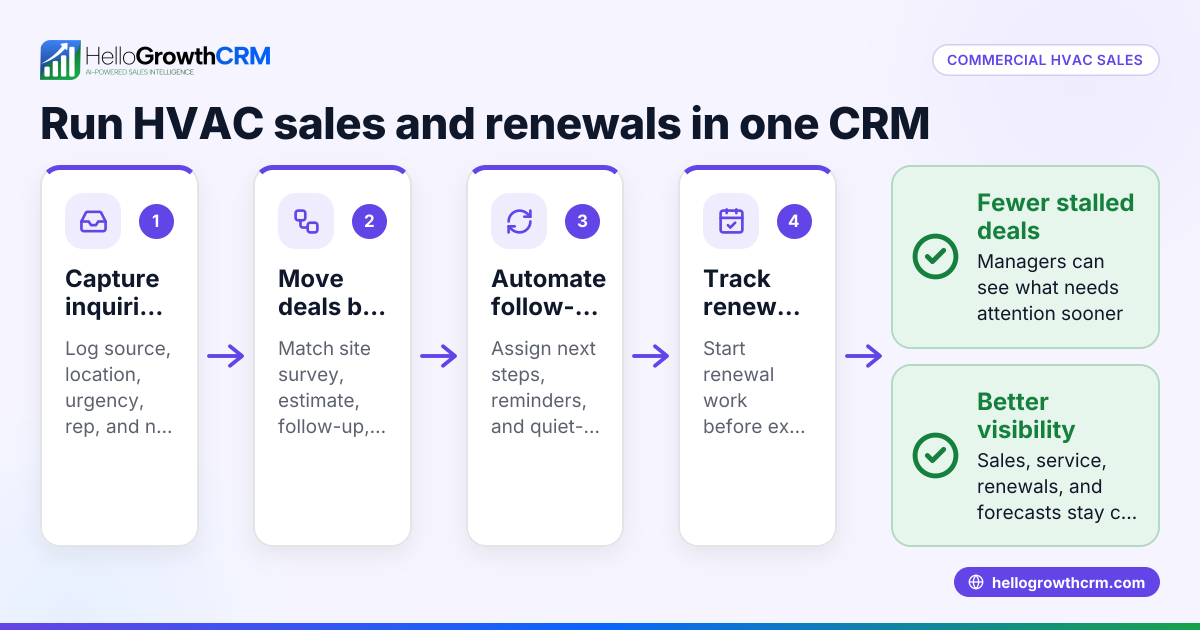
A CRM for commercial HVAC contractors should cover the full customer journey: inbound inquiry capture, qualification, site visit scheduling, estimate creation, follow-up, dispatch handoff, job completion, maintenance plan enrollment, and renewal management. If any of those steps sit outside the CRM, revenue leakage usually follows.
Service inquiry and lead capture
Commercial HVAC demand comes from many channels:
- Website forms
- Calls from existing customers
- Referral partners
- Property managers
- General contractors
- Paid ads
- Email inquiries
Your CRM should capture source, issue type, urgency, site details, and account history at intake. If you run campaigns, tying source data to Revenue Attribution helps you see which channels produce real jobs and long-term maintenance contracts.
Qualification and site survey
Not every inquiry deserves the same speed or rep time. A good HVAC workflow should capture:
- Building type
- Equipment type
- Number of sites
- Repair vs replacement intent
- Budget range
- Decision-maker role
- Need-by date
- Existing service contract status
This is where AI Lead Scoring can help prioritize urgent and high-value opportunities. A national facilities group with multiple rooftop units and no incumbent vendor should not sit in the same queue as a low-fit one-off request.
Estimate follow-up and proposal management
Many HVAC contractors lose work after the quote is sent. The estimate is accurate, but follow-up is inconsistent. Some reps call twice. Some wait a week. Some forget completely when dispatch volume spikes.
When I have audited pipelines like this, quote aging is usually the hidden problem. Teams know how many estimates they sent. They do not know how many sat untouched for 7, 14, or 21 days. Using Proposal Builder, Sales Task Boards, and automated reminders can reduce that drift.
Dispatch, service delivery, and renewal setup
Winning the work is only half the job. The CRM should also trigger the next step:
- Confirm approved estimate
- Handoff to operations
- Schedule technicians
- Track completion
- Flag upsell needs
- Convert one-time work into maintenance agreements
That is where connected workflows matter. With Meeting Scheduler, WhatsApp & SMS CRM, and Slack alerts, office teams can move faster without chasing updates across separate systems.
Which CRM features matter most for commercial HVAC teams?
The most important CRM features for commercial HVAC teams are inquiry capture, estimate pipeline tracking, dispatch handoff visibility, automated follow-up, account history, and renewal management. These features help contractors reduce missed quotes, respond faster, and turn one-time service work into recurring maintenance revenue.
Pipeline visibility by job type
Commercial HVAC contractors do not need one flat pipeline. They need stages by motion, such as:
- New service inquiry
- Site visit scheduled
- Estimate in progress
- Estimate sent
- Follow-up due
- Approved
- Dispatch ready
- Completed
- Maintenance proposal sent
- Renewal due
AI Pipeline Management helps managers see where jobs stall. AI Deal Insights can flag aging opportunities and low-engagement accounts before they go dark.
Mobile communication and technician coordination
Field work moves quickly. The CRM should support real communication, not just database entries. Teams often need:
- Call logging
- SMS and WhatsApp updates
- Technician notes
- Internal alerts
- Calendar sync
That is why many HVAC contractors benefit from CRM Dialer, Gmail, Microsoft Teams, and Twilio connections. The goal is simple: every customer touchpoint should update the same record.
Forecasting and renewal tracking
Service businesses need both sales forecasting and renewal forecasting. If you only track new projects, you miss a major profit center.
Service leaders who excel at cross-functional alignment are 1.9 times more likely to significantly outperform their peers on company goals, according to Forrester.
For HVAC contractors, that alignment affects both close rates and renewal rates. Sales Forecasting helps you predict booked work. Customer Health Score helps you spot at-risk maintenance accounts before renewal season.
How does HelloGrowthCRM fit commercial HVAC contractor workflows?
HelloGrowthCRM fits commercial HVAC contractor workflows by connecting sales, service coordination, and renewal management in one AI-powered system. It helps teams capture inquiries faster, automate estimate follow-up, monitor pipeline health, and support office-to-field handoffs without losing account context.
HelloGrowthCRM is our product, so that should be clear. This article is written from that perspective. It is a strong fit for contractors that want better revenue process control without building a large internal RevOps team.
Where HelloGrowthCRM helps most
For commercial HVAC teams, HelloGrowthCRM is especially useful in four areas:
- Inbound response speed
Route leads from web, ads, and referrals into one system with All Integrations and automation. - Estimate follow-up consistency
Use AI Sales Copilot and Email Automation to prompt the next best action. - Pipeline and dispatch handoff clarity
Keep sales and service leaders aligned with AI Deal Insights and shared task views. - Renewal revenue growth
Build recurring maintenance workflows with alerts, account health tracking, and automated outreach.
When HelloGrowthCRM is the right fit
HelloGrowthCRM works best for contractors that:
- Manage both project and service revenue
- Need stronger follow-up after estimates
- Want reporting beyond spreadsheets
- Need sales and service teams in one workflow
- Want AI support without replacing people
This setup is often ideal for small to mid-sized commercial teams. For very large enterprises with deeply custom field-service stacks, expect more integration planning. If that is your case, start with a Demo to map the workflow before rollout.
HelloGrowthCRM vs generic CRM for commercial HVAC contractors
HelloGrowthCRM differs from a generic CRM for commercial HVAC contractors because it is easier to configure around revenue operations, estimate follow-up, service handoffs, and renewal visibility. Generic systems can work, but they often need more custom admin effort to fit a field-driven contractor workflow.
| Capability | Generic CRM | HelloGrowthCRM for Commercial HVAC |
|---|---|---|
| Inbound service inquiry capture | Usually possible with setup | Built to centralize demand and response workflows |
| Estimate follow-up automation | Often manual or fragmented | Native automation with Email Automation and AI prompts |
| Pipeline visibility by service stage | Requires customization | Easier stage-based tracking with AI Pipeline Management |
| Office and field communication history | Often split across tools | More unified with Smart Inbox and messaging options |
| Renewal tracking for maintenance contracts | Often handled outside CRM | Easier recurring workflow management and health monitoring |
| RevOps support | Usually self-managed | Optional Managed RevOps support |
A useful benchmark from outside HVAC comes from customer follow-up research. Harvard Business Review has long emphasized the commercial impact of speed, consistency, and process discipline in sales execution. In contractor settings, that same discipline often decides whether a quote gets approved or forgotten.
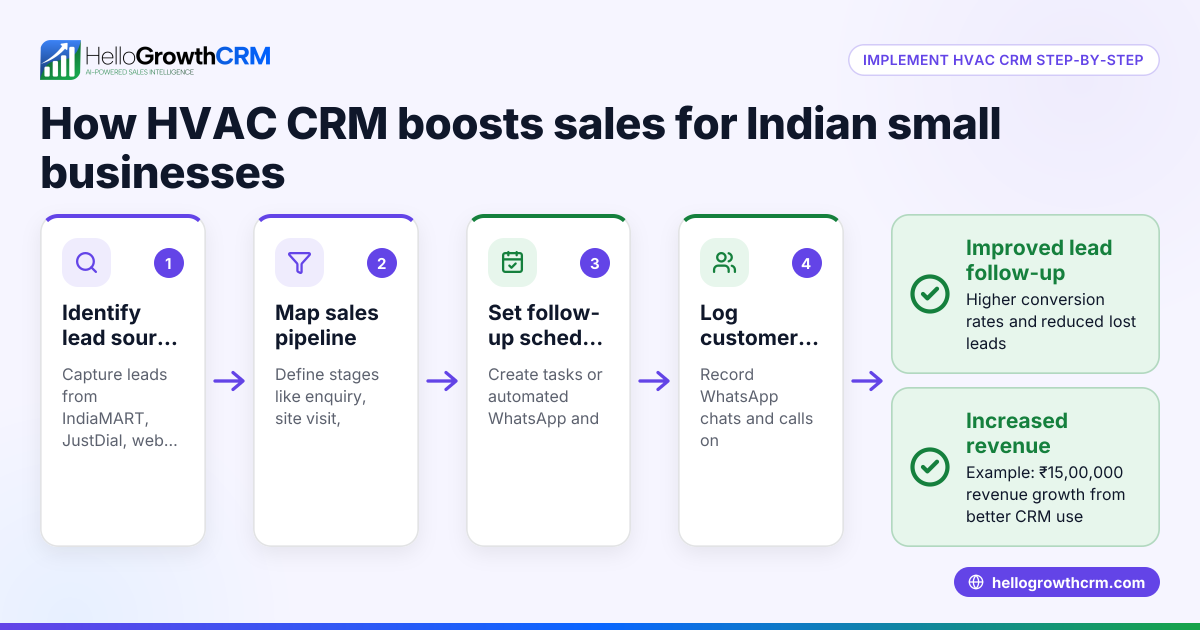
How to implement a CRM for commercial HVAC contractors: Step-by-Step
Implementing a CRM for commercial HVAC contractors means mapping your real service and sales workflow first, then configuring stages, automations, ownership rules, and renewal tracking around that process. The fastest deployments start simple, prove adoption, and add AI and reporting after the core handoffs work cleanly.
- Map your current workflow
Document each stage from inquiry to renewal. Include who owns intake, site visits, estimates, approvals, dispatch, and follow-up. - Define pipeline stages by motion
Separate service calls, retrofit bids, and maintenance renewals if needed. Clear stage design improves reporting and Pipeline Health Score accuracy. - Standardize intake fields
Capture building type, urgency, equipment, site count, contact role, and service need. This improves qualification and routing. - Set ownership and SLAs
Decide who responds to new inquiries, who follows up on estimates, and how fast each action should happen. This is where many contractor teams break down. - Automate follow-up sequences
Use templates and reminders for estimate follow-up, site survey confirmation, and renewal outreach. A Follow-Up Cadence Builder can help define this. - Connect communication tools
Sync email, calling, calendars, and messaging tools so updates flow into one account timeline. Start with tools your team already uses. - Build renewal alerts
Create tasks and automations 90, 60, and 30 days before maintenance contract expiry. Include upsell prompts for added coverage or extra sites. - Review reports weekly
Track inquiry response time, estimate aging, stage conversion, dispatch lag, and renewal win rate. Use a CRM ROI Calculator to measure impact.
If your team lacks internal operations bandwidth, Managed RevOps can help set this up faster and keep reports accurate after launch.
What metrics should commercial HVAC contractors track in CRM?
Commercial HVAC contractors should track metrics that reveal response speed, quote conversion, service execution, and renewal health. The most useful CRM dashboard shows where revenue leaks between intake, estimate, dispatch, completion, and maintenance renewal rather than just total lead volume.
Focus on these core metrics:
- Inquiry response time
- Site visit scheduled rate
- Estimate sent rate
- Estimate aging in days
- Estimate-to-approved conversion rate
- Dispatch lag after approval
- Job completion rate
- Maintenance attachment rate
- Renewal rate
- Revenue by source and account type
In one audit I ran for a regional contractor, estimate aging over 14 days was the strongest predictor of loss. Not lead source. Not price band. Once the team added automated reminders and manager alerts, old quotes stopped piling up.
For more mature teams, add:
- Stage velocity in days
- Technician-to-revenue ratio
- Multi-site account penetration
- Renewal revenue forecast
- Expansion revenue from existing accounts
Tools like RevOps Maturity Assessment can help identify whether your reporting is still reactive or truly operational.
Why managed RevOps matters for HVAC growth
Managed RevOps matters for HVAC growth because many contractors know they need better systems but do not have time to design fields, workflows, dashboards, automations, and reporting logic internally. RevOps support turns the CRM from software you own into a revenue system your team actually uses.
This is especially true in commercial HVAC. Leaders are balancing service demand, staffing gaps, seasonality, and quote pressure. The CRM often gets pushed behind dispatch and customer issues.
That is why HelloGrowthCRM pairs software with Managed RevOps. Instead of handing your team a blank system, we help configure:
- Lifecycle stages
- Routing rules
- Follow-up cadences
- Sales and service dashboards
- Renewal workflows
- Forecasting views
If you want to unify service inquiry intake, estimate follow-up, dispatch coordination, and maintenance renewals in one system, HelloGrowthCRM is built for that job. Explore Pricing, start a Free Trial, or book a Demo to see how the platform fits your commercial HVAC workflow.
About the author
Jordan Hale is a Sales Operations Lead at HelloGrowthCRM with 11 years of experience in B2B SaaS, revenue operations, and field-service workflow design. He has helped sales and service teams map CRM processes for contractor, facilities, and recurring-services businesses. One project that informed this article was a CRM redesign for a regional commercial service company that needed to connect inbound requests, quoting, dispatch handoffs, and annual contract renewals in one reporting model.
Frequently Asked Questions
Q: What is the best CRM for commercial HVAC contractors?
A: The best CRM for commercial HVAC contractors is one that handles service inquiries, estimate follow-up, dispatch handoffs, and maintenance renewals in one workflow. For teams that want AI support and RevOps help, HelloGrowthCRM is a strong fit because it connects sales and service operations.
Q: Can a CRM help reduce missed HVAC quotes?
A: Yes, a CRM can help reduce missed HVAC quotes by tracking estimate status, follow-up timing, and owner accountability in one place. Most missed quotes come from process gaps, not just pricing. Automated reminders and quote-aging dashboards make those gaps visible.
Q: Do commercial HVAC contractors need a separate system for renewals?
A: No, commercial HVAC contractors do not always need a separate system for renewals if their CRM can track contract dates, account health, and outreach tasks. Keeping renewals in the CRM gives your team one account history and better forecasting.
Q: How does HelloGrowthCRM help HVAC sales and service teams work together?
A: HelloGrowthCRM helps HVAC sales and service teams work together by sharing inquiry records, estimate stages, communication history, and handoff status in one platform. That reduces confusion between office staff, estimators, and field coordinators and improves response speed.
Q: What features should an HVAC CRM include?
Frequently Asked Questions
Ready to put this into practice?
Set up your pipeline, WhatsApp follow-ups, and AI lead scoring in minutes — free, no credit card.
Try HelloGrowthCRM freeGet CRM tips in your inbox
Join thousands of sales professionals who get weekly insights on CRM strategy, AI automation, and pipeline optimization.

The HelloGrowthCRM team publishes guides on CRM strategy, AI sales tools, and revenue operations for small business sales teams.