HelloGrowthCRM software
Built for real small-business sales teams
HelloGrowthCRM helps reps qualify faster, follow up on time, and close more deals—with practical automation in one place.
- AI lead scoring and pipeline visibility
- Built-in dialer, WhatsApp, and email automation
- Sales forecasting and RevOps-ready reporting
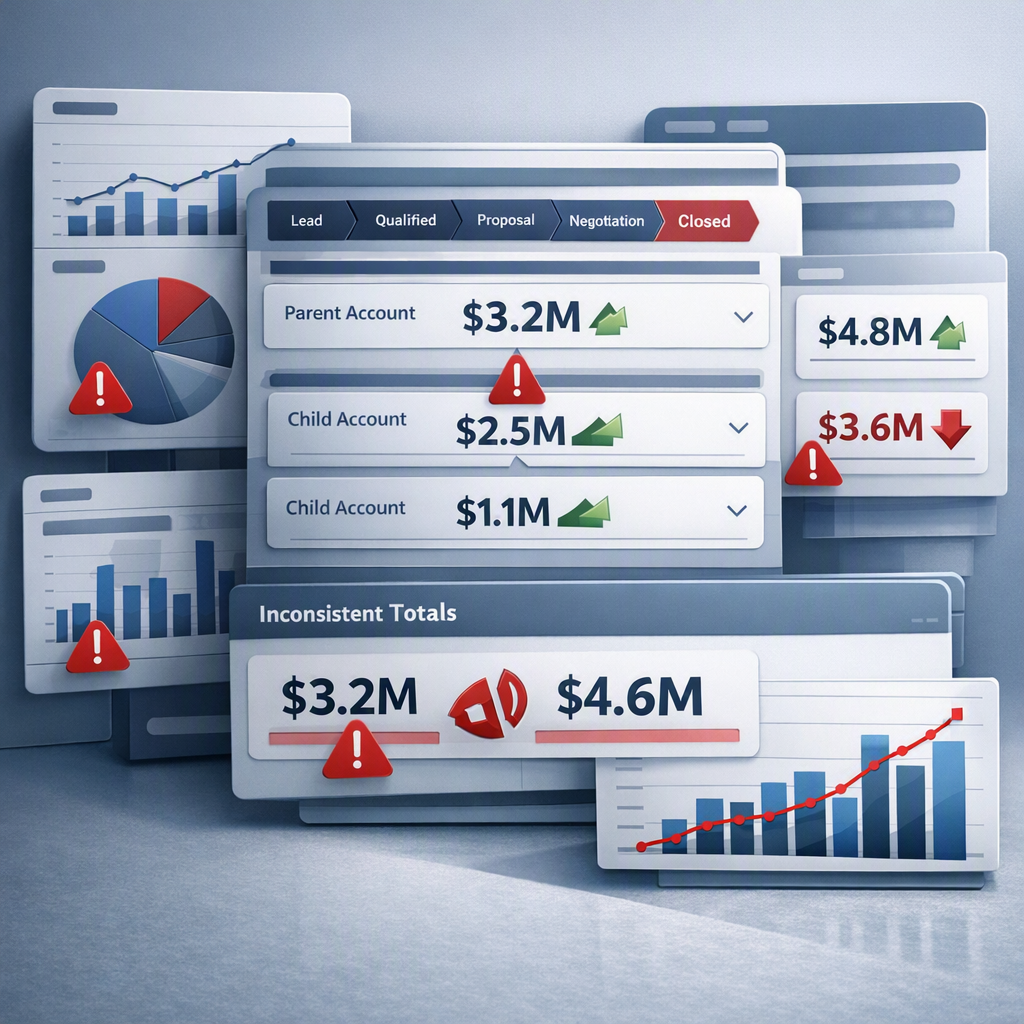
CRM pipeline rules for forecast accuracy are the standardized entry, exit, data, and activity requirements that govern how deals move through each sales stage so forecasts reflect real buyer progress, not rep optimism, incomplete records, or stalled opportunities hiding inside the pipeline.
Key Takeaways
- Forecast accuracy improves when every stage has clear exit criteria, required fields, and a dated next step.
- The biggest forecast killers are stage creep, missing close dates, weak qualification, and inactive deals that stay open too long.
- Good pipeline rules should reduce rep guesswork without creating heavy admin work.
- Automated enforcement inside a CRM works better than manager reminders alone.
- HelloGrowthCRM helps teams apply rules with AI Pipeline Management, AI Deal Insights, and Managed RevOps.
Why CRM pipeline rules matter for forecast accuracy
CRM pipeline rules matter for forecast accuracy because they define what must be true before a deal can enter, stay in, or leave a stage, which prevents inflated pipeline values, inconsistent rep judgment, and forecast calls based on opinion instead of verified buyer actions.
Most B2B teams do not have a forecasting problem first. They have a pipeline discipline problem first.
When stage definitions are loose, reps advance deals too early. When next steps are optional, deals go quiet without anyone noticing. When close dates are not enforced, quarter-end forecasts drift every week. The result is a pipeline that looks full but behaves unpredictably.
I have audited pipelines where 30% to 40% of open opportunities had no clear next meeting, no confirmed economic buyer, and no recent activity. In those situations, forecast reviews became debate sessions. Nobody trusted the CRM because the CRM was not enforcing a common standard.
That is why strong RevOps teams treat pipeline rules as operating controls, not admin tasks. In HelloGrowthCRM, these controls can sit directly inside workflows, stage requirements, alerts, and Sales Forecasting dashboards so reps do not have to remember every rule manually.
According to Harvard Business Review, sales process consistency is a major driver of performance in complex B2B selling. That principle applies directly to forecast quality.
What forecast accuracy really depends on
Forecast accuracy usually depends on four basics:
- Stage integrity
- Deal freshness
- Qualification quality
- Close date realism
If one breaks, the forecast weakens. If two break, the number is usually wrong.
Why spreadsheets and manager judgment are not enough
Managers can often spot risky deals. But they cannot inspect every field across hundreds of opportunities every day.
That is where system rules help. A CRM can check:
- whether a deal has a scheduled next step
- whether stage age exceeds a threshold
- whether MEDDPICC fields are complete
- whether close date changed multiple times
- whether activity has gone cold
If you want cleaner forecasts without more admin, use automation. HelloGrowthCRM’s AI CRM and AI Sales Copilot are built for exactly this kind of operational discipline.
Which CRM pipeline rules B2B sales teams should standardize
The CRM pipeline rules B2B sales teams should standardize are stage entry and exit criteria, required qualification fields, mandatory next steps, stage age limits, close date controls, activity freshness checks, and auto-escalation for risky deals because these rules directly improve data quality and forecast reliability.
These are the core rules I recommend for most B2B teams from seed stage through mid-market. They work especially well for teams with 5 to 50 reps. Above that, you will usually need territory-specific variants and more formal governance.
1. Stage entry and exit criteria
Every stage needs a clear definition.
For example, “Discovery Complete” should not mean “good conversation.” It should mean the rep confirmed pain, impact, timeline, and a mutually agreed next meeting. “Proposal Sent” should not mean a PDF was emailed. It should mean the proposal was reviewed with the buyer and mapped to decision criteria.
Use yes-or-no criteria. Avoid vague wording.
Good examples include:
- Budget range discussed
- Decision process confirmed
- Economic buyer identified
- Success metrics documented
- Evaluation plan agreed
2. Required qualification fields
If qualification data is optional, forecast quality will always suffer.
Require the minimum fields needed to support a confident call. For many B2B teams, that means MEDDPICC-style fields such as:
- Metrics
- Economic buyer
- Decision criteria
- Decision process
- Paper process
- Identified pain
- Champion
- Competition
In one rollout we did with a 12-person sales team, simply requiring “decision process,” “next meeting date,” and “primary pain” before Stage 2 cut forecast surprises dramatically within one quarter. The reps did not love the rule on day one. The managers loved it by month two.
3. Mandatory next step with date
This is one of the highest-impact rules.
Every open opportunity should have:
- one clear next step
- one owner
- one due date
Not “follow up next week.” Not “waiting on prospect.” Use a specific action such as “security review call on Oct 7” or “buyer to share redlines by Friday.”
HelloGrowthCRM can enforce this through Sales Task Boards, Meeting Scheduler, and Smart Inbox workflows.
4. Stage age limits
Every stage should have a maximum expected age in days.
Examples:
- Qualification: 14 days
- Discovery: 21 days
- Evaluation: 30 days
- Procurement: 21 days
If a deal exceeds the threshold, the CRM should flag it, downgrade forecast confidence, or require manager review.
When I have audited pipelines like this, over-aged deals were almost always the biggest source of hidden forecast risk. They stayed in “active” stages because nobody wanted to close them out.
5. Close date hygiene rules
Close date movement is normal. Uncontrolled close date movement is a warning sign.
Set rules such as:
- close date must align to a verified buyer event
- close date cannot move without reason code
- repeated pushes trigger manager review
- deals with no meeting in 21 days cannot stay in commit
This is where AI Deal Insights and Deal Risk Agent can help surface risk before forecast calls.
The most common pipeline rule failures that hurt forecasts
The most common pipeline rule failures that hurt forecasts are stage creep, missing next steps, weak qualification, stale activity, and unmanaged close date changes because each one allows deals to look healthier in CRM than they really are in the buying process.
Many teams know these issues exist. Fewer teams define system rules that stop them.
Stage creep
Stage creep happens when deals advance without meeting the exit criteria. This creates false pipeline coverage and false confidence.
Typical signs:
- many deals jump from discovery to proposal quickly
- stage conversion rates look uneven
- win rates collapse after later-stage entry
Missing next steps
A deal without a next step is not progressing. It is drifting.
Pipeline reviews often show “interested” buyers, but the CRM record has no meeting scheduled, no mutual action plan, and no owner for the next move. That should lower forecast confidence immediately.
Weak qualification
A late-stage deal without verified pain, buying process, or decision team is not truly late stage.
Gartner notes that B2B buying is more complex and involves more stakeholders, which makes disciplined qualification even more important in modern sales environments. See Gartner’s CRM and sales research hub at gartner.com/en/sales/topics/crm.
Stale activity
If there has been no real activity for 14, 21, or 30 days, depending on stage, forecast confidence should drop.
A CRM should not treat old deals as active just because they remain open.
Unmanaged close date changes
Every push tells a story. Good pipeline rules make that story visible.
Use reason codes like:
- buyer timeline changed
- technical validation delayed
- legal review pending
- budget approval slipped
- no response from champion
These reasons help RevOps distinguish normal movement from weak deals.
Manual enforcement vs automated enforcement in CRM
Manual enforcement versus automated enforcement in CRM is not a close contest for forecast accuracy because manager reminders are inconsistent at scale, while automated rules apply the same standards to every deal, every rep, and every forecast period without relying on memory.
That does not mean managers become less important. It means managers spend time coaching exceptions instead of policing basics.
Comparison table: manual vs automated pipeline enforcement
| Area | Manual enforcement | Automated CRM enforcement |
|---|---|---|
| Stage compliance | Checked during reviews | Checked in real time before stage change |
| Required fields | Often missed | Blocks advancement until complete |
| Next step tracking | Depends on rep habits | Auto-reminders and overdue alerts |
| Close date hygiene | Reviewed weekly | Reason codes and push tracking enforced instantly |
| Forecast confidence | Subjective | Based on rule-backed signals |
| Manager workload | High | Lower and more focused |
| Scalability | Weak beyond small teams | Strong across growing teams |
Where automation helps most
Automation works best in repeat checks that humans skip under pressure:
- validating required fields
- flagging stage age breaches
- reminding reps about overdue next steps
- escalating stalled commit deals
- updating forecast categories based on risk signals
HelloGrowthCRM supports this with Email Automation, AI Lead Scoring, and Revenue Attribution so teams can connect pipeline hygiene to actual revenue outcomes.
According to official Salesforce research, high-performing sales teams are more likely to use AI and automation to improve efficiency and decision-making. That same operating discipline helps forecasting.
How to set CRM pipeline rules for forecast accuracy: Step-by-Step
To set CRM pipeline rules for forecast accuracy, define your sales stages around buyer milestones, make key fields required, enforce dated next steps, set stage age thresholds, automate alerts and escalations, and review rule performance monthly so the system stays strict enough to improve forecasts without slowing reps down.
- Map buyer milestones
Define each stage by what the buyer has done, not what the rep feels. Use observable events like stakeholder meeting completed, proposal reviewed, or security review started. - Set exit criteria for every stage
Write 3 to 5 yes-or-no conditions for stage advancement. Keep them simple enough that managers and reps interpret them the same way. - Choose required forecast fields
Require only the fields that improve decisions. Start with next step, next step date, close date, amount, decision process, and identified pain. - Add stage age thresholds
Set expected days-in-stage limits based on historical conversion and sales cycle data. If you do not have clean history, start with manager estimates and refine later. - Create automation and alerts
Use workflows to block stage movement, send reminders, trigger Slack alerts, or request manager approval. HelloGrowthCRM can connect those actions through Slack, Gmail, and All Integrations. - Define forecast category rules
Build clear logic for pipeline, best case, commit, and closed. For example, commit may require a confirmed decision process and a meeting inside the last 14 days. - Review exceptions weekly
Managers should coach deals that fail rules instead of editing records for reps. This keeps accountability where it belongs. - Audit results monthly
Check forecast variance, stage conversion, push rates, and stale deal volume. Use those findings to tighten or relax rules.
A simple governance model that works
For most B2B teams, assign ownership like this:
- RevOps owns rules and reporting
- Sales leaders approve stage definitions
- Managers coach compliance
- Reps maintain deal quality
- CRM automation handles enforcement
If you do not have in-house RevOps, Managed RevOps is often the fastest way to get this live without a long internal project.
How HelloGrowthCRM improves pipeline discipline without adding admin overhead
HelloGrowthCRM improves pipeline discipline without adding admin overhead by combining required-field enforcement, workflow automation, AI-driven deal risk detection, and RevOps support so reps do less manual updating while leaders get cleaner stage movement, fresher next steps, and more trustworthy forecasts.
This is the key point buyers care about. Rules fail when they feel like extra admin.
HelloGrowthCRM is our product, so that is a fair limitation to state clearly. We are not a neutral reviewer. But this is also where our product is built for practical B2B pipeline control, not just contact storage.
What this looks like in practice
With HelloGrowthCRM, teams can:
- enforce stage-specific required fields in the CRM
- trigger reminders for missing next steps
- flag over-aged opportunities
- route risky deals to managers
- use AI Pipeline Management to spot bottlenecks
- use Sales Forecasting to compare forecast categories against live deal quality
- use Free Trial or book a Demo to test workflows quickly
In one implementation, we helped a mid-market SaaS team standardize stage exits, close date reasons, and next-step rules in under three weeks. The biggest win was not reporting. It was fewer arguments in forecast calls because everyone trusted the definitions.
When managed support makes sense
Managed support is useful when:
- your CRM has low adoption
- your stages are inconsistent across teams
- managers spend too much time cleaning data
- forecast calls rely on rep judgment alone
- you need faster setup than internal ops can handle
That is exactly where HelloGrowthCRM’s Managed RevOps team can help. If you want to quantify likely impact before making changes, the Pipeline Health Score and CRM ROI Calculator are good starting points.
If your team needs more accurate forecasts, start by tightening the rules that govern stage movement, next steps, and close dates. Then put those rules into the CRM so they run consistently. HelloGrowthCRM gives B2B teams the automation, AI, and RevOps support to do that without piling more admin onto reps. Explore Features, review Pricing, or start a Free Trial to see it in action.
About the author
Rohan Mehta is a Sales Operations Lead at HelloGrowthCRM with 10 years of experience in B2B SaaS revenue operations, forecasting, and CRM design. He has led pipeline governance and forecast improvement projects for growing sales teams across SaaS and services businesses. One project that shaped this article was a multi-quarter CRM cleanup for a 12-person account executive team where stage rules, MEDDPICC fields, and next-step enforcement were rebuilt to improve forecast discipline. He writes from hands-on experience implementing the workflows described here.
Frequently Asked Questions
Q: What are CRM pipeline rules for forecast accuracy?
A: CRM pipeline rules for forecast accuracy are the standards that control how deals move through stages and what data must be present so forecasts reflect verified buyer progress instead of rep opinion. Common rules include required fields, dated next steps, stage age limits, and close date controls.
Q: Which pipeline rule has the biggest impact on forecast accuracy?
A: The pipeline rule with the biggest impact on forecast accuracy is usually requiring a clear next step with an owner and due date on every open deal. If a deal has no scheduled movement, it should not carry the same forecast confidence as an active opportunity.
Q: How many required fields should a B2B sales team enforce?
Frequently Asked Questions
Ready to put this into practice?
Set up your pipeline, WhatsApp follow-ups, and AI lead scoring in minutes — free, no credit card.
Try HelloGrowthCRM freeGet CRM tips in your inbox
Join thousands of sales professionals who get weekly insights on CRM strategy, AI automation, and pipeline optimization.

The HelloGrowthCRM team publishes guides on CRM strategy, AI sales tools, and revenue operations for small business sales teams.