HelloGrowthCRM software
Built for real small-business sales teams
HelloGrowthCRM helps reps qualify faster, follow up on time, and close more deals—with practical automation in one place.
- AI lead scoring and pipeline visibility
- Built-in dialer, WhatsApp, and email automation
- Sales forecasting and RevOps-ready reporting
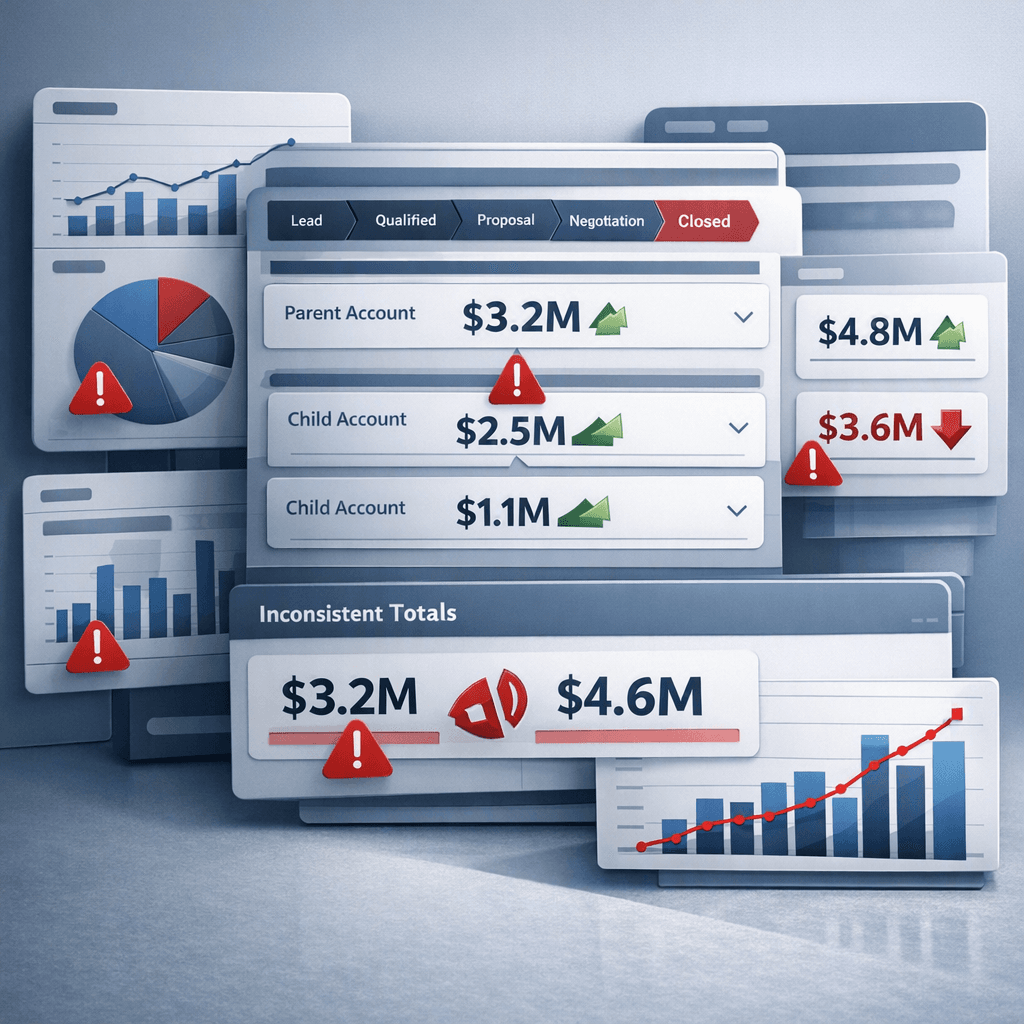
CRM forecast rollup errors are mistakes in how a CRM aggregates pipeline data across deals, stages, owners, and periods, causing forecast totals to look precise while hiding duplicated opportunities, wrong close dates, inconsistent probabilities, and missing activity signals that make B2B revenue planning unreliable.
Key Takeaways
- CRM rollup errors usually start with bad opportunity hygiene, not bad math.
- Duplicate deals, stale close dates, and custom stage rules can distort forecast views fast.
- Forecast accuracy improves when stage definitions, probability logic, and manager inspection rules are standardized.
- AI-driven data hygiene helps catch missing next steps, inactive deals, and unusual pipeline movements earlier.
- HelloGrowthCRM combines workflow rules, AI insights, and managed RevOps support to make forecast views more reliable.
Why do CRM forecast rollup errors happen?
CRM forecast rollup errors happen because pipeline totals depend on many small fields being correct at the same time, including opportunity ownership, amount, stage, probability, close date, and activity status. When those inputs are inconsistent or outdated, the rollup multiplies the problem across team forecasts, manager calls, and board reporting.
Most revenue leaders do not lose trust in forecasting because one formula breaks. They lose trust because many small process gaps stack up. A deal gets cloned. Another keeps last quarter’s close date. A manager uses commit rules differently from another region. The CRM then rolls all of it into one number.
In practice, forecast rollups fail in three layers:
- Record quality: duplicate opportunities, missing fields, wrong owners, stale amounts
- Process quality: inconsistent stage exits, weak qualification, no next-step discipline
- Aggregation quality: wrong probability rules, bad hierarchy mapping, mixed forecast categories
When I have audited pipelines like this, the top issue is rarely reporting logic alone. It is usually that the sales process and CRM rules drift apart over time. The rollup then reflects political optimism, not execution reality.
This is why teams evaluating an AI CRM should look past dashboards and ask how the system keeps forecast inputs clean every day.
Forecast rollups only work when field governance is strict
A rollup can only be as accurate as the fields it pulls from. If “close date” means “best case” for one rep and “contract sent” for another, the forecast is already broken.
Strong governance usually includes:
- Required fields at stage entry and exit
- Locked probability bands by stage
- Controlled deal owner changes
- Standardized forecast categories
- Validation on amount, term, and expected start date
What are the most common CRM forecast rollup errors?
The most common CRM forecast rollup errors are duplicate opportunities, inconsistent stage probabilities, stale close dates, missing next steps, wrong owner or territory mapping, and unclosed lost deals that remain in the pipeline. Each error inflates or deflates forecast totals in ways managers often miss until late in the quarter.
Below are the mistakes I see most often in B2B sales teams.
1. Duplicate opportunities
Duplicates create double counting. They often happen after handoffs, imports, SDR-to-AE conversion, or integration sync issues. One version may be active while another sits in the same forecast period.
In one rollout we did with a 12-person sales team, duplicate opportunities inflated late-stage pipeline by enough that managers thought coverage was healthy. Once deduped, commit coverage looked much thinner, and hiring and pipeline generation plans had to change.
2. Inconsistent stage probability rules
If one stage is set to 50% in one business unit and 70% in another, weighted forecasts become hard to compare. The issue gets worse when managers override probabilities without a shared rulebook.
That is where AI Pipeline Management and standardized admin controls matter. They keep stage logic aligned to real process exits, not rep opinion.
3. Stale close dates
Stale close dates are one of the fastest ways to break forecast trust. Reps often push deals quietly, or leave dates unchanged to avoid scrutiny. The deal stays in quarter, but actual buyer movement has stopped.
4. Missing next-step data
A deal with no scheduled meeting, no promised buyer action, and no recent activity should not carry the same forecast weight as an active deal. Yet many CRMs still roll both up the same way unless rules are added.
5. Wrong owner, team, or territory mapping
If a deal sits under the wrong manager or region, rollups by segment become misleading. This affects not just forecast totals, but also coaching, compensation, and planning. Territory Management matters here more than most teams realize.
6. Closed-lost leakage
Some teams never clean out dead deals. Others leave them open in “proposal” or “decision” for months. That creates fake pipeline and makes stage conversion rates look better than they are.
How do these errors distort B2B pipeline accuracy?
CRM forecast rollup errors distort B2B pipeline accuracy by overstating coverage, hiding risk concentration, misclassifying deal confidence, and delaying corrective action. Leaders then make hiring, spend, and target decisions from numbers that look complete but do not reflect actual buyer movement or seller execution.
The distortion usually shows up in four places.
Coverage looks healthy when pipeline quality is weak
A team may show 3x pipeline coverage on paper. But if part of that number is duplicate, stalled, or mis-staged, true coverage is much lower.
Weighted forecast looks scientific but is still wrong
Weighted forecasts can create false confidence. They look precise because probabilities are applied mathematically. But if the stage criteria are weak, the output is still weak.
Gartner notes that CRM technology is foundational to sales execution, but the value depends on adoption, process discipline, and data quality. That is exactly why rollup design matters.
Manager inspection happens too late
When next-step data and activity signals are missing, managers spot deal risk only in weekly calls or end-of-month reviews. By then, course correction is limited.
Conversion metrics become misleading
If dead deals stay open or stages are skipped, stage-to-stage conversion rates stop reflecting buyer reality. That breaks forecasting models and rep coaching.
Which pipeline fields matter most for accurate rollups?
The pipeline fields that matter most for accurate rollups are opportunity amount, close date, stage, forecast category, probability, owner, account linkage, next step, last activity date, and loss reason. These fields drive both forecast totals and the manager’s ability to judge whether a deal is real, current, and coachable.
If you only govern three fields, govern these first:
| Field | Why it matters | Common error | Forecast impact |
|---|---|---|---|
| Close date | Places revenue in the right period | Date never updated | Inflates current quarter |
| Stage | Drives pipeline grouping and probabilities | Stage set by gut feel | Misstates weighted forecast |
| Amount | Sets forecast value | Old quote or wrong term | Overstates revenue |
You should also inspect supporting fields:
| Supporting field | What it signals | Hygiene rule |
|---|---|---|
| Next step | Buyer momentum | Required for late stages |
| Last activity date | Recency | Alert after inactivity threshold |
| Forecast category | Rep confidence | Standard definitions only |
| Owner/territory | Reporting hierarchy | Sync with team rules |
| Primary contact | Deal validity | Require before proposal stage |
In HelloGrowthCRM, admins can combine field rules with Sales Task Boards, Meeting Scheduler, and Smart Inbox so managers are not relying on manual rep memory alone.
What are the warning signs your CRM rollup is broken?
The warning signs your CRM rollup is broken are repeated quarter-end surprises, large gap between weighted and actual bookings, too many old deals in late stages, forecast changes after inspection calls, and managers keeping private spreadsheets because they do not trust the CRM view.
If any of these sound familiar, you likely have a rollup problem:
- Forecast accuracy swings wildly by manager
- Commit deals have no scheduled next meeting
- Pipeline grows, but win rates do not
- Reps move close dates in bulk near month-end
- Stage age is high in proposal, legal, or procurement
- Finance and sales report different quarter views
A widely cited Harvard Business Review sales research collection has long emphasized that pipeline visibility alone does not equal forecast quality unless inspection habits and qualification discipline are strong; that remains true in modern CRM environments (HBR sales topic archive).
When I review these cases, I ask one simple question first: “What must be true for a deal to stay in commit?” If the answer changes by manager, the forecast is not standardized.
Private spreadsheets are a major red flag
The moment managers keep side spreadsheets, the CRM has lost authority. That creates two systems of truth, and both get worse over time.
How does HelloGrowthCRM reduce forecast rollup errors?
HelloGrowthCRM reduces forecast rollup errors by standardizing pipeline rules, automating field validation, surfacing deal risk signals, and giving RevOps teams managed support to maintain clean forecast logic over time. The result is a forecast view based on current execution data instead of manual cleanup before every review.
This is where a managed platform has an edge over a dashboard-only setup.
Standardized pipeline rules
HelloGrowthCRM lets teams align stage criteria, required fields, and forecast categories inside one operating model. That is stronger than asking reps to remember rules from a slide deck.
Features like AI Deal Insights and AI Lead Scoring help managers distinguish active buying signals from rep optimism.
Automated data hygiene
The system can flag:
- Missing next steps
- Unusual inactivity
- Close date slippage
- Stage jumps without required evidence
- Duplicate records from imports or syncs
That is more useful than just showing a red dashboard metric after the fact. Teams can also connect Slack, Gmail, and Calendly to improve activity capture.
Managed RevOps support
For many B2B teams, the hardest part is not setting up a forecast once. It is maintaining discipline as the team grows. Managed RevOps helps by tuning stage rules, audit checks, inspection cadences, and reporting logic as your process evolves.
This matters most for teams under 50 reps that need enterprise-grade process discipline without a large internal RevOps bench. Above that size, expect more complex regional logic and approval layers.
Nucleus Research found that CRM pays back significantly when adoption and process execution are strong, with an average return of $8.71 for every dollar spent according to its long-cited benchmark (Nucleus Research CRM ROI infographic).
How to fix CRM forecast rollup errors: Step-by-Step
Fixing CRM forecast rollup errors means cleaning core opportunity fields, standardizing stage and forecast rules, adding inspection triggers, and automating hygiene checks so bad data is caught before leadership reviews. The best results come from combining process discipline, CRM configuration, and continuous RevOps ownership.
- Audit core fields
Review amount, close date, owner, stage, probability, forecast category, and account linkage. Measure completeness and variance by team, not just overall. - Deduplicate active opportunities
Create matching rules by account, contact, amount range, and expected close window. Merge or close stale duplicates before changing forecast logic. - Define stage exit criteria
Tie each stage to specific buyer evidence. Use frameworks like MEDDPICC where helpful, especially for qualification and decision process clarity. - Lock probability logic
Set standard probability ranges by stage or forecast category. Avoid rep-level overrides unless managers approve them with a documented reason. - Require next-step hygiene
Make next step, next meeting, and primary contact required from mid-funnel onward. Late-stage deals without buyer action should trigger risk flags. - Add inactivity and slippage alerts
Use AI Sales Copilot or workflow rules to flag no-activity windows, pushed close dates, and stalled approvals before forecast calls. - Separate pipeline from forecast
Not every open opportunity belongs in commit or best case. Build clear category definitions for pipeline review, forecast call, and board reporting. - Inspect by stage age and movement
Add reports for stage age in days, close-date push count, and last meaningful activity. Teams can benchmark this with the Pipeline Health Score. - Review manager variance monthly
Compare forecast accuracy by manager and segment. Large differences often reveal coaching gaps or inconsistent rule enforcement. - Operationalize ongoing ownership
Forecast hygiene decays unless someone owns it. Use internal RevOps or a partner model, and revisit rules quarterly as your process changes.
If you want to quantify the upside before changing systems, the CRM ROI Calculator and RevOps Maturity Assessment are useful starting points.
Should you fix rollup errors in-house or use a managed CRM approach?
Whether you should fix rollup errors in-house or use a managed CRM approach depends on your team size, admin depth, and process maturity. In-house fixes work when ownership is clear and governance is strong, while a managed approach helps faster when data hygiene and forecast discipline already drift across teams.
Here is a practical comparison. HelloGrowthCRM is our product, so this comparison reflects that disclosure.
| Approach | Best for | Pros | Limits |
|---|---|---|---|
| In-house CRM cleanup | Teams with strong RevOps/admin resources | Lower external cost, full internal control | Slower rollout, easier to lose discipline |
| Managed CRM approach | Teams needing fast standardization | Faster governance, ongoing hygiene, expert support | Requires process buy-in from sales leaders |
| Hybrid model | Mid-market teams scaling quickly | Internal ownership with expert backup | Needs clear role split |
In my experience, in-house cleanup often starts strong, then slips after one or two quarters. Forecast quality is not a one-time project. It is an operating rhythm.
If your managers still patch reports manually, it may be time to look at Features, review Pricing, or book a Demo to see how HelloGrowthCRM handles forecast hygiene in live workflows.
Accurate forecasting starts with reliable rollups. If your team is fighting duplicate deals, stale close dates, and low-trust reports, HelloGrowthCRM can help you standardize pipeline rules, automate data hygiene, and build forecast views leaders can actually use. Start with a Free Trial or book a Demo to see it in action.
About the author
Arjun Mehta is a Sales Operations Lead at HelloGrowthCRM with 11 years of experience in B2B SaaS revenue operations, CRM administration, and pipeline governance. He has led forecasting redesigns for global sales teams ranging from 8 to 120 reps. One project that informed this article was a multi-region CRM cleanup where his team rebuilt stage criteria, deduplication rules, and manager forecast cadences after quarterly commit accuracy fell below plan.
Frequently Asked Questions
Q: What are CRM forecast rollup errors?
A: CRM forecast rollup errors are mistakes in how opportunity data is aggregated into forecast totals, which leads to inaccurate pipeline and revenue views. They usually come from duplicate deals, bad stage logic, stale close dates, or missing activity and next-step data.
Q: Why do duplicate opportunities hurt forecast accuracy?
A: Duplicate opportunities hurt forecast accuracy because they count the same revenue more than once in pipeline and forecast views. They also confuse ownership, activity history, and manager inspection, which makes deal risk harder to judge.
Q: How do inconsistent stage probabilities affect weighted forecasts?
Frequently Asked Questions
Ready to put this into practice?
Set up your pipeline, WhatsApp follow-ups, and AI lead scoring in minutes — free, no credit card.
Try HelloGrowthCRM freeGet CRM tips in your inbox
Join thousands of sales professionals who get weekly insights on CRM strategy, AI automation, and pipeline optimization.

The HelloGrowthCRM team publishes guides on CRM strategy, AI sales tools, and revenue operations for small business sales teams.