HelloGrowthCRM software
Built for real small-business sales teams
HelloGrowthCRM helps reps qualify faster, follow up on time, and close more deals—with practical automation in one place.
- AI lead scoring and pipeline visibility
- Built-in dialer, WhatsApp, and email automation
- Sales forecasting and RevOps-ready reporting
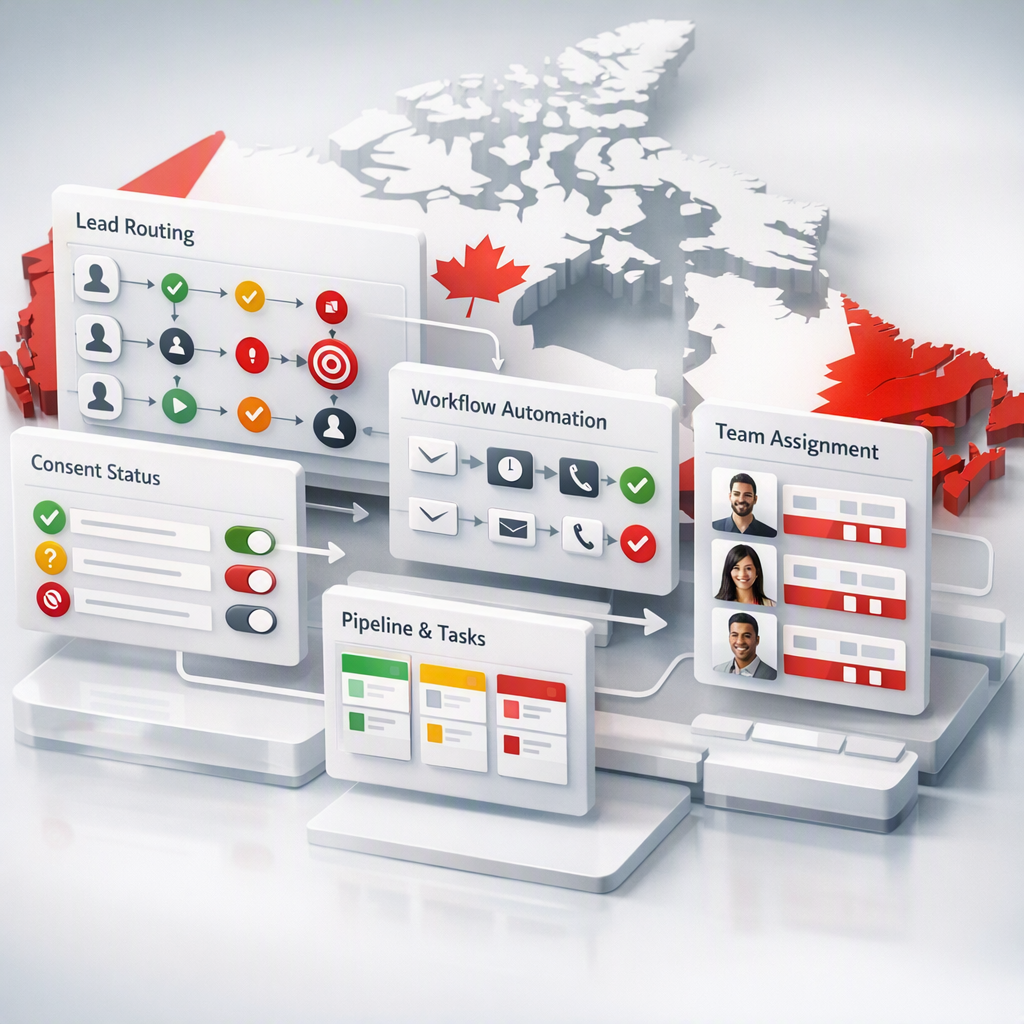
CASL-compliant AI follow-up workflows in Canada are automated sales and customer messaging sequences that use consent-aware triggers, privacy-safe data handling, and bilingual outreach rules to help Canadian SMBs follow up faster in HelloGrowthCRM while reducing risk under CASL, PIPEDA, and Quebec Law 25.
Key Takeaways
- Canadian SMBs need AI follow-up workflows that track express and implied consent, not just lead status.
- HelloGrowthCRM can combine AI CRM, Email Automation, and Smart Inbox to automate outreach without losing compliance control.
- QuickBooks Online integration helps keep customer, invoice, and account context aligned in CAD for better sales and finance handoffs.
- Teams in Toronto, Montreal, and Vancouver should build separate rules for EN/FR messaging, unsubscribe handling, and province-specific privacy expectations.
- The safest workflow design uses consent capture, clear suppression logic, human review for edge cases, and auditable records.
- CASL compliance is not only a legal issue. It also improves deliverability, reply rates, and buyer trust.
Why CASL-compliant AI follow-up workflows matter for Canadian SMBs
CASL-compliant AI follow-up workflows matter for Canadian SMBs because they let teams automate lead response and customer outreach without treating compliance as an afterthought, which lowers legal risk, protects sender reputation, and creates cleaner handoffs between marketing, sales, support, and finance inside HelloGrowthCRM.
For most SMBs, the risk does not come from sending one bad email. It comes from building automation that ignores consent, keeps poor records, or messages the wrong contact after an opt-out.
In Canada, three rules shape workflow design:
- Canada's Anti-Spam Legislation (CASL) governs commercial electronic messages, consent, and unsubscribe requirements
- PIPEDA sets the baseline for private-sector personal information handling
- Quebec's Law 25 adds stronger privacy expectations for organizations handling Quebec residents' data
If you run a Toronto B2B services team, a Montreal SaaS company, or a Vancouver wholesaler, your workflow cannot just ask, "Did a lead fill out a form?" It must also ask:
- What consent type do we have?
- When was it captured?
- What message types are allowed?
- What language should we use?
- When should AI suggest a message instead of sending one automatically?
In practice, that is where AI Lead Scoring, AI Sales Copilot, and Sales Task Boards become more useful than generic drip tools. They help teams act on intent while keeping human review where risk is higher.
What CASL, PIPEDA, and Quebec Law 25 mean for AI follow-up workflows
CASL, PIPEDA, and Quebec Law 25 mean AI follow-up workflows must do more than send messages on time; they must prove consent, limit data use, respect unsubscribe requests, and handle personal information in ways that are reasonable, documented, and appropriate for each contact’s province and communication context.
A compliant workflow starts with data structure. In HelloGrowthCRM, that means creating fields and rules for:
- Consent type: express, implied, withdrawn, unknown
- Consent source: web form, event, referral, contract, inbound inquiry
- Consent timestamp
- Consent language preference: English, French, bilingual
- Province
- Message channel: email, SMS, WhatsApp, phone
- Unsubscribe status by channel
CASL rules that shape automation
CASL is especially important if your workflow sends outbound commercial electronic messages. A simple nurture sequence can become risky if it sends promotional follow-ups without valid consent or a working unsubscribe path.
A practical CASL-safe checklist includes:
- Clear sender identification
- Message purpose tied to business context
- Valid consent before automated promotional follow-up
- Easy unsubscribe in each applicable channel
- Fast suppression after opt-out
I have audited pipelines where the biggest gap was not messaging copy. It was missing consent timestamps after list imports from trade shows and old spreadsheets. Once that data is gone, your compliance position gets much weaker.
Privacy rules that shape AI usage
PIPEDA and Quebec Law 25 push teams to be careful with what AI can access and what it should generate. If AI drafts follow-ups using notes, billing details, or support issues, your workflow should avoid pulling more personal or financial data than needed.
That is one reason many Canadian SMBs benefit from connecting QuickBooks in a narrow, controlled way. Sales may need account status, open invoice flags, or customer tier. They usually do not need every finance field exposed to every rep.
What a compliant workflow looks like inside HelloGrowthCRM
A compliant workflow inside HelloGrowthCRM uses consent as a core trigger, not a side note, so every follow-up decision checks legal basis, contact status, language preference, channel permission, and account context before AI drafts or sends a message.
The design principle is simple: automate decisions that are rules-based, and escalate decisions that are ambiguous.
Here is a practical view for Canadian SMBs:
| Workflow element | Non-compliant approach | CASL-compliant approach in HelloGrowthCRM |
|---|---|---|
| Lead capture | Form only stores email | Form stores email, consent checkbox, timestamp, source, language |
| AI follow-up trigger | Any new lead enters sequence | Only leads with valid consent or approved implied-consent use case enter |
| Messaging language | English default for all | EN/FR by preference, geography, or rep assignment |
| Unsubscribe handling | Manual cleanup | Automatic suppression across Email Automation and inbox rules |
| Finance context | Sales works from stale notes | QuickBooks sync updates account context in CRM |
| Risk review | AI sends all follow-ups | Higher-risk contacts route to Sales Task Boards for rep review |
The best use cases for SMBs under 50 reps
This setup works best for teams under 50 reps. Above that, expect more complex approval flows, regional data rules, and admin controls.
Strong SMB use cases include:
- Inbound demo request follow-up
- Quote follow-up after proposal send
- Renewal reminders with account owner review
- Re-engagement of opted-in dormant leads
- Collections-adjacent account communication that excludes promotional content
In one rollout we did with a 12-person sales team, the fastest win came from splitting workflows into three lanes: marketing nurture, sales follow-up, and account communication tied to billing status. That reduced accidental cross-over messages and made unsubscribe logic much easier to manage.
How QuickBooks Online and HelloGrowthCRM work together for safer follow-up
QuickBooks Online and HelloGrowthCRM work together for safer follow-up by syncing customer and financial context into sales workflows, which helps teams send more relevant messages, avoid embarrassing outreach to overdue or inactive accounts, and keep quotes, renewals, and account notes aligned in CAD.
This matters because sales teams often follow up without knowing the latest account status. A rep in Vancouver might chase an expansion call while finance already sees a disputed invoice. A Montreal team may need French outreach for an active Quebec account. A Toronto agency may need to stop promotional follow-up once a customer enters a billing issue.
With QuickBooks connected to HelloGrowthCRM, you can use customer data to support safer automation, such as:
- Customer active status
- Last invoice date
- Open invoice amount in CAD
- Payment delay flag
- Customer segment or service line
What data should sync, and what should not
You do not need a full finance mirror in your CRM. Keep the sync narrow.
Good fields to sync into CRM workflows:
- Customer ID
- Company name
- Billing status
- Last payment date
- Total outstanding in CAD
- Subscription or service category
Fields to restrict or review carefully:
- Bank details
- Full invoice line-item history for all users
- Sensitive payment notes
- Internal finance comments
This is also where Revenue Attribution and Sales Forecasting help. They let leaders tie follow-up activity to revenue outcomes without exposing unnecessary finance detail in every workflow.
How to build CASL-compliant AI follow-up workflows in HelloGrowthCRM: Step-by-Step
Building CASL-compliant AI follow-up workflows in HelloGrowthCRM means mapping consent, channels, language, and account context before you automate, then layering AI drafting, scoring, and routing rules so the system speeds up follow-up while preserving audit trails, opt-out handling, and finance-to-sales alignment.
- Define your consent model
Create fields for consent type, source, timestamp, expiry logic, and channel permissions. If you have old imports, do not assume consent. Mark uncertain records for review. - Set lead capture rules
Connect forms, chat, and inbound sources to AI CRM. Store language preference and province on first touch when possible. This helps EN/FR routing and Quebec-specific handling. - Create suppression logic first
Build rules for unsubscribed contacts, unknown consent, bounced addresses, and restricted channels. I always set suppression before writing a single nurture email. - Connect QuickBooks Online
Sync only the account fields sales needs. Use All Integrations if you also need tools like Gmail, Slack, or Calendly. - Score and segment leads
Use AI Lead Scoring to rank inbound leads by fit and intent. Separate prospects, customers, overdue accounts, and partner contacts so each gets the right workflow. - Build channel-specific sequences
Use Email Automation for consented email follow-up. Use WhatsApp & SMS CRM only where permission is clear and documented. - Add AI drafting with review thresholds
Let AI Sales Copilot draft messages based on stage, persona, and account context. Route higher-risk cases, such as Quebec accounts or billing disputes, to human review. - Set bilingual templates
Create English and French versions for common follow-ups. If a contact’s preference is unknown, assign a task instead of auto-sending. - Log every action
Keep an audit trail for consent updates, unsubscribe events, sequence entries, and rep overrides. This is essential if a contact questions why they received a message. - Test with a small team first
Start with one inbound flow and one customer follow-up flow. Use the Free Trial or book a Demo before scaling to your full funnel.
Message design rules for Toronto, Montreal, and Vancouver teams
Message design rules for Toronto, Montreal, and Vancouver teams should reflect local buyer expectations, bilingual needs, and channel norms, because compliant automation is not just about legal text; it is also about sending the right message in the right language and context.
Toronto
Toronto teams often run high-volume inbound and outbound motions. Keep message timing tight, but avoid over-automation. For demo and quote follow-up, use AI to draft and score, then let reps approve edge cases.
Useful setup:
- English-first templates
- Separate sequences for net-new leads and active customers
- Meeting Scheduler links in nurture messages
- CRM ROI Calculator or quote follow-up content for consultative sales
Montreal
Montreal teams need stronger EN/FR discipline. If your team serves Quebec accounts, language preference should be a required field. Law 25 also raises the stakes on privacy governance and documented handling.
Use:
- French templates for Quebec-first segments
- Human review when language preference is missing
- Controlled AI prompts that avoid unnecessary personal detail
- Clear internal ownership between sales and customer success
Vancouver
Vancouver SMBs often blend inbound, partnerships, and service-led sales. Finance context matters because account status can change quickly across project-based work.
Use:
- QuickBooks-driven account flags
- Renewal and upsell sequences tied to customer health
- Customer Health Score for post-sale follow-up
- Proposal Builder and invoice-aware sales tasks
One global benchmark is worth noting. According to Gartner, 80% of B2B sales interactions between suppliers and buyers will occur in digital channels by 2025. That makes compliant automation a revenue system issue, not just a marketing checkbox.
Common mistakes that create compliance risk
Common mistakes that create compliance risk include importing old lists without proof of consent, auto-sending promotional messages from every inbound trigger, exposing too much finance data to sales workflows, and failing to maintain bilingual, channel-specific suppression rules inside the CRM.
The most common problems I see are operational, not legal theory:
- No consent date on imported contacts
- One unsubscribe field shared across all channels
- AI prompts that pull billing notes into sales outreach
- No distinction between customer notices and promotional messages
- English-only templates sent to Quebec buyers
- Manual list exports that bypass CRM suppression
A safer operating model
When I have audited pipelines like this, the best fix was usually not more software. It was better workflow governance:
- One source of truth in CRM
- Named owner for consent operations
- Monthly suppression audit
- Quarterly template review
- Restricted role permissions for finance-linked fields
If you need extra help, HelloGrowthCRM's Managed RevOps team can help map compliant lifecycle stages, field governance, and automation review.
If your Canadian team wants faster follow-up without adding CASL or privacy risk, HelloGrowthCRM gives you one place to manage consent-aware automation, bilingual outreach, AI drafting, and QuickBooks Online context. Explore the Features, review Pricing, or start a Free Trial to build compliant AI workflows in CAD for your Toronto, Montreal, or Vancouver team.
About the author
Jordan McLean is a Revenue Operations Lead at HelloGrowthCRM with 11 years of experience in B2B SaaS sales systems, CRM architecture, and lifecycle automation. He has led CRM and automation rollouts for Canadian SMBs across software, agencies, and professional services. One project that shaped this article was a consent-and-finance workflow redesign for a 12-person Ontario sales team using QuickBooks Online and bilingual nurture paths. HelloGrowthCRM is the product discussed in this article, and the recommendations here reflect both hands-on implementation work and the platform's capabilities.
Frequently Asked Questions
Q: What is a CASL-compliant AI follow-up workflow in Canada?
A: A CASL-compliant AI follow-up workflow in Canada is an automated messaging process that checks consent, sender identity, unsubscribe status, and message context before sending commercial follow-ups. In practice, it should also keep auditable records and apply channel-specific suppression rules.
Q: Can I use AI to send follow-up emails under CASL?
A: Yes, you can use AI to send follow-up emails under CASL if the workflow respects consent, identification, and unsubscribe requirements. The main risk is not the AI itself. The risk is automating messages without valid rules and records.
Q: Does QuickBooks Online help with CASL compliance?
A: QuickBooks Online helps with CASL compliance indirectly by giving sales workflows accurate customer context that can prevent inappropriate outreach. It does not replace consent management, but it does reduce messaging mistakes tied to stale account data.
Q: How should Quebec businesses handle AI follow-up differently?
A: Quebec businesses should handle AI follow-up with stronger privacy controls, better language preference tracking, and clearer documentation for personal data use. French templates, consent records, and restricted data access are especially important under Quebec Law 25 expectations.
Q: Is implied consent enough for automated sales follow-up?
A: Implied consent can be enough for some automated sales follow-up, but it depends on the relationship and message context. Because implied consent is narrower and more time-sensitive, many SMBs choose stricter rules and more human review for safety.
Q: What fields should I track in HelloGrowthCRM for compliance?
A: You should track consent type, consent source, timestamp, language preference, province, channel permissions, and unsubscribe status in HelloGrowthCRM for compliance. Those fields let workflows make safe send-or-stop decisions before AI drafts or sends messages.
Q: Should AI fully automate follow-up for every lead?
Frequently Asked Questions
Ready to put this into practice?
Set up your pipeline, WhatsApp follow-ups, and AI lead scoring in minutes — free, no credit card.
Try HelloGrowthCRM freeGet CRM tips in your inbox
Join thousands of sales professionals who get weekly insights on CRM strategy, AI automation, and pipeline optimization.

The HelloGrowthCRM team publishes guides on CRM strategy, AI sales tools, and revenue operations for small business sales teams.