HelloGrowthCRM software
Built for real small-business sales teams
HelloGrowthCRM helps reps qualify faster, follow up on time, and close more deals—with practical automation in one place.
- AI lead scoring and pipeline visibility
- Built-in dialer, WhatsApp, and email automation
- Sales forecasting and RevOps-ready reporting
A CRM forecasting setup for Indian B2B sales teams is a sales system that captures leads from IndiaMART, JustDial, and WhatsApp, enforces stage and probability rules, and combines pipeline, payment, and accounting data so leaders can predict revenue by rep, territory, and month with fewer surprises.
Key Takeaways
- Indian B2B forecasting gets better when lead source, stage exit rules, and payment signals are tied together in one CRM.
- IndiaMART, JustDial, WhatsApp, Razorpay, and Tally each add useful forecast data, but only if fields and sync rules are standard.
- Forecast accuracy usually improves more from process discipline than from complex math.
- DPDPA 2023-safe handling matters when storing contact details, call notes, and WhatsApp conversations.
- HelloGrowthCRM is strongest when you need one workflow across sales, collections, and RevOps for Indian SME teams.
What is a forecast-ready CRM setup for Indian B2B sales teams?
A forecast-ready CRM setup for Indian B2B sales teams is a practical system design where every lead source, deal stage, owner, amount, expected close date, payment event, and collection signal follows one operating rule, so managers can trust weekly and monthly revenue forecasts.
Most Indian SME sales teams do not have a forecasting problem first. They have a data consistency problem.
I have audited pipelines where Mumbai reps marked leads as "hot" after one WhatsApp reply, while Pune reps waited for a site visit. In Bangalore, another team used "proposal sent" for both budgetary quotes and final commercial offers. The CRM looked full. The forecast was still weak.
A forecast-ready setup fixes that by standardising five things:
- lead capture
- qualification
- stage movement
- close date ownership
- payment and accounting feedback
For Indian teams, this matters even more because buying journeys often happen across channels. A deal may start on IndiaMART, move to WhatsApp, get quoted on email, close after a distributor call, and pay via Razorpay. If those signals sit in separate tools, your forecast becomes opinion, not evidence.
With HelloGrowthCRM, the goal is to centralise those signals using AI CRM, Sales Forecasting, WhatsApp & SMS CRM, and relevant integrations like Razorpay and All Integrations. That gives sales leaders one forecast view instead of five partial reports.
Why do Indian B2B teams struggle with CRM forecasting?
Indian B2B teams struggle with CRM forecasting because lead quality varies by source, follow-up happens heavily on WhatsApp and calls, territory coverage spans metros and tier-2 cities, and payment collection often affects true revenue timing more than verbal deal closure.
Here are the common failure points I see most often:
Lead source quality is mixed
IndiaMART and JustDial can drive volume, but intent differs widely. Some leads are urgent buyers. Others are broad price checks. If source-level conversion patterns are not tracked, the forecast gets inflated early.
Stage definitions are too loose
Teams often use stages like "interested" or "follow-up" without exit criteria. That makes stage-based probability nearly useless.
A better model is to define each stage by a buyer action, not a seller feeling. For example:
- Qualified: BANT or MEDDPICC basics confirmed
- Meeting done: need, use case, and timeline documented
- Proposal sent: priced offer shared with amount and validity
- Decision pending: commercial discussion active with identified approver
- Won: PO received or first payment confirmed, based on your business model
Collections and accounting are ignored
For many Indian SMEs, cash flow matters more than logo count. If the CRM says "won" but payment is delayed, revenue timing slips.
In one rollout we did with a 12-person sales team selling industrial supplies across Mumbai, Nashik, and Pune, forecast variance dropped after we split "commercial win" from "cash-confirmed win." That one change exposed how many month-end commits were actually next-month collections.
WhatsApp activity stays outside the CRM
If the real buyer conversation lives on mobile WhatsApp, managers miss critical forecast clues like silence after quote, new stakeholder additions, or delayed buying intent. This is why a connected WhatsApp workflow matters for Indian field and inside sales teams.
Which data sources should feed the forecast in India?
The right data sources for CRM forecasting in India are lead source platforms, messaging activity, call and meeting outcomes, quote activity, payment events, and accounting status, because each one improves close probability, close timing, or revenue confidence in a different way.
Think of these as forecast layers, not just integrations.
Core forecast inputs
Your CRM should capture these fields on every deal:
| Data source | What to capture | Forecast value |
|---|---|---|
| IndiaMART | enquiry date, product, city, source campaign, lead quality | early demand signal |
| JustDial | category, intent note, geography, callback outcome | lead routing and conversion pattern |
| first response time, last reply date, stakeholder messages | engagement strength | |
| Calls and meetings | call outcome, meeting held, next step date | stage progression signal |
| Proposal | amount, product line, discount, validity date | commit basis |
| Razorpay | payment link sent, payment received, partial payment | revenue confidence |
| Tally | invoice status, outstanding amount, credit terms | collection reality |
Why source-level reporting matters
A lead from IndiaMART in Pune may close differently from a JustDial lead in Coimbatore or a WhatsApp inbound from Bangalore. Keep separate conversion benchmarks for:
- source
- territory
- product line
- new vs repeat customer
- direct vs channel sale
When I have audited pipelines like this, source-level close rates almost always differ enough to justify separate forecast weighting. Treating all inbound leads the same hides risk.
A real compliance reason to centralise data
The Ministry of Electronics and Information Technology publishes India’s Digital Personal Data Protection framework updates and guidance at meity.gov.in. That matters because customer phone numbers, chat logs, and payment-linked records are personal data and should be handled with clear purpose and access controls.
What pipeline rules make forecasts reliable?
Pipeline rules make forecasts reliable when every stage has a required exit criterion, every deal has one owner and one next step, and close dates are updated based on buyer action rather than seller optimism.
This is where most forecast setups either work or fail.
Use stage exit criteria, not vague labels
Set one rule per stage that a manager can audit in under 30 seconds.
Example stage rules:
- New lead: captured, assigned, first touch pending
- Contacted: two-way response received
- Qualified: need, budget range, decision contact, and timeline noted
- Discovery complete: use case and solution fit confirmed
- Proposal sent: formal quote shared and tracked
- Negotiation: active commercial or scope discussion in last 7 days
- Commit: confirmed next action with decision-maker and expected closure within current period
- Won: PO, advance, or contract trigger defined by your business
- Lost: coded reason selected
Add aging and freshness rules
A stage without time control becomes a parking lot.
Use these baseline rules:
- no deal can sit without a next step date
- any deal idle for 14 days drops forecast category
- proposal stage over 21 days needs manager review
- commit category needs buyer-confirmed next step inside 7 days
HelloGrowthCRM teams can support this with AI Pipeline Management, AI Deal Insights, and Sales Task Boards so reps do not miss stale opportunities.
Separate bookings from collections when needed
For high-ticket B2B or distributor-led selling, use two views:
- Sales forecast: likely bookings by period
- Cash forecast: expected collections by period
That is especially useful when payment terms vary by city or partner type.
The Reserve Bank of India publishes payment system data and regulatory guidance at rbi.org.in. That broader context matters because digital payment adoption is strong, but settlement timing and commercial credit terms still affect when cash really lands.
How should IndiaMART, JustDial, WhatsApp, Razorpay, and Tally connect inside the CRM?
IndiaMART, JustDial, WhatsApp, Razorpay, and Tally should connect inside the CRM through a standard lead object, shared account and contact records, mapped status fields, and event-based updates so forecasting uses one source of truth instead of disconnected app reports.
Below is the operating model I recommend.
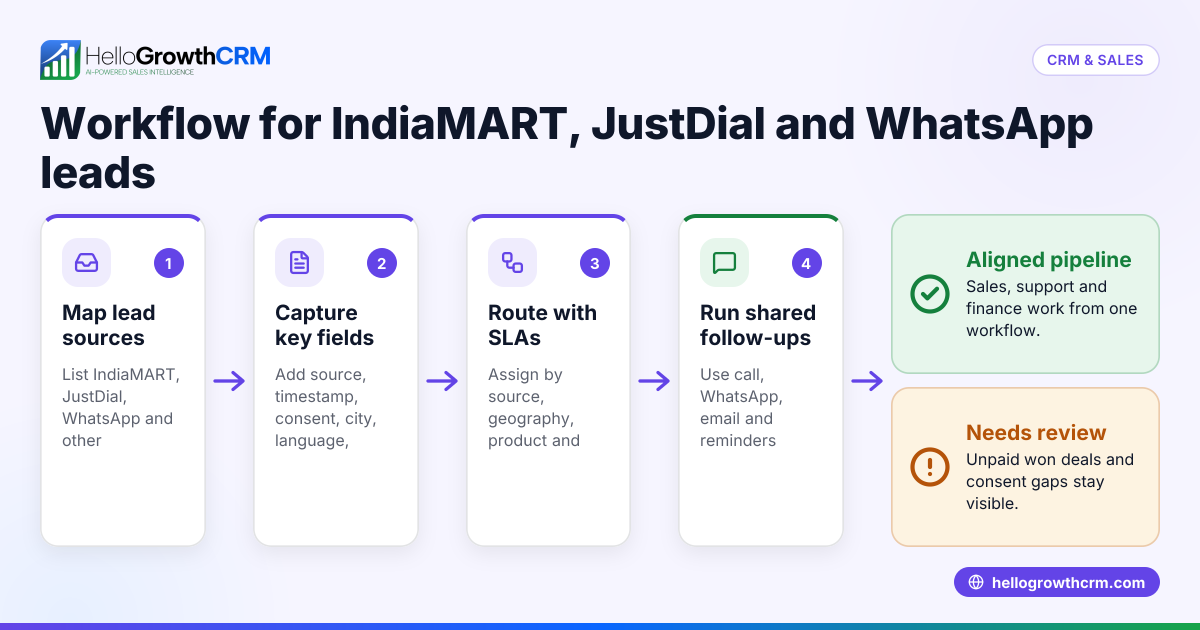
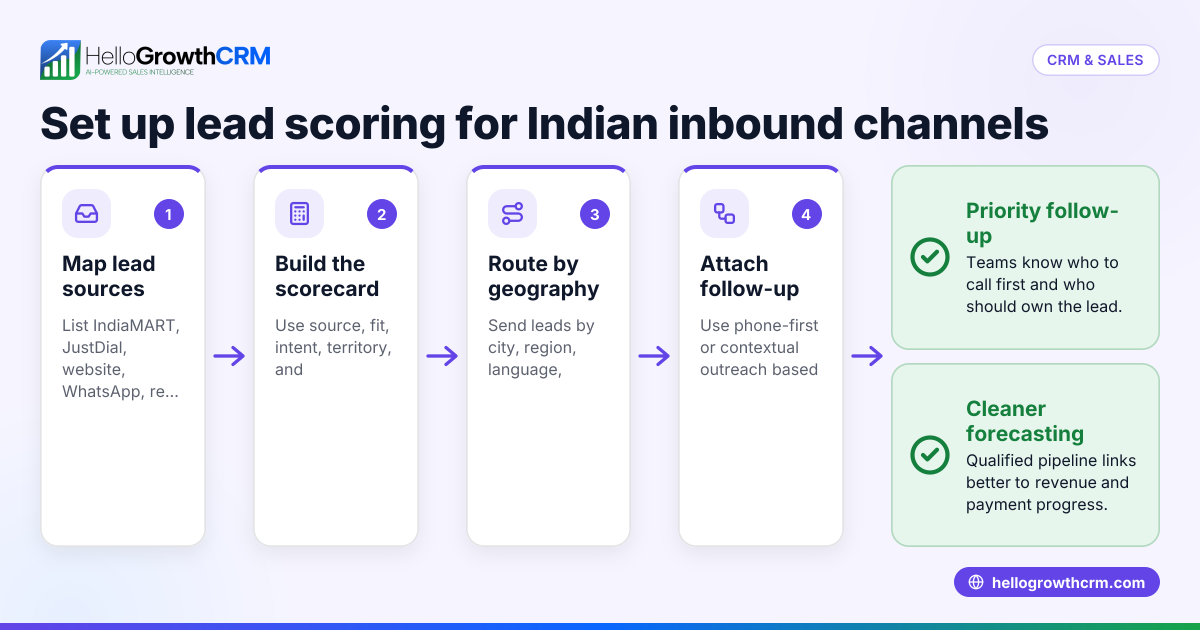
Lead capture and deduplication
Map every inbound record into one lead schema:
- source platform
- source campaign or listing
- customer name
- mobile number
- city and state
- product interest
- enquiry timestamp
- assigned rep
- territory
Use mobile number plus company name as the primary dedupe logic. This is critical when the same buyer comes from IndiaMART and then messages on WhatsApp.
With Smart Inbox, Gmail, and CRM Dialer, HelloGrowthCRM can keep communication tied to the record instead of scattered across devices.
Territory and city assignment
For Indian teams, assign by both geography and account potential. A Mumbai enterprise lead should not follow the same SLA as a tier-3 city enquiry for a low-ticket SKU.
Use routing rules based on:
- city tier
- pincode or state
- product line
- expected deal value
- language preference
- partner vs direct motion
Territory Management helps here, especially when inside sales covers Bangalore and Pune while field reps cover nearby industrial belts.
Payment and accounting feedback loop
Razorpay should update:
- payment link sent
- payment status
- partial vs full payment
- payment date
Tally sync should update:
- invoice raised
- invoice amount
- due date
- outstanding
- customer credit status
If you need flexible data movement, use Zapier or review All Integrations. For revenue visibility, Revenue Attribution and Sales Forecasting help connect pipeline and realised revenue.
How to set up CRM forecasting for Indian B2B sales teams: Step-by-Step
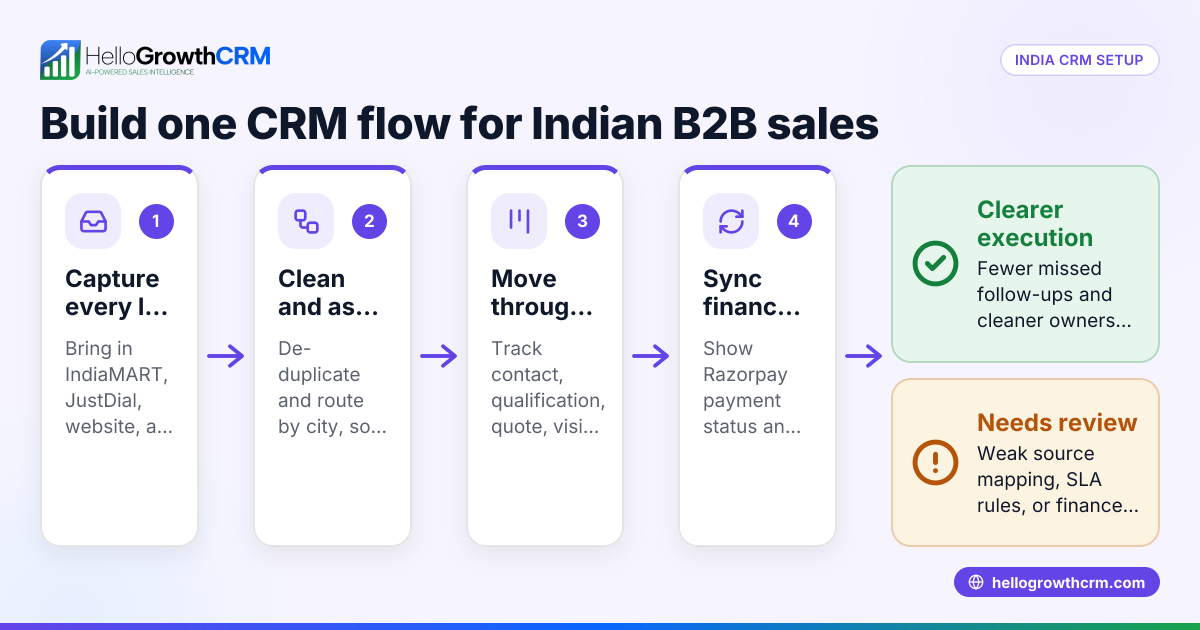
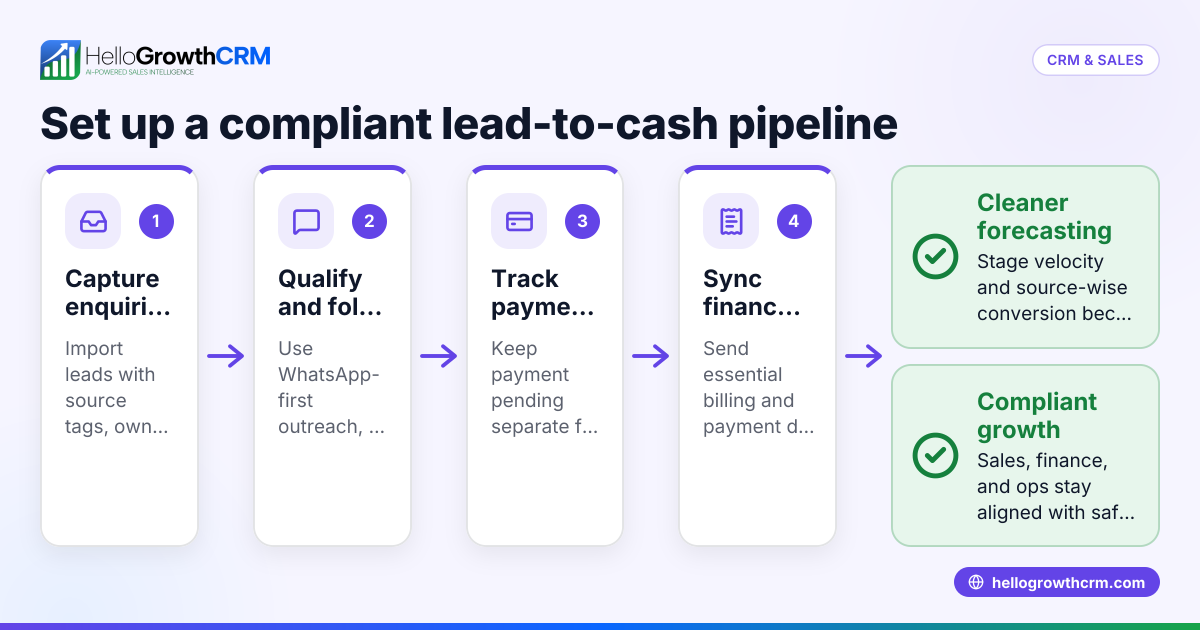
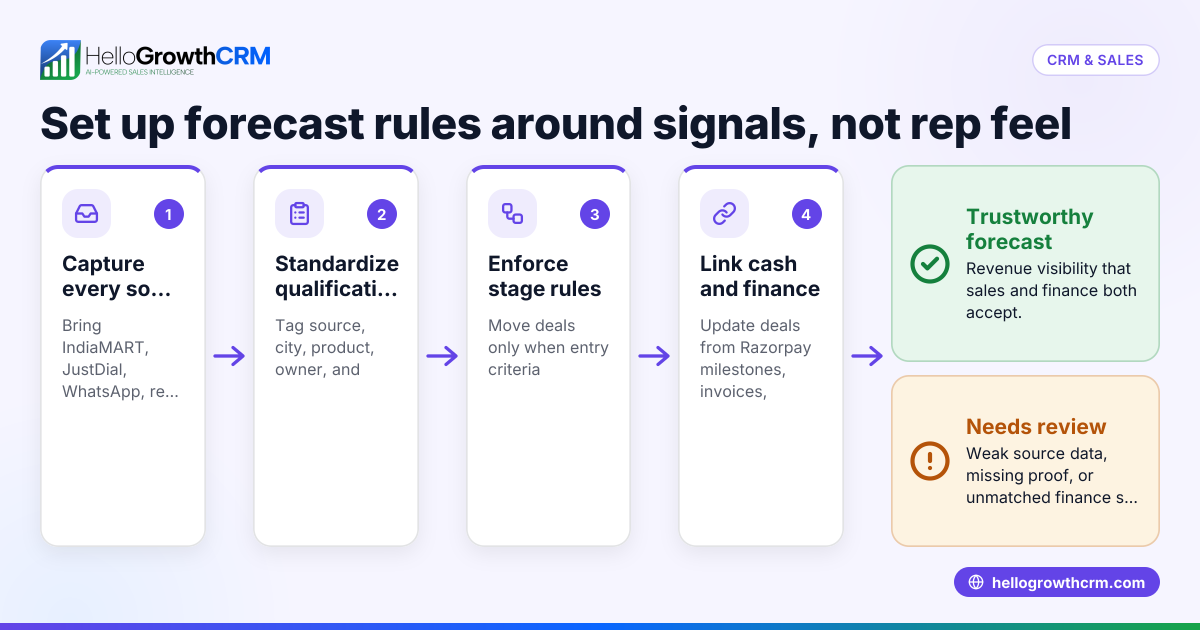
Setting up CRM forecasting for Indian B2B sales teams means defining one sales process, standardising fields and stage rules, connecting IndiaMART, JustDial, WhatsApp, Razorpay, and Tally, and then reviewing forecast quality weekly until the data and rep behaviour become consistent.
- Define your forecast outcome
Decide whether leadership needs bookings, collections, or both. Most Indian SMEs need both because cash timing affects operations. - Standardise lead and account fields
Create required fields for source, city, product, owner, amount, expected close date, and next step. Keep the form short enough that reps actually complete it. - Set stage exit criteria
Write one objective rule for each stage. Avoid emotional labels like hot, warm, and promising. - Create forecast categories
Use categories like pipeline, best case, commit, and closed. Tie each one to activity and buyer confirmation rules. - Connect inbound lead sources
Bring IndiaMART, JustDial, website, and WhatsApp enquiries into one queue. Use dedupe logic before assignment. - Capture communication signals
Log calls, WhatsApp replies, meetings, and proposal sends inside the CRM. A forecast without engagement data goes stale fast. - Sync payment and invoice events
Connect Razorpay and your accounting workflow. If Tally sync is indirect, document the handoff and update frequency clearly. - Set manager inspection rules
Review aging, close date slippage, stage hygiene, and top commit deals weekly. Managers should inspect evidence, not just rep confidence. - Measure forecast accuracy
Track forecast vs actual by rep, source, and month. You can also benchmark uplift with a CRM ROI Calculator or diagnose process gaps using the RevOps Maturity Assessment. - Automate after the process works
Add automation only after stage discipline is stable. Tools like AI Lead Scoring, AI Sales Copilot, and Meeting Scheduler work best on clean process data.
What should buyers evaluate in HelloGrowthCRM before rollout?
Buyers should evaluate HelloGrowthCRM for forecasting by checking data model fit, source capture, WhatsApp workflow coverage, payment and accounting sync options, territory logic, manager visibility, and the level of process change their team can realistically absorb in the first 60 days.
HelloGrowthCRM is our product, so here is the practical view.
What HelloGrowthCRM fits best
It is a strong fit for:
- Indian SME B2B teams with 5 to 50 reps
- inside sales plus field sales hybrids
- WhatsApp-heavy selling motions
- teams that need CRM plus RevOps discipline
- companies that want one system across lead capture, pipeline, and revenue reporting
Explore Features, Pricing, or request a Demo to see the forecast workflow live.
What to test in your evaluation
Ask these questions during a pilot:
- Can leads from IndiaMART and JustDial be normalised without manual cleanup?
- Can WhatsApp conversations stay tied to contacts and deals?
- Can managers inspect forecast evidence in one screen?
- Can Razorpay events update deal confidence or collection status?
- Can your Tally process be synced or operationally mirrored?
- Can territory assignment handle Mumbai, Pune, Bangalore, and tier-2 coverage?
- Can access controls support DPDPA-aware handling?
Important limitations
This setup works fastest for teams under 50 reps. Above that, expect more complexity around role hierarchy, custom objects, and cross-region governance. If your sales process differs heavily by business unit, plan a phased rollout with Managed RevOps support.
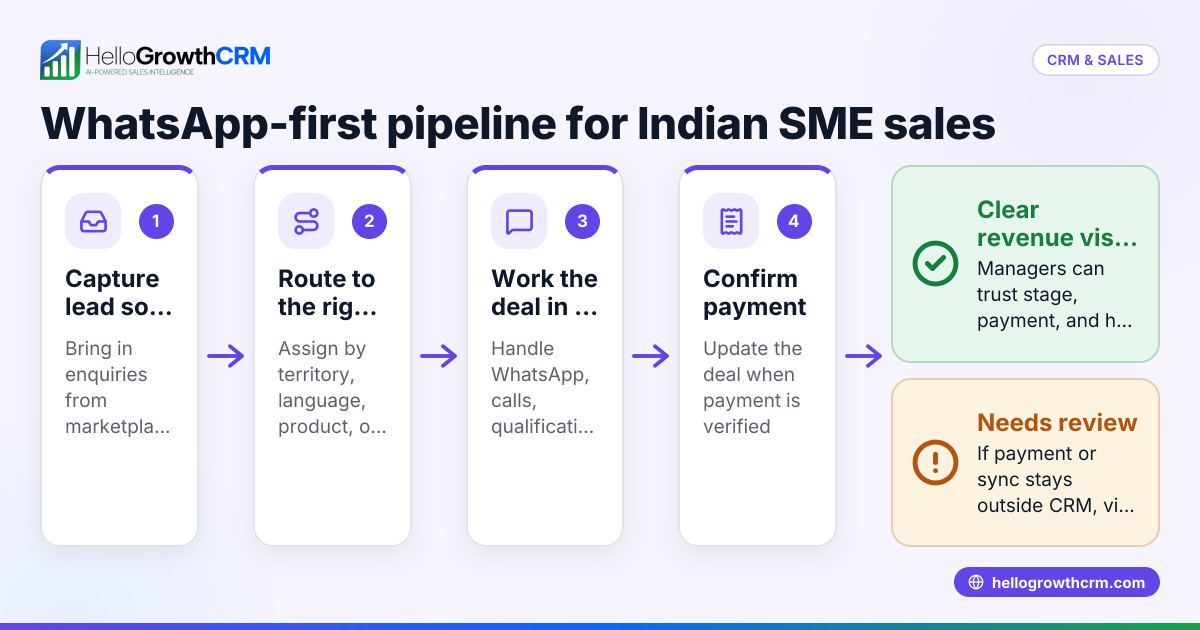
If you are evaluating now, start with a Free Trial or book a Demo and test one live use case: IndiaMART lead to WhatsApp conversation to proposal to Razorpay payment. That single workflow usually shows whether HelloGrowthCRM fits your Indian sales motion.
About the author
Rahul Menon is a Revenue Operations Lead at HelloGrowthCRM with 9 years of experience in B2B SaaS, CRM design, and sales forecasting. He has led CRM and pipeline standardisation projects for Indian SME sales teams across manufacturing, business services, and SaaS. One rollout that informed this article involved a 12-person sales team connecting inbound marketplaces, WhatsApp follow-up, and payment tracking to improve monthly forecast accuracy and manager inspection.
Frequently Asked Questions
Q: What is the best CRM forecasting setup for Indian B2B sales teams?
A: The best CRM forecasting setup for Indian B2B sales teams connects lead sources, stage rules, WhatsApp activity, payment status, and accounting signals in one workflow. The exact design depends on deal size, sales cycle length, and whether you forecast bookings, collections, or both.
Q: Why should IndiaMART and JustDial leads be separated in forecast reporting?
A: IndiaMART and JustDial leads should be separated in forecast reporting because their intent, response rate, and close patterns are often different. Separate source reporting helps you assign better probabilities and avoid overestimating early-stage pipeline.
Q: How does WhatsApp affect forecast accuracy in India?
A: WhatsApp affects forecast accuracy in India because many buyer interactions, follow-ups, and commercial nudges happen there instead of email. If those conversations are missing from the CRM, managers lose key evidence about deal momentum and buyer intent.
Q: Should Razorpay and Tally data be included in a sales forecast?
A: Razorpay and Tally data should be included in a sales forecast when payment timing and invoice status affect real revenue visibility. This is especially useful for SMEs that manage partial advances, distributor payments, or delayed collections.
Q: How often should Indian sales managers review forecasts?
A: Indian sales managers should review forecasts at least weekly, with a tighter review near month-end. Weekly reviews catch close date slippage, stale proposals, and weak commit deals before they distort the monthly number.
Q: What DPDPA 2023 issues matter in CRM forecasting?
A: DPDPA 2023 issues that matter in CRM forecasting include lawful handling of personal data, access control, purpose limitation, and safe storage of contact and communication records. Teams should control who can view phone numbers, chat logs, and payment-linked customer details.
Q: Can HelloGrowthCRM work for teams selling across Mumbai, Pune, Bangalore, and tier-2 cities?
A: HelloGrowthCRM can work for teams selling across Mumbai, Pune, Bangalore, and tier-2 cities if territory rules, SLAs, and source routing are configured properly. The key is to assign by geography and account potential, not just by rep availability.
Q: What should I test in a HelloGrowthCRM pilot before rollout?
A: You should test lead capture, deduplication, stage discipline, WhatsApp tracking, payment sync, and manager forecast visibility in a HelloGrowthCRM pilot. A focused 2-4 week pilot on one product line usually shows process fit faster than a broad rollout.
Frequently Asked Questions
Ready to put this into practice?
Set up your pipeline, WhatsApp follow-ups, and AI lead scoring in minutes — free, no credit card.
Try HelloGrowthCRM freeGet CRM tips in your inbox
Join thousands of sales professionals who get weekly insights on CRM strategy, AI automation, and pipeline optimization.

The HelloGrowthCRM team publishes guides on CRM strategy, AI sales tools, and revenue operations for small business sales teams.