HelloGrowthCRM software
Built for real small-business sales teams
HelloGrowthCRM helps reps qualify faster, follow up on time, and close more deals—with practical automation in one place.
- AI lead scoring and pipeline visibility
- Built-in dialer, WhatsApp, and email automation
- Sales forecasting and RevOps-ready reporting
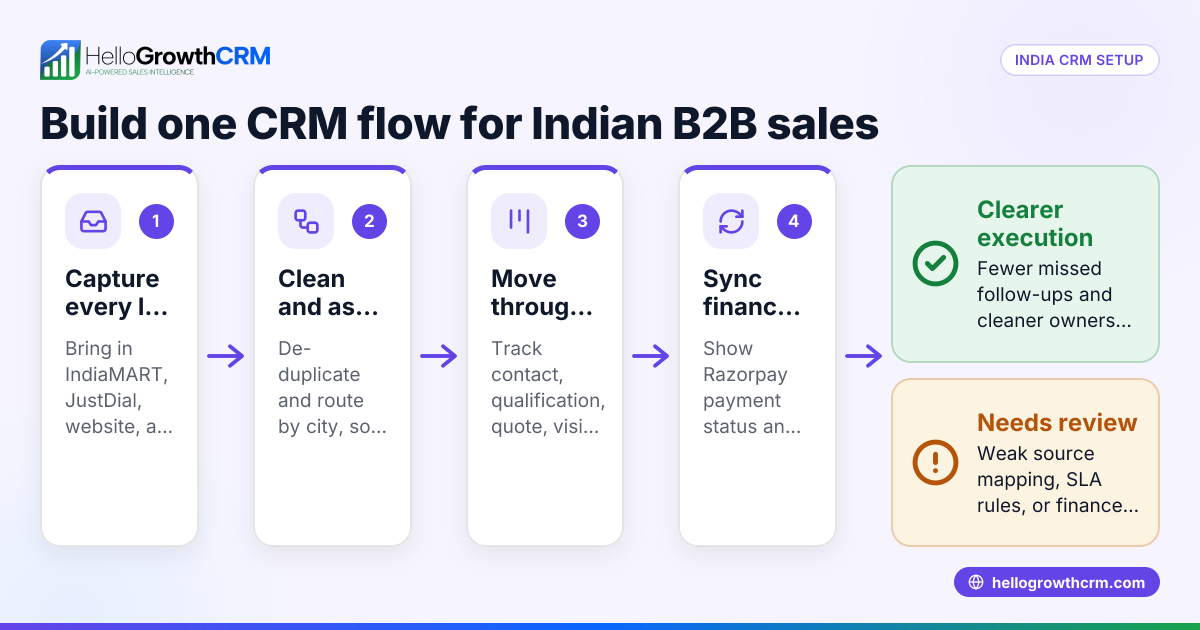
A CRM forecasting setup for Indian B2B sales teams is a structured way to predict future revenue by capturing leads from IndiaMART, JustDial, and WhatsApp inside one CRM, then linking follow-up activity, payment milestones, and accounting status to stage-based forecast rules that reflect real Indian sales cycles.
Key Takeaways
- Forecast accuracy improves when every lead source feeds one pipeline with standard fields, stage rules, and owner accountability.
- Indian B2B teams should forecast from both sales intent and cash events, especially Razorpay payments and Tally accounting sync.
- WhatsApp follow-up is critical for India, but it must be logged cleanly and handled in a DPDPA 2023-ready workflow.
- Inside sales teams in Mumbai, Bangalore, and Pune need separate forecast assumptions from tier-2 and tier-3 city motions.
- HelloGrowthCRM works best when paired with source tagging, payment-linked milestones, and stage-exit criteria instead of rep gut feel.
Why CRM forecasting matters for Indian B2B sales teams
CRM forecasting matters for Indian B2B sales teams because revenue becomes predictable only when lead sources, rep activity, payment progress, and accounting confirmation sit in one system with fixed rules. Without that setup, forecasts depend on optimism, not evidence, and founders make hiring and cash decisions on weak data.
Most Indian SME teams do not have a pipeline problem first. They have a data consistency problem.
In practice, I see five common issues when I audit forecast setups:
- IndiaMART and JustDial leads enter with missing fields
- WhatsApp conversations happen outside the CRM
- Reps move deals forward without qualification
- Advance payments are not tied to opportunity stages
- Finance and sales numbers do not match at month-end
That creates the classic problem. The sales head says INR 40 lakh is closing this month. Finance sees only INR 18 lakh likely to hit the bank.
In one rollout we did with a 12-person sales team selling industrial services across Mumbai and Pune, forecast accuracy improved only after we locked three things: source capture, stage-entry criteria, and payment verification. Before that, the team was forecasting based on “good conversations.” After the change, they forecasted based on logged calls, quote acceptance, and payment proof.
If your team already uses Sales Forecasting, this setup becomes easier because forecast categories and stage probabilities can be enforced without spreadsheet chasing.
The India-specific forecasting challenge
Indian B2B teams often sell through a mix of inbound marketplace leads, distributor referrals, and WhatsApp conversations. That means buyer intent is fragmented.
A lead from IndiaMART may ask for pricing fast. A JustDial lead may need qualification. A WhatsApp lead may be warm but undocumented. Unless all three are normalized inside your AI CRM, your forecast will always lag reality.
What a reliable CRM forecasting setup should include
A reliable CRM forecasting setup for Indian B2B sales teams should include source capture, mandatory qualification fields, stage-based exit criteria, payment-linked milestones, accounting sync, and forecast categories tied to rep behavior. The goal is not more data. The goal is trustworthy revenue visibility that sales and finance both accept.
At minimum, your setup should track:
| Forecast component | What to capture | Why it matters |
|---|---|---|
| Lead source | IndiaMART, JustDial, WhatsApp, referral, website | Shows source quality and conversion pattern |
| Qualification | Budget, use case, authority, timeline, city | Prevents unqualified deals from inflating forecast |
| Activity evidence | Calls, WhatsApp replies, meetings, proposals | Confirms deal momentum |
| Commercial status | Quote sent, negotiation, PO pending | Distinguishes interest from purchase intent |
| Payment milestone | Advance paid, partial paid, full paid | Anchors forecast to cash movement |
| Accounting sync | Invoice created, GST status, ledger sync | Aligns sales and finance |
| Forecast category | Pipeline, best case, commit, closed won | Makes roll-ups useful for leadership |
Use strict stage definitions
The fastest way to improve forecasting is to reduce subjective stage movement.
Use stages such as:
- New lead
- Contacted
- Qualified
- Meeting done
- Proposal sent
- Commercial review
- PO or approval pending
- Advance received
- Closed won
- Closed lost
Each stage should have entry criteria. For example:
- Qualified: contact confirmed, need confirmed, expected timeline captured
- Proposal sent: proposal document shared and acknowledged
- PO or approval pending: commercial terms discussed, next action date fixed
- Advance received: payment confirmed through Razorpay or finance confirmation
When I have audited pipelines like this, “proposal sent” is usually overloaded. Teams push half the pipeline there because it feels close to revenue. It is not. Proposal sent should still sit below commit unless the buyer has a defined next step.
Use forecast categories, not just stages
Stages show progress. Forecast categories show confidence.
A simple model for Indian SMEs is:
- Pipeline: early deals, under 30% confidence
- Best case: active and qualified, but not yet buyer-confirmed
- Commit: likely this month, with clear next action and commercial acceptance
- Closed won: payment or signed confirmation received
This structure works well inside AI Pipeline Management, especially when managers review category changes weekly.
How to unify IndiaMART, JustDial, WhatsApp, Razorpay, and Tally into one forecast
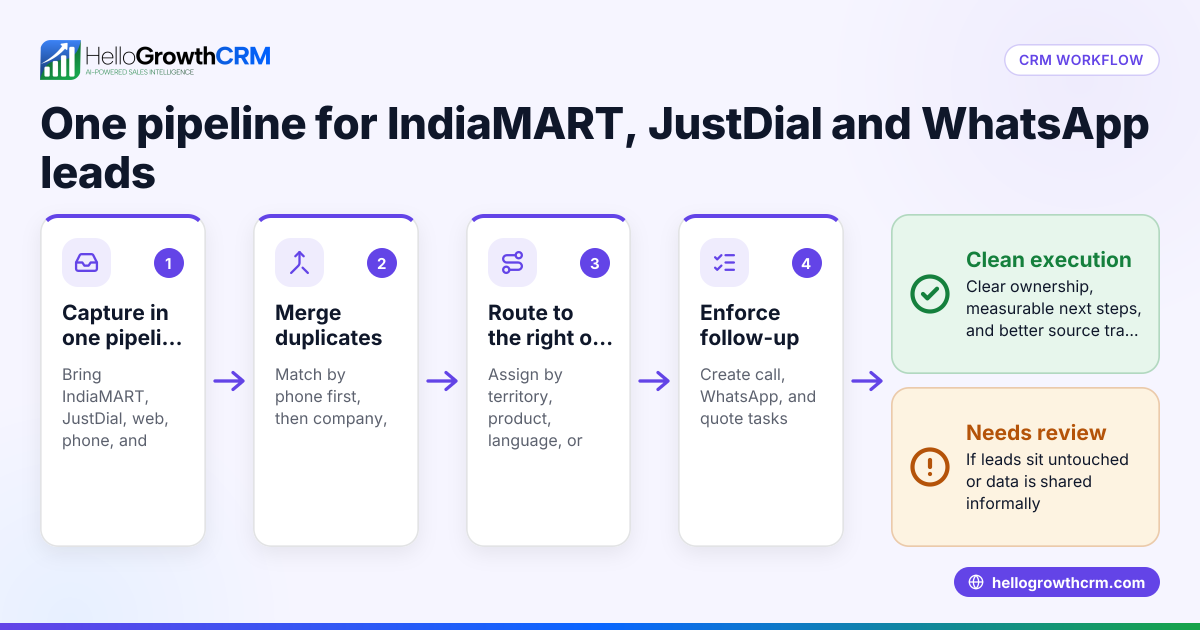
To unify IndiaMART, JustDial, WhatsApp, Razorpay, and Tally into one forecast, route every lead and transaction into one CRM record, standardize fields, and update forecast status from both selling activity and money movement. That creates a forecast based on real operating signals, not rep memory.
Lead source unification
Every new lead should enter the CRM with:
- Source name
- Campaign or listing identifier
- Product interest
- City and state
- Assigned rep
- First response SLA
- Last interaction timestamp
If you connect WhatsApp and WhatsApp & SMS CRM, reps can work from the CRM instead of personal phones. That matters for forecasting because follow-up quality drives close timing.
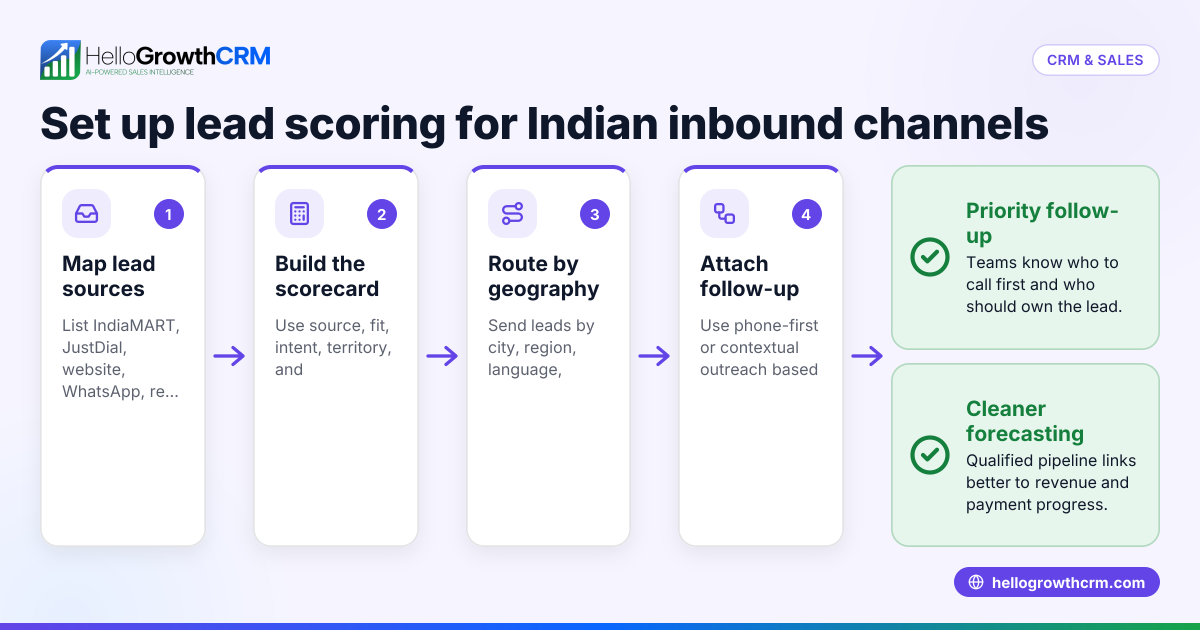
For marketplaces and forms, Zapier or All Integrations can help move inbound leads into one queue. Once there, Lead Scoring Calculator logic can prioritize high-fit leads from key cities like Mumbai, Bangalore, Ahmedabad, and Coimbatore.
Payment and accounting linkage
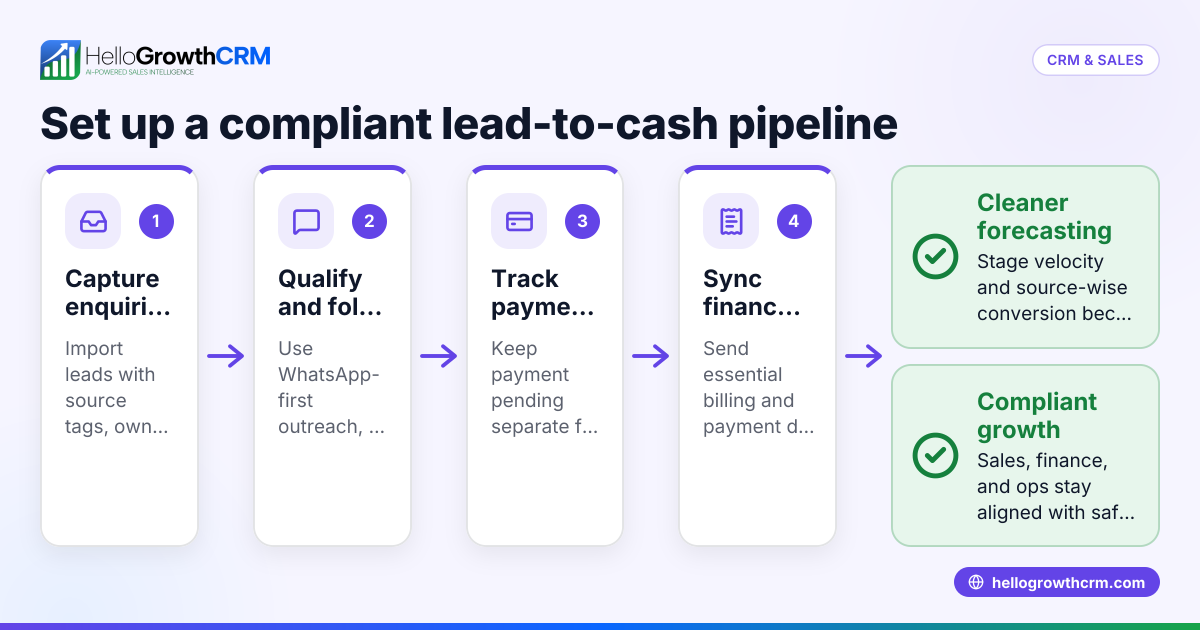
Sales forecasts in India should not stop at verbal close. They should reflect payment and finance status.
Link these events to the deal record:
- Razorpay payment link sent
- Advance payment completed
- Invoice issued
- Tally ledger sync complete
- Payment overdue
- Refund or dispute
If you use Razorpay and QuickBooks or another accounting bridge, you can trigger updates when advance payments land. If your team syncs into Tally through middleware, apply the same principle: finance events should update the opportunity, not live in a separate spreadsheet.
The Reserve Bank of India regulates payment systems in India through its official oversight framework at rbi.org.in. That makes payment-linked forecasting more defensible than relying on verbal rep confidence alone.
Why cash-linked forecasting works better
In many Indian SME deals, the true commitment point is not the signed quote. It is the advance.
That is especially true for:
- Services retainers
- Equipment orders
- Annual software implementation projects
- Distributor onboarding
- Regional franchise sales
If a deal enters commit only after commercial acceptance and payment initiation, your forecast becomes more conservative. It also becomes more useful.
DPDPA 2023-ready data handling for forecast workflows
DPDPA 2023-ready data handling for forecast workflows means collecting only necessary customer data, storing consent and communication history properly, limiting access, and keeping WhatsApp and lead-source records inside governed systems. A forecast is only trustworthy if the underlying customer data is handled legally and consistently.
India’s Ministry of Electronics and Information Technology publishes the national data protection framework at meity.gov.in.
For practical CRM execution, that means:
- Capture business-relevant fields only
- Avoid storing excess personal information
- Log consent and communication source where possible
- Restrict access by role
- Keep audit history for stage changes and contact edits
- Avoid unmanaged personal-device selling workflows
Special care for WhatsApp-heavy sales motions
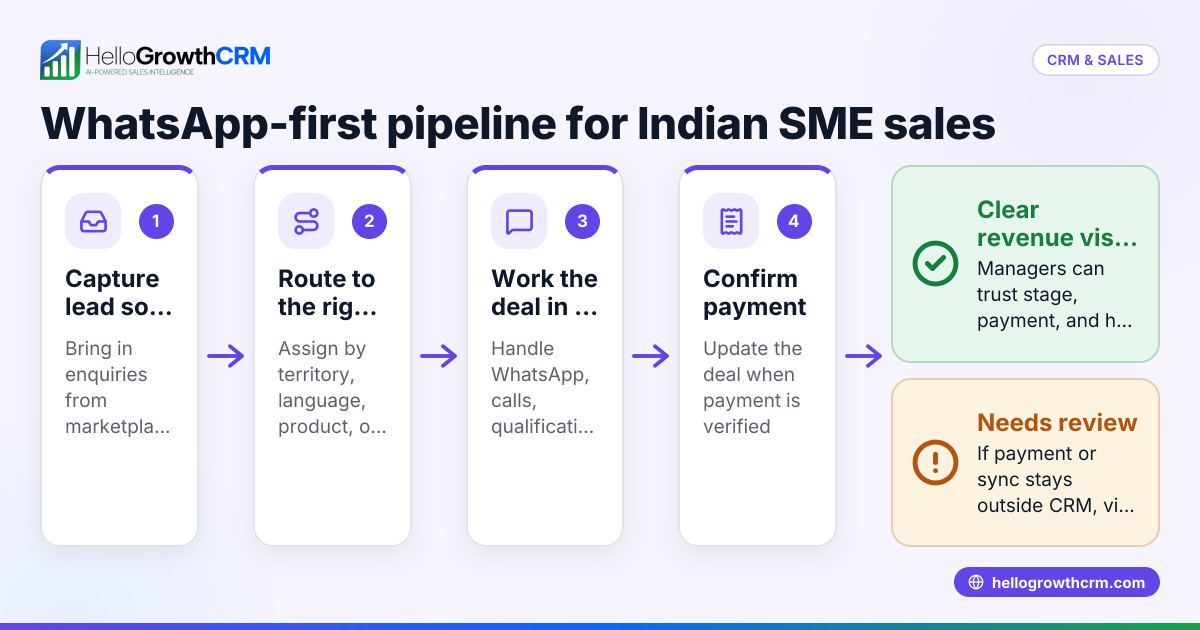
WhatsApp is the default business channel for many Indian buyers. That is useful, but risky if messages live only on a rep’s phone.
Use a shared workflow through Smart Inbox or WhatsApp & SMS CRM so that:
- Conversations stay linked to the account
- Handoffs do not break when reps leave
- Managers can review response lag
- Forecast confidence reflects actual buyer engagement
A standalone fact matters here: WhatsApp has more than 500 million users in India, according to Meta’s official India newsroom update at about.fb.com.
That is one reason Indian B2B forecasting cannot ignore WhatsApp engagement data.
Forecast rules for inside sales teams in Mumbai, Bangalore, and tier-2 or tier-3 markets
Forecast rules for inside sales teams in Mumbai, Bangalore, and tier-2 or tier-3 markets should differ by response speed, buying committee behavior, payment timing, and follow-up cadence. One forecast model rarely fits all regions because deal velocity and communication patterns change by city and segment.
Mumbai and Bangalore inside sales motions
For metro teams, use tighter activity windows:
- First response within 15 minutes for hot inbound leads
- Qualification within 24 hours
- Meeting scheduled within 3 business days
- Proposal follow-up every 48 hours
- Commit only if next meeting or payment step is scheduled
These markets move faster. Buyers compare vendors quickly. If there is no response trail, the deal should not sit in best case for long.
Using Meeting Scheduler, Email Automation, and a CRM Dialer helps enforce these windows.
Tier-2 and tier-3 city follow-up rules
For Indore, Nagpur, Surat, Rajkot, Kochi, or similar markets, you often need more attempts and more channel variety.
Use:
- Call + WhatsApp on day 1
- Follow-up call on day 2
- Voice note or vernacular support where relevant
- Dealer or local reference proof where needed
- Payment reminder before month-end procurement closure
In one project with a Bangalore-based inside sales team covering tier-3 manufacturing buyers, we found that a seven-touch cadence over 10 days outperformed a metro-style three-touch cadence. The key was not pressure. It was persistence with local context.
If your managers need better visibility, Sales Task Boards and Pipeline Health Score make stalled deals easier to spot.
How to set up CRM forecasting for Indian B2B sales teams: Step-by-Step
Setting up CRM forecasting for Indian B2B sales teams means mapping your sales process, standardizing data from IndiaMART, JustDial, and WhatsApp, linking payment and accounting events, and enforcing forecast rules through weekly reviews. The process is simple, but discipline matters more than tool complexity.
- Define your stages
Write 7-10 stages that match your actual sales motion. Do not copy a generic SaaS pipeline if you sell services, hardware, or channel-led deals. - Set stage-entry criteria
Add mandatory conditions for each stage. Examples include contact established, budget range captured, proposal shared, or advance payment initiated. - Create source fields
Tag every lead by source, city, product, and owner. This lets you compare IndiaMART, JustDial, website, referrals, and WhatsApp performance. - Connect communication channels
Bring WhatsApp, email, and calls into the CRM using tools like Gmail, WhatsApp, and CRM Dialer. Forecasting fails when rep activity is invisible. - Link payment milestones
Push Razorpay events and invoice updates into the opportunity record. Treat payment proof as a forecast signal, not just a finance event. - Sync accounting status
Map invoice, collection, and ledger status from Tally or your accounting bridge. This closes the gap between closed won in sales and recognized revenue in finance. - Build forecast categories
Use pipeline, best case, commit, and closed won. Give managers clear rules for moving deals between categories. - Review weekly by manager
Inspect stage age, next step date, and last activity date. Use AI Deal Insights or AI Sales Copilot to flag risk faster. - Track forecast accuracy monthly
Compare predicted revenue vs actual collections. Then refine stage probabilities and category rules based on real close patterns. - Audit data hygiene every quarter
Check duplicate leads, missing fields, stale opportunities, and owner discipline. If needed, use Managed RevOps to reset the process cleanly.
Common mistakes that break forecasting accuracy
Common mistakes that break forecasting accuracy include missing source data, vague stage definitions, over-reliance on rep judgment, poor WhatsApp logging, and no link between sales and finance milestones. Most forecast problems are process issues first and software issues second.
Watch for these warning signs:
- More than 25% of deals have no next step date
- Large pipeline sits in one middle stage
- Commit deals have no commercial proof
- Closed won deals have no payment confirmation
- Reps use personal WhatsApp numbers for active deals
- Finance and sales disagree on monthly bookings
A good fix is to score opportunity quality by:
- Last activity age
- Stage age in days
- Buyer response recency
- Proposal status
- Payment status
- Owner confidence vs evidence
That is where Revenue Attribution, AI Lead Scoring, and CRM ROI Calculator can help leadership move from guesswork to operating discipline.
HelloGrowthCRM is our product, so that disclosure matters. It is a strong fit for Indian SME teams that want one place for lead capture, WhatsApp follow-up, and forecast visibility. If you run a very large field-sales operation with heavy offline distributor complexity, expect some process design work before rollout.
If you want a practical forecasting setup built for Indian sales motions, try HelloGrowthCRM with a Free Trial, explore Features, or book a Demo. It is designed for teams that sell through WhatsApp, marketplace leads, inside sales, and payment-linked milestones across India.
About the author
Rohan Mehta is a Revenue Operations Lead at HelloGrowthCRM with 10 years of experience in B2B SaaS, CRM design, and sales process improvement. He has led forecasting and pipeline cleanup projects for Indian SME teams across Mumbai, Bangalore, and Pune. One project that informed this article involved redesigning lead routing, WhatsApp tracking, and payment-linked forecasting for a 12-rep inside sales team selling multi-city service contracts.
Frequently Asked Questions
Q: What is the best CRM forecasting setup for Indian B2B sales teams?
A: The best CRM forecasting setup for Indian B2B sales teams combines source capture, stage rules, WhatsApp activity logging, payment milestones, and finance sync in one system. For most SMEs, the winning model ties forecast confidence to both buyer actions and Razorpay or invoice events.
Q: How do IndiaMART and JustDial leads affect forecast accuracy?
A: IndiaMART and JustDial leads affect forecast accuracy because poor source tagging and qualification make the pipeline look bigger than it is. When these leads enter the CRM with standard fields and SLA rules, managers can forecast by source quality instead of raw volume.
Q: Should WhatsApp conversations be included in CRM forecasting?
A: Yes, WhatsApp conversations should be included in CRM forecasting because they often contain the real buyer intent, follow-up timing, and commercial confirmation. If WhatsApp stays outside the CRM, managers miss the strongest signal of whether a deal is active or stalled.
Q: How should Razorpay and Tally be used in sales forecasting?
A: Razorpay and Tally should be used in sales forecasting by linking payment and accounting milestones back to each opportunity record. This helps teams distinguish verbal wins from actual financial commitment and keeps sales and finance numbers aligned.
Q: Is DPDPA 2023 relevant to CRM forecasting workflows?
A: Yes, DPDPA 2023 is relevant to CRM forecasting workflows because forecasts depend on customer data collected from forms, calls, and WhatsApp. Teams should limit stored data, control access, and keep communication records inside approved systems rather than unmanaged personal devices.
Q: What forecast rules work best for inside sales teams in Mumbai and Bangalore?
A: The best forecast rules for inside sales teams in Mumbai and Bangalore use short response times, strict stage age limits, and frequent next-step validation. Metro buyers move quickly, so old deals without fresh activity should drop in confidence instead of staying in commit.
Q: How should tier-2 and tier-3 city sales teams handle follow-up for forecasting?
A: Tier-2 and tier-3 city sales teams should handle follow-up with longer cadences, mixed channels, and more persistence before reducing forecast confidence. These buyers may respond later, but the forecast should still depend on logged activity and defined next actions.
Q: Can HelloGrowthCRM help Indian SMEs build this setup faster?
A: Yes, HelloGrowthCRM can help Indian SMEs build this setup faster by combining lead capture, WhatsApp workflows, forecasting, and revops controls in one platform. It is especially useful for teams that want one operating system instead of separate tools and spreadsheets.
Frequently Asked Questions
Ready to put this into practice?
Set up your pipeline, WhatsApp follow-ups, and AI lead scoring in minutes — free, no credit card.
Try HelloGrowthCRM freeGet CRM tips in your inbox
Join thousands of sales professionals who get weekly insights on CRM strategy, AI automation, and pipeline optimization.

The HelloGrowthCRM team publishes guides on CRM strategy, AI sales tools, and revenue operations for small business sales teams.