HelloGrowthCRM software
Built for real small-business sales teams
HelloGrowthCRM helps reps qualify faster, follow up on time, and close more deals—with practical automation in one place.
- AI lead scoring and pipeline visibility
- Built-in dialer, WhatsApp, and email automation
- Sales forecasting and RevOps-ready reporting
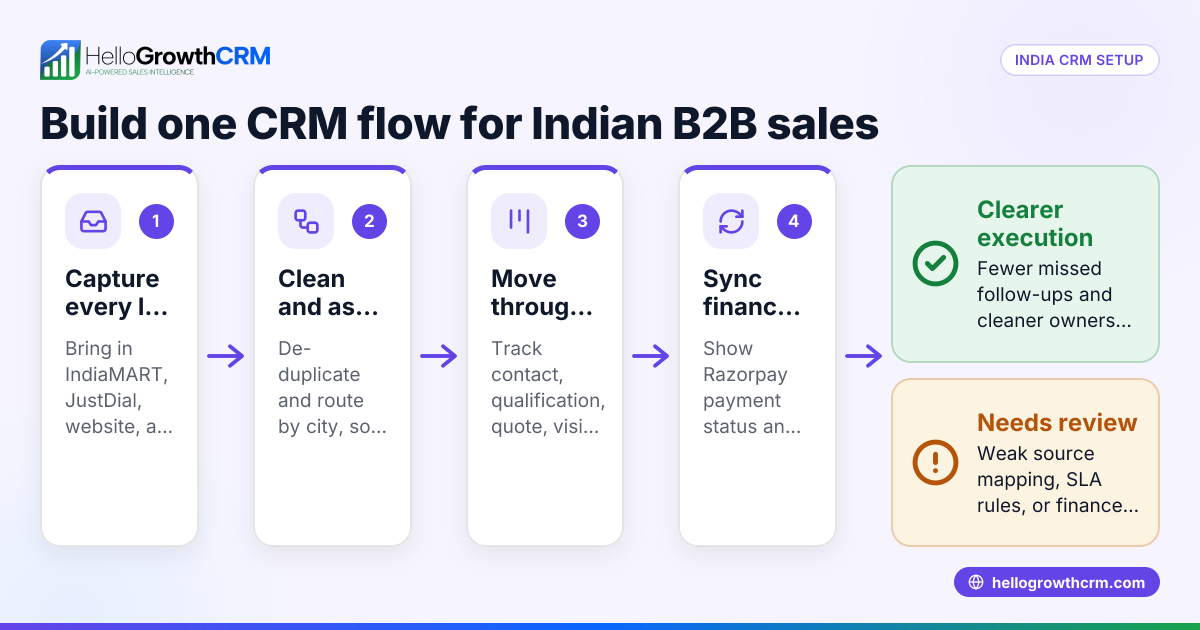
A CRM pipeline setup for Indian B2B sales teams using IndiaMART, JustDial, WhatsApp, Razorpay, Tally, and DPDPA 2023 is a structured lead-to-cash workflow that captures enquiry data, routes follow-up fast, tracks deal stages, records payments, syncs accounts, and applies consent-safe data handling for compliant growth.
Key Takeaways
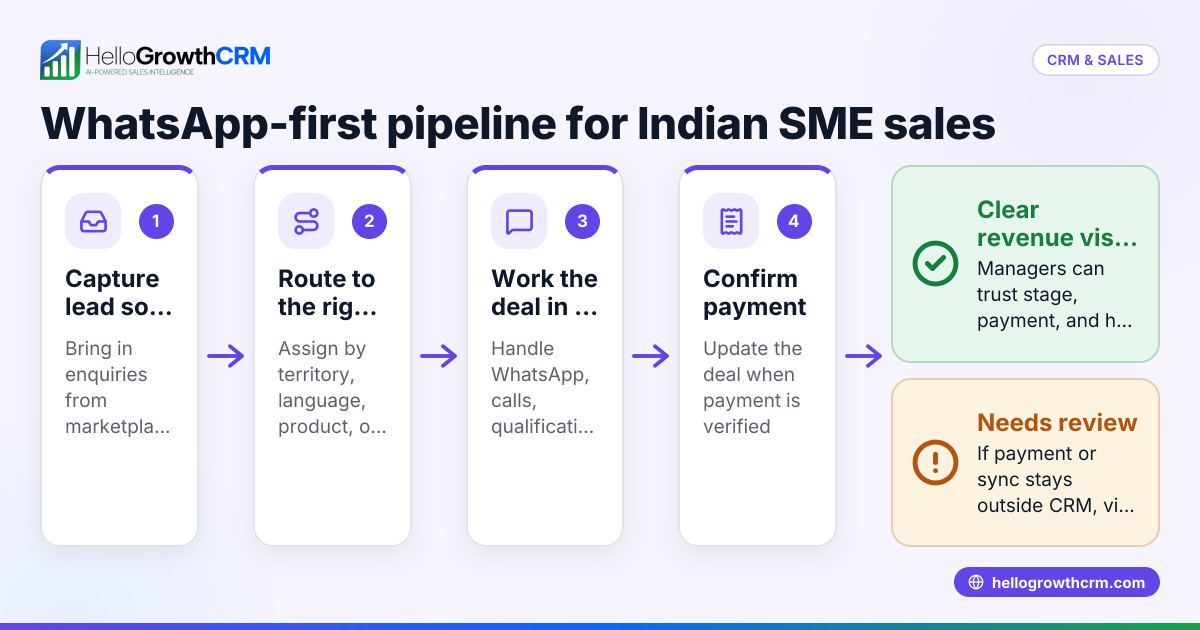
- Indian SME teams need a WhatsApp-first pipeline because many buyers reply there before they answer email.
- IndiaMART and JustDial leads should enter the CRM automatically with source tags, owner rules, and SLA timers.
- Razorpay payment status and Tally sync help sales, finance, and ops stay aligned after a deal is marked won.
- DPDPA 2023 means you should collect clear consent, store purpose-linked data, and limit unnecessary access.
- Forecasting gets better when stage entry criteria, stage-velocity in days, and source-wise conversion are defined upfront.
- HelloGrowthCRM fits this use case well because it combines WhatsApp & SMS CRM, Revenue Attribution, and Sales Forecasting in one system.
Why does CRM pipeline setup matter for Indian B2B teams using IndiaMART, JustDial, WhatsApp, Razorpay, and Tally?
A CRM pipeline setup matters for Indian B2B teams because it turns scattered lead handling into one measurable process across acquisition, follow-up, payment, and bookkeeping. For teams in Mumbai, Bangalore, Pune, and tier-2 markets, this reduces lead leakage, speeds response time, and gives cleaner forecasting and compliance control.
Most Indian SME sales teams do not have a lead problem. They have a handoff problem.
IndiaMART and JustDial enquiries often land in inboxes, spreadsheets, or on one sales rep’s phone. WhatsApp chats stay outside the CRM. Razorpay payments get checked by finance later. Tally updates happen after the fact. The result is familiar:
- Reps call the same lead twice
- Hot leads wait too long for the first response
- Managers cannot trust stage numbers
- Finance chases payment proof manually
- Leadership sees revenue only after month-end
In one rollout we did with a 12-person sales team selling industrial components across Mumbai and Ahmedabad, first response time dropped sharply once IndiaMART leads were auto-assigned with round-robin rules and WhatsApp templates. Before that, reps were forwarding screenshots in internal groups.
A good setup should connect five motions:
- Lead capture
- Lead qualification
- Follow-up and meetings
- Commercials and payment
- Handover to finance and post-sale ops
If you are evaluating a CRM for this, start with Features and check whether the platform supports WhatsApp, Razorpay, and All Integrations without heavy custom work.
What should a practical Indian B2B CRM pipeline include?
A practical Indian B2B CRM pipeline should include source capture, lead enrichment, qualification rules, WhatsApp-first outreach, clear stage criteria, payment checkpoints, accounting sync, and consent records. It should also show source-wise conversion, forecast category, and owner accountability so managers can act before deals slip.
Recommended pipeline stages for Indian SME sales
Use simple stages that map to how your team actually sells. For most enquiry-driven B2B teams, these stages work:
| Pipeline Stage | What it means | Exit criteria | Primary owner |
|---|---|---|---|
| New Enquiry | Lead captured from IndiaMART, JustDial, website, referral, or ads | Lead assigned and first outreach attempted | SDR/Inside sales |
| Contacted | First call, WhatsApp, or email sent | Two-way response or qualification started | SDR/AE |
| Qualified | Budget, need, timeline, and buyer role confirmed | Meeting booked or requirement documented | AE |
| Solution Fit | Demo, consultation, sample, or requirement mapping done | Proposal requested | AE |
| Proposal Sent | Commercial or proposal shared | Decision date confirmed | AE |
| Negotiation | Price, terms, or scope under discussion | Verbal approval or payment link shared | AE/Manager |
| Won - Payment Pending | Buyer approved but payment not complete | Razorpay payment received or PO approved | AE/Finance |
| Closed Won | Payment or formal win recorded | Tally sync and handoff complete | Ops/Finance |
| Closed Lost | Deal not moving forward | Lost reason captured | AE |
This is better than using too many stages. When I have audited pipelines like this, the biggest issue was stage inflation. Teams add stages for every internal activity. That makes forecasting worse, not better.
Use stage entry criteria, not just labels
Each stage needs a rule. Otherwise reps move deals based on hope.
Examples:
- Qualified: Must include use case, buyer role, location, and expected order value
- Proposal Sent: Proposal link or PDF must be attached
- Negotiation: Commercial objection or legal/payment terms discussion must be logged
- Won - Payment Pending: Razorpay link issued or PO uploaded
Inside HelloGrowthCRM, this works best when paired with AI Pipeline Management, AI Deal Insights, and Sales Task Boards so managers can spot skipped steps quickly.
How should you capture and route IndiaMART and JustDial leads?
You should capture and route IndiaMART and JustDial leads into the CRM automatically with source tags, duplicate checks, lead owner rules, and response SLAs. The goal is simple: every enquiry should become a trackable record within minutes, not a missed message buried in email or a rep’s phone.
Capture the right fields on day one
Do not overload forms. Start with fields your team will actually use:
- Lead source
- Product or category interest
- Contact name
- Mobile number
- City and state
- Business name
- Enquiry date and time
- Requirement notes
- Consent status
- Owner
- Expected deal value band
If you can connect source feeds through Zapier or a native connector, do it. If not, use structured import every few minutes or every hour. Manual CSV imports should be the fallback, not the operating model.
Set routing rules around speed and territory
Indian B2B buying often depends on local language, timing, and city familiarity. A Bangalore SaaS enquiry may fit round-robin. A machinery lead from Nagpur may need a Marathi-speaking rep or distributor partner.
Use routing based on:
- Product line
- City or pin code
- Language
- Deal value band
- Existing account vs new logo
- Working hours and rep availability
Pair this with Territory Management and AI Lead Scoring if you want high-intent leads handled first.
Measure lead quality by source
Do not treat IndiaMART and JustDial as identical. Track:
- Connect rate
- Qualification rate
- Proposal rate
- Win rate
- Average sales cycle
- Average order value
- Refund or cancellation pattern
This is where Revenue Attribution and Pipeline Health Score become useful. They help you cut low-quality spend and double down on the source that produces cash, not just raw enquiries.
Why is WhatsApp-first follow-up essential for Indian sales execution?
WhatsApp-first follow-up is essential for Indian sales execution because many buyers respond faster on chat than on email, especially after an IndiaMART or JustDial enquiry. A CRM should log messages, automate reminders, and connect chat history to the deal so no context is lost across reps or locations.
Build a simple response cadence
For most SME teams, this cadence works well:
- Immediate WhatsApp acknowledgement
- Call attempt within 10 minutes during business hours
- Reminder message with value proposition
- Meeting link if the buyer engages
- Follow-up with proposal or sample details
The Telecom Regulatory Authority of India reported that India had over 1.19 billion total telephone subscribers as of May 2024. That matters because mobile-first behaviour shapes how quickly B2B buyers expect a response.
Use WhatsApp & SMS CRM, CRM Dialer, and Meeting Scheduler together so reps can move from chat to call to booked meeting without switching tools.
Keep WhatsApp compliant and usable
Do not spam fresh leads with long brochures.
Instead:
- Send a short acknowledgement
- Confirm requirement
- Ask one clarifying question
- Offer a call time
- Share payment or proposal links only at the right stage
This is also where Smart Inbox helps. It gives managers visibility into chats that would otherwise sit on personal devices.
How do Razorpay and Tally improve pipeline hygiene and forecasting?
Razorpay and Tally improve pipeline hygiene and forecasting by creating clear payment checkpoints between verbal approval and actual revenue. When payment status flows back into the CRM and accounting sync happens quickly, teams can distinguish “likely” from “booked” revenue and reduce disputes over won deals.
Why payment status should sit inside the pipeline
Many teams mark deals won too early. That inflates the forecast.
A better model is:
- Negotiation: Terms discussed
- Won - Payment Pending: Payment link sent or PO approved
- Closed Won: Payment captured or invoicing confirmed
- Booked Revenue: Finance-validated milestone
The Reserve Bank of India states that digital payments in India have seen sustained growth through its payments vision and ecosystem development. That is one reason buyers increasingly expect fast payment links and confirmations.
With Razorpay connected, reps can see if the payment was attempted, completed, or failed. With QuickBooks or custom accounting workflows, the pattern is similar. If your finance team still relies heavily on Tally, map the sync fields clearly and keep one system as the source of truth for accounting.
Tally sync rules that avoid rework
Keep the sync limited to what finance needs:
- Customer name
- GST details if applicable
- Billing entity
- Invoice status
- Payment status
- Item or service category
- Order amount
- Tax amount
Do not push every CRM note into accounting. Finance needs clean records, not sales chatter.
What does DPDPA 2023 mean for CRM pipeline design in India?
DPDPA 2023 means your CRM pipeline in India should collect personal data for a clear business purpose, record consent where needed, limit access, support correction or deletion workflows, and avoid uncontrolled data sharing across spreadsheets, personal WhatsApp accounts, and unmanaged exports.
India’s Ministry of Electronics and Information Technology provides the official data protection framework context for implementation under India’s digital governance approach at MeitY.
Practical DPDPA-safe controls for SME sales teams
You do not need an enterprise privacy office to start doing this well. You do need process discipline.
Set up these controls:
- Consent checkbox or consent log for inbound forms
- Source capture for IndiaMART and JustDial imports
- Purpose field such as demo request, quotation, support, or renewal
- Role-based access for sales, finance, and admin
- Retention rules for stale leads
- Export restrictions for bulk data
- Process to remove or correct records on request
In one implementation for a business services company in Pune, the fastest improvement was moving from shared rep spreadsheets to central CRM ownership. That reduced duplicate records and made it much easier to answer who had accessed a lead and why.
Watch personal device risk
This is a common issue in Indian SMEs.
If reps manage business chats on personal numbers without CRM logging, you lose:
- Consent history
- Customer communication history
- Manager visibility
- Offboarding control
This is a limitation worth stating clearly. A CRM-led process works best for teams under 50 reps without a large IT team. Above that, expect more policy work, device controls, and integration planning. If you need help, Managed RevOps can support rollout design.
How to set up a CRM pipeline for IndiaMART, JustDial, WhatsApp, Razorpay, Tally, and DPDPA 2023: Step-by-Step
To set up a CRM pipeline for IndiaMART, JustDial, WhatsApp, Razorpay, Tally, and DPDPA 2023, start by defining stages and ownership, then connect lead sources, messaging, payment, and accounting systems, and finally enforce consent, reporting, and review routines so the pipeline stays accurate after launch.
- Define stages and exit criteria
Create 6-8 pipeline stages and write one measurable exit rule for each. Keep finance validation separate from verbal wins. - Map lead sources and fields
List every inbound source including IndiaMART, JustDial, website, referrals, and partners. Standardise core fields so reporting stays clean. - Connect source capture to the CRM
Use native connectors, Zapier, or scheduled imports. Apply source tags, duplicate rules, and owner assignment automatically. - Set up WhatsApp-first outreach
Build acknowledgement templates, call tasks, and follow-up reminders. Use Email Automation only where buyers prefer email. - Add lead scoring and qualification rules
Score by source, city, product fit, urgency, and engagement. Test your logic with the Lead Scoring Calculator. - Connect meetings, calls, and notes
Ensure calls, chats, and meetings are logged to the same record. This is easier with Google Meet, Microsoft Teams, or Calendly. - Integrate Razorpay and define payment checkpoints
Track payment link creation, payment status, and failed attempts. Do not mark revenue as won until your rule is met. - Sync approved finance data to Tally workflow
Push only essential billing and payment data. Confirm your finance team’s source-of-truth logic before go-live. - Apply DPDPA controls
Record consent, restrict exports, define retention, and document who can access what. Review this with sales and finance together. - Launch reports and review weekly
Track first response time, stage conversion, ageing, forecast category, and source-wise win rate. Use Sales Forecasting and CRM ROI Calculator to show business impact.
What should buyers evaluate in HelloGrowthCRM before rollout?
Buyers should evaluate HelloGrowthCRM by checking whether it supports source capture, WhatsApp workflows, payment visibility, reporting discipline, and controlled data access without forcing heavy admin work. The right fit is not the longest feature list. It is the cleanest execution path for your actual sales motion in India.
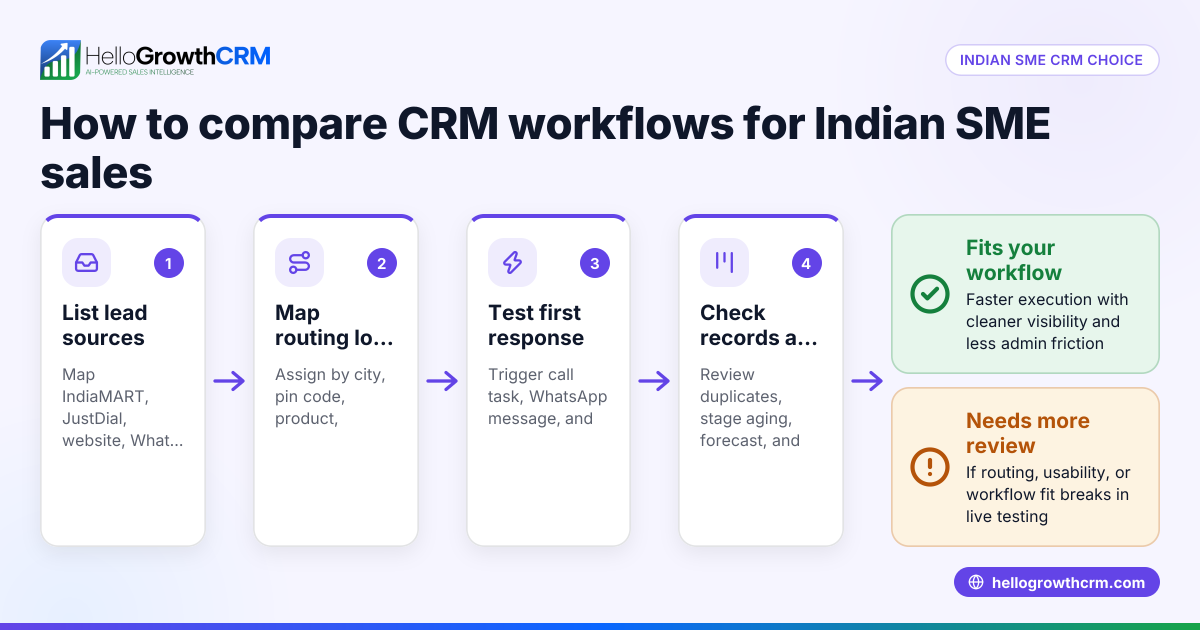
Ask these questions during evaluation:
- Can leads from IndiaMART and JustDial enter automatically?
- Can WhatsApp chats, calls, and tasks stay on one timeline?
- Can you track payment stage movement through Razorpay?
- Can finance and sales see the same deal status without conflicts?
- Can managers forecast by source, rep, and city?
- Can access be restricted for privacy and offboarding?
- Can the system support Mumbai, Bangalore, and tier-2 routing logic?
HelloGrowthCRM is our product, so that comparison should be read with that disclosure in mind. Still, this is exactly the use case where the platform is strong: AI CRM for workflow control, AI Sales Copilot for rep guidance, and Demo support for real pipeline walkthroughs.
If your team wants less spreadsheet chasing and more predictable execution, start with a Free Trial or review Pricing for Indian rollout planning.
Indian B2B sales teams do not need a fancy pipeline. They need a pipeline that matches how buyers actually enquire, chat, pay, and get onboarded. Try HelloGrowthCRM to connect IndiaMART, JustDial, WhatsApp, Razorpay, and finance handoffs into one practical system for Indian growth teams.
About the author
Rohan Mehta is a Revenue Operations Lead at HelloGrowthCRM with 11 years of experience in B2B SaaS, CRM design, and sales process improvement. He has led pipeline audits and CRM rollouts for Indian SME teams across SaaS, industrial distribution, and business services. One project that informed this article was a multi-city rollout for a 12-person inside sales team handling IndiaMART and WhatsApp-led enquiries with payment-stage forecasting. His work focuses on pipeline governance, forecasting accuracy, and practical RevOps for growth-stage teams.
Frequently Asked Questions
Q: How do I set up a CRM pipeline for IndiaMART and JustDial leads in India?
A: A CRM pipeline for IndiaMART and JustDial leads in India should capture enquiries automatically, tag the lead source, assign an owner, and trigger immediate follow-up tasks. After that, define qualification rules, stage movement criteria, and source-wise reporting so you can measure which channel produces revenue.
Q: Why should Indian B2B sales teams use WhatsApp in the CRM pipeline?
A: Indian B2B sales teams should use WhatsApp in the CRM pipeline because buyers often reply faster on chat than on email or unknown calls. When WhatsApp is logged inside the CRM, managers can track conversations, coach reps, and protect customer context during handoffs or employee exits.
Q: Can Razorpay and Tally be part of a sales pipeline workflow?
A: Razorpay and Tally can be part of a sales pipeline workflow by linking payment status and finance sync to later deal stages. This helps teams separate verbal approvals from actual revenue and reduces the common problem of marking deals won too early.
Q: What is the best pipeline stage before Closed Won for Indian SME teams?
A: The best pipeline stage before Closed Won for Indian SME teams is usually a payment-pending or approval-pending stage. This gives finance and sales a shared checkpoint for payment links, POs, or invoice confirmation before revenue is counted.
Q: How does DPDPA 2023 affect CRM setup in India?
A: DPDPA 2023 affects CRM setup in India by requiring clearer purpose-based data handling, tighter access control, and better record management for customer information. In practice, that means logging consent where relevant, limiting exports, and reducing personal-device sales data sprawl.
Q: What reports should a sales manager track after CRM rollout?
A: A sales manager should track first response time, stage conversion, ageing, forecast category, and source-wise win rate after CRM rollout. These reports show whether the process is actually improving speed, quality, and predictability across reps and lead channels.
Q: Is HelloGrowthCRM a good fit for Indian SME sales teams?
A: HelloGrowthCRM is a good fit for Indian SME sales teams that need WhatsApp-first follow-up, source-based routing, payment visibility, and practical reporting without enterprise complexity. It is especially useful when IndiaMART, JustDial, and finance handoffs are part of the daily workflow.
Q: How long does CRM pipeline setup usually take for a small Indian team?
A: CRM pipeline setup usually takes a small Indian team between a few days and a few weeks, depending on source integration, data cleanup, and approval workflows. If your process is simple and stakeholders align early, rollout is much faster and cleaner.
Frequently Asked Questions
Ready to put this into practice?
Set up your pipeline, WhatsApp follow-ups, and AI lead scoring in minutes — free, no credit card.
Try HelloGrowthCRM freeGet CRM tips in your inbox
Join thousands of sales professionals who get weekly insights on CRM strategy, AI automation, and pipeline optimization.

The HelloGrowthCRM team publishes guides on CRM strategy, AI sales tools, and revenue operations for small business sales teams.