HelloGrowthCRM software
Built for real small-business sales teams
HelloGrowthCRM helps reps qualify faster, follow up on time, and close more deals—with practical automation in one place.
- AI lead scoring and pipeline visibility
- Built-in dialer, WhatsApp, and email automation
- Sales forecasting and RevOps-ready reporting
CRM pricing in India for B2B sales teams is the total monthly and annual cost of running lead capture, follow-up, pipeline management, payment visibility, and reporting across channels like WhatsApp, IndiaMART, JustDial, Razorpay, and Tally sync—not just the listed per-user INR subscription.
Key Takeaways
- Indian B2B teams should compare CRM pricing using total cost of ownership, not only seat price.
- WhatsApp workflows, lead-source sync, Razorpay updates, and Tally data handoff often create the biggest hidden costs.
- Setup effort matters more for SMEs in Mumbai, Bangalore, Pune, and tier-2 cities with lean sales ops support.
- DPDPA 2023 readiness, access controls, and audit trails should be part of CRM pricing evaluation.
- HelloGrowthCRM is strongest when you need execution-focused sales workflows, automation, and Indian channel coverage in one stack.
- Buyers should test admin effort, reporting depth, and integration reliability before committing to an annual plan.
What does CRM pricing in India for B2B sales teams really include?
CRM pricing in India for B2B sales teams includes software seats, onboarding, workflow setup, lead-source integrations, WhatsApp messaging operations, payment and accounting sync, reporting, admin time, and compliance effort. For most Indian SMEs, the real cost sits in execution gaps and manual work more than in the sticker price.
Most buyers start with the per-user number. That is normal. It is also where many teams make the wrong decision.
For a 10-person inside sales team in Mumbai or Bangalore, the real question is not “Is this CRM INR 999 or INR 1,999 per user?” The real question is “How much time, leakage, and follow-up delay will this system remove from our sales motion?”
A practical pricing review should include:
- Subscription cost by user or team
- Setup and onboarding fees
- Data migration from spreadsheets or old CRM
- WhatsApp workflow costs
- IndiaMART and JustDial lead capture setup
- Razorpay payment update sync
- Tally export or sync effort
- Reporting and forecasting setup
- Ongoing admin and support time
- Compliance controls and user permissions
In one rollout we did with a 12-person sales team selling industrial equipment in Pune, the cheapest CRM on paper became the most expensive in practice. Reps still copied leads manually from IndiaMART, managers exported reports every Friday, and finance chased payment status in a separate sheet. The team saved money on licenses but lost far more in response time and admin work.
That is why a buyer should view Pricing alongside the depth of Features, not as separate decisions.
Why Indian sales teams misread CRM cost
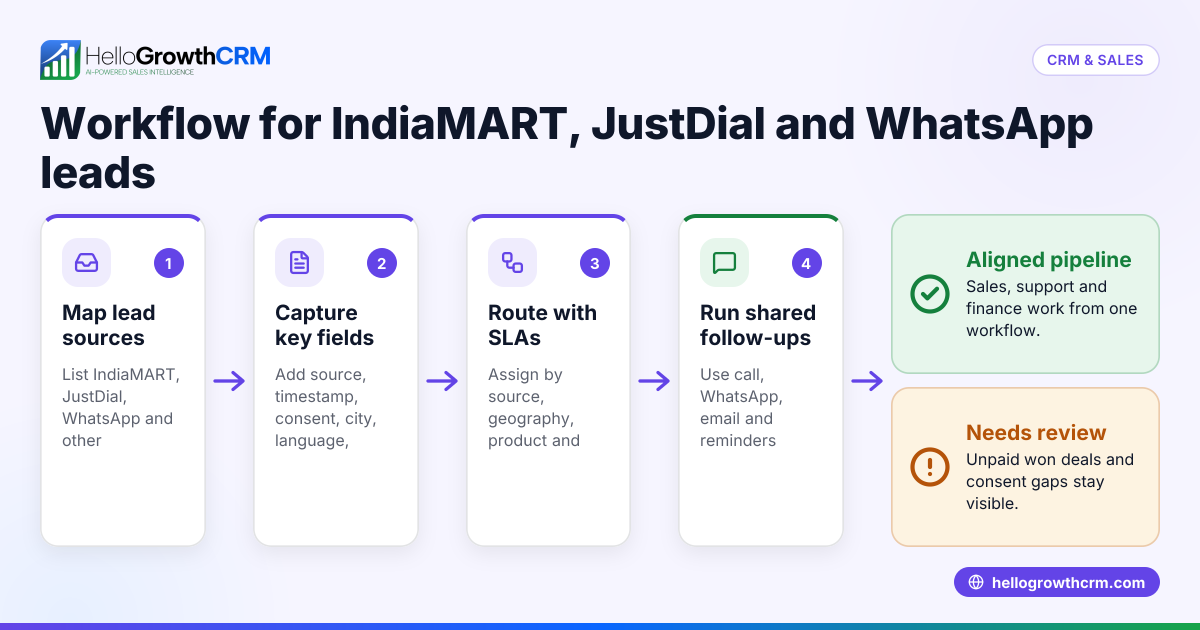
Most Indian SME teams run a mixed sales process. Leads come from:
- IndiaMART
- JustDial
- Website forms
- WhatsApp inquiries
- Referral calls
- Distributor or channel partner lists
When these sources do not flow into one pipeline, your CRM becomes a record system, not a selling system. That difference drives total cost.
Why per-user CRM plans can mislead Indian SMEs
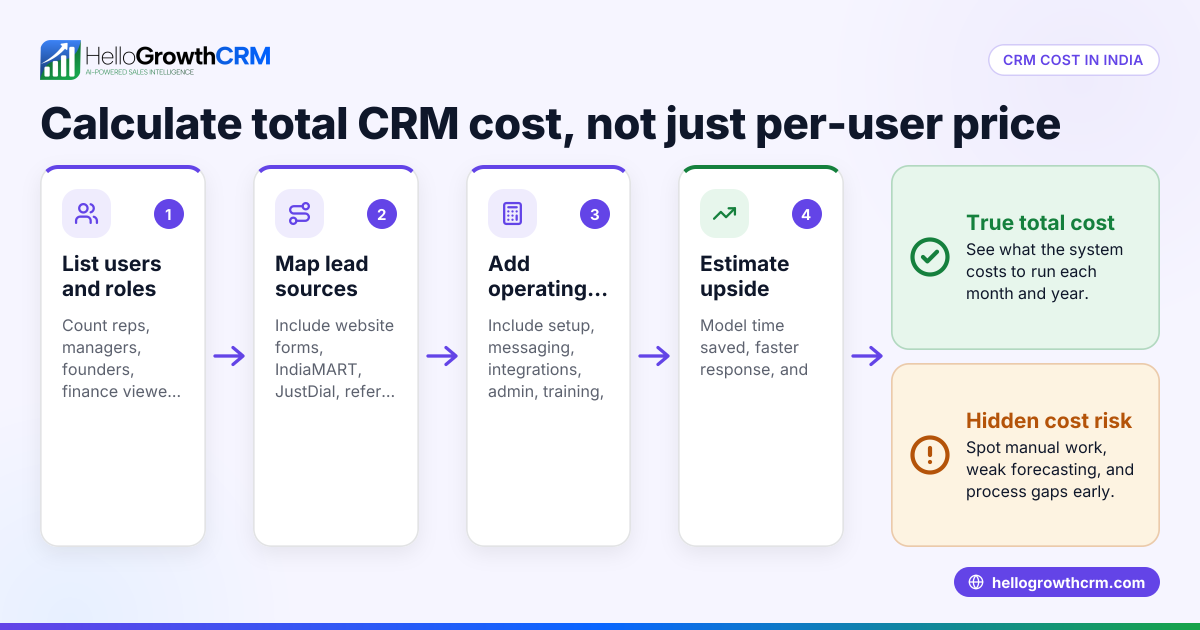
Per-user CRM plans can mislead Indian SMEs because the visible seat fee hides the operational work needed to make the system usable across lead capture, follow-up, manager reporting, and finance coordination. A lower monthly rate often means higher manual effort, slower response times, and more spreadsheet dependency.
A CRM may look affordable at INR 900 per user. But if it lacks native or easy workflows for WhatsApp & SMS CRM, Email Automation, and source attribution, someone on your team will fill the gaps manually.
Common hidden costs include:
- One admin spending 10-15 hours a week fixing lead routing
- Managers exporting data to build forecast sheets
- Reps updating stages after calls instead of during workflow
- Missed follow-ups from unassigned IndiaMART and JustDial leads
- Payment disputes because sales cannot see collection status
- Delays in handoff between sales and finance
India has over 900 million internet subscribers as of March 2024, according to TRAI. That scale matters because lead volumes are growing across digital channels, and manual handling breaks faster.
The real metric: cost per converted opportunity
A better way to judge CRM pricing is to ask:
- How much does the platform reduce lead response time?
- How many more qualified meetings does it create?
- How much manager time does it save?
- How quickly can finance and sales align on payment status?
- How reliable is forecasting after setup?
If your CRM helps reps act faster with AI Lead Scoring, Meeting Scheduler, and Sales Task Boards, a higher seat cost may still produce lower cost per won deal.
Which cost drivers matter most for WhatsApp, IndiaMART, JustDial, Razorpay, and Tally sync?
The biggest CRM cost drivers for Indian B2B teams are channel integration effort, automation depth, data cleanliness, finance visibility, and support load. WhatsApp and marketplace lead sync affect speed to lead, while Razorpay and Tally workflows affect revenue visibility, reconciliation, and back-office effort.
Let’s break each one down.
WhatsApp workflow cost
For many Indian SMEs, WhatsApp is not an add-on. It is the main buyer communication channel.
You should evaluate:
- Shared inbox or individual rep control
- Auto-assignment rules
- Template approval handling
- Stage-based reminders
- Missed reply alerts
- Conversation history inside contact records
A CRM with built-in Smart Inbox and WhatsApp support cuts tool switching. That lowers training and admin cost.
IndiaMART and JustDial lead capture cost
If sales reps must copy leads from email or CSV into the CRM, your response time will suffer.
Check whether the CRM supports:
- Automatic lead ingestion
- Duplicate detection
- Source tagging
- Lead owner assignment
- SLA alerts for first response
- Campaign or source reporting
When I have audited pipelines like this, the most common leak was not lead volume. It was unworked leads sitting in a manager inbox for 4-6 hours. For high-intent inbound channels, that delay is costly.
Razorpay payment update cost
B2B sales teams need to know whether a customer paid, partially paid, or dropped off before renewal or upsell action.
A good CRM should either sync payment signals or make them easy to trigger through Razorpay, Zapier, or All Integrations. This helps teams build collection-aware follow-ups and better revenue reporting.
Tally sync or accounting handoff cost
Many SMEs still use Tally as the operational source for invoices and accounting. Even if full two-way sync is not available, the CRM should support structured export, custom fields, and clean mapping.
If your team also uses QuickBooks or Stripe in some workflows, mixed finance stacks increase setup complexity. Price that in early.
How should Indian buyers compare CRM pricing models?
Indian buyers should compare CRM pricing models using a total-cost scorecard that measures subscription fees, onboarding, automation depth, integration effort, admin burden, and compliance readiness. This approach gives a more accurate view than comparing INR seat prices alone, especially for execution-heavy B2B sales teams.
Use a scorecard across five areas:
- License cost
- Setup cost
- Operating cost
- Scale cost
- Risk cost
Simple comparison framework
| Cost area | What to check | Low-risk sign | Hidden-cost warning |
|---|---|---|---|
| License cost | Per-user, per-team, annual discount | Clear INR pricing | Add-ons needed for core workflows |
| Setup cost | Migration, custom stages, forms, templates | Guided onboarding or Demo support | You need an external consultant |
| Lead capture | IndiaMART, JustDial, forms, WhatsApp | Auto-routing and source tags | Manual import and inbox assignment |
| Automation | Follow-ups, reminders, payment triggers | Built-in workflow tools | Only basic task reminders |
| Reporting | Forecast, source ROI, rep activity | Real-time dashboards and Sales Forecasting | CSV exports for every review |
| Finance sync | Razorpay, Tally, invoice status | Structured mapping and alerts | No payment visibility for sales |
| Compliance | Access controls, logs, consent handling | Role-based controls and audit trail | Shared logins and weak permissions |
| Admin load | Weekly maintenance time | Reps can self-serve most work | One power user runs everything |
Compare entry price with execution depth
Here is a practical way to compare options:
| CRM evaluation factor | Low-cost generic CRM | HelloGrowthCRM-style execution CRM |
|---|---|---|
| Seat price | Usually lower upfront | May be higher upfront |
| WhatsApp workflow depth | Often partial | Built for Indian sales follow-up |
| IndiaMART/JustDial handling | Usually manual or patched | Better fit for lead routing workflows |
| Forecasting quality | Limited without cleanup | Stronger with AI Pipeline Management and AI Deal Insights |
| Payment visibility | Often external only | Easier revenue workflow alignment |
| Admin effort | High after month one | Lower if setup is done well |
| Best fit | Very small, simple teams | Growing B2B teams needing execution |
To be transparent, HelloGrowthCRM is our product. This article is written from that perspective. It is a strong fit for teams that want one operating system for lead management, follow-up, and pipeline execution. If you need deep enterprise customization across hundreds of reps, you should test boundaries carefully before buying.
What hidden admin and compliance costs do Indian teams often miss?
Indian teams often miss the cost of admin ownership, data cleanup, permissions, consent handling, and reporting discipline when pricing a CRM. These costs grow quickly when a team sells across cities, uses WhatsApp heavily, and depends on one operations person to keep records usable.
The legal and trust side matters too.
The Ministry of Electronics and Information Technology publishes India’s Digital Personal Data Protection framework and related updates through MeitY’s data protection resources. If you collect lead data from forms, calls, WhatsApp, and marketplaces, your CRM setup should support controlled access and cleaner consent processes.
DPDPA 2023 readiness checklist
Ask vendors about:
- Role-based permissions
- Audit trails
- Data export and deletion workflows
- Consent capture process
- Vendor and integration access control
- Data retention settings
This is especially important if your team sells into BFSI, healthcare, education, or larger enterprise accounts.
The cost of bad reporting
Poor reporting creates hidden cost in three ways:
- Managers lose trust in pipeline numbers
- Reps stop updating stages
- Finance and sales argue over revenue timing
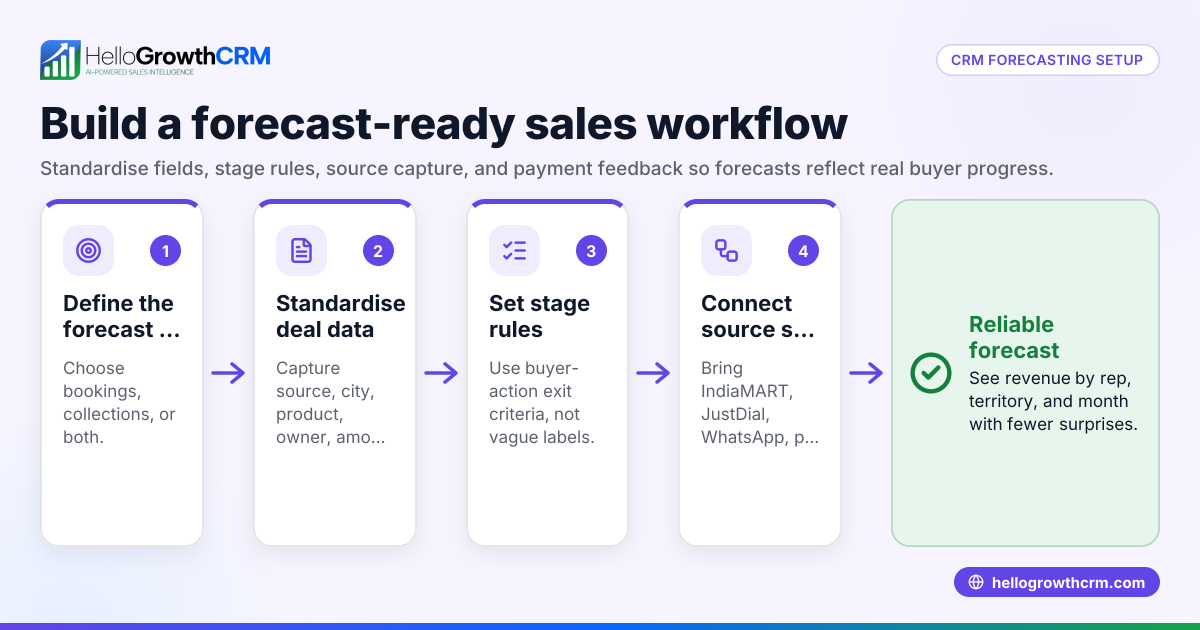
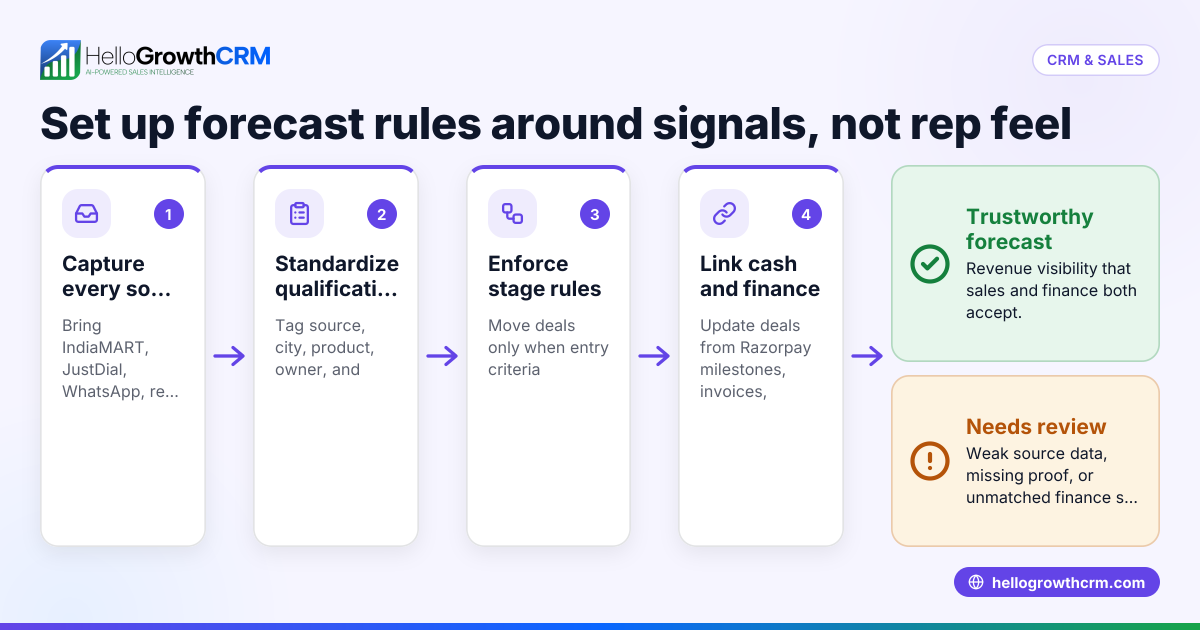
A CRM should help you connect pipeline progress with payment and collection signals. That is where Revenue Attribution and cleaner forecasting workflows matter.
How to evaluate CRM pricing in India for B2B sales teams: Step-by-Step
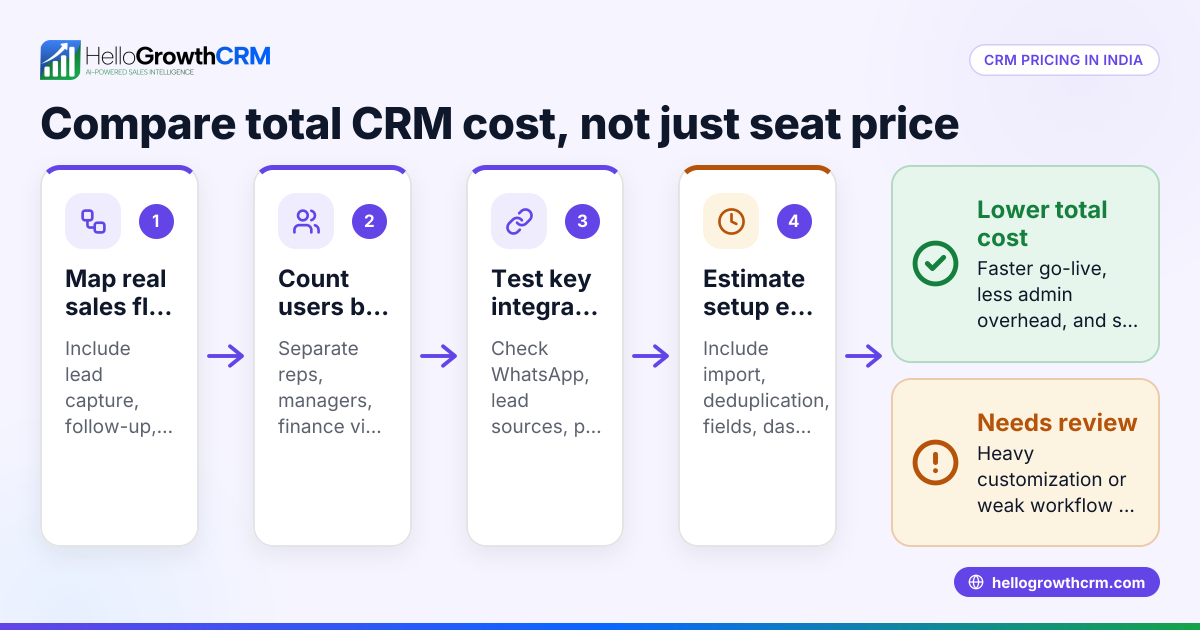
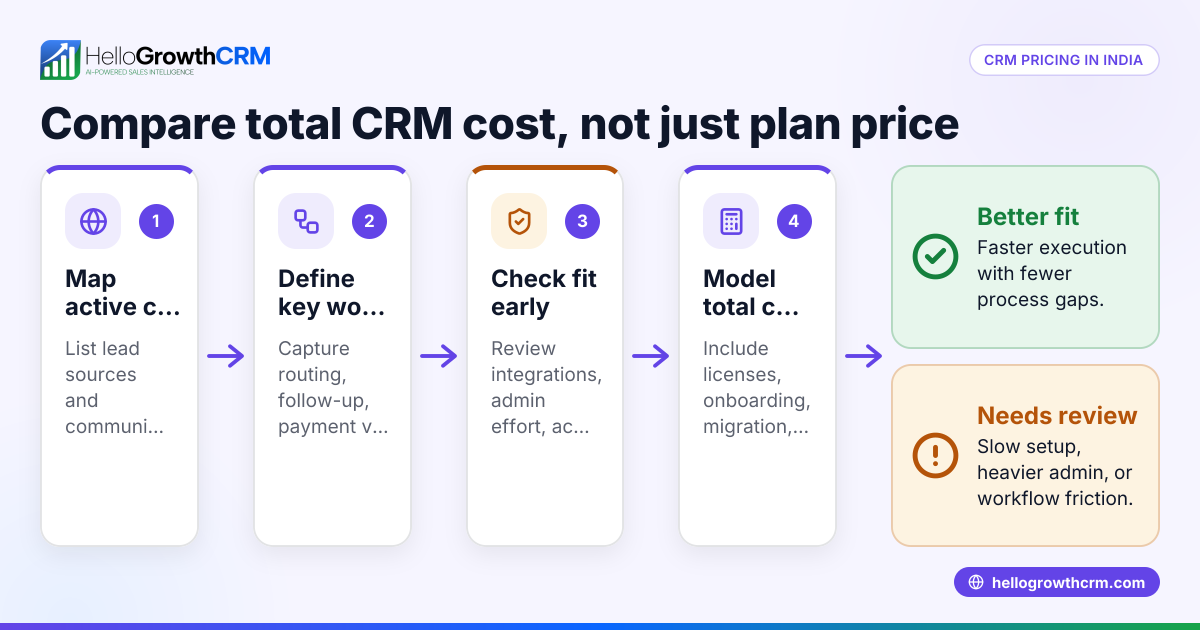
To evaluate CRM pricing in India for B2B sales teams, map your full sales workflow first, then estimate license, setup, integration, admin, and compliance costs together. The goal is to calculate the total monthly effort and revenue impact of running the CRM, not just the software fee.
- Map your current lead sources
List every lead source, including IndiaMART, JustDial, website forms, WhatsApp, phone calls, and referrals. Note average monthly lead volume and who currently assigns each lead. - Define your core workflow
Write down stages from first inquiry to won, lost, and payment confirmation. Include sales, manager, and finance handoff points. - Estimate integration effort
Check how each source will connect. Review Gmail, Slack, Razorpay, and broader All Integrations coverage if your stack is mixed. - Score automation depth
Test follow-up reminders, task creation, source routing, and payment-triggered actions. Use tools like the CRM ROI Calculator to compare time saved. - Measure reporting reliability
Ask whether forecast, source ROI, and rep performance dashboards work without exports. If not, include manager time in your pricing model. - Review compliance and permissions
Check roles, audit logs, and data handling controls. This matters more if multiple agencies or external partners access your system. - Run a 14-30 day pilot
Use a small team from one city and one tier-2 market. Compare response time, lead leakage, stage movement, and admin hours before and after. - Choose based on operating fit, not lowest quote
The best CRM is the one your reps actually use every day. For most Indian B2B teams, daily execution fit beats feature-count marketing.
What is a realistic CRM budget for Indian SME sales teams?
A realistic CRM budget for Indian SME sales teams should include software, onboarding, messaging workflows, basic integrations, and one owner’s admin time for the first 90 days. For most 5-25 user teams, budget planning should focus on cost per active workflow, not only cost per seat.
A sensible budgeting model includes:
- Monthly subscription
- One-time setup or onboarding
- Data import and field mapping
- WhatsApp or communication workflow cost
- Integration or automation support
- Manager training
- Admin time in the first quarter
Budget by team maturity
Early-stage team, 5-8 users
- Best if process is still being defined
- Keep customization light
- Focus on lead capture, follow-ups, and simple reporting
Growth team, 8-20 users
- Need stronger routing, dashboards, and forecasting
- Should test AI CRM and qualification workflow support
- Usually gains the most from automation
Structured team, 20-50 users
- Needs territory rules, forecasting cadence, and stronger controls
- Should assess Territory Management and Managed RevOps
This works very well for teams under 50 reps. Above that, expect more complex admin, governance, and integration design. In that case, setup quality matters even more than software price.
If your team wants a CRM that matches Indian selling reality across WhatsApp, inbound marketplaces, payments, and pipeline execution, explore HelloGrowthCRM’s Free Trial or book a Demo. For Mumbai, Bangalore, Pune, and tier-2 sales teams, it is built to reduce manual work and help reps move deals faster.
About the author
Aman Deshmukh is a Sales Operations Lead at HelloGrowthCRM with 11 years of experience in B2B SaaS, CRM implementation, and revenue operations. He has led CRM rollouts for Indian SME sales teams across manufacturing, services, and SaaS, with a focus on lead routing, forecasting, and sales-finance handoffs. One project that informed this article was a 12-rep deployment for a Pune-based industrial distributor that needed WhatsApp follow-up workflows, IndiaMART lead capture, and payment visibility tied to collections. He writes from hands-on implementation experience, and HelloGrowthCRM is the platform he works on.
Frequently Asked Questions
Q: How much does CRM pricing in India for B2B sales teams usually cost?
A: CRM pricing in India for B2B sales teams usually includes more than seat cost, because setup, WhatsApp workflows, lead capture, and reporting effort all add to the real budget. Most SMEs should compare total operating cost over 12 months, not just monthly user fees.
Q: Why is WhatsApp important when comparing CRM pricing in India?
A: WhatsApp is important when comparing CRM pricing in India because many B2B inquiries, follow-ups, and negotiation messages happen there first. If WhatsApp is handled outside the CRM, teams lose context, speed, and accountability.
Q: Do IndiaMART and JustDial integrations change total CRM cost?
A: Yes, IndiaMART and JustDial integrations change total CRM cost because they affect lead response speed, assignment quality, and admin workload. Manual import may look cheaper upfront but usually costs more in missed follow-up and manager effort.
Q: Should Razorpay and Tally sync be part of CRM pricing evaluation?
A: Yes, Razorpay and Tally sync should be part of CRM pricing evaluation because payment visibility and accounting handoff affect collections, forecasting, and customer follow-up. If sales cannot see payment status, pipeline reporting stays incomplete.
Q: What hidden CRM costs do Indian SMEs miss most often?
A: The hidden CRM costs Indian SMEs miss most often are admin time, data cleanup, reporting exports, weak permissions, and workflow gaps across channels. These costs grow quickly when one ops person supports the whole sales team.
Q: Is a lower per-user CRM always better for a small B2B sales team?
A: No, a lower per-user CRM is not always better for a small B2B sales team because cheaper tools often shift work back to reps and managers. The best option is the one that reduces response time and manual effort.
Q: How can I compare CRM options for an Indian team across Mumbai and tier-2 cities?
A: You can compare CRM options for an Indian team across Mumbai and tier-2 cities by scoring setup effort, lead routing, WhatsApp workflow depth, reporting, finance sync, and compliance controls together. A short pilot with real leads is the most reliable test.
Q: Is HelloGrowthCRM a good fit for Indian B2B sales teams?
A: HelloGrowthCRM is a good fit for Indian B2B sales teams that need one system for lead capture, follow-up, pipeline execution, and revenue visibility. It is especially suitable for teams using WhatsApp, inbound marketplace leads, and lean sales ops support.
Frequently Asked Questions
Ready to put this into practice?
Set up your pipeline, WhatsApp follow-ups, and AI lead scoring in minutes — free, no credit card.
Try HelloGrowthCRM freeGet CRM tips in your inbox
Join thousands of sales professionals who get weekly insights on CRM strategy, AI automation, and pipeline optimization.

The HelloGrowthCRM team publishes guides on CRM strategy, AI sales tools, and revenue operations for small business sales teams.